Question
  1. Write outer electronic configuration of Cr atom. Why are half filled orbitals more stable?
  2. An electron has a velocity of $50 \mathrm{~ms}^{-1}$, accurate upto $99.99 \%$. Calculate the uncertainty in locating its position. (Mass of electron $=9.1 \times 10^{-31} \mathrm{~kg}, \mathrm{~h}=6.6 \times 10^{-34} \mathrm{~J}$ s)
  3. Write the atomic number of the element in which filling of 3d sub-shell in the atom just starts.
Answer

  1. Cr(24): $1 s^2 2 s^2 2 p^6 3 s^2 3 p^6 4 s^1 3 d^5$
Half filled orbitals are more stable because of symmetrical distribution of electrons and exchange energy is maximum.
  1. $\Delta\text{V}=50\times\big[(100-99.99)\%\big]$
$=50\times\frac{0.01}{100}=50\times10^{-4}$
$=5\times10^{-3}\text{ms}^{-1}$
$\Delta\text{x}.\Delta\text{V}=\frac{\text{h}}{4\pi\text{m}}$
$\Delta\text{x}\times5\times10^{-3}\text{ms}^{-1}=\frac{6.6\times10^{-34}\text{Js}}{4\times3.142\times9\times10^{-31}\text{kg}}$
$\Rightarrow\Delta\text{x}=\frac{6.6\times10^{-34}\text{Js}}{4\times3.142\times9.1\times10^{-31}\text{kg}\times5\times10^{-3}\text{ms}^{-1}}$
$=1.154\times10^{-2}\text{m}$
  1. Scandium (Atomic number 21) is the element in which filling of 3d orbitals starts.

Need a full question paper?

Generate a complete, print-ready paper with questions like this in minutes — across 16+ boards, with answer keys.

Start Generating Free

Similar questions

  1. Name the element which forms maximum number of compound.
  2. How is nascent hydrogen prepared?
  3. What is ratio of $\frac{\text{C}_\text{P}}{\text{C}_\text{V}}$ for hydrogen andwhy?
  4. What is half life of tritium? How is it obtained?
  5. If we electrolyse 2000 litres of $H_2O_2$ how much heavy water will be formed?
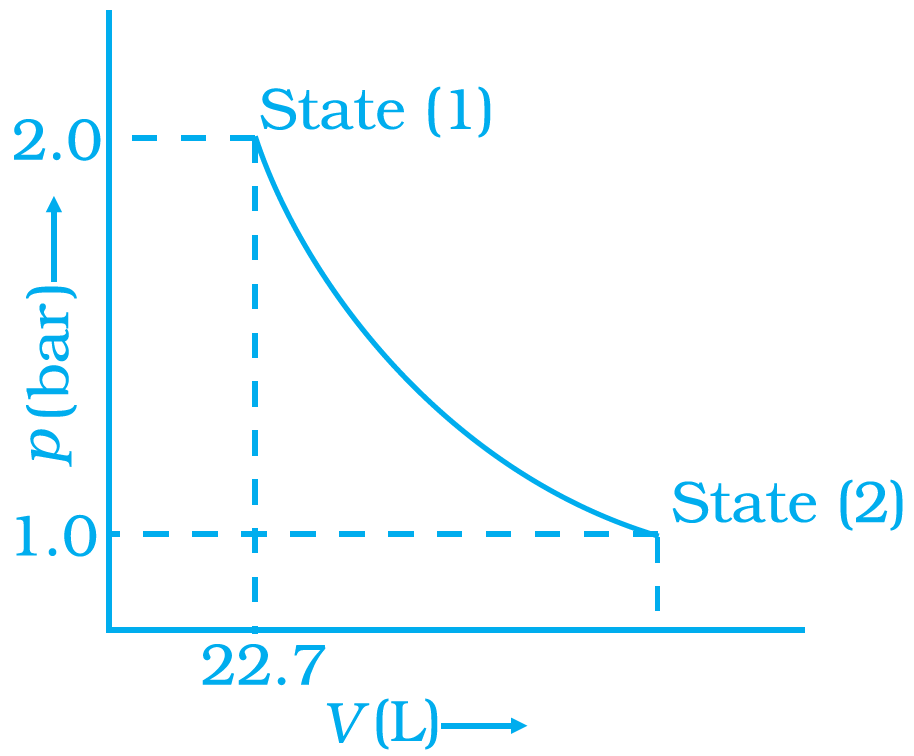
1.0 mol of a monoatomic ideal gas is expanded from state (1) to state (2) as shown in Fig. Calculate the work done for the expansion of gas from state (1) to state (2) at 298K.
$3.2mol$ of HI were taken in a sealed bulb at $440°C$ till the equilibrium state was reached. Its degree of dissociation was found to be $20\%$. Calculate the number of moles of HI. $H_2$ and $I_2$ present at equilibrium point and also determine the equilibrium constant.
  1. What are two conditions for the formation of hydrogen bond?
  2. In which of the following compounds 'S' does not obey octet rule?
$\text{SF}_2,\text{SF}_4,\text{SF}_6,\text{SO}_2$
  1. Explain the term hybridisation taking $\text{CH}\equiv\text{CH}$ as an example.
According to molecular orbital theory, how many types of molecular orbitals are there? How are they formed and also tell the order of energy of molecular orbitals formed form different atomic orbitals?
How many neutrons and protons are there in the following nuclei?
$\text{ }^{13}_{06}\text{C},\text{ }^{16}_{08}\text{O},\text{ }^{24}_{12}\text{Mg},\text{ }^{56}_{26}\text{Fe},\text{ }^{88}_{38}\text{Sr}$
The ionization constant of phenol is $1.0 \times 10^{–10}$. What is the concentration of phenolate ion in $0.05M$ solution of phenol? What will be its degree of ionization if the solution is also $0.01M$ in sodium phenolate?
What is common ion effect? Explain with examples.
$\mathrm{BCl}_3$ exists as monomer whereas $\mathrm{AlCl}_3$ is dimerised through halogen bridging. Give reason. Explain the structure of the dimer of $\mathrm{AlCl}_3$ also.
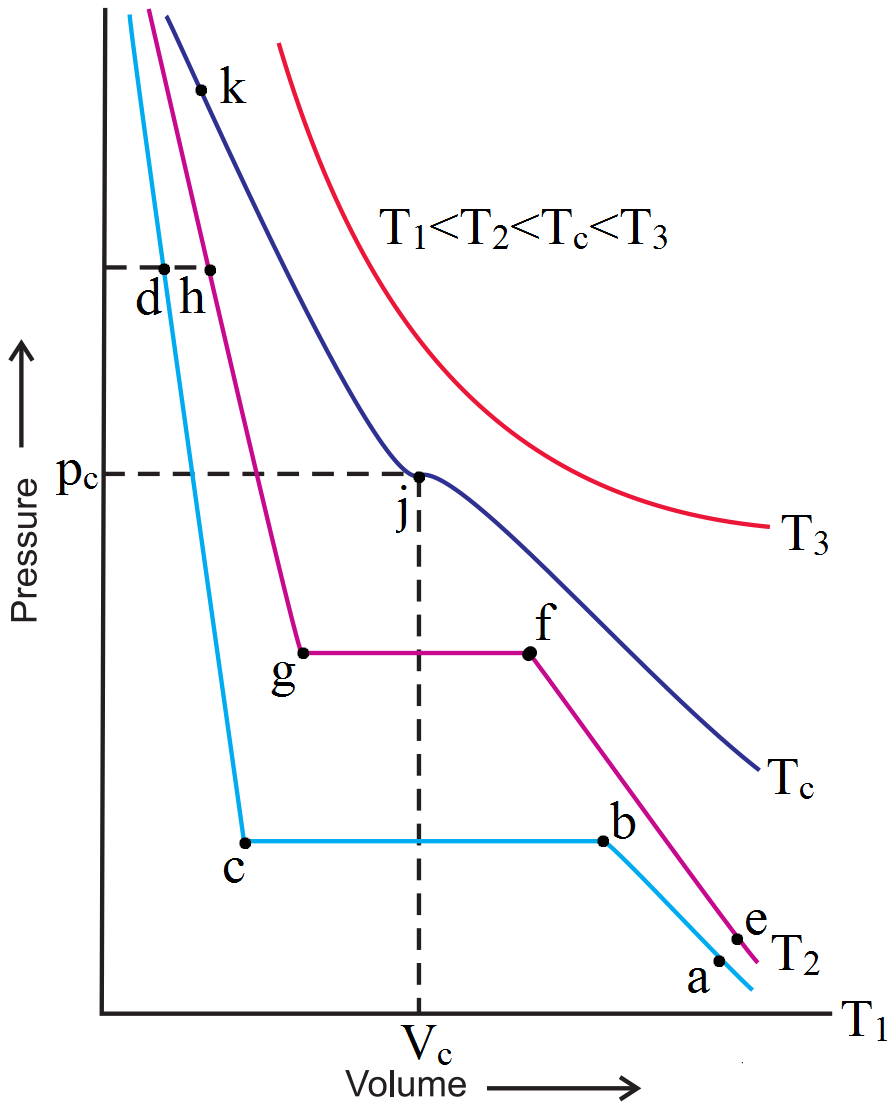
Isotherms of carbon dioxide at various temperatures are represented in the figure. Answer the following questions based on the figure.

i. In which state will $CO _2$ exist between the points a and b at temperature $T _1$ ?
ii. At what point will $CO _2$ start liquefying when temperature is $T _1$ ?
iii. At what point will $CO _2$ be completely liquefied when temperature is $T _2$ ?
iv. Will condensation take place when the temperature is $T_3$ ?
v. What portion of the isotherm at $T _1$ represent liquid and gaseous $CO _2$ at equilibrium?