Question
Write short note on Nuclear Force.

Answer

→Nucleus contains protons and neutrons, in which there is a coulomb repulsion between protons and protons. However, the proton can not escape from the nucleus. Because to bind a nucleus together there must be a strong attractive force of a totally different kind. It must be strong enough to overcome the repulsion between (the positively charged) protons and to bind both protons and neutrons into the tiny nuclear volume.
→Many features of the nuclear binding force are summarised below :
(i) The nuclear force is much stronger than the Coulomb force acting between charges or the gravitational forces between masses. That's why it holds protons and neutrons in the nucleus.
(ii) The range of the nuclear force is of the order of femtometres. For distances greater than one femtometres this force rapidly decreases to zero.
→This leads to saturation of forces in a medium or a large sized nucleus.
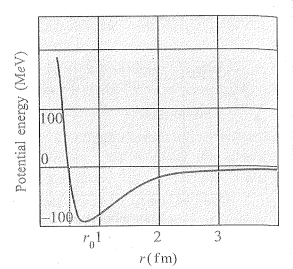
→A plot of the potential energy between two nucleons as a function of distance as shown in figure.
Image
→The potential energy is minimum at a distance $r_0$ of about 0.8 fm .The force is attractive for distance larger than 0.8 fm .
→The force is repulsive for distance less than 0.8 fm .
(iii) The nuclear force between neutronneutron, proton-neutron and proton-proton is approximately the same. The nuclear force does not depend on the electric charge.
→Unlike Coulomb's law or the Newton's law of gravitation there is no simple mathematical form of the nuclear force.

Need a full question paper?

Generate a complete, print-ready paper with questions like this in minutes — across 16+ boards, with answer keys.
Start Generating Free

Similar questions

Two thin lenses, whose power is $+5 D$ and $-3 D$. are kept in mutual contact. Find the focal length of the combination.
The temperatures of the junctions of a bismuth-silver thermocouple are maintained at $0^{\circ} \mathrm{C}$ and $0.001^{\circ} \mathrm{C}$. Find the thermo-emf (Seebeck emf) developed. For bismuth-silver, $a=-46 \times 10^{-6} \mathrm{~V}^{\circ} \mathrm{C} ^{-1}$ and $\mathrm{b}=-0.48 \times 10^{-6} \mathrm{~V}^{\circ} \mathrm{C}^{-2}$.
Two convex lenses of same focal length but of aperture $A_1$ and $A_2\left(A_2<A_1\right)$, are used as the objective lenses in two astronomical telescopes having identical eyepieces. What is the ratio of their resolving power? Which telescope will you prefer and why? Give reason.
Work function of aluminium is 4.2eV. If two photons, each of energy 2.5eV, are incident on its surface, will the emission of electrons take place? Justify your answer.
A driver takes 0.20s to apply the brakes after he sees a need for it. This is called the reaction time of the driver. If he is driving a car at a speed of 54km/h and the brakes cause a deceleration of $6.0m/s^2$, find the distance travelled by the car after he sees the need to put the brakes on.
A dbuteron and an alpha particle are accelerated with the same accelerating potential. Which one of the two has:
  1. Greater value of de-Broglie wavelength, associated with it and
  2. Less kinetic energy? Explain.
In a double slit interference experiment, the separation between the slits is 1.0mm, the wavelength of light used is $5.0 × 10^{-7}m$ and the distance of the screen from the slits is 1.0m.
  1. Find the distance of the centre of the first minimum from the centre of the central maximum.
  2. How many bright fringes are formed in one centimeter width on the screen?
Explain the difference between electric potential and electrical potential energy and explain the relationship between them.
The focal length of a convex lens made of glass is 20cm. What will be its new focal length when placed in a medium of refractive index 1.25?
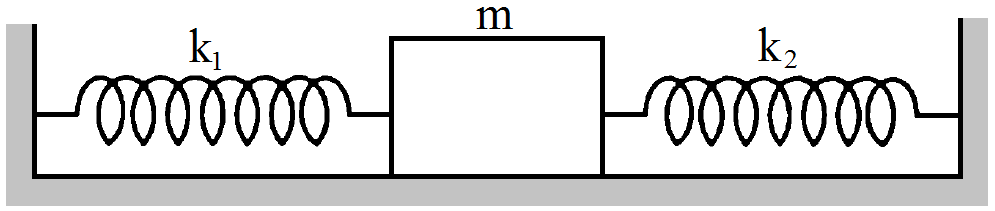
A block of mass $m$ is attached to two unstretched springs of spring constants $k_1$ and $k_2$ as shown in figure. The block is displaced towards right through a distance $x$ and is released. Find the speed of the block as it passes through the mean position shown.