Question
Write short note: Production of cheese.

Answer

Cheese is made from cow’s milk throughout the world. The steps in the process of cheese manufacture are as follows:
  • Chemical and microbiological testing of milk is done.
  • Three types of bacteria, viz. Lactobacillus lactis, Lactobacillus cremoris and Streptococcus thermophilus along with some colour is added to the milk.
  • It imparts sourness to the milk and it is converted into yoghurt like substance.
  • The water from this yoghurt, i.e. whey is not removed to make the yoghurt denser.
  • Enzyme, rennet or protease is added to the mixture to make it more denser.
  • Later cutting the solid yoghurt into pieces, washing, rubbing, salting, land mixing of essential microbes, pigments and flavours is done in suitable steps.
  • The pressed cheese is then cut in to pieces and stored for ripening.

Need a full question paper?

Generate a complete, print-ready paper with questions like this in minutes — across 16+ boards, with answer keys.
Start Generating Free

Similar questions

They are not correct. The father with blood group A has genotype $I^AI^O.$ The mother with blood group $B$ has genotype $I^BI^O.$ Hence, the possible genotypes of the children will be $I^AI^B, I^AI^O, I^BI^O$ and $I^OI^O$. Thus, the possible blood groups of children will be $AB, A, B$ and $O.$ Hence, if the father has blood group A, and the mother has blood group $B, $ it is possible for them to have children with blood group O.

Image

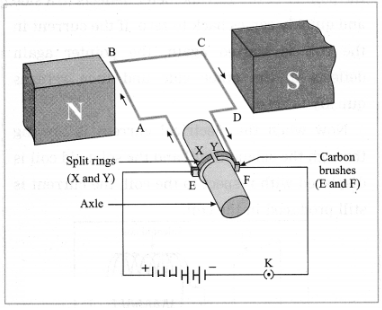
Observe the following diagram and answer the questions. (Practice Activity Sheet – 1)
(a) Construction of which equipment does the following diagram show?
(b) On which principle does this equipment work?
(c) According to which law does the coil ABCD rotate?
(d) Write the law in your own words.
(e) Where is this equipment used?

Explain with examples types of asexual reproduction in unicellular organisms.
An element A which is a part of common salt and kept under kerosene reacts with another element B of atomic number 17 to give a product C. When an aqueous solution of product C is electrolysed then a compound D is formed and two gases are liberated.
  1. What are A and B?
  2. Identify C and D.
  3. What will be the action of C on litmus solution? Why?
  4. State whether element B is a solid, liquid or gas at room temperature.
  5. Write formula of the compound formed when element B reacts with an element E having atomic number 5.
When a human female reaches a certain age then vaginal bleeding occurs for a few days after regular time intervals.
  1. What is this process known as (i) in scientific terms, and (ii) in everyday language?
  2. At what approximate age this process starts in human females? When is the human female said to have attained at this stage?
  3. After how much time is this process repeated? For how many days does this process usually last?
  4. What does the onset of this process in human females signify?
  5. At which particular event in the life of a human female does this process stop temporarily but start again?
  6. At which approximate age of human female does this process stop permanently?
State and explain the reaction, if any, of the following metals with a solution of copper sulphate:
  1. Gold.
  2. Copper.
  3. Zinc.
  4. Mercury.
Mahatma Gandhi said, 'The Earth is sufficient to satisfy everyone's need but not the greed' Explain.
Explain structure of modern periodic table in short.
A thickened underground stem X of a plant which is swollen with stored food has a number of points Y on its surface. When the old stem X is planted in the soil of a field in the next growing season, then each point Y present on its surface grows into a new plant.
  1. What is the general name of the underground stems like X?
  2. Give one example of X.
  3. What are points Y present on X known as?
  4. Is it necessary to plant the whole of stem X in the ground to obtain its new plants? Explain your answer.
  5. What is the name of this method of reproduction of plants?
  6. What is the advantage of growing new plants from the underground stems like X?
What is stem cell? Write any four uses of stem cell.