Question
Write short notes: Structure of the modern periodic table.

Answer

(1) In the modern periodic table, the elements are arranged in the order of their increasing atomic number. In the modern periodic table there are seven horizontal rows called periods and eighteen vertical columns (1 to 18) called groups. The arrangement or the periods and groups results into formation of boxes. Atomic numbers are serially indicated in the upper part of these boxes.

(2) Each box represents the place for one element. Apart from these seven rows, there are two rows of elements placed separately at the bottom of the periodic table. They are lanthanides and actinides series. There are 118 boxes in the periodic table including the two series that means there are 118 places for elements in the modern periodic table.

The formation of a few elements was established experimentally very recently and thereby the modern periodic table is now completely filled with 118 elements.

(3) On the basis of the electronic configuration, the elements in the modern periodic table are divided into four blocks, viz. s-block, p-block, d-block and f-block. The s-block constitute groups 1 and 2. The groups 13 to 18 constitute the p-block. Groups 3 to 12 constitute the d-block, while the lanthanide and actinide series at the bottom form the f-block. The d-bloclçelements are called transition elements.

A zig-zag line shown in the p-block of the periodic table. This zig-zag line shows the three traditional types of elements, i.e. metals, nonmetals and metalloids. The metalloid elements lie along the border of zig-zag line. All the metals lie on the left side of the zig-zag line while all the nonmetals lie on the right side.

Need a full question paper?

Generate a complete, print-ready paper with questions like this in minutes — across 16+ boards, with answer keys.
Start Generating Free

Similar questions

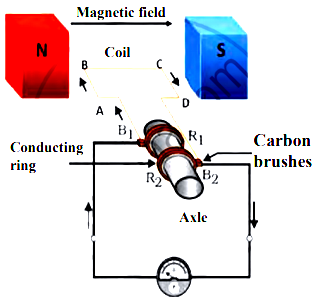
Observe the figure and write the answers to the questions asked.
  1. The construction shown in the figure is of which device?
  2. Explain the principle on which this device works.
  3. Write any three uses of this device.
A red-brown metal $X$ forms a salt $XSO_4$. When hydrogen sulphide gas is passed through an aqueous solution of $XSO_4,$ then a black precipitate of $XS$ is formed alongwith sulphuric acid solution.
  1. What could the salt $XSO_4$ be?
  2. What is the colour of salt $XSO_4?$
  3. Name the black precipitate $XS.$
  4. By using the formula of the salt obtained in $(a)$ above, write an equation of the reaction which takes place when hydrogen sulphide gas is passed through its aqueous solution.
  5. What type of chemical reaction takes place in this case?
Sketch, labell and classify: Wall Lizard
Explain the principle of dialysis with the help of a labelled diagram.
What is lymphatic system? What are its functions?
What will you do?
i. You are spending more time on internet.
ii. Child of your neighbour is addicted to tobacco chewing.
iii. Your sister has become incommunicative.
iv. You have to use free space around your home for good purpose.
v. Your brother studying in XII has developed
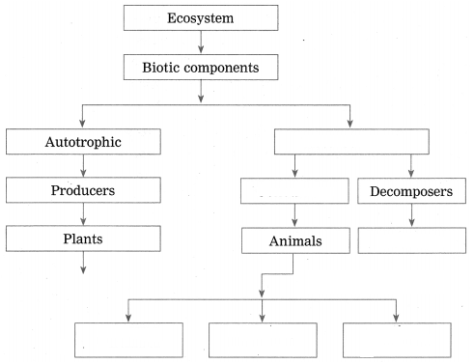
Questions based on the charts.
Complete the flow chart:
Image
Write short notes: Homologous series.
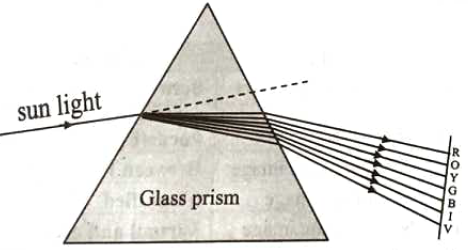
Observe the given diagram and answer the questions :
Image
i. Name the process shown in the figure.
II. Name the colour that deviates the most.
iii. Name the colour that deviates the least.
iv. Name any one phenomenon in the nature which is based on the above process.
v. Define 'spectrum'.
Write Short note: Biotechnology: Professional uses. (Commercial uses)