Question
Write Short note: Biotechnology: Professional uses. (Commercial uses)

Answer

(1) Biotechnology can be used in the following professional fields, viz. crop biotechnology, animal husbandry, human health, etc.

(2) In crop biotechnology, improvement in the yield and variety of agricultural field is done. The hybrid seeds, genetically modified crops, herbicide tolerant plants are some of the areas in which lot of biotechnological research is being done. By such research, high yielding and disease resistant varieties and varieties which can tolerate stresses such as alkalinity, weeds, cold and drought etc. are produced. BT cotton, BT Brinjal and golden rice are some GMO plants which have become popular in India.

Due to herbicide tolerant plants, the weeds are now selectively destroyed. By using biofertilizers, the use of chemical fertilizers is reduced. Use of bacteria such as Rhizobium, Azotobacter, Nostoc, Anaixiena and plants like Azolla the nitrogen fixation and phosphate solubilization abilities of the plants are improved.

(3) Animal husbandry is now using the methods of artificial insemination and embryo transfer by which the breeds of cattle are improved.

(4) To improve and to manage the human health, diagnosis ahd treatment of diseases have to be focussed. Diagnosis of diabetes, heart diseases and infectious diseases such as AIDS and dengue can be done rapidly due to biotechnology.

(5) The treatment and prevention of diseases need hormones, interferons, antibiotics and different vaccine which are now manufactured through biotechnology. Gene therapy is also used to treat hereditary disorders.

(6) Industrial products and clean technology to combat environmental pollution uses biotechnology practices.

(7) DNA fingerprinting has revolutionized the profession of forensic science.

Need a full question paper?

Generate a complete, print-ready paper with questions like this in minutes — across 16+ boards, with answer keys.

Start Generating Free

Similar questions

A group of students measured the pH of some substances they found in their homes. Their results are given in the following table:
Sabstance pH Sabstance pH
Apples 3.0 Salt 7.0
Baking soda 8.5 Sugar 7.0
Black coffee 5.0 Toothpaste 9.0
Houshold ammonoa 12.0 Vinegar 3.0
Lemon juoce 2.5 Wasimg soda 11.5
Milk 6.0    
  1. What would the students have used to measure the pH?
  2. Which solution is the most acidic (c) Which solution is the most alkaline?
  3. Which solutions are neutral?
  4. Which solution can be used to treat wasp stings?
  5. Which solution can be used to treat bee stings?
In case of sexual reproduction, newborn shows similarities about characters. Explain this statement with suitable example.
An organism A which cannot move from one place to another, makes a simple food B from the substances C and D available in the environment. This food is made in the presence of a green coloured substance E present in organs F in the presence of light energy in a process called G. Some of the simple food B also gets converted into a complex food H for storage purposes. The food H gives a blue-black colour with dilute iodine solution.
  1. What is (i) organism A, (ii) food B and (iii) food H?
  2. What are C and D?
  3. Name (i) green coloured substance E, and (ii) organ F.
  4. What is the process G?
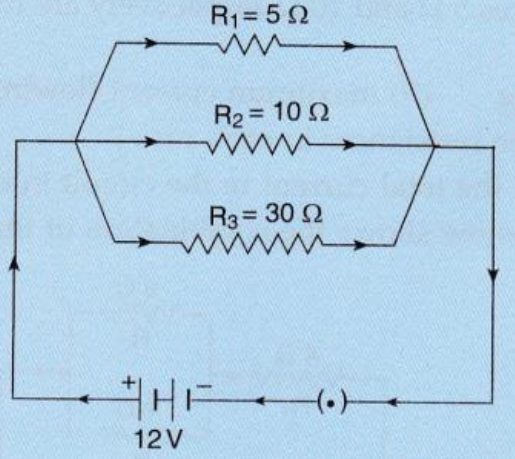
In the circuit diagram given below, three resistors R R , and R of $5 Ω, 10 Ω$ and $30 Ω,$ respectively are connected as shown.
Calculate:
  1. Current through each resistor.
  2. Total current in the circuit.
  3. Total resistance in the circuit.
With a neat labelled diagram, explain advanced sunrise and delayed sunset.
The pH values of five solutions A, B, C, D and E are given below:
  1. 1
  2. 5
  3. 7
  4. 11
  5. 13
Which solution is:
  1. Weakly alkaline.
  2. Neutral.
  3. Strongly acidic.
  4. Strongly alkaline, and.
  5. Weakly acidic?
Draw a labelled diagram of the human respiratory system.
Explain budding in yeast.
With a neat labelled diagram, explain the construction and working of a compound microscope.
What are the advantages of hydroelectric power generation?