Question
Write the atomic number of the element present in the third period and seventeenth group of the periodic table.

Answer

There are two elements in the $1^{\text {st }}$ period and eight elements in the $2^{\text {nd }}$ period., The third period starts with the element with $Z=11$. Now, there are eight elements in the third period. Thus, the $3^{\text {rd }}$ period ends with the element with $Z=18$ i.e., the element in the $18^{\text {th }}$ group of the third period has $Z=18$. Hence, the element in the $17^{\text {th }}$ group of the third period has atomic number $Z=17$.

Need a full question paper?

Generate a complete, print-ready paper with questions like this in minutes — across 16+ boards, with answer keys.
Start Generating Free

Similar questions

Hydrogen atom has only one electron, so mutual repulsion between electrons is absent. However, in multielectron atoms mutual repulsion between the electrons is significant. How does this affect the energy of an electron in the orbitals of the same principal quantum number in multielectron atoms?
Calculate $\Delta_{\mathrm{f}} \mathrm{H}^{\circ}$ of HCl if bond energy of $\mathrm{H}-\mathrm{H}$ bond is $437 \mathrm{~kJ} \mathrm{~mol}^{-1}, \mathrm{Cl}-\mathrm{Cl}$ bond is $244 \mathrm{~kJ} \mathrm{~mol}^{-1}$ and $\mathrm{H}-\mathrm{Cl}$ is $433 \mathrm{~kJ} \mathrm{~mol}^{-1}$.
The compression factor (compressibility factor) for one mole of a van der Waals gas at 0°C and 100 atm pressure is found to be 0.5. Assuming that the volume of a gas molecule is negligible, calculate the van der Waals' constant a.
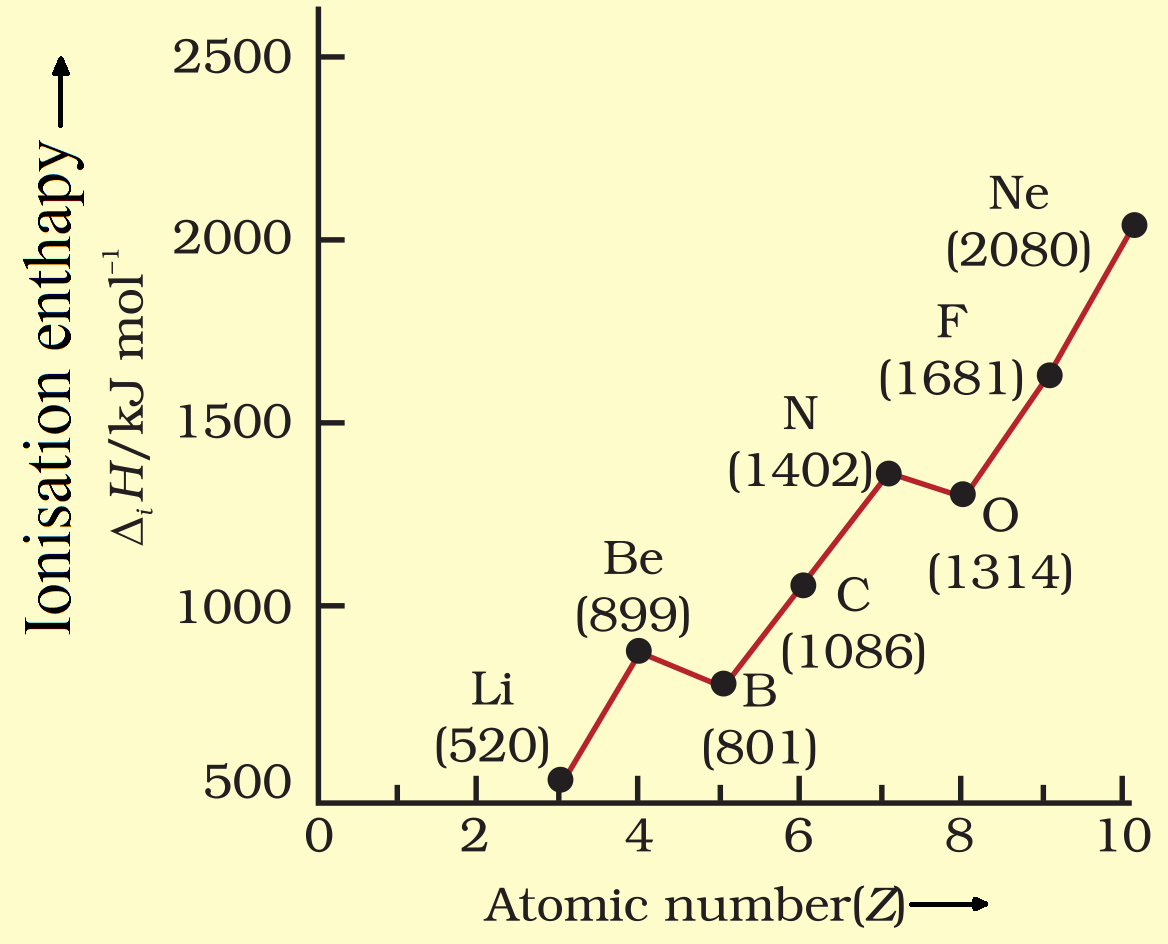
Arrange the elements N, P, O and S in the order of:
  1. Increasing first ionisation enthalpy.
  2. Increasing non metallic character. Give reason for the arrangement assigned.
Consider the reactions: $\mathrm{O}_3(\mathrm{~g})+\mathrm{H}_2 \mathrm{O}_2(\mathrm{l}) \rightarrow \mathrm{H}_2 \mathrm{O}(\mathrm{l})+2 \mathrm{O}_2(\mathrm{~g})$ Why it is more appropriate to write these reactions as:
$\mathrm{O}_3(\mathrm{~g})+\mathrm{H}_2 \mathrm{O}_2(\mathrm{l}) \rightarrow \mathrm{H}_2 \mathrm{O}(\mathrm{l})+\mathrm{O}_2(\mathrm{~g})+\mathrm{O}_2(\mathrm{~g})$
Also suggest a technique to investigate the path of the above redox reactions.
Why is $\mathrm{Li}_2 \mathrm{CO}_3$ decomposed at a lower temperature whereas $\mathrm{Na}_2 \mathrm{CO}_3$ at higher temperature?
A farmer was using pesticides on his farm. He used the produce of his farm as food for rearing fishes. He was told that fishes were not fit for human consumption because large amount of pesticides had accumulated in the tissues of fishes. Explain how did this happen?
Write down the outermost electronic configuration of alkali metals. How will you justify their placement in group 1 of the periodic table?
Express each of the following in SI units,
  1. 14 pound per square inch (atmospheric pressure).
  2. 100 mile per hour.
  3. 5 feet 2 inch.
  4. 150 pound.
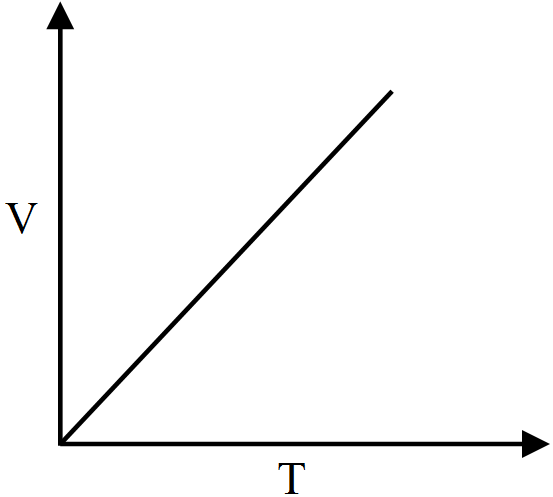
  1. Which gas law is shown by the following graph?
  1. Calculate the temperature of 4.0mol of gas occupying $5dm^3$​​​​​​​ at 332 bar.
[$R = 0.083$bar $dm3mol^{-1}K]$