Question
Write the definition of electrostatic potential. Tell whether it is a vector or a scalar quantity ? Also write its SI unit and dimensional formula.

Answer

→"Work done in bringing unit positive charge from infinity to the given point in the electric field against the electric field is called electrostatic potential ( $V$ ) at that point."
OR
→"In the region of static electric field, electric potential at any point means work done by external force in bringing unit positive charge from infinity to that point, without acceleration."
Electrostatic potential is a scalar quantity.
Its SI unit is : V (Volt) OR J/C.
Its DF (Dimensional Formula) is $M ^1 L^2 T^{-3} A^{-1}$

Need a full question paper?

Generate a complete, print-ready paper with questions like this in minutes — across 16+ boards, with answer keys.

Start Generating Free

Similar questions

If we put a cardboard (say 20cm × 20cm) between a light source and our eyes, we can't see the light. But when we put the same cardboard between a sound source and our ear, we hear the sound almost clearly. Explain.
Show diagrammatically when is magnetic flux taken as:
  1. Positive.
  2. Negative.
What is the radius of the path of an electron $($mass $9 \times 10^{-31} kg$ and charge $1.6 \times 10^{-19} C$ ) moving at a speed of $3 \times 10^7 m / s$ in a magnetic field of $6 \times 10^{-4} T$ perpendicular to it? What is its frequency? Calculate its energy in $keV .\left(1 eV =1.6 \times 10^{-19} J \right)$.
A uniformly charged conducting sphere of 2.4 m diameter has a surface charge density of $80.0\ μC/m^2$.
  1. Find the charge on the sphere.
  2. What is the total electric flux leaving the surface of the sphere?
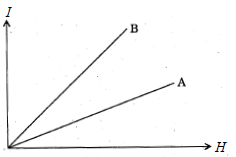
The following figure shows the variation of intensity of magnetisation versus the applied magnetic field intensity, H, for two magnetic materials A and B:
  1. Identify the materials A and B.
  2. Why does the material B, have a larger susceptibility than A, for a given field at constant temperature?
A simple microscope is rated 5 for a normal relaxed eye. What will be its magnifying power for a relaxed farsighted eye whose near point is 40cm?
Explain destructive interference using proper $($appropriate$)$ example.
When 40kV is applied across an X-ray tube, X-ray is obtained with a maximum frequency of $9.7 \times 10^{18}Hz$. Calculate the value of Planck constant from these data.
Is it necessary to have two waves of equal intensity to study interference pattern? Will there be an effect on clarity if the waves have unequal intensity?
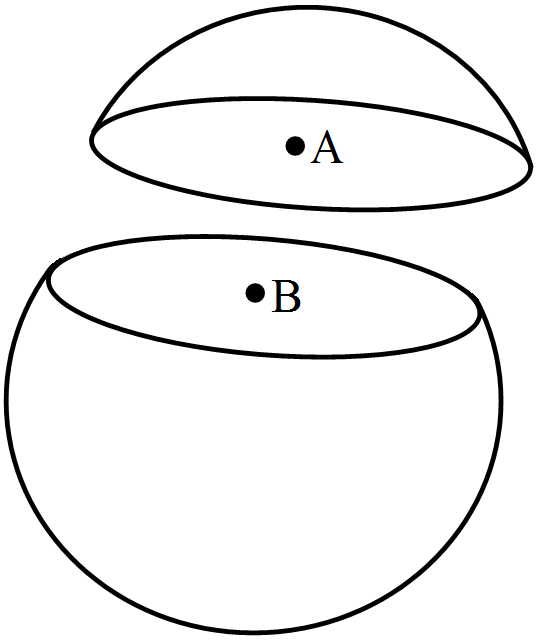
A thin spherical shell having uniform density is cut in two parts by a plane and kept separated as shown in figure (11-E3). The point A is the centre of the plane section of the first part and B is the centre of the plane section of the second part. Show that the gravitational field at A due to the first part is equal in magnitude to the gravitational field at B due to the second part.