Question
Write the difference between parallel combination and series combination of capacitors.

Answer

(1) Such a combination of capacitors in which the value of potential difference on each capacitor is equal, is called parallel combination. Such a combination of capacitors, in which the magnitude of charge on each capacitor remains the same, is called a series combination.
(2) Combination of capacitors by connecting them in parallel, equivalent capacitance is equal to the sum of the capacitances of each capacitor. In series combination, the reciprocal of the equivalent capacitance of the circuit is equal to the sum of the reciprocals of the capacitance of each capacitor used in this combination.
The value of equivalence obtained in series combination is less than the value of any capacitance.
Need a full question paper?

Generate a complete, print-ready paper with questions like this in minutes — across 16+ boards, with answer keys.

Start Generating Free

Similar questions

Which rules are followed in nuclear reactions?
Explain why cooking is faster in a pressure cooker.
Using the curve for the binding energy per nucleon as a function of mass number A, state clearly how the release in energy in the processes of nuclear fission and nuclea fusion can be explained.
Provide the classification of solids on the basis of the relative values of electrical conductivity $(\sigma)$ or resistivity ( $\rho$ ).
State the right hand thumb rule for finding the direction of the magnetic field due to a current carrying circular loop.
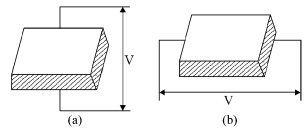
In a given figure, a rectangular object is shown. Its length is I, breadth is 0.5 I and thickness 0.25 I . To measure its resistance, potential difference $V$ is applied in two ways [figure (a) and (b)]. In which arrangement, the resistance of the substance will be more?
Image
Two stable isotopes of lithium $^6_3\text{Li }\text{ and }\ ^7_3\text{Li}$  have respective abundances of 7.5% and 92.5%. These isotopes have masses 6.01512 u and 7.01600 u, respectively. Find the atomic mass of lithium.
A proton and an a particle are accelerated through the same potential difference. Which one of the two has (i) greater de-Broglie wavelength, and (ii) less kinetic energy? Justify your answer.
If the intensity of light falling on a metal plate is doubled, what will be the effect on photocurrent and maximum kinetic energy of emitted photoelectrons?
Current is allowed to flow in a metallic wire at a constant potential difference. When the wire becomes hot, cold water is poured on half of its portion. By doing so, its other half portion becomes still more hot. Explain its reason.