Question
Write the expression for the de Broglie wavelength associated with a charged particle having charge ‘q’ and mass ‘m’, when it is accelerated by a potential V.

Answer

de Broglie wavelength $\lambda = \frac{\text{h}}{\text{p}} = \frac{\text{h}}{\sqrt{2\text{mqV}}}$Hint: $\text{W = K qV} = \frac{\text{P}^{2}}{2\text{m}}\text { or } \text{p}= \sqrt{2\text{mqV}}.$

Need a full question paper?

Generate a complete, print-ready paper with questions like this in minutes — across 16+ boards, with answer keys.

Start Generating Free

Similar questions

In the figure given below, on moving a magnet NS kept between two coils AB and CD in the direction of arrow, in which coil the direction of induced current will be anticlockwise when seen from left?
Image
What is the height of the final image of the tower if it is formed at $25\ cm?$
If a graph is drawn between different potential differences applied across the ends of the conductor and their corresponding values of current, then what type of graph is obtained?
What is the length of the telescope in normal adjustment?
What is the reason that the numbers of absorption transitions is less than the emission transition in atom?
Consider a book lying on a table. The weight of the book and the normal force by the table on the book are equal in magnitude and opposite in direction. Is this an example of Newton's third law?
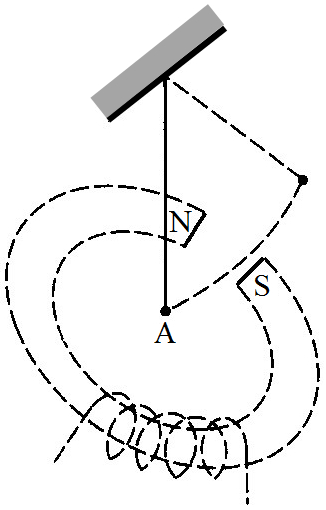
A metallic bob A oscillates through the space between the poles of an electromagnet. The oscillations are more quickly damped when the circuit is on, as compared to the case when the circuit is off. Explain.
In an ac circuit, instantaneous current and voltage are $I = I _0 \sin 300 t A$ and $V =200 \sin 300 t$ respectively. What is average power dissipated in the circuit?
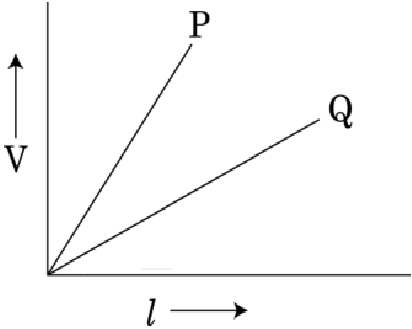
The variation of potential V with length l in case of two potentiometers wires P and Q is as shown. Which one of these will you prefer comparing emfs of two primary cells and why?
Is it possible in a LCR series circuit that the value of applied potential on any component of circuit is more than the peak value of applied alternating potential?