Questions

1 Marks Question

Take a timed test

53 questions · self-marked practice — reveal the answer and mark yourself.

Question 11 Mark
shows a capacitor made of two circular plates each of radius $12 \ cm,$ and separated by $5.0 \ cm$. The capacitor is being charged by an external source $($not shown in the figure$)$. The charging current is constant and equal to $ 0.15A.$
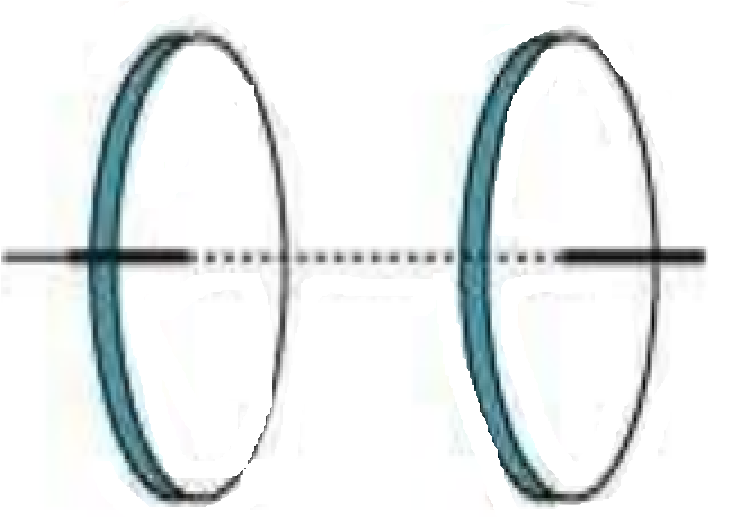
  1. Calculate the capacitance and the rate of charge of potential difference between the plates.
  2. Obtain the displacement current across the plates.
  3. Is Kirchhoff’s first rule $($junction rule$)$ valid at each plate of the capacitor? Explain.
​​​​​​​
Answer
Radius of each circular plate $, r = 12 \ cm = 0.12 m$ Distance between the plates $, d = 5 \ cm = 0.05 m$ Charging current $, I = 0.15$ A Permittivity of free space $,\varepsilon_0=8.85\times10^{-12} \ \text{cm}=0.12 \ \text{m}$
  1. Capacitance between the two plates is given by the relation,
$A =$ Area of each plate $=\pi\text{r}^2$
$=\frac{8.85\times10^{-12}\times\pi\times12^2}{0.05}$
$V =$ Potential difference across the plates
Differentiation on both sides with respect to time $(t)$ gives:
But  $, \frac{\text{dq}}{\text{dt}}=\text{current }(I)$
Therefore, the change in potential difference between the plates is $1.87\times10^9\text{V}/\text{s}$.
  1. The displacement current across the plates is the same as the conduction current. Hence, the displacement current $, i_d$ is $0.15 A.$
  2. Yes
View full question & answer
Question 21 Mark
Suppose that the electric field part of an electromagnetic wave in vacuum is $\text{E}=\{(3.1 \ \text{N}/\text{C}\cos[(1.8 \text{rad}/ \text{m}) \text{y}+(5.4\times10^6 \ \text{red}/\text{s}\text{t}]\hat{\text{i}}\}$.
  1. What is the direction of propagation?
  2. What is the wavelength $\lambda$ ?
  3. What is the frequency $ν$ ?
  4. What is the amplitude of the magnetic field part of the wave?
  5. Write an expression for the magnetic field part of the wave.
Answer
  1. From the given electric field vector, it can be inferred that the electric field is directed along the negative $x$ direction. Hence, the direction of motion is along the negative $y$
diraction i.e., $-\hat{\text{j}}$.
  1. It is given that,
$\vec{\text{E}}=3.1 \ \text{N}/\text{C}\cos\Big[(1.8 \ \text{rad}/ \text{m})\text{y}+(5.4\times10^8 \ \text{rad}/\text{s})\text{t}\Big]\hat{\text{i}}\dots(1)$
$\vec{\text{E}}=\text{E}_0\sin(\text{kx}-\omega\text{t})\dots(2)$
Electric field amplitude $, E_0 = 3.1 N/C$
$\omega = 5.4 x 10^8 rad/s$
$\lambda=\frac{2\pi}{1.8}=3.490 \ \text{m}$
  1. Frequency of wave is given as:
$\text{v}=\frac{\omega}{2\pi}$
$=\frac{5.4\times10^8}{2\pi}=8.6\times10^7 \ \text{Hz}$
  1. Magnetic field strength is given as:
$\text{B}_0=\frac{\text{E}_0}{\text{c}}$
Where,
$\therefore\ \text{B}_0=\frac{3.1}{3\times10^8}=1.03\times10^{-7} \ \text{T}$
  1. On observing the given vector field, it can be observed that the magnetic field vector is directed along the negative $z$ direction.
  2. Hence, the general equation for the magnetic field vector is written as:
$\vec{\text{B}}=\text{B}_0\cos(\text{ky}+\omega\text{t})\hat{\text{k}}$
$=\Big\{(1.03\times10^{-7}\text{T})\cos\Big[(1.8 \ \text{rad}/\text{m})\text{y}+(5.4\times10^6\text{rad}/\text{s})\text{t}\Big]\Big\}\hat{\text{k}}$
View full question & answer
Question 31 Mark
A plane electromagnetic wave of frequency $25 MHz$ travels in free space along the $x$-direction. At a particular point in space and time, $E =6.3 \hat{ j } V / m$. What is $B$ at this point?
Answer
Using Eq. (8.10), the magnitude of $B$ is
$
\begin{aligned}
B & =\frac{E}{c} \\
& =\frac{6.3 V / m }{3 \times 10^8 m / s }=2.1 \times 10^{-8} T
\end{aligned}
$
To find the direction, we note that $E$ is along $y$-direction and the wave propagates along $x$-axis. Therefore, B should be in a direction perpendicular to both $x$ - and $y$-axes. Using vector algebra, $E \times B$ should be along $x$-direction. Since, $(+\hat{ j }) \times(+\hat{ k })=\hat{ i }, B$ is along the $z$-direction. Thus, $\quad B =2.1 \times 10^{-8} k T$
View full question & answer
Question 41 Mark
In which directions do the electric and magnetic field vectors oscillate in an electromagnetic wave propagating along the x-axis?
Answer
$\overrightarrow{E}\text{ }\text{ }\text{along y- axis and}\text{ }\overrightarrow{B}\text{ }\text{ }\text{along z- axis}$Alternate answer
$\overrightarrow{E}\text{along z-axis and}\text{ }\overrightarrow{B}\text{ }\text{along y-axis}$
View full question & answer
Question 51 Mark
Write the relation for the speed of electromagnetic waves in terms of the amplitudes of electric and magnetic fields.
Answer
Speed of electromagnetic wave, $\text{C}=\frac{\text{E}_0}{\text{B}_0}.$
View full question & answer
Question 71 Mark
Welders wear special goggles or face masks with glass windows to protect their eyes from electromagnetic radiations. Name the radiations and write the range of their frequency.
Answer
Radiations above violet $($in $\text{VIBGYOR}).$ Frequency range $10^{15} –10^{17}\ Hz.$
Hint: Frequecy of visible light is of the order of $10^{14}\ Hz.$
View full question & answer
Question 81 Mark
Write the expression for the de Broglie wavelength associated with a charged particle having charge ‘q’ and mass ‘m’, when it is accelerated by a potential V.
Answer
de Broglie wavelength $\lambda = \frac{\text{h}}{\text{p}} = \frac{\text{h}}{\sqrt{2\text{mqV}}}$Hint: $\text{W = K qV} = \frac{\text{P}^{2}}{2\text{m}}\text { or } \text{p}= \sqrt{2\text{mqV}}.$
View full question & answer
Question 91 Mark
What are the directions of electric and magnetic field vectors relative to each other and relative to the direction of propagation of electromagnetic waves?
Answer
$\overrightarrow{\text{E}}$ is perpendicular to$\overrightarrow{\text{B}}$ $\overrightarrow{\text{E}}$and$\overrightarrow{\text{B}}$ are both perpendicular to the direction of propagation of wave.
View full question & answer
Question 101 Mark
Name the part of electromagnetic spectrum whose wavelength lies in the range of $10^{–10} m.$ Give its one use.
Answer
The wavelength range of $10^{–10} m$ lies in $X-$rays. $X-$rays are used as a diagnostic tool in medicine and as a treatment for certain forms of cancer.
View full question & answer
Question 111 Mark
Name the EM waves used for studying crystal structure of solids. What is its frequency range?
Answer
$\text{X }\text{rays},3\times10^{16}\text{Hz to }3\times10^{20}\text{Hz}.$
View full question & answer
Question 121 Mark
Ultraviolet radiations of different frequencies and are incident on two photosensitive materials having work functions $\ce{W_1}$ and $\ce{W_2(W_1>W_2)}$ respectively. The kinetic energy of the emitt3ed electrons is same in both the cases. Which one of the two radiations will be of higher frequency?
Answer
$\text{v}_{1}>\text{v}_{2}$.
View full question & answer
Question 131 Mark
Write the expression for speed of electromagnetic waves in a medium of electrical permittivity $\epsilon$ and magnetic permeability $\mu$.
Answer
$c=\frac{1}{\sqrt\mu\epsilon}$Alternate Answer
$c=\frac{1}{\sqrt{\mu_0\mu_r\epsilon_0\epsilon_r}}$
View full question & answer
Question 141 Mark
Write the expression for speed of electromagnetic waves in a medium of electrical permittivity $\varepsilon$ and magnetic permeability $\mu$.
Answer
$C=\frac{1}{\sqrt{\mu\epsilon}}$Alternate Answer
$C=\frac{1}{\sqrt{\mu_0\mu_r\epsilon_0\epsilon_r}}$
View full question & answer
Question 151 Mark
Why are microwaves considered suitable for radar systems used in aircraft navigation?
Answer
Due to their short wavelengths, (they are suitable for radar system used in aircraft navigation).
View full question & answer
Question 161 Mark
How is the speed of em-waves in vacuum determined by the electric and magnetic field?
Answer
Speed of em waves is determined by the ratio of the peak values of electric and magnetic field vectors.
View full question & answer
Question 171 Mark
Name the physical quantity which remains same for microwaves of wavelength 1mm and UV radiations of 1600 Å in vacuum.
Answer
Speed (or velocity).
View full question & answer
Question 181 Mark
A plane electromagnetic wave travels in vacuum along z-direction. What can you say about the direction of electric and magnetic field vectors?
Answer
$\overrightarrow{\text{E}}$ along X-axis, $\overrightarrow{\text{B}}$ alongY-axis.Alternate Answer
$\overrightarrow{\text{E}}$alongY-axis,$\overrightarrow{\text{B}}$ along X-axis.
View full question & answer
Question 201 Mark
Write the following radiations in ascending order in respect of their frequencies: X-rays, microwaves, UV rays and radio waves.
Answer
Radio waves, Microwaves, UV Rays, X-Rays.
View full question & answer
Question 211 Mark
Name the part of the electromagnetic spectrum of wavelength $10^{–2 }m$ and mention its one application.
Answer
Microwave Application: Radar$/$Microwave oven.
View full question & answer
Question 221 Mark
Name the electromagnetic radiations used for (a) water purification, and (b) eye surgery.
Answer
  1. Water purification → Ultraviolet rays.
  2. Eye-surgery → Ultraviolet rays.
View full question & answer
Question 231 Mark
Differentiate between conduction current and displacement current.
Answer
Conduction current is established by actual movement of free electrons through a metallic conductor while displacement current is established by polarization of molecules of a dielectric under the influence of an external electric field.
View full question & answer
Question 241 Mark
Write the mathematical form of Ampere-Maxwell circuital law.
Answer
$\int\vec{\text{B}}.\vec{\text{dl}}=\mu_0\Big(\text{I}+\varepsilon_0\frac{\text{d}\phi_\text{e}}{\text{dt}}\Big).$
View full question & answer
Question 251 Mark
What is the origin of displacement current?
Answer
Displacement current does not arise due to motion of charge carriers but it arises due to time variation of electric flux.
View full question & answer
Question 261 Mark
Name the part of electromagnetic spectrum of wavelength 102m and mention its one application.
Answer
Wavelength 102m belongs to radio-waves. This is used to broadcast radio programmes to long distances.
View full question & answer
Question 271 Mark
Name the electromagnetic radiations used for viewing objects through haze and fog.
Answer
Infrared rays are used for viewing objects through haze and fog.
View full question & answer
Question 281 Mark
Which out of the following are electromagnetic waves X-rays, sound waves and radio waves?
Answer
X-rays and radio waves are electromagnetic waves.
View full question & answer
Question 291 Mark
The frequency of oscillation of the electric field vector of a certain electromagnetic wave is $5 \times 1014\ Hz.$ What is the frequency of oscillation of the corresponding magnetic field vector and to which part of the electromagnetic spectrum does it belong?
Answer
Frequency of oscillation of magnetic field vector is same as that of electric field vector.
i.e., $ν = 5 \times 10^{14}Hz$ It lies in visible region.
View full question & answer
Question 301 Mark
Write the following in descending order of wavelength:
Gamma rays, Hertzian waves, yellow light, blue light, infrared radiation, ultraviolet radiation, X-rays, γ-rays.
Answer
Hertzian waves, infrared radiation, yellow light, blue light, ultraviolet radiation, X-rays, γ-rays.
View full question & answer
Question 311 Mark
Identify the part of the electromagnetic spectrum to which the following wavelengths belong:
  1. $1 \ mm$
  2. $10^{-11}m$
Answer
  1. Wavelength $1 \ mm$ belongs to the microwaves.
  2. Wave length $10^{-11}m = 0.1A$ belongs to gamma rays.
View full question & answer
Question 321 Mark
Name the electromagnetic waves that have frequencies greater than those of ultraviolet light but less than those of gamma rays.
Answer
X-ray.
View full question & answer
Question 331 Mark
Which of the following has the least wavelength? Gamma rays, blue light, infrared radiation and ultraviolet radiation.
Answer
Gamma rays have the least wavelength.
View full question & answer
Question 341 Mark
What is the unit of ratio $\frac{\text{E}}{\text{H}}?$
Answer
The unit of $\frac{\text{E}}{\text{H}}$ is volt/ ampere or ohm.
View full question & answer
Question 351 Mark
Name the part of electromagnetic spectrum which is used for taking photographs of earth under foggy conditions from great heights.
Answer
Infrared radiation.
View full question & answer
Question 361 Mark
A variable frequency a.c source is connected to a capacitor. How will the displacement current change with decrease in frequency?
Answer
Capacitive reaction $\text{X}_\text{C}=\frac{1}{2\pi\text{fC}}$
Hence, $\text{X}_\text{C}\propto\frac{1}{\text{f}}$
As frequency decreases, XC increases and the conduction current is inversely proportional to $\text{X}_\text{C}\Big(\because\text{I}\propto\frac{1}{\text{X}_\text{C}}\Big)$.
It means the displacement current decreases as the conduction current is equal to the displacement current.
View full question & answer
Question 381 Mark
Which of the following has the minimum wavelength and which has the maximum wavelength?
Blue light, infrared rays, gamma rays, green light.
Answer
Out of the given wavelengths gamma rays have the minimum wavelength and infrared rays have the maximum wavelength.
View full question & answer
Question 411 Mark
Give a reason to show that microwaves are better carriers of signals for long range transmission than radio waves.
Answer
Microwaves are short wavelength waves, so they go straight in a specified direction without any bending.
View full question & answer
Question 421 Mark
Which of the following radiations are:
  1. Heat radiation,
  2. Used for long distance transmission? Infrared rays, gamma rays, ultraviolet rays, microwaves.
Answer
Infrared rays are heat radiation, Microwaves are used for long distance transmission.
View full question & answer
Question 431 Mark
Is the ratio of frequencies of ultraviolet rays and infrared rays in glass more than, less than or equal to 1?
Answer
Ultraviolet rays have more frequency than infrared rays hence ratio is:
$\frac{\nu_\text{ultraviolet}}{\nu_\text{infrared}}=1$
View full question & answer
Question 441 Mark
Name the part of the electromagnetic spectrum of wavelength $10^{-2}m$ and mention its one application.
Answer
Used in $\ce{RADAR}$ system for aircraft navigation.
View full question & answer
Question 451 Mark
Special devices, like the klystron valve or the magnetron valve, are used for production of electromagnetic waves. Name the waves and also write one of their applications.
Answer
  1. Name: Microwaves.
  2. Use: For cooking in microwaves ovens.
View full question & answer
Question 461 Mark
From the following, identify the electromagnetic waves having the:
  1. Maximum.
  2. Minimum frequency.
  1. Radio waves,
  2. Gamma-rays,
  3. Visible light,
  4. Microwaves,
  5. Ultraviolet rays,
  6. Infrared rays.
Answer
  1. The waves of maximum frequency are gamma rays.
  2. The waves of minimum frequency are radio waves.
View full question & answer
Question 471 Mark
To which regions of the electromagnetic spectrum, the following wavelengths belong? $2,000\mathring{\text{A}},5,000\mathring{\text{A}},10,000\mathring{\text{A}}$ and $1.0\mathring{\text{A}.}$
Answer
  1. $2,000\mathring{\text{A}}-\text{Ultraviolet radiation}.$
  2. $5,000\mathring{\text{A}}-\text{Visible light}.$
  3. $10,000\mathring{\text{A}}-\text{Infrared radiation}.$
  4. $1.0\mathring{\text{A}}-\text{X-rays}.$
View full question & answer
Question 481 Mark
Name the characteristics of electromagnetic waves that:
  1. Increases.
  2. Remains constant.
In the electromagnetic spectrum as one moves from radio wave region towards ultraviolet region.
Answer
  1. Frequency increases.
  2. Speed in vacuum remains constant.
View full question & answer
Question 491 Mark
The following table gives the wavelength range of some constituents of the electromagnetic spectrum.
S. No. Wavelength Range
$1.$ $1\ mm$ to $700\ nm$
$2.$ $400\ nm$ to $1\ nm$
$3.$ $1\ nm$ to $10^{-3}\ nm$
$4.$ $< 10^{-3}\ nm$
Select the wavelength range and name the electromagnetic waves that are:
  1. Widely used in the remote switches of household electronic devices.
  2. Produced in nuclear reactions.
Answer
  1. Infrared waves $($wavelength range $1\ mm$ to $700\ nm).$
  2. Gamma rays $($wavelength range $< 10^{-3}\ nm).$
View full question & answer
Question 501 Mark
Identify the part of the electromagnetic spectrum to which the following wavelengths belong$:$
  1. $10^{-1}m$
  2. $10^{-12}m$
Answer
  1. $10^{-1}m = 10\ cm$ belongs to short radio waves.
  2. $10^{-12}m = 0.01A$ belongs to gamma rays.
View full question & answer
Question 511 Mark
Identify the type of waves which are produced by the following way and write one application for each:
  1. Radioactive decay of the nucleus.
  2. Rapid acceleration and decelerations of electrons in aerials.
  3. Bombarding a metal target by high energy electrons.
Answer
S. No Type of wave Application
(i) Gamma rays Treatment of tumors.
(ii) Radio waves Radio and television communication systems.
(iii) X-rays Study of crystals.
View full question & answer
Question 521 Mark
Experimental observations have shown that $X-$rays$:$
  1. Travel in vacuum with a speed of $3 \times 10^8\ ms^{-1}.$
  2. Exhibit the phenomenon of diffraction and can be polarised.
What conclusion can be drawn about the nature of $X-$rays from each of these observations?
Answer
  1. $X-$rays are electromagnetic waves.
  2. $X-$rays are transverse in nature.
View full question & answer
Question 531 Mark
Define displacement current.
Answer
Displacement current is the current which comes into existence in a region where the electric field (and electric flux) is changing with time. It is given by $I_d=\in_0 \frac{d \Phi_E}{d t}$.
View full question & answer