Question
Write the laws of refraction.

Answer

(i) Incident ray, refracted ray and the normal separating both the mediums, lie in the same plane.
(ii) For any two mediums and for light of a certain colour (wavelength), the result of the sine of the angle of incidence and the sine of the angle of refraction is a constant.
If the angle of incidence is $i$ and the angle of refraction is $r$. Then $\sin \frac{\sin i}{\sin r}=$ constant $={ }_1 n_2$.

Need a full question paper?

Generate a complete, print-ready paper with questions like this in minutes — across 16+ boards, with answer keys.
Start Generating Free

Similar questions

When an electron revolving in its lowest energy level in the hydrogen atom moves to the third excited state, how is the de Broglie wavelength associated with it affected?
Write relation between conductivity and mobility of metal.
Which of the following can act as a source of electromagnetic waves:
  1. A charge moving with a constant velocity.
  2. A charge moving in a circular orbit.
  3. A charge at rest.
Give reason.
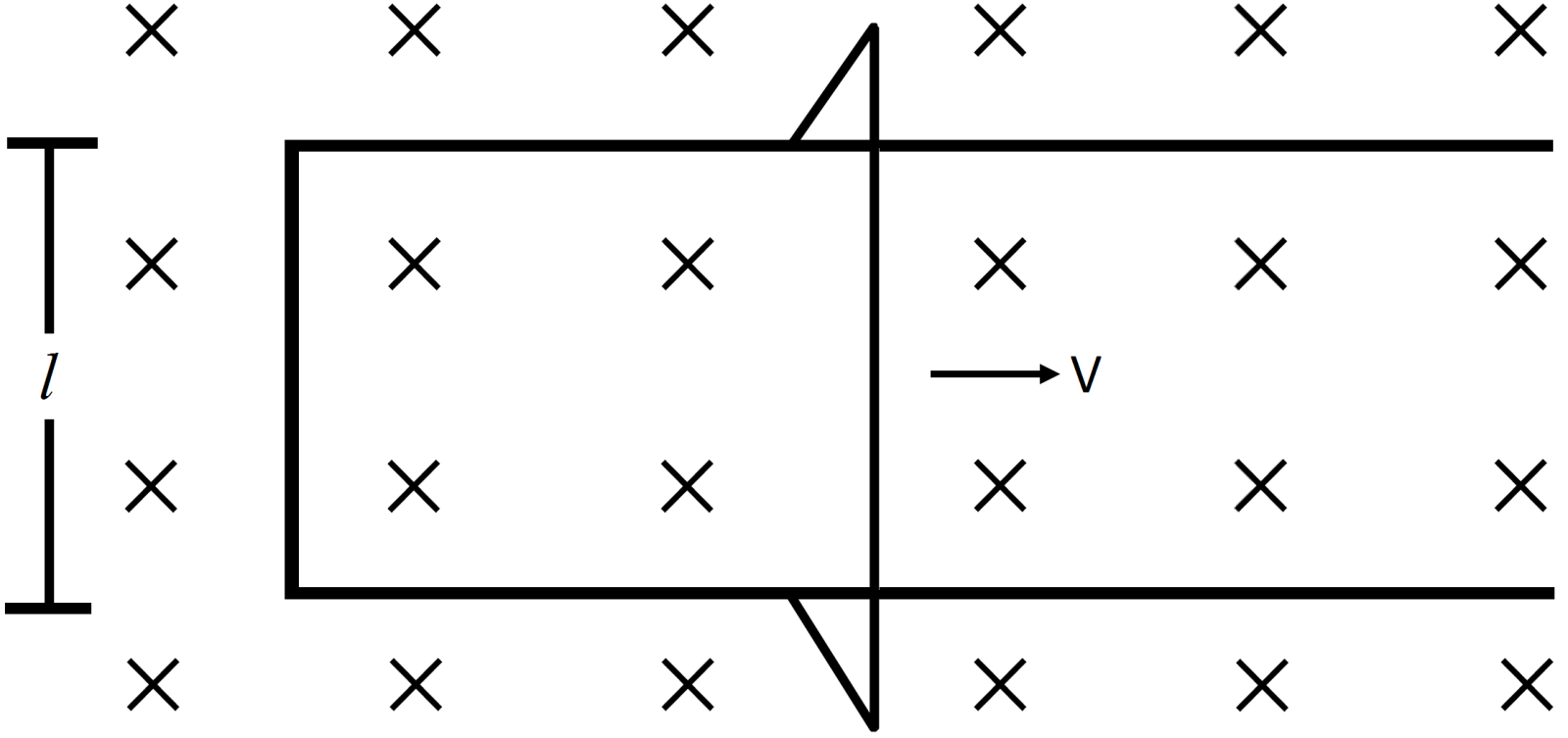
Figure shows a long U-shaped wire of width l placed in a perpendicular magnetic field B. A wire of length l is slid on the U-shaped wire with a constant velocity v towards right. The resistance of all the wires is r per unit length. At t = 0, the sliding wire is close to the left edge of the U-shaped wire. Draw an equivalent circuit diagram, showing the induced emf as a battery. Calculate the current in the circuit.
Derive the equation of average power for $\text{L - C - R}$ series $AC$ circuit.
"Monochromatic light should be used to produce pure spectrum". Comment on this statement.
Answer the following:
a. Magnetic field lines can be entirely confined within the core of a toroid, but not within a straight solenoid. Why?
b. Does a bar magnet exert a torque on itself due to its own field? Justify your answer.
c. When an electron revolves around a nucleus, obtain the expression for the magnetic moment associated with it.
What facts are obtained by the scattering with angle more than $90^{\circ}$.
Use the formula $\lambda_{ m } T =0.29 cm K$ to obtain the characteristic temperature ranges for different parts of the electromagnetic spectrum. What do the numbers that you obtain tell you?
State the Oersted's observation.