Question
Differentiate between self induction and mutual induction with examples.

Answer

Self Induction : "The phenomenon of electromagnetic induction in which on changing the main current in a coil, an induced current is developed in the same coil, is called self induction."
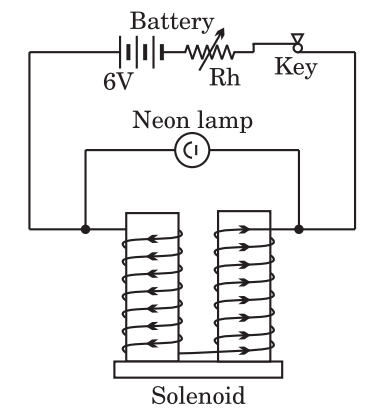
Example : A solenoid having a large number of turns of insulated wire wound over soft iron core is connected in series with a 6 V battery, a rheostat and a tapping key.
Image
A neon lamp is connected in parallel with the solenoid. First press the tapping key and adjust the current in the circuit with the help of rheostat such that the lamp glows faintly. Now, as the tapping is stopped, the lamp glows brightly for a moment and then goes out. This is due to the fact that as the circuit is broken suddenly the magnetic flux linked with the coil of solenoid suddenly vanishes i.e. the rate of change of magnetic flux linked with the solenoid i.e. self induced emf is very large. Hence a large self induced current flows in the circuit which makes the bulb glow brightly for a moment.
Mutual Induction : "It is the phenomenon of electromagnetic induction in which induced emf is produced in the another coil placed near by a coil in which the magnetic flux is changed by changing the current in this coil."
The coil in which the magnetic flux is changed by passing an electric current through it or by changing the current already passing through it or by stopping the current already flowing through it is called the primary coil while the other coil in which the induced emf is produced is called secondary coil.
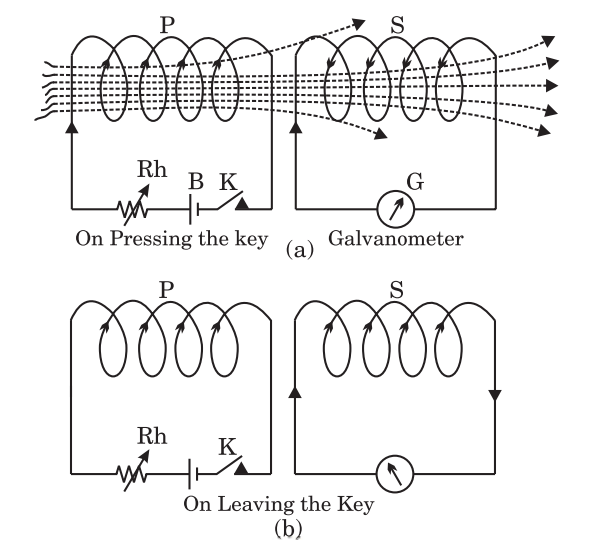
Example : P is primary coil T and S is the secondary coil placed close to each other. The coil P is connected to a battery B, tapping key K and a rheostat Rh. The coil S is connected to a galvanometer G. As the key K in primary coil P circuit is closed a momentary deflection is seen in the galvanometer connected in secondary coil circuit. This is due to the fact that when the key K is pressed, current passes in the coil P and a magnetic field is produced around it. Some of the magnetic flux lines pass through S also. Thus on pressing the key K the number of flux lines passing through S increases from 0 to a definite value. Due to this change in the number of magnetic flux lines i.e. the magnetic flux an emf is induced in the coil S and its corresponding induced current flowing through S produces momentary deflection in galvanometer G. According to Lenz's law the induced current in S opposes the change in magnetic flux in P. hence the direction of induced current in S will be opposite to the direction of main current in the primary coil P [Fig. (a)].
When the key K in primary coil is released then again a momentary deflection is seen in the galvanometer G in secondary coil but now in the direction opposite to the previous direction. This is due to the fact that on releasing the key the current flowing through P reduces from its steady value to zero and hence the flux lines passing through S become zero. Hence again an induced emf is generated in S and corresponding induced current flows through it giving deflection in G. But according to Lenz's law this current opposes the decrease in magnetic flux in P, hence it tends to maintain the flux lines in S. Therefore now the direction of induced current in S flows in the same direction of current as was in P [Fig. (b)].
Image
Similarly, when the current flowing through P is varied (increased or decreased) with the help of rheostat Rh, there is a change in magnetic flux lines around it and also linked with S. Hence so long as the current in P is changing an induced current in S flows.
All of this is due to mutual induction between P and S.

Need a full question paper?

Generate a complete, print-ready paper with questions like this in minutes — across 16+ boards, with answer keys.
Start Generating Free

Similar questions

A bullet of mass 25g is fired horizontally into a ballistic pendulum of mass 5.0kg and gets embedded in it. If the centre of the pendulum rises by a distance of 10cm, find the speed of the bullet.
The current in an ideal, long solenoid is varied at a uniform rate of 0.01A/s. The solenoid has 2000 turns/m and its radius is 6.0cm.
  1. Consider a circle of radius 1.0cm inside the solenoid with its axis coinciding with the axis of the solenoid. Write the change in the magnetic flux through this circle in 2.0 seconds.
  2. Find the electric field induced at a point on the circumference of the circle.
  3. Find the electric field induced at a point outside the solenoid at a distance 8.0cm from its axis.
What is interference of light? Write two essential conditions for sustained interference pattern to be produced on the screen. Draw a graph showing the variation of intensity versus the position on the screen in Young's experiment when (a) both the slits are opened and (b) one of the slit is closed. What is the effect on the interference pattern in Young's double-slit experiment when: 32. 33.
i. Screen is moved closer to the plane of slits?
ii. Separation between two slits is increased. Explain.
Do permeability and relative permeability have the same dimensions?
Consider the situation in figure. The bottom of the pot is a reflecting plane mirror, S is a small fish and T is a human eye. Refractive index of water is.
  1. At what distance(s) from itself will the fish see the image(s) of the eye?
  2. At what distance(s) from itself will the eye see the image(s) of the fish.
A block of mass m is kept over another block of mass M and the system rests on a horizontal surface figure. A constant horizontal force F acting on the lower block produces an acceleration $\frac{\text{F}}{2(\text{m+M})}$ in the system, the two blocks always move together.
  1. Find the coefficient of kinetic friction between the bigger block and the horizontal surface.
  2. Find the frictional force acting on the smaller block.
  3. Find the work done by the force of friction on the smaller block by the bigger block during a displacement d of the system.
By explaining magnetic field lines, write their characteristics.
A boy riding on his bike is going towards east at a speed. of $4\sqrt{2}\ \text{m/s}$ At a certain point he produces a sound pulse of frequency $1650\ Hz$ that travels in air at a speed of $334\ m/s$. A second boy stands on the ground $45^\circ$ south of east from him. Find the frequency of the pulse as received by the second boy.
A charged particle is accelerated through a potential difference of $12\ kV$ and acquires a speed of $1.0 \times 10^6m s^{−1}.$ It is then injected perpendicularly into a magnetic field of strength $0.2T.$ Find the radius of the circle described by it.
The activity R of an unknown radioactive nuclide is measured at hourly intervals. The results found are tabulated as follows:
t(h) 0 1 2 3 4
R(MBq) 100 35.36 12.51 4.42 1.56
  1. Plot the graph of R versus t and calculate half-life from the graph.
  2. Plot the graph of 0 ln $\Big(\frac{\text{R}}{\text{R}_0}\Big)$ versus t and obtain the value of half-life from the graph.