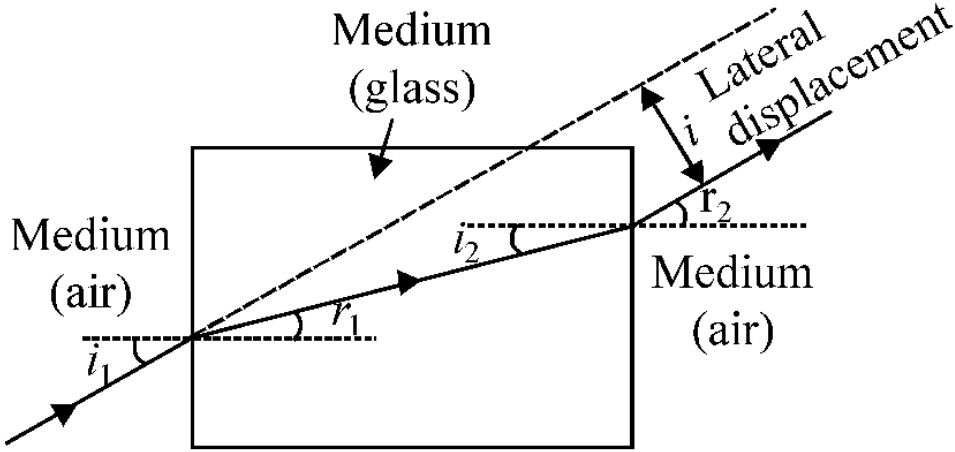
Question
Prove : $n_{12}=\frac{1}{n_{21}}$

Need a full question paper?

Generate a complete, print-ready paper with questions like this in minutes — across 16+ boards, with answer keys.
Start Generating Free

Similar questions

  1. Show that the normal component of electrostatic field has a discontinuity from one side of a charged surface to another given by
$(\text{E}_2-\text{E}_1).\hat{\text{n}}=\frac{\sigma}{\epsilon_0}$
where $\hat{\text{n}}$ is a unit vector normal to the surface at a point and $\sigma$ is the surface charge density at that point. $ ($The direction of $\hat{\text{n}}$ is from side $1$ to side $2.)$ Hence show that just outside a conductor, the electric field is $\sigma \hat{\text{n}} /ε_0.$
  1. Show that the tangential component of electrostatic field is continuous from one side of a charged surface to another.
$[$Hint: For $(a),$ use Gauss’s law. For $, (b)$ use the fact that work done by electrostatic field on a closed loop is zero.$]$
Two particles A and B, each carrying a charge Q, are held fixed with a separation d between them. A particle C having mass m and charge q is kept at the middle point of the line AB.
  1. If it is displaced through a distance x perpendicular to AB, what would be the electric force experienced by it.
  2. Assuming x << d, show that this force is proportional to x.
  3. Under what conditions will the particle C execute simple harmonic motion if it is released after such a small displacement?
Find the time period of the oscillations if these conditions are satisfied.
  1. Differentiate between three segments of a transistor on the basis of their size and level of doping.
  2. How is a transistor biased to be in active state?
  3. With the help of necessary circuit diagram, describe briefly how $n-p-n$ transistor in $CE$ configuration amplifies a small sinusoidal input voltage. Write the expression for the ac current gain.
$4 \times 10^{23}$ tritium atoms are contained in a vessel. The half$-$life of decay tritium nuclei is $12.3y$. Find:
  1. The activity of the sample.
  2. The number of decay in the next $10$ hours.
  3. The number of decays in the next $6.15y$.
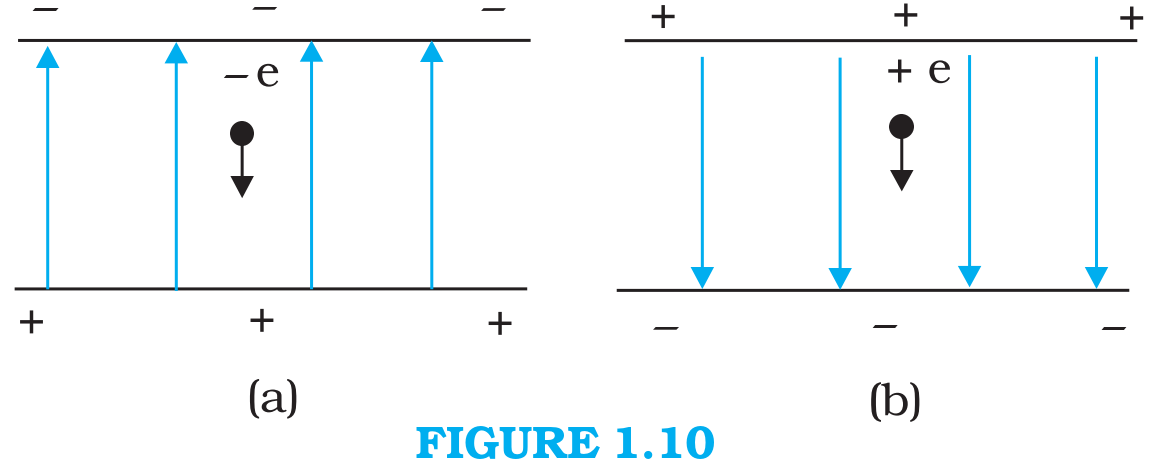
An electron falls through a distance of $1.5 \ cm$ in a uniform electric field of magnitude $2.0 \times 10^4 N C ^{-1} [$Fig. $1.10(a)]$. The direction of the field is reversed keeping its magnitude unchanged and a proton falls through the same distance $ [$Fig. $1.10(b)].$ Compute the time of fall in each case. Contrast the situation with that of 'free fall under gravity'.
Image
Two particles $A$ and $B$, having opposite charges $2.0 \times 10^{-6}C$ and $2.0 \times 10^{-6}C$, are placed at a separation of $1.0\ cm.$
  1. Write down the electric dipole moment of this pair.
  2. Calculate the electric field at a point on the axis of the dipole $1.0m$ awa.y from the centre.
  3. Calculate the electric field at a point on the perpendicular bisector of the dipole and $1.0m$ away from the centre.
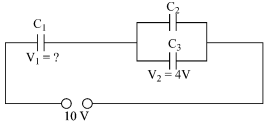
Define capacitor. Obtain the relation of equivalence in series combination of capacitors by making a circuit diagram. Write the value of voltage $V_1$ in the given circuit.
Image
A car accelerates on a horizontal road due to the force exerted by:
  1. The engine of the car.
  2. The driver of the car.
  3. The earth.
  4. The road.
An LR circuit contains an inductor of 500mH, a resistor of $25.0\Omega$ and emf 5.00 V in series. Find the potential difference across the resistor at.
  1. 20.0ms
  2. 100ms and
  3. 1.00s
  1. Using Biot-Savart’s law, derive the expression for the magnetic field in the vector form at a point on the axis of a circular current loop.
  2. What does a toroid consist of ? Find out the expression for the magnetic field inside a toroid for N turns of the coil having the average radius r and carrying a current I. Show that the magnetic field in the open space inside and exterior to the toroid is zero.