Question
Write the properties of charge. What is meant by charge conservation? Explain with example. What do you understand by charge quantization?

Answer

SELF

Need a full question paper?

Generate a complete, print-ready paper with questions like this in minutes — across 16+ boards, with answer keys.

Start Generating Free

Similar questions

An $\text{X-OR}$ gate has following truth table:
$A$ $B$ $Y$
$0$ $0$ $0$
$0$ $1$ $1$
$1$ $0$ $1$
$1$ $1$ $0$
It is represented by following logic relation
$\text{Y}=\bar{\text{A}}.\text{B}+\text{A}.\bar{\text{B}}$
Build this gate using $\ce{AND, OR}$ and $\text{NOT}$ gates.
A ball is thrown horizontally from a point $100\ m$ above the ground with a speed of $20m/s$. Find:
  1. The time it takes to reach the ground.
  2. The horizontal distance it travels before reaching the ground.
  3. The velocity $($direction and magnitude$)$ with which it strikes the ground.
A myopic adult has a far point at $0.1m.$ His power of accomodation is $4$ diopters.
  1. What power lenses are required to see distant objects?
  2. What is his near point without glasses?
  3. What is his near point with glasses? $($Take the image distance from the lens of the eye to the retina to be $2\ cm.)$
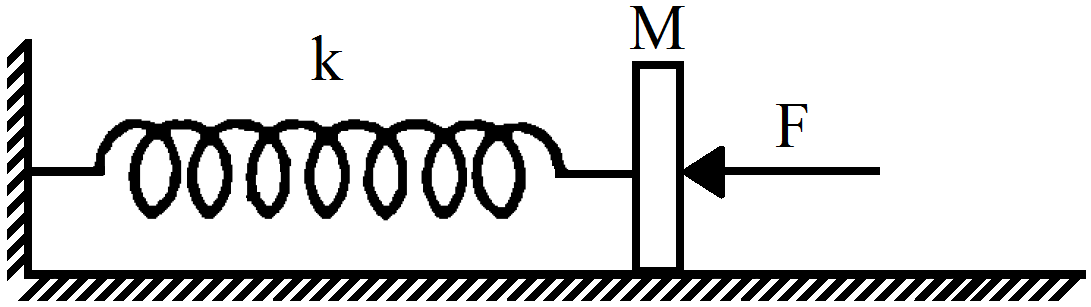
In figure k = 100N/m, M = 1kg and F = 10N,
  1. Find the compression of the spring in the equilibrium position.
  2. A sharp blow by some external agent imparts a speed of 2m/s to the block towards left. Find the sum of the potential energy of the spring and the kinetic energy of the block at this instant.
  3. Find the time period of the resulting simple harmonic motion.
  4. Find the amplitude.
  5. Write the potential energy of the spring when the block is at the left extreme.
  6. Write the potential energy of the spring when the block is at the right extreme.
The answers of (b), (e) and (f) are different. Explain why this does not violate the principle of conservation of energy.
A spherical ball $A$ of surface area $20\ cm^2$ is kept at the centre of a hollow spherical shell $B$ of area $80\ cm^2.$ The surface of $A$ and the inner surface of $B$ emit as blackbodies. Both $A$ and $B$ are at $300K.$
  1. How much is the radiation energy emitted per second by the ball $A?$
  2. How much is the radiation energy emitted per second by the inner surface of $B$
  3. How much of the energy emitted by the inner surface of $B$ falls back on this surface itself?
$a.$ Explain why, for any charge configuration, the equipotential surface through a point is normal to the electric field at that point.
Draw a sketch of equipotential surfaces due to a single charge $(-q),$ depicting the electric field lines due to the charge.
$b.$ Obtain an expression for the work done to dissociate the system of three charges placed at the vertices of an equilateral triangle of side a as shown alongside.
  1. In the explanation of photo electric effect, we asssume one photon of frequency $ν$ collides with an electron and transfers its energy. This leads to the equation for the maximum energy $E_\text{max}$ of the emitted electron as,
  1. $\text{E}_\text{max}=\text{hv}-\phi_0$
    where $\phi_0$ is the work function of the metal. If an electron absorbs $2$ photons $($each of frequency $ν)$ what will be the maximum energy for the emitted electron?
  2. Why is this fact $($two photon absorption$)$ not taken into consideration in our discussion of the stopping potential?
A vessel of volume $125\ cm^3$ contains tritium $\big(\text{ }^3\text{H,t}_{\frac{1}{2}}=12.3\text{y}\big)$ at $500\ \text{kPa}$ and $300K$. Calculate the activity of the gas.
How many wavelengths are emitted by atomic hydrogen in visible range $(380\ nm-780\ nm)?$ In the range $50] nm$ to $100\ nm?$
Two point charges $q_A=3 \mu C$and $q _{ B }=$$-3 \mu C$ are located 20 cm apart in vacuum.
(a) What is the electric field at the midpoint O of the line AB joining the two charges?
(b) If a negative test charge of magnitude $1.5 \times$$10^{-9} C$ is placed at this point, what is the force experi-enced by the test charge?