Write the structures and names of the compounds formed when compound ‘$A’$ with molecular formula, $\ce{C_7H_8}$ is treated with $\ce{Cl_2}$ in the presence of $\ce{FeCl_3}$.
Download our app for free and get started
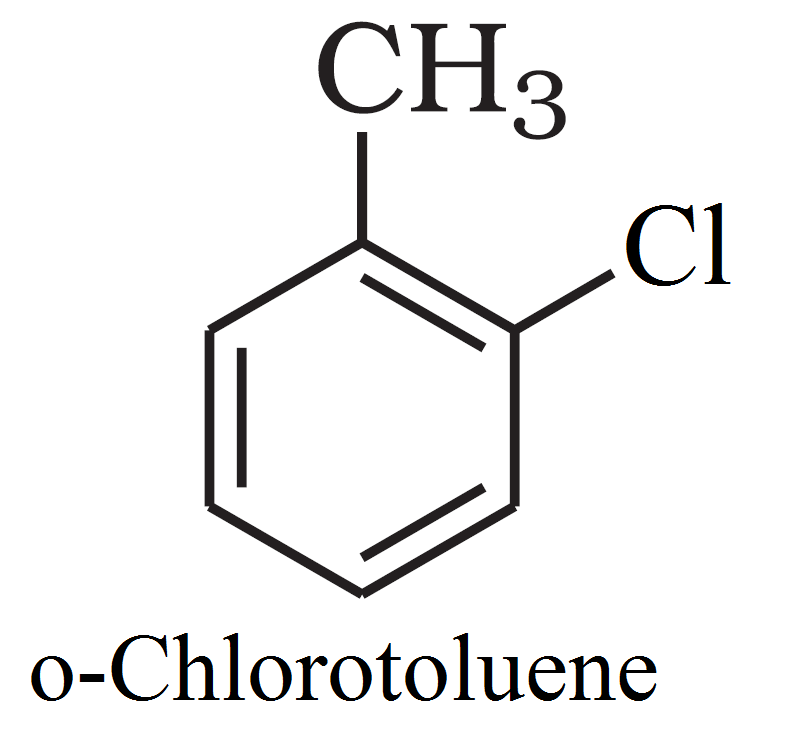
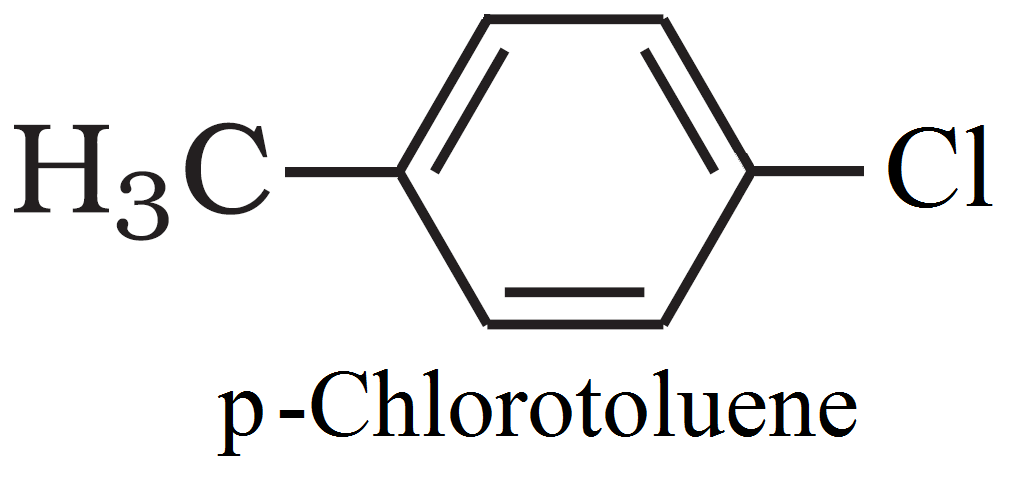
The given compound '$A'$ with molecular formula, $\ce{C_7 H_8}, $ represents an aromatic compound 'toluene.
Chlorination of toluene is brought about in presence of a catalyst $\ce{FeCl_3}$ yields the above products.

Download our appand get started for free
Experience the future of education. Simply download our apps or reach out to us for more information. Let's shape the future of learning together!No signup needed.*
Similar Questions
- 1Write the structure of the major organic product in each of the following reaction:View Solution
$\text{CH}_3\text{CH}_2\text{CH}=\text{CH}_2+\text{HBr}\xrightarrow{\text{peroxide}}$ - 2View SolutionHow will you convert aniline to bromobenzene?
- 3Read the given passage and answer the questions number $1$ to $5$ that follow:View Solution
The substitution reaction of alkyl halide mainly occurs by $S_N1$ or $S_N2$ mechanism. Whatever mechanism alkyl halides follow for the substitution reaction to occur, the polarity of the carbon halogen bond is responsible for these substitution reactions. The rate of $S_N1$ reactions are governed by the stability of carbocation whereas for $S_N2$ reactions steric factor is the deciding factor. If the starting material is a chiral compound, we may end up with an inverted product or racemic mixture depending upon the type of mechanism followed by alkyl halide. Cleavage of ethers with $HI$ is also governed by steric factor and stability of carbocation, which indicates that in organic chemistry, these two major factors help us in deciding the kind of product formed.
Predict the stereochemistry of the product formed if an optically active alkyl halide undergoes substitution reaction by $S_N1$ mechanism. - 4Which compound in each of the following pairs will react faster in $\ce{S_N2}$ reaction with $–\ce{OH(CH_3)_3CCl}$ or $\ce{CH_3Cl}$.View Solution
- 5View SolutionWrite structures of the following compounds:
1, 4-Dibromobut-2-ene. - 6View SolutionWrite the equations for the preparation of 1-iodobutane from:
but-1-ene. - 7View SolutionHow the following conversion can be carried out?
Chloroethane to butane. - 8View SolutionHow the following conversion can be carried out?
Aniline to phenylisocyanide. - 9View SolutionWrite the structures of the following organic halogen compound.
1,4-Dibromobut-2-ene. - 10Write the $\ce{IUPAC}$ name of the following compound: $\ce{(CH_3)_3CCH_2Br}.$View Solution