Question
Write the upper and lower limits of interference in terms of path difference.

Answer

We know that :
Phase difference $=\frac{2 \pi}{\lambda} \times$ path difference
or $\phi=\frac{2 \pi}{\lambda} y \quad \ldots(i)$
We also know that for constructive interference to $\quad \phi=2 n \pi \ldots(ii)$
From equation (i) and (ii)
$\frac{2 \pi}{\lambda} y=2 n \pi$
or $y=2 n \cdot \frac{\lambda}{2}$
For $n$th maxima, $y=y_n$
$\underline {y_n=2 n \cdot \frac{\lambda}{2}}$
Thus, to occur the constructive interference, path difference must be even multiple of $\frac{\lambda}{2}$
For minimum intensity $\quad \phi=(2 n+1) \pi$
or $\frac{2 \pi}{\lambda} y=(2 n+1) \pi$
$\therefore$ $y=(2 n+1) \frac{\lambda}{2}$
For $n$th minima : $y=y_n$
$\therefore$$y_n=(2 n+1) \frac{\lambda}{2}$
Thus, for destructive interference, path difference must be odd multiple of $\frac{\lambda}{2}$.

Need a full question paper?

Generate a complete, print-ready paper with questions like this in minutes — across 16+ boards, with answer keys.
Start Generating Free

Similar questions

Write Einstein's photoelectric equation and explain any two observations related to the photoelectric effect.
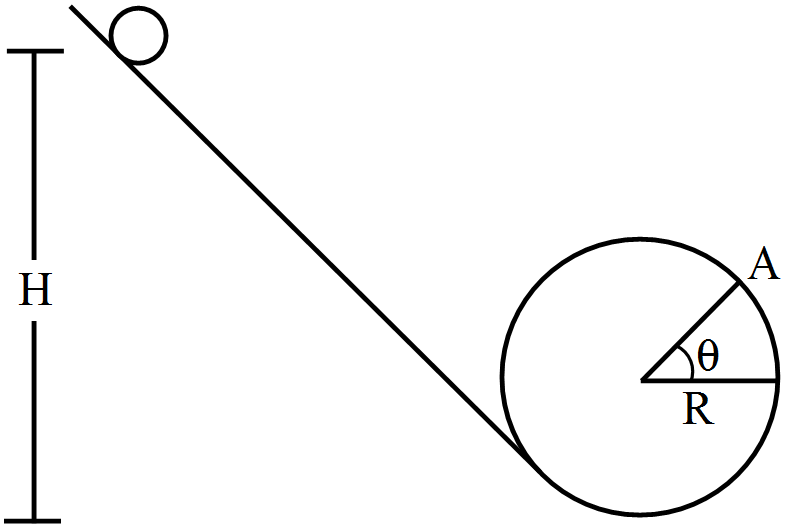
Figure shows a small spherical ball of mass m rolling down the loop track. The ball is released on the linear portion at a vertical height H from the lowest point. The circular part shown has a radius R.
  1. Find the kinetic energy of the ball when it is at a point A where the radius makes an angle $\theta$ with the horizontal.
  2. Find the radial and the tangential accelerations of the centre when the ball is at A.
  3. Find the normal force and the frictional force acting on the ball if H = 60cm, R = 10cm, $\theta=0 $ and m = 70g.
Find the time period of small oscillations of the following systems.
  1. A metre stick suspended through the $20\ cm$ mark.
  2. A ring of mass in and radius $r$ suspended through a point on its periphery.
  3. A uniform square plate of edge a suspended through a corner.
  4. A unifrom disc of mass $m$ and radius $r$ suspended through a point $\frac{\text{r}}{2}$ away from the centre.
If the outer coil of the previous problem is rotated through 90° about a diameter, what would be the magnitude of the magnetic field B at the centre?
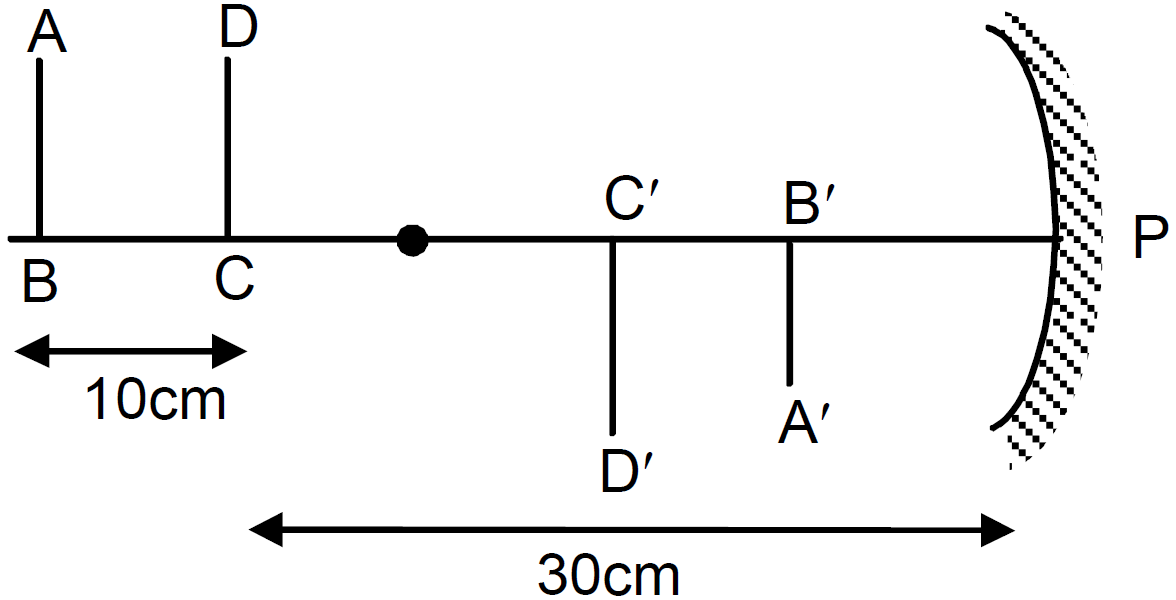
A U-shaped wire is placed before a concave mirror having radius of curvature 20cm. Find the total length of the image.
A cubical metal block of edge 12cm floats in mercury with one fifth of the height inside the mercury. Water is poured till the surface of the block is just immersed in it. Find the height of the water column to be poured. Specific gravity of mercury = 13.6.
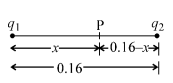
Two charges of$5 \times 10^{-8} C$ and $-3 \times 10^{-8}$ are located at a distance of 16 cm apart. At what point on the line joining the two charges is the electric potential zero? Take the potential at infinity to be zero.
Image
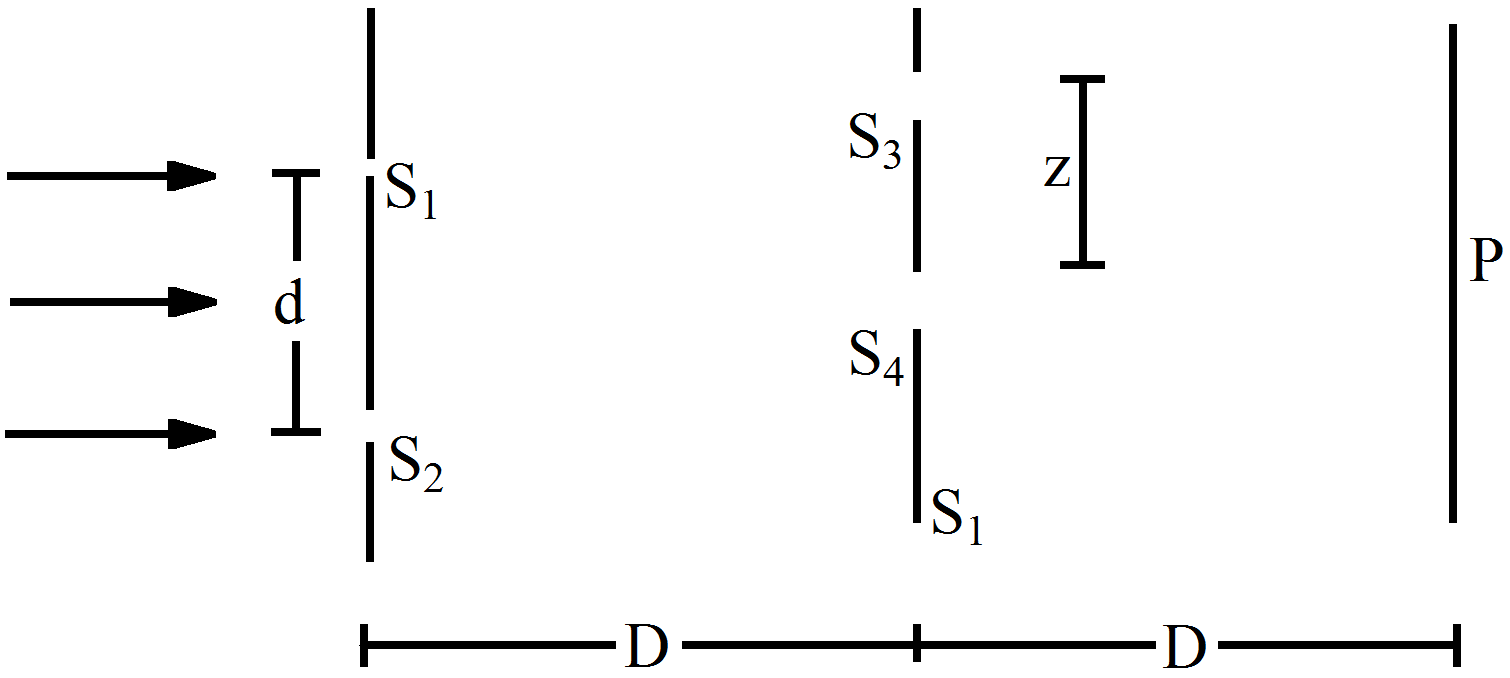
Consider the arrangement shown in figure. By some mechanism, the separation between the slits $S_3$ and $S_4$ can be changed. The intensity is measured at the point $P$ which is at the common perpendicular bisector

of $S_1,S_2$ and $S_3,S_4$.
When $\text{z}=\frac{\text{D}\lambda}{2\text{d}},$ intensity measured at $P$ is $I$.
​​​​​​​Find this intensity when $z$ is equal to:
  1. $\frac{\text{D}\lambda}{\text{d}}$
  2. $\frac{3\text{D}\lambda}{2\text{d}}$
  3. $\frac{2\text{D}\lambda}{\text{d}}$
A metre scale made of steel reads accurately at $20^\circ C$. In a sensitive experiment, distances accurate up to $0.055\ mm$ in $1m$ are required. Find the range of temperature in which the experiment can be performed with this metre scale. Coefficient of linear expansion of steel $= 11 \times 10^{-6^\circ} C^{-1}$.
If a proton had a radius $R$ and the charge was uniformly distributed, calculate using Bohr theory, the ground state energy of a $H-$ atom when:
  1. $R = 0.1 \mathring A .$
  2. $R = 10 \mathring A .$