Question
If a proton had a radius $R$ and the charge was uniformly distributed, calculate using Bohr theory, the ground state energy of a $H-$ atom when:
  1. $R = 0.1 \mathring A .$
  2. $R = 10 \mathring A .$

Answer

For a point nucleus in $H-$ atom,
Ground state: $mvr = h,$
$\frac{\text{mv}^2}{\text{r}_\text{B}}=-\frac{\text{e}^2}{\text{r}^2_\text{B}}.\frac{1}{4\pi\epsilon_0}$
The electrostatic force of attraction between positively charged nucleus and negatively charged electrons $($Coulombian force$)$ provides necessary centripetal force of revolution.
$\frac{\text{mv}^2}{\text{r}_\text{B}}=-\frac{\text{e}_2}{\text{r}^2_\text{B}}.\frac{1}{4\pi\epsilon_0}$
By Bohr's postulates in ground state, we have
$mvr = h$
$\therefore\ \text{m}\frac{\text{h}^2}{\text{m}^2\text{r}^2_\text{B}}=+\Big(\frac{\text{e}^2}{4\pi\epsilon_0}\Big)\frac{1}{\text{r}_\text{B}^2}$
$\therefore\ \frac{\text{h}^2}{\text{m}}.\frac{4\pi\epsilon_0}{\text{e}^2}=\text{r}_\text{B}=0.51\mathring{\text{A}}$
Potential energy
$-\Big(\frac{\text{e}^2}{4\pi\text{r}_0}\Big).\frac{1}{\text{r}_\text{B}}=-27.2\text{ev}; \text{KE}=\frac{\text{mv}^2}{2}=\frac{1}{2}\text{m}.\frac{\text{h}^2}{\text{m}^2\text{r}^2_\text{B}}=\frac{\text{h}}{2\text{mr}^2_\text{B}}=+13.6\text{eV}$
For a spherical nucleus of radius $R,$
If $R < r_B,$ same result.
If $R > > r_B$ the electron moves inside the sphere with redius $r'_B (r'_B=$ new Bohr radius$)$.
Charge inside, $\text{r}_\text{B}^4=\text{e}\Big(\frac{\text{r}^3_\text{B}}{\text{R}^3}\Big)$
$\therefore\ \text{r}'_\text{B}=\frac{\text{h}^2}{\text{m}}\Big(\frac{4\pi\epsilon_0}{\text{e}^2}\Big)\frac{\text{R}^3}{\text{r}_\text{B}'^3}$
$\text{r}_\text{B}'^4=(0.51\mathring{\text{A}}),\text{R}^3\ \ [\text{R}=10\mathring{\text{A}}]$
$=510(\mathring{\text{A}})^4$
$\therefore\ \text{r}'\text{B}\approx(510)^{\frac{1}{4}}\mathring{\text{A}}<\text{R}$
$\text{KE}=\frac{1}{2}\text{mv}^2=\frac{\text{m}}{2}.\frac{\text{h}}{\text{m}^2\text{r}'^2_\text{B}}=\frac{\text{h}}{2\text{m}}.\frac{1}{\text{r}'^2_\text{B}}$
$=\Big(\frac{\text{h}}{2\text{mr}^2_\text{B}}\Big)\Big(\frac{\text{r}^2_\text{B}}{\text{r}'^2_\text{B}}\Big)=(13.6\text{eV})\frac{(0.51)^2}{(510)^\frac{1}{2}}=\frac{3.54}{22.6}=0.16\text{eV}$
$\text{PE}=+\Big(\frac{\text{e}^2}{4\pi\epsilon_0}\Big).\Big(\frac{\text{r}'^2-3\text{R}^2}{2\text{R}^3}\Big)=+\Big(\frac{\text{e}^2}{4\pi\epsilon_0}.\frac{1}{\text{r}_\text{B}}\Big)\bigg(\frac{\text{r}_\text{B}(\text{r}'^2_\text{B}-3\text{R}^2)}{\text{R}^3}\bigg)$
$=+(27.2\text{eV})\bigg[\frac{0.51(\sqrt{510}-300)}{1000}\bigg]$
$=+(27.2\text{eV}),\frac{-141}{1000}=-3.83\text{eV}$

Need a full question paper?

Generate a complete, print-ready paper with questions like this in minutes — across 16+ boards, with answer keys.

Start Generating Free

Similar questions

Check that the ratio $ke ^2 / Gm _{ e } m _{ p }$, is dimen-sionless. Look up a Table of Physical Constants and determine the value of this ratio. What does the ratio signify?
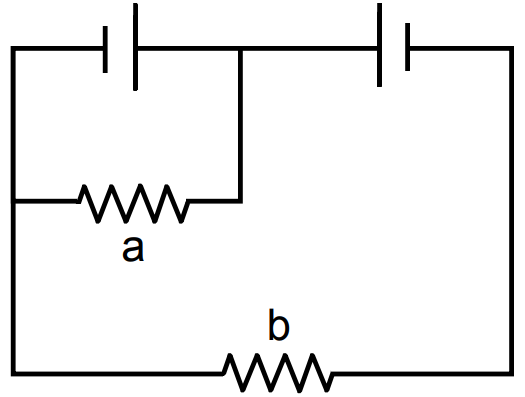
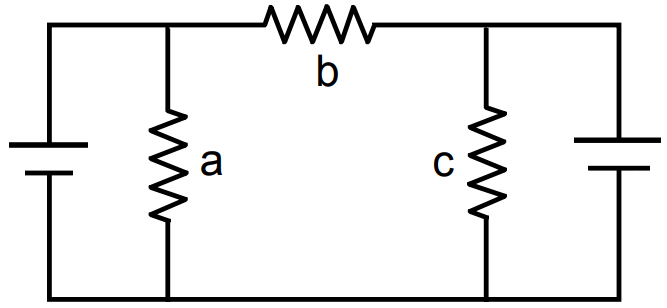
Each of the resistors shown in figure. has a resistance of $10\Omega$ and each of the batteries has an emf of 10V. Find the currents through the resistors a and b in the two circuits.

A charge is distributed uniformly over a ring of radius ‘a’. Obtain an expression for the electric intensity E at a point on the axis of the ring. Hence show that for point’s at large distances from the ring, it behaves like a point charge.
State and Prove Gauss theorem in electrostatics.
Two point charges of magnitude +q and -q are placed at $\Big(-\frac{\text{d}}{2},0,0\Big)$ and $\Big(\frac{\text{d}}{2},0,0\Big)$, respectively. Find the equation of the equipoential surface where the potential is zero.
The magnetic field inside a long solenoid having $50 turns/cm$ is increased from $2·5 \times 10.3T$ to $2.5T$ when an iron core of cross-sectional area $4\ cm^2$ is inserted into it. Find:
  1. The current in the solenoid.
  2. The magnetization I of the core.
  3. The pole strength developed in the core.
Explain the resolving power of an optical instrument. Write the formula for resolving power of telescope and microscope. Why is the resolving power of electron microscope more than that of optical microscope ?
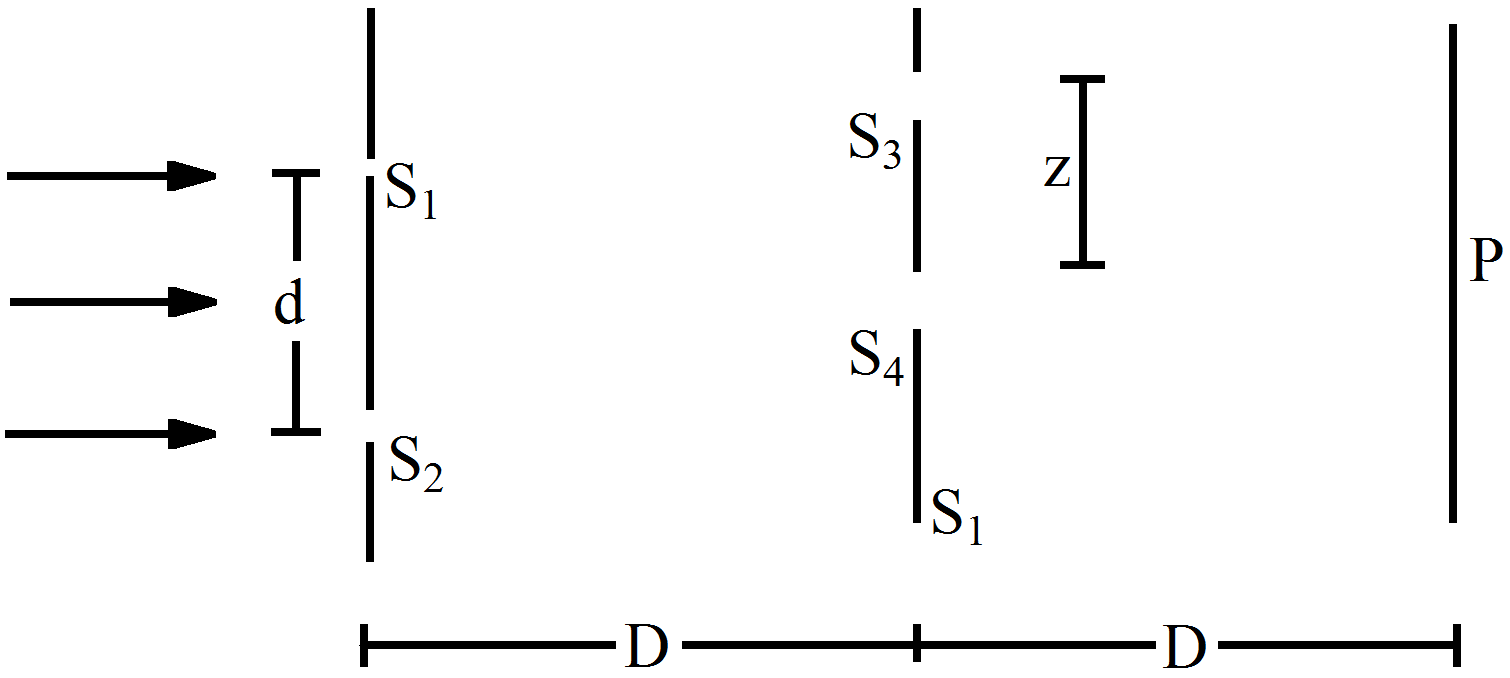
Consider the arrangement shown in figure. By some mechanism, the separation between the slits $S_3$ and $S_4$ can be changed. The intensity is measured at the point $P$ which is at the common perpendicular bisector

of $S_1S_2$ and $S_3S_4$. When $\text{z}=\frac{\text{D}\lambda}{2\text{d}},$ intensity measured at $P$ is I. Find this intensity when $z$ is equal to:
  1. $\frac{\text{D}\lambda}{\text{d}}$
  2. $\frac{3\text{D}\lambda}{2\text{d}}$
  3. $\frac{2\text{D}\lambda}{\text{d}}$
A hemispherical portion of the surface of a solid glass sphere $(\mu=1.5)$ of radius r is silvered to make the inner side reflecting. An object is placed on the axis of the hemisphere at a distance 3r from the centre of the sphere. The light from the object is refracted at the unsilvered part, then reflected from the silvered part and again refracted at the unsilvered part. Locate the final image formed.
Consider a non-conducting plate of radius r and mass m that has a charge q distributed uniformly over it. The plate is rotated about its axis with an angular speed $\omega.$ Show that the magnetic moment $\mu$ and the angular momentum of the plate are related as $\mu=\frac{\text{q}}{2\text{m}}\text{l}.$