MCQ
$\xrightarrow[{hv}]{{NBS}}$ Product ;
Which product will not likely to form
- A
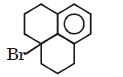
- ✓
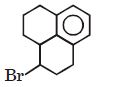
- C
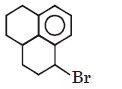
- D
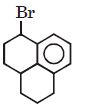
Which product will not likely to form
Generate a complete, print-ready paper with questions like this in minutes — across 16+ boards, with answer keys.
Compound $(X)$ $\xrightarrow[{Pt}]{{5{H_2}}}$
Compound $(X)$ $\xrightarrow{{AgN{O_3}}}$ Precipitate
Compound $(X)$ $\xrightarrow[{M{e_2}S}]{{{O_3}}}$ $\begin{array}{*{20}{c}}
{\,\,\,\,\,\,\,O\,\,\,\,\,\,\,\,\,\,\,\,\,\,\,\,\,\,\,\,\,\,\,\,\,\,\,\,\,\,\,\,\,\,\,\,\,\,\,\,\,\,\,O\,\,\,\,\,\,\,\,\,\,O\,\,\,\,} \\
{\,\,\,\,\,\,\,\,\,\,\,\,\,\,\,\,\,\,\,||\,\,\,\,\,\,\,\,\,\,\,\,\,\,\,\,\,\,\,\,\,\,\,\,\,\,\,\,\,\,\,\,\,\,\,\,\,\,\,\,\,\,\,\,\,||\,\,\,\,\,\,\,\,\,\,||\,\,\,\,\,\,\,\,\,\,\,\,\,\,\,\,\,\,} \\
{H - C - C{H_2} - C{H_2} - C - C - H}
\end{array}$ $\begin{array}{*{20}{c}}
{\,\,O\,\,\,\,\,\,O\,\,\,\,\,\,\,\,\,\,} \\
{||\,\,\,\,\,\,\,\,||\,\,\,\,\,\,\,\,\,} \\
{H - C - C - O - H}
\end{array}$ $ + \begin{array}{*{20}{c}}
{O\,\,\,\,\,\,\,} \\
{||\,\,\,\,\,\,\,\,} \\
{H - C - O - H}
\end{array}$ $ + \begin{array}{*{20}{c}}
{CHO} \\
{|\,\,\,\,\,\,\,\,} \\
{CHO}
\end{array}$
| LIST $I$ (Technique) | LIST $II$ (Application) |
| $A$. Distillation | $I$. Separation of glycerol from spent-lye |
| $B$. Fractional distillation | $II$Aniline - Water mixture |
| $C$. Steam distillation | $III$Separation of crude oil fractions |
| $D$. Distillation under reduced pressure | $IV$.ChloroformAniline |
Choose the correct answer from the options given below:
.......$ kJ/mole$
$\xrightarrow[\Delta ]{{{H^ \oplus }}}\,B$
The product $"B"$ is