$y = a\cos (kx + \omega t)$ superimposes on another wave giving a stationary wave having node at $x = 0.$ What is the equation of the other wave
Easy
Download our app for free and get started
(c) $a\cos (kx + \omega \,t)$
hence ${y_{{\rm{reflected}}}} = a\cos ( - kx + \omega \,t + \pi ) = - a\cos (kx - \omega \,t)$
hence ${y_{{\rm{reflected}}}} = a\cos ( - kx + \omega \,t + \pi ) = - a\cos (kx - \omega \,t)$

Download our appand get started for free
Experience the future of education. Simply download our apps or reach out to us for more information. Let's shape the future of learning together!No signup needed.*
Similar Questions
- 1The equation of displacement of two waves are given as ${y_1} = 10\sin \left( {3\pi t + \frac{\pi }{3}} \right)$; ${y_2} = 5(\sin 3\pi t + \sqrt 3 \cos 3\pi t)$. Then what is the ratio of their amplitudesView Solution
- 2A sinusoidal wave of frequency $500 \,Hz$ has a speed of $350 \,m / s$. The phase difference between two displacements at a certain point at times $1 \,m$ apart is ...........View Solution
- 3View SolutionA device used for investigating the vibration of a fixed string or wire is
- 4Two tuning forks of frequencies $256$ and $258$ vibrations/sec are sounded together, then time interval between consecutive maxima heard by the observer is ..... $sec$View Solution
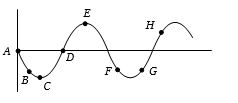
- 5View SolutionThe diagram below shows the propagation of a wave. Which points are in same phase
- 6Two whistles $A$ and $B$ each have a frequency of $500\,\,Hz$. $A$ is stationary and $B$ is moving towards the right (away from $A$) at a speed of $50\,\, m/s$. An observer is between the two whistles moving towards the right with a speed of $25\,\, m/s.$ The velocity of sound in air is $350 \,\,m/s$. Assume there is no wind. Then which of the following statements are true:View Solution
- 7A train moves towards a stationary observer with speed $34\, m/s$. The train sounds a whistle and its frequency registered by the observer is $f_1$. If the speed of the train is reduced to $17\, m/s$, the frequency registered is $f_2$. If speed of sound is $340\, m/s$, then the ratio $f_1/f_2$ isView Solution
- 8If the ratio of amplitude of wave is $2 : 1$, then the ratio of maximum and minimum intensity isView Solution
- 9Two sitar strings, $A$ and $B,$ playing the note $'Dha'$ are slightly out of tune and produce beats and frequency $5\,Hz.$ The tension of the string $B$ is slightly increased and the beat frequency is found to decrease by $3\,Hz$ . If the frequency of $A$ is $425\,Hz,$ the original frequency of $B$ is ... $Hz$View Solution
- 10Two whistles $A$ and $B$ produces notes of frequencies $660 Hz$ and $596 Hz$ respectively. There is a listener at the mid-point of the line joining them. Now the whistle $B$ and the listener start moving with speed $30 m/s$ away from the whistle $A.$ If speed of sound be $330 m/s,$ how many beats will be heard by the listenerView Solution