If the ratio of amplitude of wave is $2 : 1$, then the ratio of maximum and minimum intensity is
Medium


Download our appand get started for free
Experience the future of education. Simply download our apps or reach out to us for more information. Let's shape the future of learning together!No signup needed.*
Similar Questions
- 1A closed organ pipe $150 \mathrm{~cm}$ long gives $7$ beats per second with an open organ pipe of length $350 \mathrm{~cm}$, both vibrating in fundamental mode. The velocity of sound is_________ $\mathrm{m} / \mathrm{s}$.View Solution
- 2Two waves are represented by ${y_1} = a\sin \left( {\omega \,t + \frac{\pi }{6}} \right)$ and ${y_2} = a\cos \omega \,t$. What will be their resultant amplitudeView Solution
- 3The displacement of a particle is given by $y = 5 \times {10^{ - 4}}\sin (100t - 50x)$, where $x$ is in meter and $t$ in sec, find out the velocity of the wave .... $m/sec$View Solution
- 4A vibrating string of certain length $\ell$ under a tension $\mathrm{T}$ resonates with a mode corresponding to the first overtone (third harmonic) of an air column of length $75 \mathrm{~cm}$ inside a tube closed at one end. The string also generates $4$ beats per second when excited along with a tuning fork of frequency $\mathrm{n}$. Now when the tension of the string is slightly increased the number of beats reduces $2$ per second. Assuming the velocity of sound in air to be $340 \mathrm{~m} / \mathrm{s}$, the frequency $\mathrm{n}$ of the tuning fork in $\mathrm{Hz}$ isView Solution
- 5A transverse wave propagating along $x-$ axis is represented by $y (x,t)= 8.0 sin$ $\left( {0.5\pi x - 4\pi t - \frac{\pi }{4}} \right)$ where $x$ is in metres and $t$ is in seconds. The speed of the wave is ..... $m/s$View Solution
- 6A surface of area $S$ is placed perpendicular to the direction of travel of a plane wave. The energy per unit time intercepted by the surface is $E$ when the amplitude of the wave is $A$ . The area of the surface is reduced to $\frac{1}{2} \ S$ and the amplitude of the wave is increased to $2\ A$ . What is the energy per unit time intercepted by this smaller surface?View Solution
- 7A wire of density $9 \times 10^{-3} \,kg\, cm ^{-3}$ is stretched between two clamps $1\, m$ apart. The resulting strain in the wire is $4.9 \times 10^{-4}$. The lowest frequency of the transverse vibrations in the wire is......$HZ$View Solution
(Young's modulus of wire $Y =9 \times 10^{10}\, Nm ^{-2}$ ), (to the nearest integer),
- 8A train moving towards a hill at a speed of $72\ km/hr$ sounds a whistle of frequency $500\ Hz$ . A wind is blowing from the hill at a speed of $36\ km/hr$ . If the speed of sound in air is $340\ m/s$ , the frequency heard by a man on the hill (nearly) is ... $Hz$View Solution
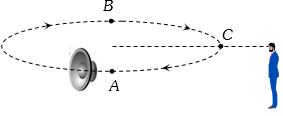
- 9A small source of sound moves on a circle as shown in the figure and an observer is standing on $O$. Let ${n_1},\;{n_2}$ and ${n_3}$be the frequencies heard when the source is at $A,\,B$ and $C$ respectively. ThenView Solution
- 10A man is standing on a railway platform listening to the whistle of an engine that passes the man at constant speed without stopping. If the engine passes the man at time ${t_0}$. How does the frequency $f$ of the whistle as heard by the man changes with timeView Solution