MCQ
$y = a\cos (kx + \omega t)$ superimposes on another wave giving a stationary wave having node at $x = 0.$ What is the equation of the other wave
  • A
    $ - a\cos (kx + \omega t)$
  • B
    $a\cos (kx - \omega t)$
  • $ - a\cos (kx - \omega t)$
  • D
    $ - a\sin (kx + \omega t)$

Answer

Correct option: C.
$ - a\cos (kx - \omega t)$
c
(c) $a\cos (kx + \omega \,t)$
hence ${y_{{\rm{reflected}}}} = a\cos ( - kx + \omega \,t + \pi ) = - a\cos (kx - \omega \,t)$

Need a full question paper?

Generate a complete, print-ready paper with questions like this in minutes — across 16+ boards, with answer keys.

Start Generating Free

Similar questions

When $1\, N$ force acts on $1 \,kg$ body that is able to move freely, the body receives
Suppose the law of gravitational attraction suddenly changes and becomes an inverse cube law i.e. $F \propto {1\over r^3}$, but still remaining a central force. Then
During a nuclear fission reaction:
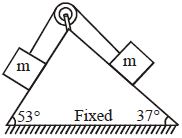
Two blocks which are connected to each other by means of a massless string are placed  on two inclined planes as shown in figure. After releasing from rest, the magnitude of  acceleration of the centre of mass of both the blocks is $(g = 10\, m/s^2)$
$A$ man of mass $M$ stands at one end of a plank of length $L$ which lies at rest on a frictionless surface. The man walks to other end of the plank. If the mass of the plank is $\frac{M}{3}$ , then the distance that the man moves  relative to ground is :
The potential energy of a particle executing S.H.M. is $ 2.5\, J$, when its displacement is half of amplitude. The total energy of the particle be .... $J$
The tones that are separated by three octaves have a frequency ratio of
A uniform rope of mass $6\,kg$ hangs vertically from a rigid support. A block of mass $2\,kg$ is attached to the free end of the rope. A transverse pulse of wavelength $0.06\,m$ is produced at the lower end of the rope. The wavelength of the pulse when it reaches the top is (in $m$ )
A block is attached to a spring as shown and very-very gradually lowered so that finally  spring expands by $"d"$. If same block is attached to spring & released suddenly then maximum expansion in spring will be-
A container holds $10^{26} molecules/m^3$ each of mass $3 \times 10^{-27}\,\,kg$. Assume that $1/6$ of the molecules move with velocity $2000 \,\,m/s$ directly towards one wall of the container while the remaining $5/6$ of the molecules move either away from the wall or in perpendicular direction, and all collisions of the molecules with the wall are elastic