Question
You are given the following current- time graphs from two different sources:
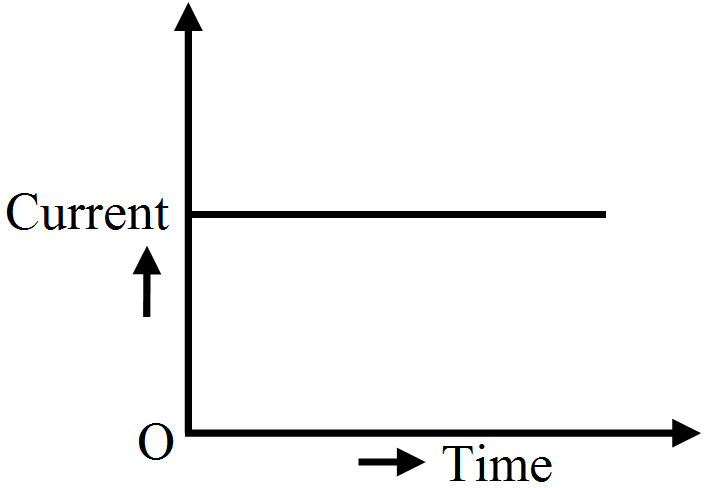
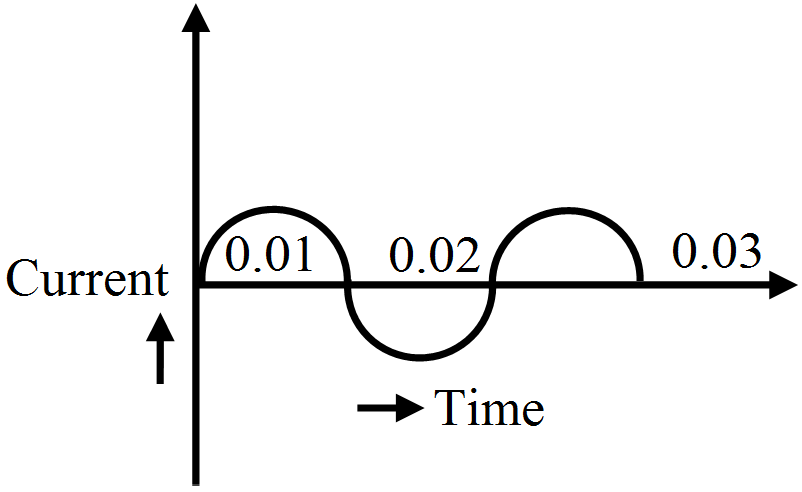
Now, answer the following questions:
  1. Name the type of current in two cases.
  2. Identify any one source for each type of these currents.
  3. What is the frequency of current in case (b) in India?
Use above graphs to write two differences between the current in two cases.

Answer

In graph (a) current is constant and in graph (b) current is different.
  1. Source of (a) is battery and source of (b) is AC generator.
  2. 50Hz frequency of current in case b.
  3. Alternating current Direct current
    1.
    Both the magnitude and direction of current varies within equal intervals of time.
    Direction of current does not vary with time and remains constant.
    2.
    The frequency of ac is 50Hz or 60Hz depending upon the country.
    The frequency for direct current is zero.

Need a full question paper?

Generate a complete, print-ready paper with questions like this in minutes — across 16+ boards, with answer keys.

Start Generating Free

Similar questions

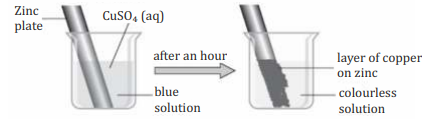
Reena immersed a zinc plate in an aqueous solution of copper sulphate.
She noticed a thick layer of copper on the surface of the zinc plate after an hour.

Image
3. What is the formula of the colourless solution formed after the reaction?
A. Zn
B. Cu
C. ZnSO₄
D. CuSO₄
4. What should Reena have done to make the reaction faster?
A. Use a thicker zinc plate
B. Use pieces of small zinc lakes
C. Use a copper vessel for the reaction
D. Use copper sulphate solution of higher concentration
5. No reaction takes place when a copper plate is immersed in an aqueous solution of zinc sulphate.
Explain the reason behind this.
6. What makes gold exist in free state in nature?
7. 2Al + 3H₂O Al₂O₃+ X
What is X in the reaction?
A. Al
B. H₂
C. O₃
D. AlH₃
8. Which of these is a property of an ionic compound?
Circle ‘Yes’ or ‘No’ to the correct response.

Is this a property of an ionic compound?

Yes or No

It is insoluble in water.

Yes/No

It has a high melting point.

Yes/No

It contains atoms of metal and non-metal.

Yes/No

During respiration in an organism A, one molecule of glucose produces 2 ATP molecules whereas in respiration of another organism B, one molecule of glucose produces 38 ATP molecules.
i. Which organism is undergoing aerobic respiration?
ii. Which organism is undergoing anaerobic respiration?
iii. Which type of organism A or B can convert glucose into alcohol?
iv. Name one organism which behaves like A.
v. Name one organism which behaves like B.

Reproduction in human beings is by sexual reproduction where both the male and female gametes fertilise to give rise to an embryo. The fertilization of the human embryo occurs inside the body of the female.

(i) Name the part of the male reproductive system where the formation of sperms takes place.
(ii) What is the placenta?
(iii) What is the other name of the oviduct?
(iv) Define the term implantation.
The table given below shows the hints given by the quiz master in a quiz.
S.NO HINT
(i) Substance 'C' is used as a preservative.
(ii) 'C' has two carbon atoms; 'C' is obtained by the reaction of 'A' in presence of alkaline Potassium permanganate followed by acidification.
(iii) Misuse of 'A' in industries is prevented by adding Methanol, Benzene, and pyridine to 'A'.
(iv) 'F' is formed on heating 'A' in presence of conc Sulphuric acid.
(v) 'F' reacts with Hydrogen gas in presence of Nickel and Palladium catalyst.
Based on the above hints answer the following questions
a) Give the IUPAC names of $A$ and $F$
b) Illustrate with the help of chemical equations the changes taking place. ( $A \rightarrow C$ and $A \rightarrow F$ )
OR
Name the chemical reactions which occur in steps 2 and 5 . Identify the compounds formed in these steps if ' $A$ ' is replaced with its next homologue.
Nutrition is the process of taking food by an organism and the utilization of food for energy. This is a vital process that helps living beings obtain their energy from various sources.Nutrients are substances that provide nutrition.
The mode of nutrition varies from one species to another. Plants do photosynthesis to prepare their own food. Animals depend on plants for food.
Image
i. What do you understand by nutrition?
ii. Mention how organisms like bread moulds and mushrooms obtain their food.
iii. What do you understand by autotrophic nutrition?
OR
What is common for Cuscuta, ticks, and leeches?
Read the following and answer any three questions from (i) to (iv).The electrical energy consumed by an electrical appliance is given by the product of its power rating and the time for which it is used. The SI unit of electrical energy is Joule. Actually, Joule represents a very small quantity of energy, and therefore it is inconvenient to use where a large quantity of energy is involved. So for commercial purposes we use a bigger unit of electrical energy which is called kilowatt-hour. 1 kilowatt-hour is equal to $3.6 × 10^6$ joules of electrical energy.
  1. The energy dissipated by the heater is E. When the time of operating the heater is doubled, the energy dissipated will?
     
  2. The power of a lamp is 60W. The energy consumed in 1 minute will?
     
  3. The electrical refrigerator rated 400W operates 8 hours a day. The cost of electrical energy is ₹ 5 per kWh. Find the cost of running the refrigerator for one day?
    OR
  4. Calculate the energy transformed by a 5A current flowing through a resistor of $2\Omega$ for 30 minutes?
Read the following and answer any three questions from (i) to (iv).All the elements on the left side and in the middle of the periodic table (except hydrogen) are metallic elements or metals. Also, majority of elements in periodic table are metals. ln the modern periodic table, the metals are separated from non-metals by a zig-zag line. Some non-metals are gases, some are liquids and rest are solids at room temperature. They generally differ from metals in appearance and in other physical properties. Some elements, that lie along the zig-zag line that separates metals from non-metals, have properties that fall between those of metals and non-metals. These elements are regarded as semi-metals or metalloids.
  1. Define metals and non -metals?
     
  2. state the groups contains metals, non-metals and metalloids?
     
  3. what is a metalloids? give example.

    OR
  4. A) Why Silicon is a metalloids?

    B) Which is the lightest metal?
Copper sulphate crystal contains water of crystallisation when the crystal is heated the water is removed and salt turns white. The crystal can be moistened again with water. The water of crystallisation is the fixed number of water molecules present in 1 formula unit of copper sulphate. On heating gypsum at 373K, it loses water molecules and became calcium sulphate hemihydrate.
Image
(a) If the crystal is moistened with water, then which colour of the crystal reappears?
(b) What is the commercial name of calcium sulphate hemihydrate?
OR
How many water molecules are present in one formula unit of copper sulphate?
A scale for measuring hydronium ion in a solution is called the pH scale. The pH of a neutral solution is 7. A value of less than 7 on the pH scale represents an acidic solution. As the pH value, increases from 7 to 14 it represents OH- ion concentration in solution i.e a basic solution.
Image

(a) What is the pH range of the Human Body?
(b) The strength of acid and bases depends on which factor?

OR

If the pH of soil X is 7.5 while that of soil Y is 4.5, then which soil should be treated with powdered chalk to adjust its pH?
You must have noticed many dramatic changes in your appearance as well as that of your friends as you approached 10-12 years of age. These changes associated with puberty are because of the secretion of testosterone in males and oestrogen in females. Do you know anyone in your family or friends who has been advised by the doctor to take less sugar in their diet because they are suffering from diabetes? As a treatment, they might be taking injections of insulin. This is a hormone that is produced by the pancreas.
(a) Why is pancreas a dual gland?
(b) Name the hormone which is secreted by males and females during adolescence.
(c) What happens if Insulin is not secreted in the proper amount?
OR
From which cells of pancreatic islets insulin and glucagon hormone are secreted?