Question 14 Marks
Read the following and answer any three questions from (i) to (iv).
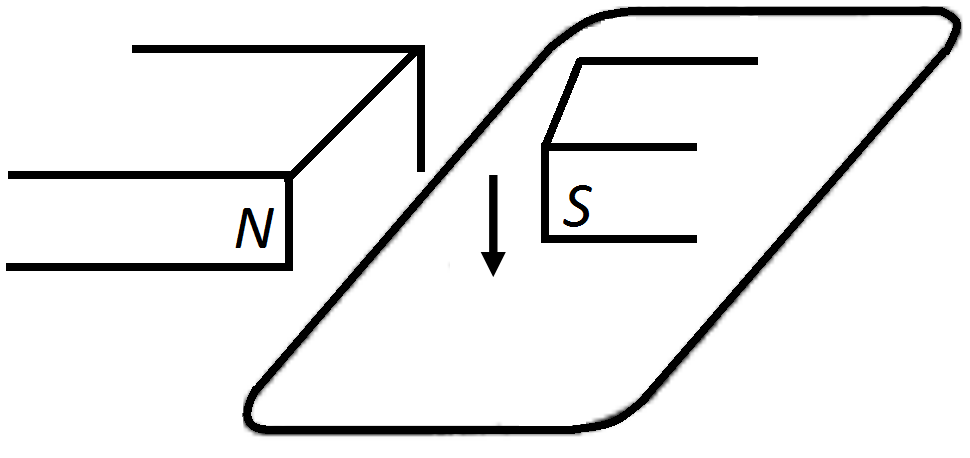
Andre Marie Ampere suggested that a magnet must exert an equal and opposite force on a current carrying conductor, which was experimentally found to be true. But we know that current is due to charges in motion. Thus, it is clear that a charge moving in a magnetic field experience a force, except when it is moving in a direction parallel to it. If the direction of motion is perpendicular to the direction of magnetic field, the magnitude of force experienced depends on the charge, velocity (v), strength of magnetic field (B), and sine of the angle between v and B. Direction of magnetic force is given by Fleming's left-hand rule.
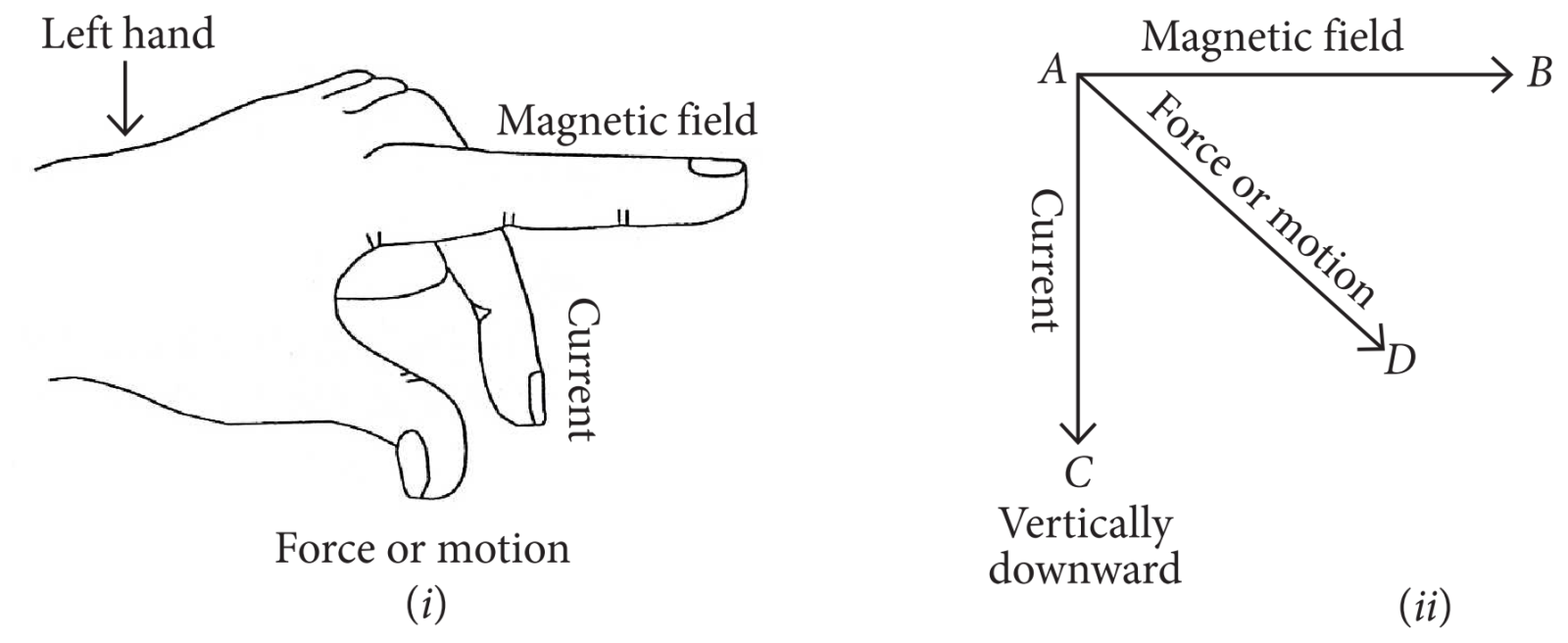
- If an electron is travelling horizontally towards east. A magnetic field in vertically downward direction exerts a force on the electron along which side?
- If a charged particle is moving along a magnetic field line. The magnetic force on the particle will?
- a) A magnetic field exerts no force on?
b) what Andre Marie Ampere suggested?
- What is fleming's left hand rule?
Answer
Fleming's left-hand rule is used to determine the direction of force on electron i.e., in south direction.
The angle between velocity and magnetic field is zero. Therefore, magnetic force on the particle is zero.
As the direction of current is taken opposite to the direction of motion of electrons, therefore, current from the motion of electron and proton is n the same direction, i.e., from bottom to top. Now, according to Fleming's left-hand rule, the electron and the proton experience forces both pointing into the plane of paper.
View full question & answer→- (d) South.
Fleming's left-hand rule is used to determine the direction of force on electron i.e., in south direction.
- (d) Zero.
The angle between velocity and magnetic field is zero. Therefore, magnetic force on the particle is zero.
- (a) A stationary electric charge.
- (a) Forces both pointing into the plane of paper.
As the direction of current is taken opposite to the direction of motion of electrons, therefore, current from the motion of electron and proton is n the same direction, i.e., from bottom to top. Now, according to Fleming's left-hand rule, the electron and the proton experience forces both pointing into the plane of paper.
- (c) Into the page.
 Now, answer the following questions: