Question
You are provided with two separate colorless solutions. Solution A is suspected to contain either silver (Ag+) or copper(II) (Cu2+) ions, Solution B is suspected to contain either sulfate (SO42-) or carbonate (CO32-) ions.
Design a step-by-step procedure to identify the ions present in both solutions, detailing the reagents you would use, the observations you would expect, and the chemical equations for the reactions involved.
Answer

Solution A: Test for Silver (Ag+) ions
Reagent: Add a few drops of dilute hydrochloric acid (HCl) to Solution A.Observation: Formation of a white precipitate indicates the presence of silver ions.
Test for Copper(II) (Cu2+) ions
Reagent: If no precipitate forms with HCl2 add a few drops of sodium hydroxide (NaOH) to Solution A. Observation: Formation of a blue precipitate indicates the presence of copper(II) ions.
Solution B: Test for Sulphate (SO42-) ions
Reagent: Add a few drops of barium chloride (BaCl2) to Solution B.Observation: Formation of a white precipitate indicates the presence of sulfate ions.
Test for Carbonate (CO32-) ions:
Reagent: If no precipitate forms with BaCl2, add a few drops of dilute hydrochloric acid (HCl) to Solution B.Observation: Effervescence (bubbling) due to the release of carbon dioxide gas indicates the presence of carbonate ions. You can confirm by passing the gas through limewater, which will turn milky.
• Summary:
Solution A: Test with HCl and NaOH to identify Ag+ or Cu2+,
Solution B: Test with BaCl2 and HCl to identify SO42- or CO32-.

Need a full question paper?

Generate a complete, print-ready paper with questions like this in minutes — across 16+ boards, with answer keys.

Start Generating Free

Similar questions

The usefulness of a fertilizer depends upon percentage of nitrogen present in it. Find which of the following is a better fertilizer:
$(a)$ Ammonium nitrate $[NH_4NO_3]$
$(b)$ Ammonium phosphate $[(NH_4)_3PO_4(N=14,H=1,O=16,P=31)]$
How will you prepare hydrochloric acid in laboratory? OR
Describe briefly the method employed to dissolve hydrogen chloride gas in water as it is prepared. What is the purpose of funnel while preparing hydrochloric acid from HCI gas?
How is aluminium obtained from pure ore?
A compound contains $87.5\%$ by mass of nitrogen and $12.5\%$ by mass of hydrogen. Determine the empirical formula of this compound.
The following experiment was performed in order to determine the formula of a hydrocarbon. The hydrocarbon $X$ is purified by fractional distillation.
$0.145 g$ of $X$ was heated with dry copper (II) oxide and $224 cm ^3$ of carbon dioxide was collected at S.T.P.
(a) Which elements does X contain?
(b) What was the purpose of copper (II) oxide?
(c ) Calculate the empirical formula of $X$ by the following steps:
(i) Calculate the number of moles of carbon dioxide gas.
(ii) Calculate the mass of carbon contained in this quantity of carbon dioxide and thus the mass of carbon in sample $X$.
(iii) Calculate the mass of hydrogen in sample X.
(iv) Deduce the ratio of atoms of each element in $X$ (empirical formula).
Name the substance used for drying ammonia gas? Why cannot substances such as conc.$H_2SO_4$​​​​​​​, anhydrous calcium chloride and phosphorus pentoxide be used for drying ammonia gas?
A gaseous compound of nitrogen and hydrogen contains $12.5\%$ hydrogen by mass. Find the molecular formula of the compound if its relative molecular mass is $37.$
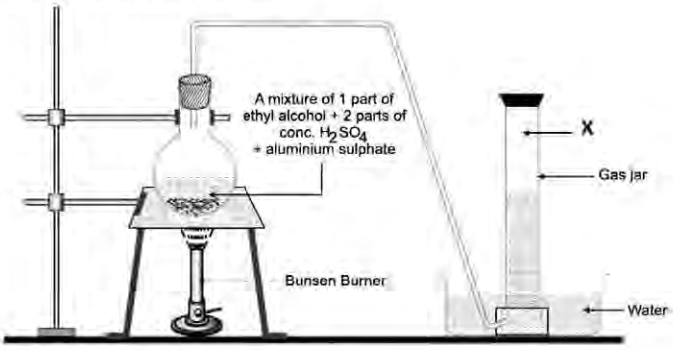
Look at the set-up of given apparatus carefully.
Image
(i) Identify 'X'.
(ii) Name the process of collection of 'X'. Justify.
(iii) Write the chemical equations involved.
(iv) What is the role of sulphuric acid in the above process?
How would you prepare :
zinc sulphate crystals from zinc dust (powdered zinc and zinc oxide).
A gaseous hydrocarbon contains $82.76\%$ of carbon. Given that its vapour density is $29$, find its molecular formula.