Question
How is aluminium obtained from pure ore?
Answer

Aluminium is obtained from pure ore by Hall - Heroults process as follows:
i. Electrolyte used :
a. Pure alumina
b. Cryolite
c. Aluminium fluoride
d. Calcium fluoride or Fluorspar
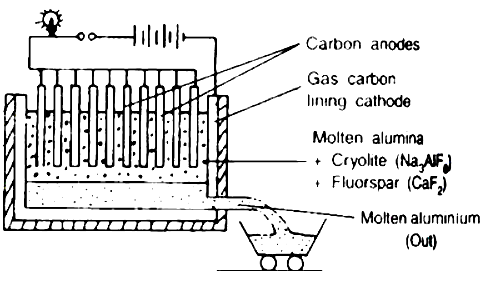
ii . Electrolytic cell : It is a rectangular steel tank with a thick inner lining of carbon .
iii . Electrodes used :
a. Cathode: inner lining of carbon
b. Anode: Thick carbon rods dipping into the fused electrolytes.
Reactions: On passage of electricity through electrolyte aluminium and oxide ions are formed.
At cathode: Aluminium ions get reduced as:
$Al^{3+} + 3e^- → Al$​​​​​​​
At anode: oxygen gas is liberated as:
$O^{2-} - 2e^- → [ O ]$
$[ O ] + [ O ] → O_2$​​​​​​​
The oxygen formed at anode oxidizes the carbon of the anode to carbon dioxide.
$C + O_2 → CO_2​​​​​​​$​​​​​​​
As a result the anode gets oxidized and it has to be replaced periodically.

Figure: Extraction of aluminium from pure ore.

Need a full question paper?

Generate a complete, print-ready paper with questions like this in minutes — across 16+ boards, with answer keys.
Start Generating Free

Similar questions

How does Avogadro's law explain Gay $-$ lussac's law of combining volumes?
Name the method used for preparation of the following salts from the list given below:
(i) Sodium nitrate
(ii) Iron (III) chloride
(iii) Lead chloride
(iv) Zinc sulphate
(v) Sodium hydrogen sulphate
List :
(a) Simple displacement
(b) Neutralization
(c) Decomposition by acid
(d) Double decomposition
(e) Direct synthesis
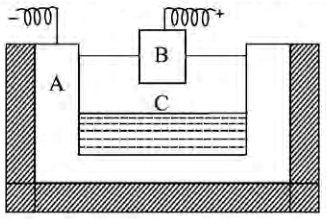
The following is a sketch of an electrolytic cell used in the extraction of aluminium:
Image
(i) What is the substance of which the electrodes A and B are made?
(ii) At which electrode (A or B) is aluminium formed?
(iii) What are the two aluminium compounds in the electrolyte C?
(iv) Why is it necessary for electrode B to be continuously replaced?
State your observations when ammonium hydroxide solution is added drop by drop and then in excess to each of the following solutions :
1) Copper sulphate solution
2) Zinc sulfate solution.
You are given three white powders-calcium carbonate, lead carbonate and zinc carbonate. Describe the tests you would carry out in solution, to identify the metal ion in each of the above compounds. Indicate clearly how you would prepare the solutions for the tests.
Choosing only substances from the list given in the box below, write equations for the reactions which you would use in the laboratory to obtain:
(i) Sodium sulphate
(ii) Copper sulphate
(iii) Iron (II) sulphate
(iv) Zinc carbonate
Dilute sulphuric acidCopper, Iron,
Sodium, Zinc
Copper carbonate,
Sodium carbonate
Look at the given picture carefully and answer the related questions:
Image
(i) Which step of metallurgy is performed by this method?
(ii) Give two examples of ores related to this method.
(iii) Write the property of ore and the principle of this process.
(iv) Name two other processes that come under the step of metallurgy in (i).
What are the products obtained by heating ethane in:
(a) Excess of air
(b) Absence of air
(c) Air in presence of copper and 120atm pressure
(d) Air with molybdenum oxide at 100 atm pressure.
(a) Copy and complete the following table which refers to two practical applications of electrolysis
  Anode Electrolyte Cathode
Silver plating of a spoon   A solution of potassium argentocyanide  
Purification of copper      
(iii) Extraction of sodium      
(b) Write the equation taking place at the anode for Q. 2(a).
A compound X when treated with an organic acid Y (having vinegar-like smell) in the presence of the acid Z, forms a compound P which has a fruity smell.
(a) Identify X, Y, and Z
(b) Write the structural formula of X and Y.
(c) What type of compound P is?
(d)Name the above reaction.
(e) If compound X and Y both have 2 carbon atoms. Write the reaction.