Questions · Page 3 of 3

3 Marks Question

Question 1023 Marks
Answer

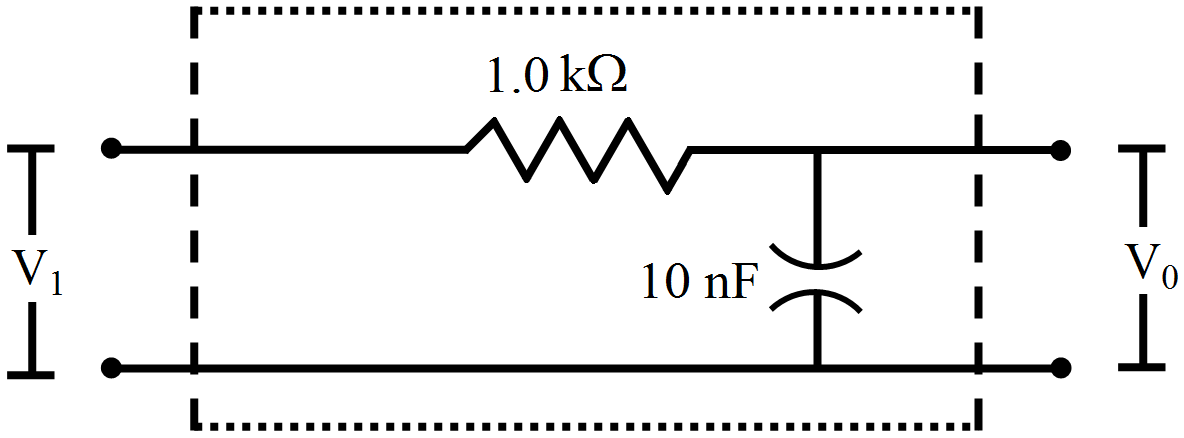
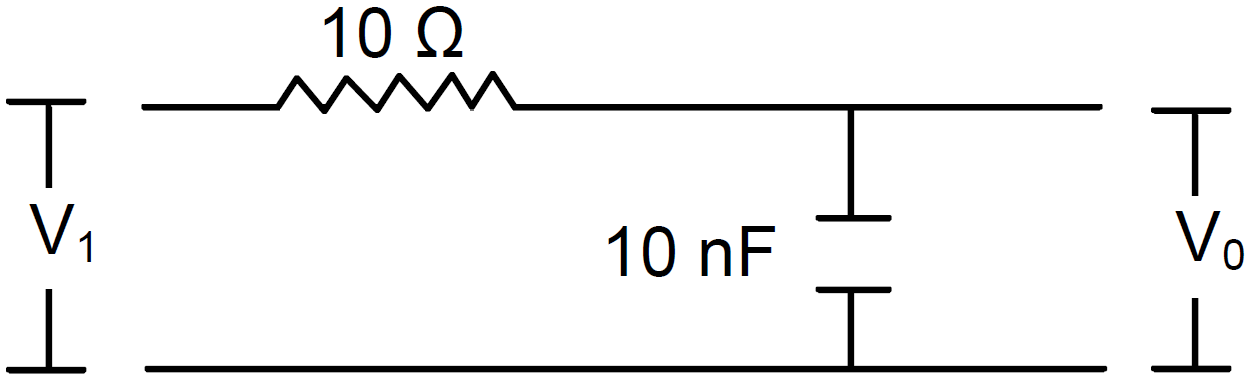
$\text{V}_1=10\times10^{-3}\text{V}$

$\text{R}=1\times10^3\Omega$

$\text{C}=10\times10^{-9}\text{F}$

  1. $\text{X}_\text{C}=\frac{1}{\omega\text{C}}=\frac{1}{2\pi\text{fC}}$

$=\frac{1}{2\pi\times10\times10^3\times10\times10^{-9}}$

$=\frac{1}{2\pi\times10^{-4}}$

$=\frac{10^4}{2\pi}=\frac{5000}{\pi}$

$\text{Z}=\sqrt{\text{R}^2+\text{X}_\text{C}{^2}}$

$=\sqrt{\big(1\times10^3\big)^2+\Big(\frac{5000}{\pi}\Big)^2}$

$=\sqrt{10^6+\Big(\frac{5000}{\pi}\Big)^2}$

$\text{I}_0=\frac{\text{E}_0}{\text{Z}}=\frac{\text{V}_1}{\text{Z}}$

$=\frac{10\times10^{-3}}{\sqrt{10^6+\Big(\frac{5000}{\pi}\Big)^2}}$

  1. $\text{X}_\text{C}=\frac{1}{\omega\text{C}}=\frac{1}{2\pi\text{fC}}$

$=\frac{1}{2\pi\times10^5\times10\times10^{-9}}$

$=\frac{1}{2\pi\times10^{-3}}=\frac{10^3}{2\pi}=\frac{500}{\pi}$

$\text{Z}=\sqrt{\text{R}^2+\text{X}_\text{C}{^2}}$

$=\sqrt{\big(10^3\big)^{2}+\Big(\frac{500}{\pi}\Big)^2}$

$=\sqrt{10^6+\Big(\frac{500}{\pi}\Big)^2}$

$\text{I}_0=\frac{\text{E}_0}{\text{Z}}=\frac{\text{V}_1}{\text{Z}}$

$=\frac{10\times10^{-3}}{\sqrt{10^6+\Big(\frac{500}{\pi}\Big)^2}}$

$\text{V}_0=\text{I}_0\text{X}_\text{C}=\frac{10\times10^{-3}}{\sqrt{10^6+\Big(\frac{500}{\pi}\Big)^2}}\times\frac{500}{\pi}$

$=1.6124\text{V}\approx1.6\text{mV}$

  1. $\text{f}=1\text{MHz}=10^6\text{Hz}$

$\text{X}_\text{C}=\frac{1}{\omega\text{C}}=\frac{1}{2\pi\text{fC}}$

$=\frac{1}{2\pi\times10^6\times10\times10^{-9}}$

$=\frac{1}{2\pi\times10^{-2}}=\frac{10^2}{2\pi}=\frac{50}{\pi}$

$\text{Z}=\sqrt{\text{R}^2+\text{X}_\text{C}{^2}}$

$=\sqrt{\big(10^3\big)^{2}+\Big(\frac{50}{\pi}\Big)^2}$

$=\sqrt{10^6+\Big(\frac{50}{\pi}\Big)^2}$

$\text{I}_0=\frac{\text{E}_0}{\text{Z}}=\frac{\text{V}_1}{\text{Z}}$

$=\frac{10\times10^{-3}}{\sqrt{10^6+\Big(\frac{50}{\pi}\Big)^2}}$

$\text{V}_0=\text{I}_0\text{X}_\text{C}=\frac{10\times10^{-3}}{\sqrt{10^6+\Big(\frac{50}{\pi}\Big)^2}}\times\frac{50}{\pi}$

$\approx1.16\mu\text{V}$

  1. $\text{f}=10\text{MHz}=10^7\text{Hz}$

$\text{X}_\text{C}=\frac{1}{\omega\text{C}}=\frac{1}{2\pi\text{fC}}$

$=\frac{1}{2\pi\times10^7\times10\times10^{-9}}$

$=\frac{1}{2\pi\times10^{-1}}=\frac{10}{2\pi}=\frac{5}{\pi}$

$\text{Z}=\sqrt{\text{R}^2+\text{X}_\text{C}{^2}}$

$=\sqrt{\big(10^3\big)^{2}+\Big(\frac{5}{\pi}\Big)^2}$

$=\sqrt{10^6+\Big(\frac{5}{\pi}\Big)^2}$

$\text{I}_0=\frac{\text{E}_0}{\text{Z}}=\frac{\text{V}_1}{\text{Z}}$

$=\frac{10\times10^{-3}}{\sqrt{10^6+\Big(\frac{5}{\pi}\Big)^2}}$

$\text{V}_0=\text{I}_0\text{X}_\text{C}=\frac{10\times10^{-3}}{\sqrt{10^6+\Big(\frac{5}{\pi}\Big)^2}}\times\frac{5}{\pi}$

$\approx16\mu\text{V}$
View full question & answer
Question 1033 Marks
Prove that the power dissipated in an ideal resistor connected to an ac source is $\frac{\text{V}^2_{\text{eff}}}{\text{R}}.$
Answer
Power in ac circuit, P $=\text{V}_{\text{rms}}\text{i}_{\text{rms}}\cos\varphi$
As rms values of current and voltage are also caled effective values i.e.
$\text{P = V}_{\text{eff}}\text{I}_{\text{eff}}\cos\varphi \ ...(\text{i})$
But $\cos\varphi=\text{power factor}=\frac{\text{R}}{\text{Z}}$
In a purely resistive circuit Z $=\text{R},\cos\varphi=1$
and $\text{i}_{\text{eff}}=\frac{\text{V}_{\text{eff}}}{\text{Z}}=\frac{\text{V}_{\text{eff}}}{\text{R}}$
Substituting these value in (i), we get
$\text{P}=\text{V}_{\text{eff}}.\frac{\text{V}_{\text{eff}}}{\text{R}}\times1=\frac{\text{V}^2_{\text{eff}}}{\text{R}}$
View full question & answer
Question 1043 Marks
An electric bulb is designed to operate at 12 volts DC. If this bulb is connected to an AC source and gives normal brightness, what would be the peak voltage of the source?
Answer
$\text{E}=12\text{volt}$
$\text{i}^2\text{Rt}=\text{i}^2_\text{rms}\text{RT}$
$\Rightarrow\ \frac{\text{E}^2}{\text{R}^2}=\frac{\text{E}^2_\text{rms}}{\text{R}^2}$
$\Rightarrow\ \text{E}^2=\frac{\text{E}_0^2}{2}$
$\Rightarrow\ \text{E}_0{^2}=2\text{E}^2$
$\Rightarrow\ \text{E}_0{^2}=2\times12^2=2\times144$
$\Rightarrow \text{E}_0=\sqrt{2\times144}=16.97\approx17\text{V}$
View full question & answer
Question 1053 Marks
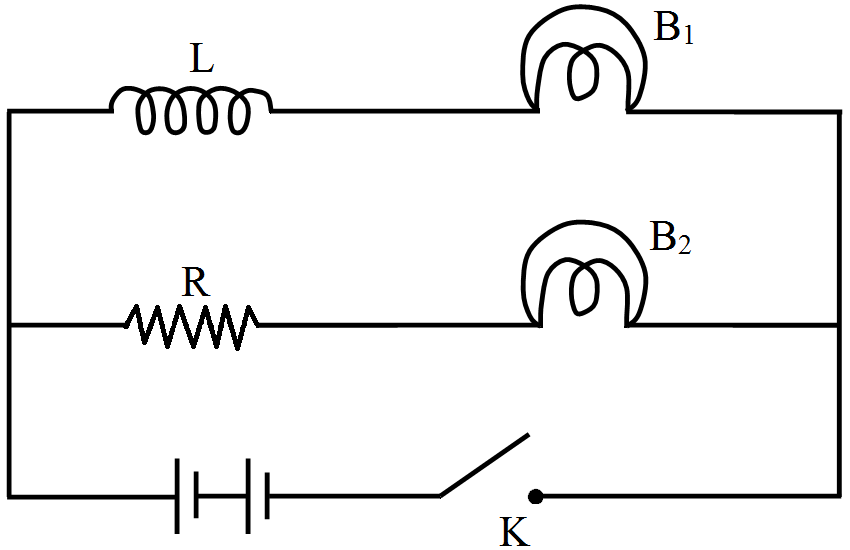
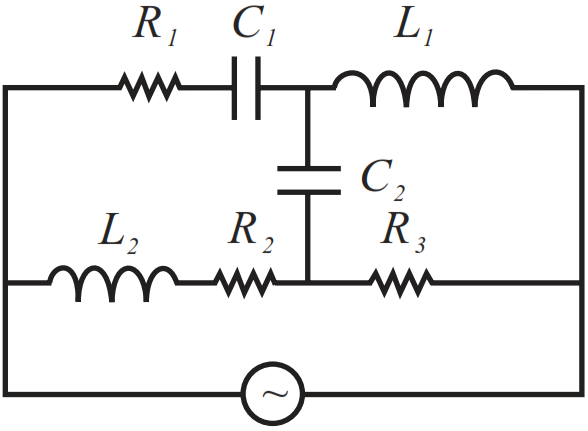
In the given circuit, the value of resistance effect of the coil L is exactly equal to the resistance R. Bulbs B1 and B2 are exactly identical.

Answer the following questions based on above information:

  1. Which one of the two bulbs lights up earlier, when key K is closed and why?
  2. What will be the comparative brightness of the two bulbs after sometime if the key K is kept closed and why?
Answer
  1. Bulb B2 lights up earlier. The self-induction effect due to coil L in bulb B1 arm does not allow the current to attain maximum value immediately on closing the circuit.
  2. Since the resistance effect of the coil L is equal to R and the self-induction effect in coil L will disappear after sometime, the current in both the arms will be equal. Hence, both the bulbs will glow with equal brightness after sometime.
View full question & answer
Question 1063 Marks
Calculate the following:

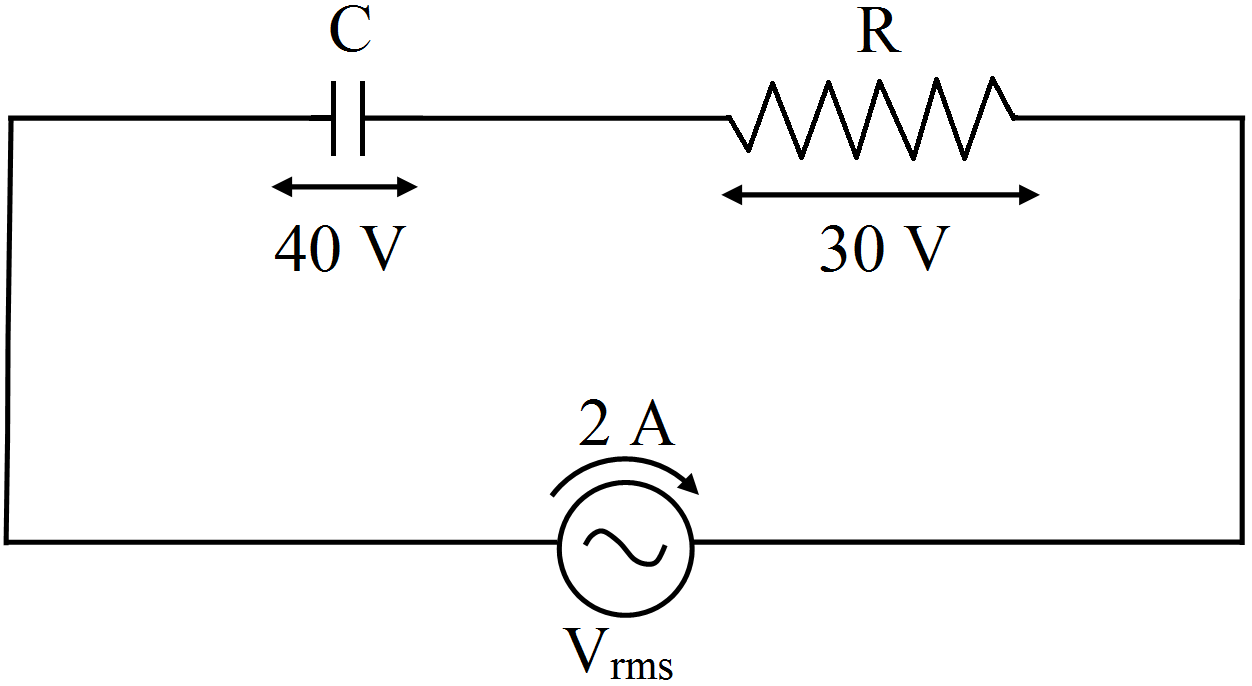
  1. Impedance of the given ac circuit.
  2. Wattless current of the given ac circuit.
Answer
  1. Potential difference across capacitance, VC = XI

$\therefore$ Capacitive reactance,

$\text{X}_{\text{C}}=\frac{\text{V}_{\text{C}}}{\text{I}}=\frac{40}{2}=20\Omega$

Resistance, $\text{R}=\frac{\text{V}_{\text{R}}}{\text{I}}=\frac{30}{2}=15\Omega$

Impedance, $\text{Z}=\sqrt{\text{R}^2+\text{X}^2_{\text{C}}}=\sqrt{(15)^2+(20)^2}$

$=\sqrt{225+400}=\sqrt{625}\Omega=25\Omega$

  1.  

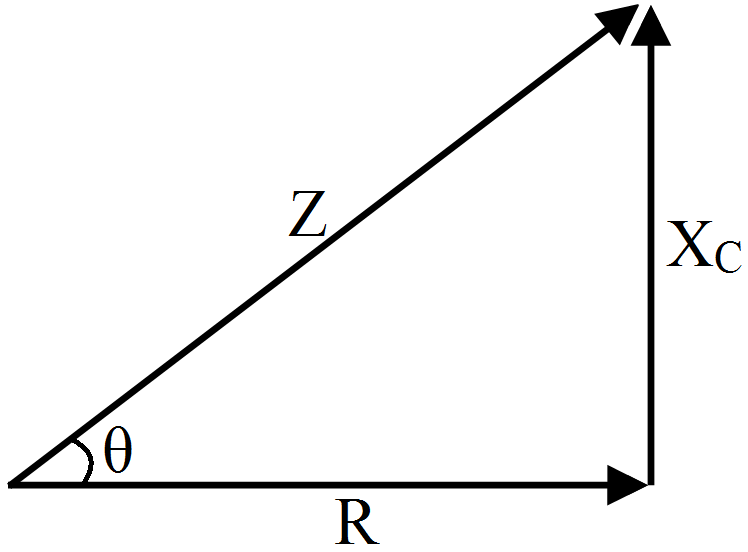
The phase lead $(\varphi)$ of current over applied voltage is

$\varphi=\frac{\text{X}_{\text{C}}}{\text{R}}$

Wattless Current, $\text{I}_{\text{wattless}}=\text{I}\sin\varphi=\text{I}\Big(\frac{\text{X}_{\text{C}}}{\text{Z}}\Big)$

$=2\times\frac{20}{25}\text{A}=1.6\text{A}$

View full question & answer
Question 1073 Marks
A coil of inductance 5.0mH and negligible resistance is connected to the oscillator of the previous problem. Find the peak currents in the circuit for $\omega=100\text{s}^{-1},500\text{s}^{-1},1000\text{s}^{-1}.$
Answer
Inductance $=5.0\text{mH}=0.005\text{H}$

  1. $\omega=100\text{s}^{-1}$

$\text{X}_\text{L}=\omega\text{L}$

$=100\times\frac{5}{1000}=0.5\Omega$

$=\text{i}=\frac{\in_0}{\text{X}_\text{L}}=\frac{10}{0.5}=20\text{A}$

  1. $\omega=500\text{s}^{-1}$

$\text{X}_\text{L}=\omega\text{L}$

$=500\times\frac{5}{1000}=2.5\Omega$

$=\text{i}=\frac{\in_0}{\text{X}_\text{L}}=\frac{10}{2.5}=4\text{A}$

  1. $\omega=1000\text{s}^{-1}$

$\text{X}_\text{L}=\omega\text{L}$

$=1000\times\frac{5}{1000}=5\Omega$

$=\text{i}=\frac{\in_0}{\text{X}_\text{L}}=\frac{10}{5}=2\text{A}$

View full question & answer
Question 1083 Marks
The instantaneous current in an ac circuit is $\text{i}=0.5\sin314\text{t},$ what is (i) rms value and (ii) frequency of the current.
Answer
Given $\text{I}=0.5\sin314\text{t} \ ...(\text{i})$
Standard equation of current is $\text{I = I}_0\sin\omega\text{t} \ ...(\text{ii})$
Comparing (i) and (ii), we get $\text{I}_{0}=0.5\text{A},\omega=314$
Therefore,
  1. rms value $\text{I}_{\text{rms}}=\frac{\text{I}_0}{\sqrt{2}}=\frac{0.5}{\sqrt{2}}\text{A}=0.35\text{A}$
  2. Frequency $\text{v}=\frac{\omega}{2\pi}=\frac{314}{2\times3.14}=50\text{Hz}$
View full question & answer
Question 1093 Marks
The voltage and current in a series AC circuit are given by, $\text{V}=\text{V}_0\cos\omega\text{t}$ and $\text{i}=\text{i}_0\sin\omega\text{t}.$ What is the power dissipated in the circuit?
Answer
Power $=\text{I}_\text{rms}\text{E}_\text{rms}\cos\phi$
$\phi=\frac{\pi}{2}$ so $\text{P}=0.$
View full question & answer
Question 1103 Marks
What is the power dissipated in an ac circuit in which voltage and current are given by $\text{V}=230\sin(\omega\text{t}+\frac{\pi}{2})$ and $\text{I}=10\sin\omega\text{t}?$
Answer
Power dissipated P $=\frac{1}{2}\text{V}_0\text{I}_0\cos\varphi$
Here, $\text{V}_0=230\text{V},\text{I}_0=10\text{A},\varphi=\frac{\pi}{2}$
$\therefore\text{P}=\frac{1}{2}\times230\times10\cos\frac{\pi}{2}=0$
View full question & answer
Question 1113 Marks
When a capacitor is connected in series LR circuit, the alternating current flowing in the circuit increases. Explain why.
Answer
Impedance of series LR circuit
$\text{Z}_1=\sqrt{\text{R}^2+\text{X}^2_{\text{L}}}$
When capacitor is also connected in circuit,
Then impedance
$\text{Z}_{\text{L}}=\sqrt{\text{R}^2+(\text{X}_{\text{L}}-\text{X}_{\text{C}})^2}$
Clearly impedance of circuit decreases (Z2 < Z1), so the value of current $\text{I}=\frac{\text{v}}{\text{z}}\propto\frac{1}{\text{z}}$ in the circuit increases.
View full question & answer
Question 1123 Marks
Consider the situation of the previous problem. Find the average electric field energy stored in the capacitor and the average magnetic field energy stored in the coil.
Answer
$\text{R}=300\Omega$
$\text{C}=20\mu\text{F}=20\times10^{-6}\text{F}$
$\text{L}=1\text{H},\text{Z}=500$ $(\text{from}\ 14)$
$\in_0=50\text{V},\text{I}_0=\frac{\text{E}_0}{\text{Z}}=\frac{50}{500}=0.1\text{A}$
Electric Energy stored in Capacitor $=\Big(\frac{1}{2}\Big)\text{CV}^2$
$=\Big(\frac{1}{2}\Big)\times20\times10^{-6}\times50\times50$
$=25\times10^{-3}\text{J}=25\text{mJ}$
Magnetic field energy stored in the coil $=\Big(\frac{1}{2}\Big)\text{LI}_0{^2}$
$=\Big(\frac{1}{2}\Big)\times1\times(0.1)^{2}$
$=5\times10^{-3}\text{J}=5\text{mJ}$
View full question & answer
Question 1133 Marks
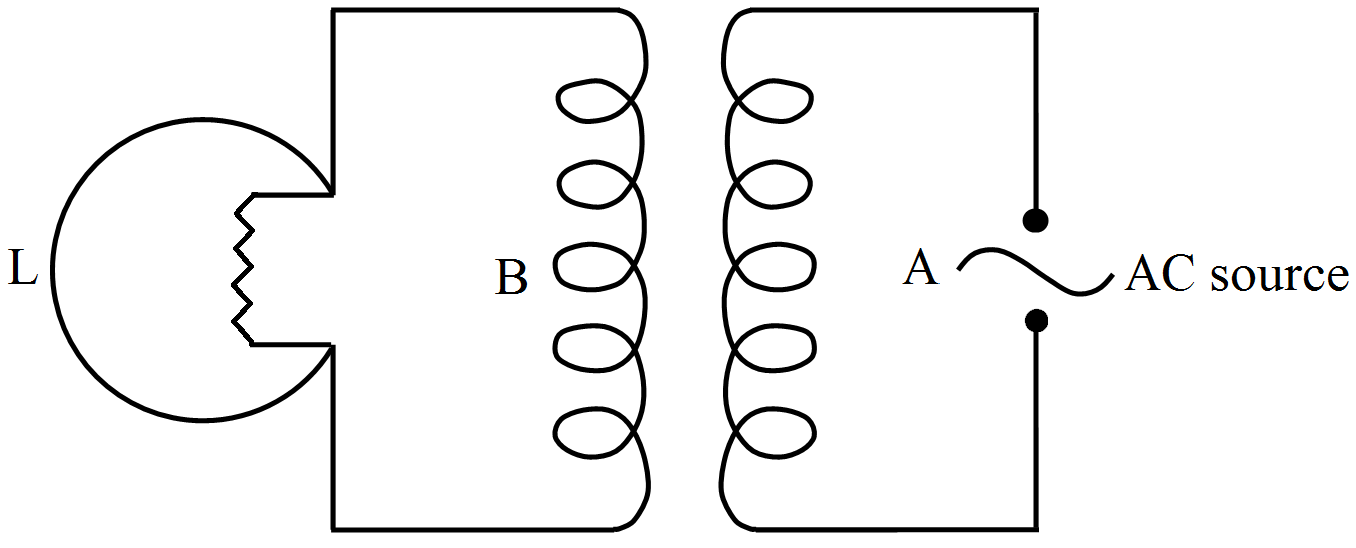
In the given diagram, a coil B is connected to low voltage bulb L and placed parallel to another coil A as shown. Explain the following observations:

  1. Bulb lights.
  2. Bulb gets dimmer if the coil B moves upwards.
Answer
  1. Bulb lights up due to induced current in B because of change in flux linked with it as a consequence of continuous variation of magnitude of alternative current flowing in A.
  2. When coil B moves upward, the magnetic flux linked with B decreases and hence lesser current is induced in B.
View full question & answer
Question 1143 Marks
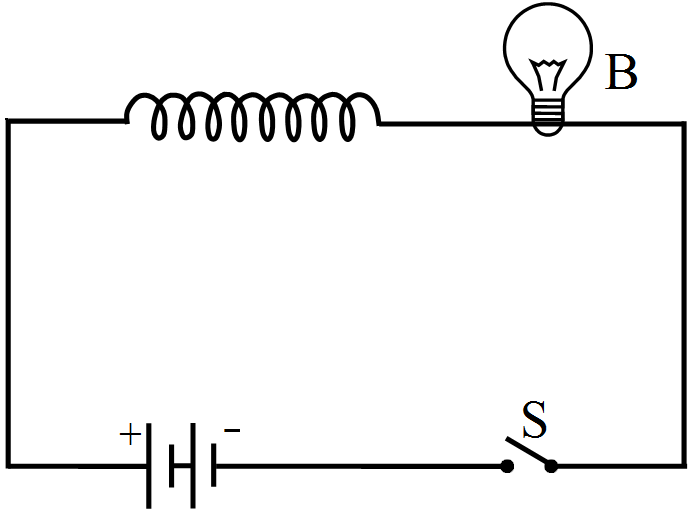
Figure shows a light bulb (B) and iron cored inductor connected to a dc battery through a switch (S).

  1. What will one observe when switch (S) is closed?
  2. How will the glow of the bulb change when the battery is replaced by an ac source of rms voltage equal to the voltage of dc battery? Justify your answer in each case.
Answer
  1. When switch S is closed, the bulb will give full brightness slowly, because inductor opposes the rise of current in the circuit depending on the value of ratio $\frac{\text{L}}{\text{R}}.$

(L = inductance, R = resistance of bulb).

  1. When battery is replaced by an ac source, the inductor offers reactance $(\omega\text{L})$ so impedance of circuit increases and the bulb will glow with less brightness.
View full question & answer
Question 1153 Marks
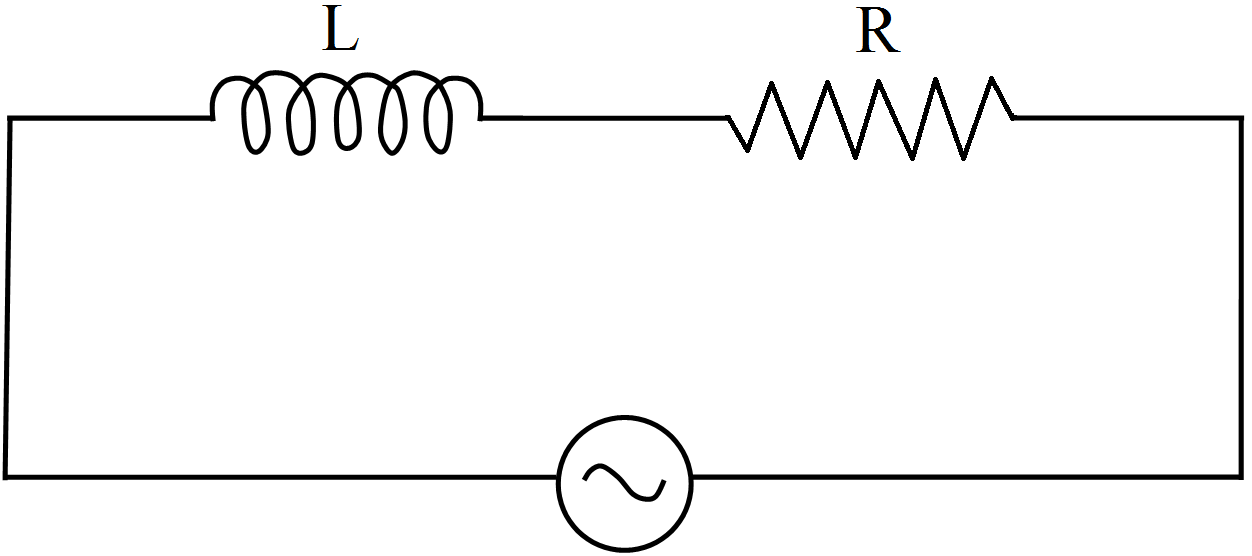
In the given circuit, the potential difference across the inductor L and resistor R are 200V and 150V respectively and the rms. value of current is 5A. Calculate (i) the impedance of the circuit and (ii) the phase angle between the voltage and the current.
Answer

Voltage applied $\text{V}=\sqrt{\text{V}^2_\text{L}+\text{V}^2_\text{R}}=\sqrt{(200)^2+(150^2)}=250\text{V}$

Impedance of circuit, $\text{Z}=\frac{\text{V}}{\text{I}}=\frac{250}{5}=50\Omega$

Phase angle between voltage and current

$\tan\varphi=\frac{\text{x}_{\text{L}}}{\text{R}}=\frac{\text{V}_{\text{L}}}{\text{V}_{\text{R}}}=\frac{200}{150}=\frac{4}{3}$

$\varphi=\tan^{-1}\Big(\frac{4}{3}\Big)=53^{\circ}$

View full question & answer
Question 1163 Marks
Explain why the reactance provided by a capacitor to an alternating current decreases with increasing frequency.
Answer
A capacitor does not allow flow of direct current through it as the resistance across the gap is infinite. When an alternating voltage is applied across the capacitor plates, the plates are alternately charged and discharged. The current through the capacitor is a result of this changing voltage (or charge). Thus, a capacitor will pass more current through it if the voltage is changing at a faster rate, i.e. if the frequency of supply is higher. This implies that the reactance offered by a capacitor is less with increasing frequency; it is given by $\frac{1}{\omega\text{C}}$.
View full question & answer
Question 1173 Marks
An inductor-coil, a capacitor and an AC source of rms voltage 24V are connected in series. When the frequency of the source is varied, a maximum rms current of 6.0A is observed. If this inductor coil is connected to a battery of emf 12V and internal resistance $4.0\Omega,$ what will be the current?
Answer
$\text{E}_\text{rms}=24\text{V}$
$\text{r}=4\Omega,\text{I}_\text{rms}=6\text{A}$
$\text{R}=\frac{\text{E}}{\text{I}}=\frac{24}{6}=4\Omega$
Internal Resistance $=4\Omega$
Hence net resistance $=4+4=8\Omega$
$\therefore$ Current $=\frac{12}{8}=1.5\text{A}$
View full question & answer
Question 1183 Marks
In a series LCR circuit, $\text{R = 1k}\Omega,\text{C}=2\mu\text{F}$ and voltage across R is 100V. The resonant frequency of the circuit $\omega$ is 200 rad s-1. Calculate the value of voltage across L at resonance.
Answer
Current flowing in the circuit is
$\text{I}=\frac{\text{V}_{\text{R}}}{\text{R}}=\frac{100}{1000}=0.1\text{A}$
$\therefore$ Also at resonance, $\omega\text{L}=\frac{1}{\omega\text{C}}$
$\omega\text{L}=\frac{1}{200\times2\times10^{-6}}=2500\Omega$
$\therefore$ Volage across, $\text{L = I}(\omega\text{L})=0.1\times2500=250\text{V}$
View full question & answer
Question 1193 Marks
Both alternating current and direct current are measured in amperes. But how is the ampere defined for an alternating current?
Answer
For a Direct Current (DC),
1 Ampere = 1 Coulomb/Sec
Direction of AC changes with the frequency of source with the source frequency and the attractive force would average to zero. Thus, the AC ampere must be defined in terms of some property that is independent of the direction of current. Joule’s heating effect is such property and hence it is used to define rms value of AC.
So, r.m.s. value of AC is equal to that value of DC, which when passed through a resistance for a given time will produce the same amount of heat as produced by the alternating current when passed through the same resistance for same time.
View full question & answer
Question 1203 Marks
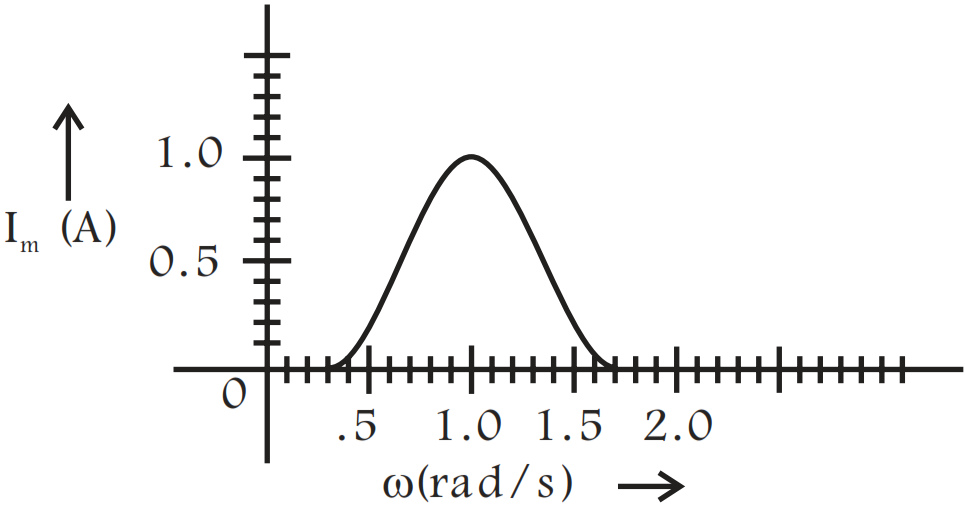
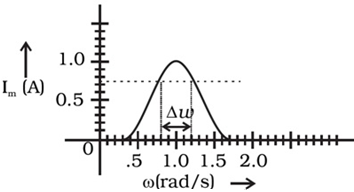
In series LCR circuit, the plot of Imax vs $\omega$ is shown in Fig. Find the bandwidth and mark in the figure.

Answer
According top the given diagram,
Bandwidth $\Delta\omega=\omega_2-\omega_1$

where $\omega_1$ and $\omega_2$ correspond to frequencies at which magnitude of current is $\frac{1}{\sqrt{2}}$ times of maximum value.
i.e., $\text{I}_\text{rms}=\frac{\text{I}_\text{max}}{\sqrt{2}}=\frac{1\text{A}}{\sqrt{2}}\approx0.7\text{A}$
From the graph these frequencies are $\omega_1=0.8\frac{\text{rad}}{\text{s}}$ and $\omega_2=1.2\frac{\text{red}}{\text{s}}.$
Thus, bandwidth, $\Delta\omega=\omega_1-\omega_2=1.2-0.8=0.4\frac{\text{rad}}{\text{s}}.$
View full question & answer
Question 1213 Marks
Explain why the reactance offered by an inductor increases with increasing frequency of an alternating voltage.
Answer
The inductive reactance is given by $\text{X}_\text{L}=2\pi\text{fL}$, XL is proportional to the frequency and current is inversely proportional to the reactance. An inductor opposes the flow of current through it by developing a back emf according to Lenz’s law. If the current is decreasing, the polarity of the induced emf will be so as to increase the current and vice-versa.
Since, the induced emf is proportional to the rate of change of current.
View full question & answer
Question 1223 Marks
An AC voltage V = Vm is applied across a:
  1. Series RC circuit in which capacitive reactance is ‘a’ times the resistance in the circuit.
  2. Series RL circuit in which inductive reactance is ‘b’ times the resistance in the circuit.
Find the value of power factor of the circuit in each case.
Answer
Power factor $\cos\varphi=\frac{\text{R}}{\text{Z}},$ when $\text{Z}=\sqrt{\text{R}^2+\text{X}^2}$

  1. $\text{X = X}_{\text{C}} = \text{aR},$

$\therefore\text{Z}=\sqrt{\text{R}^2+(\text{aR})^2}=\text{R}\sqrt{1+\text{a}^2}$

$\therefore\cos\varphi=\frac{\text{R}}{\text{R}\sqrt{1+\text{a}^2}}=\frac{1}{\sqrt{1+\text{a}^2}}$

  1. $\text{X = X}_{\text{L}}=\text{bR},$

$\therefore\text{Z}=\sqrt{\text{R}^2+(\text{bR})^2}=\text{R}\sqrt{1+\text{b}^2}$

$\therefore\cos\varphi=\frac{\text{R}}{\text{R}\sqrt{1+\text{b}^2}}=\frac{1}{\sqrt{1+\text{b}^2}}$

View full question & answer
Question 1233 Marks
An inductor 200mH, a capacitor $100\mu\text{F}$ and a resistor $10\Omega$ are connected in series to an a.c. source of 100V, having variable frequency.
  1. At what frequency of the applied voltage will the power factor of the circuit be 1?
  2. What will be the current amplitude at this frequency?
  3. Calculate the Q-factor of the circuit.
Answer
  1. Since the power factor $\varphi=1$ it means the phase difference between voltage and the current is zero.

This is possible when

$\text{wL}=\frac{1}{\omega\text{C}}$

$\omega^2=\frac{1}{\text{LC}}\Rightarrow\text{v}=\frac{1}{2\pi\sqrt{\text{LC}}}=35.58\text{Hz}$

  1. Current Amplitude, $\text{I}=\frac{\text{V}_{\text{eff}}}{\text{Z}}=\frac{\text{V}_{\text{eff}}}{\text{R}}=\frac{100}{10}=10\text{A}$ $(\therefore\text{Z = R})$

  2. Quality factor, $\text{Q}=\frac{1}{\text{R}}\sqrt{\frac{\text{L}}{}\text{C}}=4.47$

View full question & answer
Question 1253 Marks
Find the time required for a 50Hz alternating current to change its value from zero to the rms value.
Answer
$\text{f}=50\text{Hz}$
$=\text{I}=\text{I}_0\sin\omega\text{t}$
Peak value $\text{I}=\frac{\text{I}_0}{\sqrt{2}}$
$\frac{\text{I}_0}{\sqrt{2}}=\text{I}_0\sin\omega\text{t}$
$\Rightarrow\ \frac{1}{\sqrt{2}}=\sin\omega\text{t}=\sin\frac{\pi}{4}$
$\Rightarrow\ \frac{\pi}{4}=\omega\text{t}$
Or $\text{t}=\frac{\pi}{400}$
$=\frac{\pi}{4\times2\pi\text{f}}=\frac{1}{8\text{f}}$
$=\frac{1}{8\times50}=0.0025\text{s}=2.5\text{ms}$
View full question & answer
Question 1263 Marks
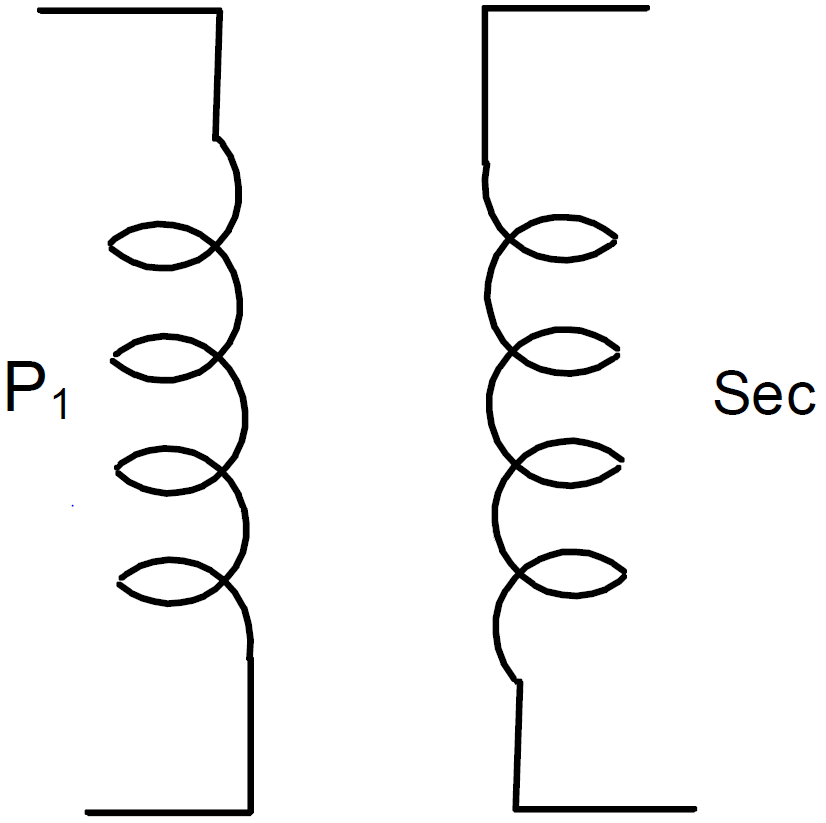
A transformer has 50 turns in the primary and 100 in the secondary. If the primary is connected to a 220V DC supply, what will be the voltage across the secondary?
Answer

Transformer works upon the principle of induction which is only possible in case of AC.
Hence when DC is supplied to it, the primary coil blocks the Current supplied to it and hence induced current supplied to it and hence induced Current in the secondary coil is zero.
View full question & answer
3 Marks Question - Page 3 - Physics STD 12 Science Questions - Vidyadip