Questions · Page 2 of 2

3 Marks Question

Question 513 Marks
A radioactive isotope is being produced at a constant rate $\frac{\text{dN}}{\text{dt}}=\text{R}$ in an experiment. The isotope has a half-life $\text{t}_{\frac{1}2{}}.$ Show that after a time $\text{t}>>\text{t}_{\frac{1}{2}},$ the number of active nuclei will become constant. Find the value of this constant.
Answer
Given: Half life period $=\text{t}_{\frac{1}{2}}$
Rate of radio active decay $=\frac{\text{dN}}{\text{dt}}=\text{R}\Rightarrow\text{R}=\frac{\text{dN}}{\text{dt}}$
Given after time $\text{t}>>\text{t}_{\frac{1}{2}},$ the number of active nuclei will become constant.
i.e. $\Big(\frac{\text{dN}}{\text{dt}}\Big)_{\text{present}}=\text{R}=\Big(\frac{\text{dN}}{\text{dt}}\Big)_{\text{decay}}$
$\therefore\text{R}=\Big(\frac{\text{dn}}{\text{dt}}\Big)_{\text{decay}}$
$\Rightarrow\text{R}=\lambda\text{N}$ [where, $\lambda$ = Radioactive decay constant, N = constant number]
$\Rightarrow\text{R}=\frac{0.693}{\text{t}_{\frac{1}{2}}}(\text{N})\Rightarrow\text{Rt}_{\frac{1}{2}}=0.693\text{N}\Rightarrow\text{N}=\frac{\text{Rt}_{\frac{1}{2}}}{0.693}$
View full question & answer
Question 523 Marks
Explain with example, whether the neutron-proton ratio in a nucleus increases or decreases due to $\beta-$decay.
Answer
In $\beta-$decay a neutron is converted into a proton, so the neutron-proton ratio decreases. Equation of $\beta-$decay is:
$\text{zX}^\text{A}\rightarrow\text{Z}+_1\text{Y}^\text{A}+_{-1}\beta^0+\bar{\text{v}}$
$_{90}\text{Th}^{234}\ \rightarrow\ _{91}\text{Pa}^{234}+_{-1}\beta^0+\bar{\text{v}}$
Neutron to proton ratio before $\beta-$decay $=\frac{234-91}{90}=\frac{144}{90}=1.60$
Neutron to proton ratio aftere $\beta-$decay $=\frac{234-91}{91}=\frac{143}{91}=1.57$
$\frac{143}{91}<\frac{144}{90},$ so neutron to proton ratio in $\beta-$decay decreases.
View full question & answer
Question 533 Marks
Define half-life of a radioactive sample. Which of the following radiations: $\alpha-$rays, $\beta-$rays and $\gamma-$rays.
  1. Are similar to X-rays.
  2. Are easily absorbed by matter.
  3. Travel with the greatest speed.
  4. Are similar in nature to cathode rays?
Answer
Half-life: The half-life of a radioactive sample is defined as the time in which the mass of sample is left one half of the original mass.
  1. $\gamma-$rays are similar to X-rays.
  2. $\alpha-$rays are easily absorbed by matter.
  3. $\gamma-$rays travel with greatest speed.
  4. $\beta-$rays are similar to cathode rays.
View full question & answer
Question 543 Marks
How much energy is released in the following reaction?
$\text{ }^7\text{Li + p}\rightarrow\alpha+\alpha.$
Atomic mass of 7Li = 7.0160u and that of 4He = 4.0026u.
Answer
$\text{Li}^7+\text{p}\rightarrow\text{l}+\alpha+\text{E};\text{Li}^7=7.016\text{u}$
$\alpha=\text{ }^4\text{He}=4.0026\text{u};\text{p}=1.007276\text{u}$
$\text{E}=\text{Li}^7+\text{P}-2\alpha=(7.016+1.007276)\text{u}\\-(2\times4.0026)\text{u}=0.018076\text{u}.$
$\Rightarrow0.018076\times931=16.828=16.83\text{MeV}.$
View full question & answer
Question 553 Marks
Calculate the Q-value of the fusion reaction
4He + 4He = 8Be.
Is such a fusion energetically favourable? Atomic mass of 8Be is 8.0053u and that of 4He is 4.0026u.
Answer
4H + 4H → 8Be
M(2H) → 4.0026u
M(8Be) → 8.0053u
Q value = [2M(2H) - M(8Be)] = (2 × 4.0026 - 8.0053)u
= -0.0001u = -0.0931Mev = -93.1Kev.
View full question & answer
Question 563 Marks
Calculate the maximum kinetic energy of the beta particle emitted in the following decay scheme:
$\text{ }^{12}\text{N}\rightarrow{ }^{12}\text{C}^*+\text{e}^++\text{v}$
$\text{ }^{12}\text{C}^*\rightarrow\text{ }^{12}\text{C}+\gamma(4.43\text{MeV}).$
The atomic mass of 12N is 12.018613u.
Answer
Given:
Atomic mass of 12N, m(12N) = 12.018613u
12N → 12C* + e+ + v
12C* → 12C + Y (4.43MeV)
Net reaction is given by
12N → 12C + e+ + v + Y (4.43MeV)
Qvalue of the $\beta^+$ decay will be
 Qvalue= [m(12N) - (m(12C*) + 2me)]c2
= [12.018613 × 931MeV - (12 × 931 + 4.43) MeV - (2 × 511)keV]
= [11189.3287 - 11176.43 - 1.022]MeV
= 11.8767MeV = 11.88MeV
The maximum kinetic energy of beta particle will be 11.88MeV, assuming that neutrinos have zero energy.
View full question & answer
Question 573 Marks
In a typical fission reaction, the nucleus is split into two middle-weight nuclei of unequal masses. Which of the two (heavier or lighter) has greater kinetic energy? Greater linear momentum?
Answer
Two photons having equal liner momentum have equal wavelengths as here for both the photons the direction and magnitude of linear momentum will be same. For the rest of the options, magnitude will be same but nothing can be said about the direction of the photons.
Hence the correct option is D.
View full question & answer
Question 583 Marks
A certain sample of a radioactive material decays at the rate of 500 per second at a certain time. The count rate falls to 200 per second after 50 minutes.
  1. What is the decay constant of the sample?
  2. What is its half-life?
Answer
$\text{A = 200, A}_0 = 500, \text{t = 50 min}$

  1. $\text{A = A}_0\text{e}^{-\lambda\text{t}}$

$200=500\times\text{e}^{-50\times60\times\lambda}$

$\Rightarrow\lambda=3.05\times10^{-4}\text{s}.$

  1. $\text{t}_{\frac{1}{2}}=\frac{0693}{\lambda}=\frac{0.693}{0.000305}=2272.13\sec=38\text{min}$
View full question & answer
Question 593 Marks
Prove that the instantaneous rate of change of the activity of a radioactive substance is inversely proportional to the square of its half-life.
Answer
Activity of a radioactive substance.
$\text{R}\Big(=-\frac{\text{dN}}{\text{dt}}\Big)=\lambda\text{N}\ \dots(\text{i})$
Rate of change of activity
$\frac{\text{dR}}{\text{dt}}=\lambda \Big(\frac{\text{dN}}{\text{dt}}\Big)=\lambda(-\lambda\text{N})$
$=-\lambda^2\text{N}$
As $\lambda =\frac{\log_\text{e}2}{\text{T}_{\frac{1}{2}}}$ $\therefore \frac{\text{dR}}{\text{dt}}=-\Big(\frac{\log_\text{e}2}{\text{T}_{\frac{1}{2}}}\Big)^2\text{N}$
$\therefore$ Instantaneous activity, $\frac{\text{dR}}{\text{dt}}\propto\frac{1}{\text{T}^2_{\frac{1}{2}}}$
View full question & answer
Question 603 Marks
A charged capacitor of capacitance C is discharged through a resistance R. A radioactive sample decays with an average-life $\tau.$ Find the value of R for which the ratio of the electrostatic field energy stored in the capacitor to the activity of the radioactive sample remains constant in time.
Answer
$\text{Q = qe}^{\frac{-\text{t}}{\text{CR}}};\text{A = A}_0\text{e}^{-\lambda\text{t}}$
$\frac{\text{Energy}}{\text{Activity}}=\frac{1\text{q}^2\times\text{e}^{\frac{-2\text{t}}{\text{CR}}}}{2\text{CA}_0\text{e}^{-\lambda\text{t}}}$
Since the term is independent of time, so their coefficients can be equated,
So, $\frac{2\text{t}}{\text{CR}}=\lambda\text{t}$
$\lambda=\frac{2}{\text{CR}}$
$\frac{1}{\tau}=\frac{2}{\text{CR}}$
$\text{R}=2\frac{\tau}{\text{C}}$
View full question & answer
Question 613 Marks
With the help of an example, explain how the neutron to proton ratio changes during $\alpha-$decay of a nucleus.
Answer
Let us like the example of $\alpha-$decay of $^{238}_{92}\text{U}.$ The decay scheme is
$^{238}_{92}\text{U}\rightarrow ^{234}_{90}\text{Th}+^4_2\alpha \text{ (or}^4_2\text{He})$
Neutron to proton ratio before $\alpha-$decay $=\frac{238-92}{92}=\frac{146}{92}=1.59$
Neutron to proton ratio after $\alpha-$decay $=\frac{238-90}{90}=\frac{144}{90}=1.60$
$\frac{146}{92}<\frac{144}{90}$
This shows that the neutron to proton ratio increases during $\alpha-$decay of a nucleus.
View full question & answer
Question 623 Marks
Carbon (Z = 6) with mass number 11 decays to boron (Z = 5).
  1. Is it a $\beta^+-\text{decay}$ or a $\beta^--\text{decay}?$
  2. The half-life of the decay scheme is 20.3 minutes. How much time will elapse before a mixture of 90% carbon-11 and 10% boron-11 (by the number of atoms) converts itself into a mixture of 10% carbon-11 and 90% boron-11?
Answer
$\text{P}\rightarrow\text{n + e}^++\text{v}$ Hence it is a $\beta^+\text{decay}.$
Let the total no. of atoms be 100 N0.
  Carbon Boron
Initially 90N0 10N0
Finally 10N0 90N0
Now, $10\text{N}_0=90\text{N}_0\text{e}^{-\lambda\text{t}}\Rightarrow\frac{1}9{}=\text{e}^{\frac{-0.693}{20.3}\times\text{t}}$ $\Big[$because $\text{t}_{\frac{1}2{}}=20.3\text{min}\Big]$
$\Rightarrow\text{In}\frac{1}9{}=\frac{-0.693}{20.3}\text{t}\Rightarrow\text{t}=\frac{2.1972\times20.3}{0.693}=64.36=64\text{min}.$
View full question & answer
Question 633 Marks
Consider a radioactive nucleus A which decays to a stable nucleus C through the following sequence:
A → B → C
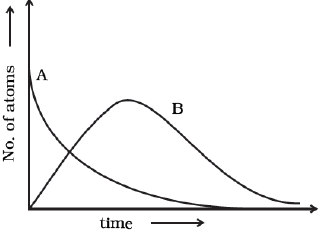
Here B is an intermediate nuclei which is also radioactive. Considering that there are N0 atoms of A initially, plot the graph showing the variation of number of atoms of A and B versus time.
Answer
Consider the situation shown in the graph.

At t = 0, NA = NO while NB = 0. As time increases, NA falls off exponentially, the number of atoms of B increases, becomes maximum and finally decays to zero at ∞ (following exponential decay law).

View full question & answer
Question 643 Marks
Is it easier to take out a nucleon from carbon or from iron? Fi-om iron or from lead?
Answer
Binding energy per nucleon of a nucleus is defined as the energy required to break-off a nucleon from it.
  1. As the binding energy per nucleon of iron is more than that of carbon, it is easier to take out a nucleon from carbon than iron.
  2. As the binding energy per nucleon of iron is more than that of lead. Therefore, it is easier to take out a nucleon from lead as compared to iron.
View full question & answer
Question 653 Marks
If both the number of protons and number of neutrons are conserved in each nuclear reaction, in what way is mass converted into energy (or vice-versa) in a nuclear reaction?
Answer
In fact the number of protons and number of neutrons are same before and after a nuclear reaction, but the binding energies of nuclei present before and after a nuclear reaction are different. This difference is called the mass defect. This mass defect appears as energy of reaction. In this sense a nuclear reaction is an example of mass-energy interconversion.
View full question & answer
Question 663 Marks
Assume that the mass of a nucleus is approximately given by M = Amp where A is the mass number. Estimate the density of matter in kg/m3 inside a nucleus. What is the specific gravity of nuclear matter?
Answer
$\text{M = Am}_{\text{p}},\text{f}=\frac{\text{M}}{\text{V}},\text{m}_{\text{p}}=1.007276\text{u}$
$\text{R = R}_0\text{A}^{\frac{1}{3}}=1.1\times10^{-15}\text{A}^{\frac{1}{3}},\\\text{u}=1.6605402\times10^{-27}\text{kg}$
$=\frac{\text{A}\times1.007276\times1.6605402\times10^{-27}}{\frac{4}{3}\times3.14\times\text{R}^3}$
$=0.300159\times10^{18}=3\times10^{17}\text{kg/m}^3.$
‘f’ in CGS = Specific gravity $=3\times10^{14}.$
View full question & answer
Question 673 Marks
A molecule. of hydrogen contains two protons and two electrons. The nuclear force between these two protons is always neglected while discussing the behaviour of a hydrogen molecule. Why?
Answer
Inside the nucleus, two protons exert nuclear force on each other. These forces are short-ranged (a few fm), strong and attractive forces. They also exert electrostatic repulsive force (long-ranged). While discussing the behaviour of a hydrogen molecule, the nuclear force between the two protons is always neglected. This is because the separation between the two protons in the molecule is ~70pm which is much greater than the range of the nuclear force.
View full question & answer
Question 683 Marks
Consider the fusion in helium plasma. Find the temperature at which the average thermal energy 1.5kT equals the Coulomb potential energy at 2fm.
Answer
$\text{PE}=\frac{\text{Kq}_1\text{q}_2}{\text{r}}=\frac{9\times10^9\times(2\times1.6\times10^{-19})^2}{\text{r}} \ ...(1)$
$1.5\text{KT}=1.5\times1.38\times10^{-23}\times\text{T} \ ...(2)$
Equating (1) and (2) $1.5\times1.38\times10^{-23}\times\text{T}=\frac{9\times10^9\times10.24\times10^{-38}}{2\times10^{-15}}$
$\Rightarrow\text{T}=\frac{9\times10.24\times10^{-38}}{2\times10^{-15}\times1.5\times1.38\times10^{-23}}$
$=22.26087\times10^9\text{K}=2.23\times10^{10}\text{K}$
View full question & answer
Question 693 Marks
An ideal diode should pass a current freely in one direction and should stop it completely in the opposite direction. Which is closer to ideal-vacuum diode or a p-n junction diode?
Answer
It should be an ideal vacuum diode. When a p-n junction diode is reverse biassed then a small current called reverse current flows across the diode. As the the p‒n junction diode allows some current in reverse biassed condition also so the given diode cannot be a p-n junction diode.
View full question & answer
Question 703 Marks
  1. A giant refracting telescope at an observatory has an objective lens of focal length 15 m. If an eyepiece of focal length 1.0 cm is used, what is the angular magnification of the telescope?
  2. If this telescope is used to view the moon, what is the diameter of the image of the moon formed by the objective lens? The diameter of the moon is 3.48 × 10m, and the radius of lunar orbit is 3.8 × 10m.
Answer
Focal length of the objective lens, f0 = 15 m = 15 × 10cm

Focal length of the eyepiece, fe = 1.0 cm 

  1. The angular magnification of a telescope is given as:

$\alpha=\frac{\text{f}_0}{\text{f}_\text{e}}$

$=\frac{15\times10^2}{1.0}=1500$

Hence, the angular magnification of the given refracting telescope is 1500.

  1. Diameter of the moon, d = 3.48 × 10m

Radius of the lunar orbit, r0 = 3.8 × 10⁸ m

Let d' be the diameter of the image of the moon formed by the objective lens.

The angle subtended by the diameter of the moon is equal to the angle subtended by the image.

$\frac{\text{d}}{\text{r}_0}=\frac{\text{d}'}{\text{d}_0}$

$\frac{3.48\times10^6}{3.8\times10^8}=\frac{\text{d}'}{15}$

$\therefore \ \text{d}'=\frac{3.48}{3.8}\times10^{-2}\times15$

= 13.74 × 10⁻² m = 13.74 cm

Hence, the diameter of the moon's image formed by the objective lens is 13.74 cm.

View full question & answer
Question 713 Marks
Find the energy liberated in the reaction:
223Ra → 209Pb + 14C.
The atomic masses needed are as follows.
223Ra 209Pb 14C
22.018u 208.981u 14.003u
Answer
223Ra = 223.018u; 209Pb = 208.981u; 14C = 14.003u.
223Ra → 209Pb + 14C
$\Delta\text{m}$ = mass 223Ra - mass(209Pb + 14C)
= 223.018 - (208.981 + 14.003) = 0.034.
Energy = $\Delta\text{M}\times\text{u}$ = 0.034 × 931 = 31.65Me.
View full question & answer
Question 723 Marks
Suppose we have 12 protons and 12 neutrons. We can assemble them to form either a :uMg nucleus or two 12C nuclei. In which of the two cases more energy will be liberated?
Answer
If we assemble 6 protons and 6 neutrons to form 12C nucleus, 92.15 MeV (product of mass number and binding energy per nucleon of carbon-12) of energy is released. Therefore, the energy released in the formation of two carbon nuclei is 184.3 MeV. On the other hand, when 12 protons and 12 neutrons are combined to form a 24Mg atom, 198.25 MeV of energy (binding energy) is released. Hence, in case of ​24Mg nucleus, more energy is liberated.
View full question & answer
Question 733 Marks
Radioactive isotopes are produced in a nuclear physics experiment at a constant rate $\frac{\text{dN}}{\text{dt}}=\text{R}.$ An inductor of inductance 100mH, a resistor of resistance $100\Omega$ and a battery are connected to form a series circuit. The circuit is switched on at the instant the production of radioactive isotope starts. It is found that $\frac{\text{i}}{\text{N}}$ remains constant in time where i is the current in the circuit at time t and N is the number of active nuclei at time t. Find the half-life of the isotope.
Answer
$\text{R}=100\Omega;\text{ L}=100\text{mH}$
After time t, $\text{i = i}_0\Big(1-\text{e}^{\frac{-\text{t}}{\text{Lr}}}\Big)\text{ N = N}_0\big(\text{e}^{-\lambda\text{t}}\big)$
$\frac{\text{i}}{\text{N}}=\frac{\text{i}_0\big(1-\text{e}^{-\frac{\text{tR}}{\text{L}}}\big)}{\text{N}_0\text{e}^{-\lambda\text{t}}}\frac{\text{i}}{\text{N}}$ is constant i.e. independent of time.
Coefficients of t are equal $-\frac{\text{R}}{\text{L}}=-\lambda\Rightarrow\frac{\text{R}}{\text{L}}=\frac{0.693}{\text{t}_{\frac{1}{2}}}$
$=\text{t}_{\frac{1}{2}}=0.693\times10^{-3}=6.93\times10^{-4}\text{sec}.$
View full question & answer
Question 743 Marks
A human body excretes (removes by waste discharge, sweating, etc.) certain materials by a law similar to radioactivity. If technetium is injected in some form in a human body, the body excretes half the amount in 24 hours. A patient is given an injection containing 99Tc. This isotope is radioactive with a half-life of 6 hours. The activity from the body just after the injection is $6\mu\text{Ci}.$ How much time will elapse before the activity falls to $3\mu\text{Ci}?$
Answer
$\text{t}_{\frac{1}{2}}=24\text{h}$
$\therefore\text{t}_{\frac{1}{2}}=\frac{\text{t}_1\text{t}_2}{\text{t}_1+\text{t}_2}=\frac{24\times6}{24+6}=4.8\text{h}.$
$\text{A}_0=6\text{rci};\text{A}=3\text{rci}$
$\therefore\text{A}=\frac{\text{A}_0}{2^{\frac{\text{t}}{\text{t}_{\frac{1}{2}}}}}\Rightarrow3\text{rci}=\frac{6\text{rci}}{2^{\frac{\text{t}}{4.8\text{h}}}}$
$\Rightarrow\frac{\text{t}}{24.8\text{h}}=2\Rightarrow\text{t}=4.8\text{h}$
View full question & answer
Question 753 Marks
A radioactive material is reduced to $\frac{1}{16}$ of its original amount in 4 days. How much material should one begin with so that 4 × 10⁻³kg of the material is left after 6 days?
Answer
$\frac{\text{N}}{\text{N}_0}=\Big(\frac{1}{2}\Big)^\text{n}$
Where $\text{n}=\frac{\text{t}}{\text{T}}$ is number of halp lives.
Given $\frac{\text{N}}{\text{N}_0}=\frac{1}{16}=\Big(\frac{1}{2}\Big)^4$
$\therefore \Big(\frac{1}{2}\Big)^4=\Big(\frac{1}{2}\Big)^\text{n}$
$\text{n}=4$
$\therefore$ Given t = 4 days
$\therefore \frac{\text{t}}{\text{T}}=4\Rightarrow \text{Half life,}\ \text{T}=\frac{\text{t}}{4}=\frac{4}{4}=1\text{day}$
If m0 is initial mass of radioactive material, then $=\frac{\text{m}}{\text{m}_0}=\Big(\frac{1}{2}\Big)^\text{n}.$
Here $\text{n}=\frac{\text{t}}{\text{T}}=\frac{6}{1}=6,\ \text{m}=4\times 10^{-3}\text{kg}$
$\therefore \frac{\text{m}}{\text{m}_0}=\Big(\frac{1}{2}\Big)^6=\frac{1}{64}$
m0 = 64m = 64 × 4 × 10-3kg
= 0.256kg
View full question & answer
Question 763 Marks
Calculate the energy that can be obtained from 1kg of water through the fusion reaction
2H + 2H → 3H + p.
Assume that 1.5 × 10⁻²% of natural water is heavy water D2O (by number of molecules) and all the deuterium is used for fusion.
Answer
Given:
18g of water contains 6.023 × 1023 molecules.
$\therefore1000\text{g}$ of water $=\frac{6.023\times10^{23}\times1000}{18}=3.346\times10^{25}$ molecules
% of deuterium $=3.346\times10^{25}\times\frac{0.015}{100}=0.05019\times10^{23}$
Energy of deuterium $=30.4486\times10^{25}$
= [2 × m(2H) - m(3H) - mp]c2
= (2 × 2.014102u - 3.016049u - 1.007276u)c2
= 0.004879 × 931Me
= 4.542349Me
= 7.262 × 10-13J
Total energy = 0.05019 × 1023 × 7.262 × 10-13J
= 3644MJ
View full question & answer
Question 773 Marks
228Th emits an alpha particle to reduce to 224Ra. Calculate the kinetic energy of the alpha particle emitted in the following decay:
$\text{ }^{228}\text{Th}\rightarrow\text{ }^{224}\text{Ra}^*+\alpha$
$\text{ }^{224}\text{Ra}^*\rightarrow\text{ }^{224}\text{Ra}+\gamma(217\text{kev}).$
Atomic mass of 228Th is 228.028726u, that of 224Ra is 224.020196u and that of $\text{ }^4_2\text{He}$ is 4.00260u.
Answer
Mass $\text{ }^{228}\text{Th}=228.028726\text{u};\text{ }^{224}\text{Ra}=224.020196\text{u}$
$\alpha=\text{ }^4_2\text{He}\rightarrow4.00260\text{u}$
$\text{ }^{228}\text{Th}\rightarrow\text{ }^{224}\text{Ra}^*+\alpha$
$\text{ }^{224}\text{Ra}^*\rightarrow\text{ }^{224}\text{Ra + v}(217\text{kev})$
Now, Mass of $\text{ }^{224}\text{Ra}^* = 224.020196 \times 931 + 0.217\text{ Mev} $
$= 208563.0195\text{Mev.}$
KE of $\alpha=\text{E}^{226}\text{Th}-\text{E}(\text{ }^{224}\text{Ra}^*+\alpha)$
$= 228.028726\times 931-[208563.0195 + 4.00260\times931]$
$= 5.30383\text{Mev}= 5.304\text{Mev.}$
View full question & answer
Question 783 Marks
A small telescope has an objective lens of focal length 144 cm and an eyepiece of focal length 6.0 cm. What is the magnifying power of the telescope? What is the separation between the objective and the eyepiece?
Answer
Focal length of the objective lens, f0 = 144 cm
Focal length of the eyepiece, fe = 6.0 cm
The magnifying power of the telescope is given as:
$\text{m}=\frac{\text{f}_0}{\text{f}_\text{e}}$
$=\frac{144}{6}=24$
The separation between the objective lens and the eyepiece is calculated as:
f0 + fe
= 144 + 6 = 150 cm
Hence, the magnifying power of the telescope is 24 and the separation between the objective lens and the eyepiece is 150 cm.
View full question & answer
Question 793 Marks
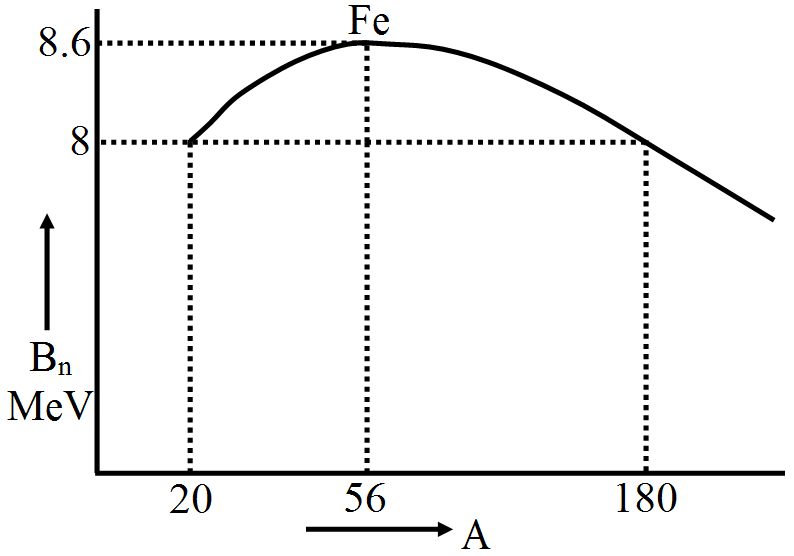
Draw the graph showing the variation of binding energy per nucleon with mass numbers. Give the reason for the decrease of binding energy per nucleon for nuclei with higher mass number.

Answer
The graph of the binding energy per nucleon versus mass number A is shown in figure. The decrease of the binding energy per nucleon for nuclei with high mass number is due to increased coulomb repulsion between protons inside the nucleus.
View full question & answer
Question 803 Marks
The decay constant of 238U is 4.9 × 10⁻¹⁸ S-1.
  1. What is the average-life of 238U?
  2. What is the half-life of 238U?
  3. By what factor does the activity of a 238U sample decrease in 9 × 10⁹ years?
Answer
$\lambda=4.9\times10^{-18}\text{s}^{-1}$

  1. Avg. life of $\text{ }^{238}\text{U}=\frac{1}{\lambda}=\frac{1}{4.9\times10^{-18}}=\frac{1}{4.9}\times10^{-18}\sec.$

$=6.47\times10^{3}\text{years}.$

  1. Half life of uranium $=\frac{0.693}{\lambda}=\frac{0.693}{4.9\times10^{-18}}=4.5\times10^9\text{years}.$
  2. $\text{A}=\frac{\text{A}_0}{2^{\frac{\text{t}}{\text{t}_{\frac{1}{2}}}}}\Rightarrow\frac{\text{A}_0}{\text{A}}=2^{\frac{\text{t}}{\text{t}_{\frac{1}{2}}}}=2^2=4.$
View full question & answer
Question 813 Marks
When charcoal is prepared from a living tree, it shows a disintegration rate of 15.3 disintegrations of 14C per gram per minute. A sample from an ancient piece of charcoal shows 14C activity to be 12.3 disintegrations per gram per minute. How old is this sample? Half-life of 14C is 5730y.
Answer
$\text{A}_0=15.3;\text{ A}=12.3;\text{t}_{\frac{1}{2}}=5730\text{ year}$
$\lambda=\frac{0.6931}{\text{T}_{\frac{1}{2}}}=\frac{0.6931}{5730}\text{yr}^{-1}$
Let the time passed be t,
We know $\text{A = A}_0\text{e}^{-\lambda\text{t}}-\frac{0.6931}{5730}\times\text{t}$
$\Rightarrow12.3=15.3\times\text{e}$
$\Rightarrow\text{t}=1804.3\text{ years.}$
View full question & answer
Question 823 Marks
Distinguish between isotopes and isobars. Give one example for each of the species.
Answer
S. No. Isotopes Isobars
1. The nuclides having the same atomic number (Z). The nuclides having the same atomic mass (A) but.
2. But different atomic masses (A) are called isotopes. Examples: $^1_1\text{H},\ ^2_1\text{H},\ ^3_1\text{H}$ Different atomic numbers (Z) are called isobars. Examples: $^3_1\text{H},\ ^3_2\text{He}$
View full question & answer
Question 833 Marks
$\text{ }^{197}_{80}\text{Hg}$ decay to $\text{ }^{197}_{79}\text{Au}$ through electron capture with a decay constant of 0.257 per day.
  1. What other particle or particles are emitted in the decay?
  2. Assume that the electron is captured from the K shell. Use Moseley's law $\sqrt{\text{v}}=\text{a(Z}-\text{b})$ with $\text{a}=4.95\times10^7\text{s}^{-\frac{1}{2}}$ and b = 1 to find the wavelength of the $\text{K}_{\alpha}$ X-ray emitted following the electron capture.
Answer
  1. $\text{P + e}\rightarrow\text{n + v}$ neutrino $\big[\text{a}\rightarrow4.95\times10^7\text{s}^{-\frac{1}{2}};\text{b}\rightarrow1\big]$
  2. $\sqrt{\text{f}}=\text{a(z}-\text{b})$

$\Rightarrow\sqrt{\frac{\text{c}}{\lambda}}=4.95\times10^7(79-1)=4.95\times10^7\times78$

$\Rightarrow\frac{\text{c}}{\lambda}=(4.95\times78)^2\times10^{14}$

$\Rightarrow\lambda=\frac{3\times10^8}{14903.2\times10^{14}}$

$=2\times10^{-5}\times10^{-6}=2\times10^{-4}\text{m}=20\text{pm}$

View full question & answer
Question 843 Marks
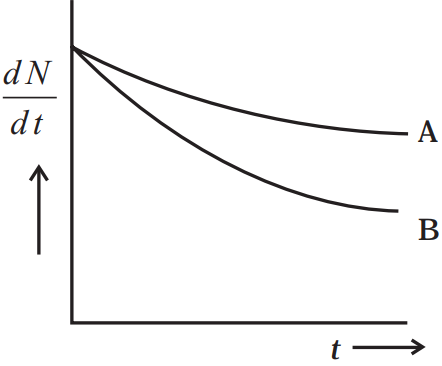
Which sample, A or B shown in Fig. has shorter mean-life?

Answer
B has shorter mean life as $\lambda$ is greater for B. This can be explained mathematically as given below
From the given graph, at $\text{t}=0,\Big(\frac{\text{dN}}{\text{dt}}\Big)_\text{A}=\Big(\frac{\text{dN}}{\text{dt}}\Big)_\text{B}\Rightarrow\ (\text{N}_0)_\text{A}=(\text{N}_0)_\text{B}$
Considering any instant t by drawing a line perpendicular to time axis, we find that $\Big(\frac{\text{dN}}{\text{dt}}\Big)_\text{A}>\Big(\frac{\text{dN}}{\text{dt}}\Big)_\text{B}$
$\Rightarrow\ \lambda_\text{A}\text{N}_\text{A}>\lambda_\text{B}\text{N}_\text{B}$
$\because\ \text{N}_\text{A}>\text{N}_\text{B}$ (rate of decay of B is slower)
$\because\ \lambda_\text{B}>\lambda_\text{A}$
As, average life, $\tau=\frac{1}{\lambda}$
$\Rightarrow\ \tau_\text{A}>\tau_\text{B}$
View full question & answer
Question 853 Marks
If three helium nuclei combine to form a carbon nucleus, energy is liberated. Why can't helium nuclei combine on their own and minimise the energy?
Answer
When three helium nuclei combine to form a carbon nucleus, energy is liberated. This energy is greater than the that liberated when these nuclei combine on their own. Hence, formation of carbon nucleus leads to much more stability as compared to the combination of three helium nuclei.
View full question & answer
Question 863 Marks
Consider two pairs of neutrons. In each pair, the separation between the neutrons is the same. Can the force between the neutrons have different magnitudes for the two pairs?
Answer
Neutrons are chargeless particles and they exert only short range nuclear forces on each other. If we have two pairs of neutrons and the separation between them is same in both the pairs. The force between the neutrons will be of same magnitude for the two pairs until there is some other influence on any of them.
View full question & answer
Question 873 Marks
Find the binding energy per nucleon of $\text{ }^{197}_{79}\text{Au}$ if its atomic mass is 196.96u.
Answer
B = (Zmp + Nmn - M)C2
Z = 79; N = 118; mp = 1.007276u; M = 196.96u; mn = 1.008665u
B = [(79 × 1.007276 + 118 × 1.008665)u - Mu]c2
= 198.597274 × 931 - 196.96 × 931 = 1524.302094
so, Binding Energy per nucleon $=\frac{1524.3}{197}=7.737.$
View full question & answer
Question 883 Marks
radioactive isotope has a half-life of 5 years. After how much time is its activity reduced to 3.125% of its original activity?
Answer
We know $\frac{\text{R}}{\text{R}}_0=\Big(\frac{1}{2}\Big)^\text{}n$
Given $\frac{\text{R}}{\text{R}}_0=3.125\%=\frac{3.125}{100}$
$\therefore \frac{3.125}{100}=\Big(\frac{1}{2}\Big)^\text{n}$
$\frac{1}{32}=\Big(\frac{1}{2}\Big)^\text{n}$
$\Big(\frac{1}{2}\Big)^5=\Big(\frac{1}{2}\Big)^\text{n}$
$\Rightarrow \text{n}=5$
Given T = 5 years
As $\text{n}=\frac{\text{t}}{\text{T}}$
$\therefore \frac{\text{t}}{\text{T}}=5$
$\text{t}=5\times5=25\text{years}$
View full question & answer
Question 893 Marks
Consider the situation of the previous problem. Suppose the production of the radioactive isotope starts at t = 0. Find the number of active nuclei at time t.
Answer
Let N0 = No. of radioactive particle present at time t = 0
N = No. of radio active particle present at time t.
$\therefore\text{N = N}_0\text{e}^{-\lambda\text{t}}$ [$\lambda$ -Radioactive decay constant]
$\therefore$ The no.of particles decay $=\text{N}_0-\text{N}=\text{N}_0-\text{N}_0\text{e}^{-\lambda\text{t}}=\text{N}_0(1-\text{e}^{-\lambda\text{t}})$
We know, $\text{A}_0=\lambda\text{N}_0;\text{R}=\lambda\text{N}_0;\text{N}_0=\frac{\text{R}}{\lambda}$
From the above equation
$\text{N = N}_0(1-\text{e}^{-\lambda\text{t}})=\frac{\text{R}}{\lambda}(1-\text{e}^{-\lambda\text{t}})$ (substituting the value of N0)
View full question & answer
Question 903 Marks
Does a nucleus lose mass when it suffers gamma decay?
Answer
Gamma rays consist of photons that are produced when a nucleus from its excited state comes to its ground state releasing energy. Since gamma rays are chargeless and massless particles, the nucleus does not suffer any loss in mass during the gamma decay.
View full question & answer
Question 913 Marks
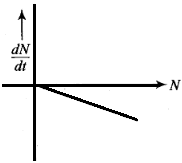
Draw a graph showing the variation of decay rate with number of active nuclei.
Answer
According to Rutherford and Soddy law for redioactive decay $=\frac{-\text{dN}}{\text{dt}}=\lambda\text{N}$ where decay constant $(\lambda)$ is constant for a given radioactive material. Therefore, graph between N and $\frac{\text{dN}}{\text{dt}}$ is a straight line as shown in the diagram.

View full question & answer
Question 923 Marks
The count rate from a radioactive sample falls from 4.0 × 10⁶ per second to 1.0 × 10per second in 20 hours. What will be the count rate 100 hours after the beginning?
Answer
$\text{A}_0=4\times10^5$ disintegration/sec

$\text{A}'=1\times10^6$ dis/sec; t = 20 hours.

$\text{A}'=\frac{\text{A}_0}{2^{\frac{\text{t}}{\text{t}_{\frac{1}{2}}}}}\Rightarrow2^{\frac{\text{t}}{\text{t}_{\frac{1}{2}}}}=\frac{\text{A}_0}{\text{A}'}\Rightarrow2^{\frac{\text{t}}{\text{t}_{\frac{1}{2}}}}=4$

$\Rightarrow\frac{\text{t}}{\text{t}_{\frac{1}{2}}}=2\Rightarrow\text{t}^{\frac{1}{2}}=\frac{\text{t}}{2}=\frac{20\text{ hours}}{2}=10\text{ hours}.$

$\text{A}''=\frac{\text{A}_0}{2^{\frac{\text{t}}{\text{t}_{\frac{1}{2}}}}}\Rightarrow\text{A}''=\frac{4\times10^6}{2^{\frac{100}{10}}}$

$=0.00390625\times10^6=3.9\times10^3$ dintegrations/sec.

View full question & answer
Question 933 Marks
The drift current in a reverse-biased p-n junction increases in magnitude if the temperatu,re of the junction is increased. Explain this on the basis of creation of hole-electron pairs.
Answer
When the temperature of a reverse-biassed p‒n junction is increased, the breaking of bonds takes place because of the increase in the thermal energy of the charge carriers. Drift current is due to the flow of the minority carriers across the junction. So, when a p‒n junction is reverse biassed, the applied voltage supports the flow of minority charge carriers across the junction. Thus, the drift current increases with increase in temperature in a reverse biassed p‒n junction.
View full question & answer
3 Marks Question - Page 2 - Physics STD 12 Science Questions - Vidyadip