MCQ 511 Mark
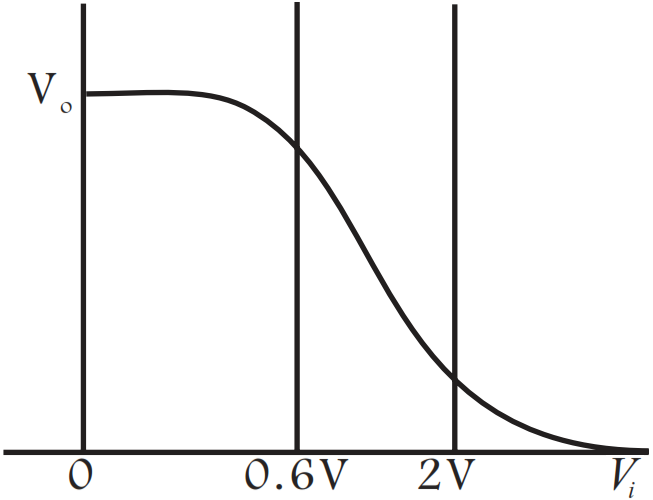
Figure shows the transfer characteristics of a base biased CE transistor. Which of the following statements are true?
- AAt Vi = 0.4V, transistor is in active state.
- BAt Vi = 1V, it can be used as an amplifier.
- CAt Vi = 0.5V, it can be used as a switch turned off.
- DAt Vi = 2.5V, it can be used as a switch turned on.
Answer
View full question & answer→- At Vi = 1V , it can be used as an amplifier.
- At Vi = 0.5V, it can be used as a switch turned off.
- At Vi = 2.5V, it can be used as a switch turned on.
Solution:
According to above graph transfer characteristics of a base biased common emitter transistor, we note that.
- When Vi= 0.4 V, output voltage remain same,there is no collection current. So, transistor circuit is not in active state.
- when Vi = 1V (This is in between 0.6V to 2V), the transistor circuit is in active state and when input is increasing output is decreasing because when CE is used as an amplifier input and output voltages are 180º out of phase. Then it is used as an amplifier.
- when Vi = 0.5V, there is no collector current. The transistor is in cut off state. The transistor circuit can be used as a switch to be turned off.
- when Vi = 2.5V, the collector current becomes maximum and transistor is in a saturation state and can used as switch turned on state.