MCQ 511 Mark
Find the angle which is $30^\circ $ more than its complement.
AnswerLet the required angle be $x,$ then its complement $= (90 - x)$
Given that $x = (90 - x) + 30$
$\Rightarrow 2x = 120$
$\Rightarrow x = 60^\circ $
View full question & answer→MCQ 521 Mark
If two interior angles on the same side of a transversal intersecting two parallel lines are in the ratio $3: 7,$ then the measure of the larger angle is:
- A
$54^\circ $
- B
$120^\circ$
- ✓
$126^\circ$
- D
$108^\circ$
AnswerCorrect option: C. $126^\circ$
Let the angles be $3x$ and $7x.$
We know that sum of two interior angles on the same side of transversal is $180.$
$3x + 7x =180$
$\Rightarrow 10x = 180$
$\Rightarrow x = 18$
Therefore, the greater angle is $7x = 7 \times 18 = 126$
View full question & answer→MCQ 531 Mark
How many degrees are there in an angle which equals one - fifth of its supplement$?$
- A
$15^\circ$
- ✓
$30^\circ$
- C
$75^\circ$
- D
$150^\circ$
AnswerCorrect option: B. $30^\circ$
Let the angle in degrees be $x$. Then, its supplement $= (180^\circ − x)$
Given, $\text{x}=\frac{1}{5}(180^\circ-\text{x})$
$\Rightarrow 5x = 180^\circ − x$
$\Rightarrow 6x = 180^\circ $
$\Rightarrow x = 30^\circ $
View full question & answer→MCQ 541 Mark
The angle between the lines $x + y - 3 = 0$ and $x - y + 3 = 0$ is α and the acute angle between the lines $\text{x}-\sqrt{3\text{y}}+2\sqrt3=0$ and $\sqrt{3\text{x}}-\text{y}+1=0$ is $\beta$. Which one of the following is correct?
- A
$\alpha-\beta$
- ✓
$\alpha>\beta$
- C
$\alpha<\beta$
- D
$\alpha-2\beta$
AnswerCorrect option: B. $\alpha>\beta$
$\angle$ between the lines $x + y - 3 = 0\ \&\ x - y + 3 = 0$ is $90^\circ $
$\Rightarrow\alpha=90^\circ$
As, $\beta$ is acuteTherefore $\alpha>\beta$
View full question & answer→MCQ 551 Mark
In Fig. $PQ || SR$ and $SP || RQ. $ Then, angles a and b are respectively: 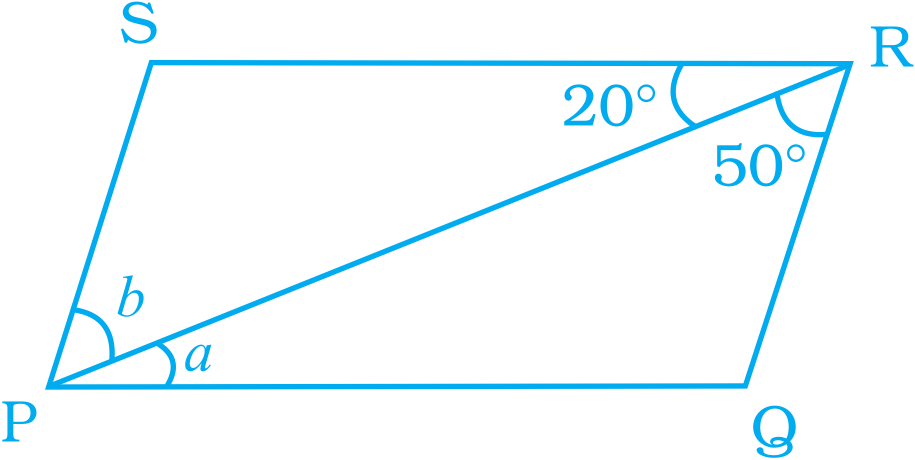
- ✓
$20^\circ , 50^\circ$
- B
$50^\circ , 20^\circ$
- C
$30^\circ , 50^\circ$
- D
$45^\circ , 35^\circ$
AnswerCorrect option: A. $20^\circ , 50^\circ$
Given, $PQ || SR$ and $PR$ is transversal.
$\therefore \angle \text{QPR}=\text{SRP}$ [Alternate interior angles]
$\Rightarrow \text{a}=20^\circ$
Also , $SP || RQ$ and $PR$ is transversal.
$\therefore \angle \text{SPR}=\text{QRP}$ [Alternate interior angles]
$\Rightarrow \text{b}=50^\circ$
View full question & answer→MCQ 561 Mark
Two supplementary angles are in the ratio $3 : 2.$ The smaller angle measures:
- A
$108^\circ $
- B
$81^\circ$
- ✓
$72^\circ $
- D
$68^\circ$
AnswerCorrect option: C. $72^\circ $
Let the angles be $3x$ and $2x$
Now, $3x + 2x = 180^\circ $
$\Rightarrow 5x = 180^\circ $
$\Rightarrow x = 36^\circ $
$\therefore$ Smaller angle $= 2x = 2 \times 36^\circ = 72^\circ $
Hence, the correct answer is option $(c).$
View full question & answer→MCQ 571 Mark
Two supplementary angles are in the ratio $4 : 5.$ Find the angles.
- A
$20^\circ , 25^\circ $
- B
$40^\circ , 50^\circ$
- ✓
$80^\circ , 100^\circ$
- D
$60^\circ , 75^\circ$
AnswerCorrect option: C. $80^\circ , 100^\circ$
Supplementary angles add up to form
Two angles are in ratio $4 : 5 ($given$)$
Let one angle be $4x$ and other be $5x$
Hene $4x + 5x = 180 ($supplementary angles$)$
$\Rightarrow9\text{x}=180$
$\Rightarrow\text{x}=\frac{180}{9}=20$
Hence two angles are
$4x = 4 × 20 = 80$
$5x = 5 × 20 = 100$
Hence two angles are
View full question & answer→MCQ 581 Mark
If the supplement of an angle is three times its complement, then angle is:
- A
$40^\circ $
- B
$35^\circ$
- C
$50^\circ$
- ✓
$45^\circ$
AnswerCorrect option: D. $45^\circ$
Let the $\angle{\text{x}}$ be the required angle
Thus, according to the question
$180 - x = 3 (90 - x)$
$\Rightarrow 180 - x = 270 - 3x$
$\Rightarrow 2x = 90$
$\Rightarrow x = 45$
View full question & answer→MCQ 591 Mark
In Fig. $PQ$ is a mirror, $AB$ is the incident ray and $BC$ is the reflected ray. If $\angle \text{ABC} = 46^\circ$, then $\angle \text{ABP}$ is equal to: 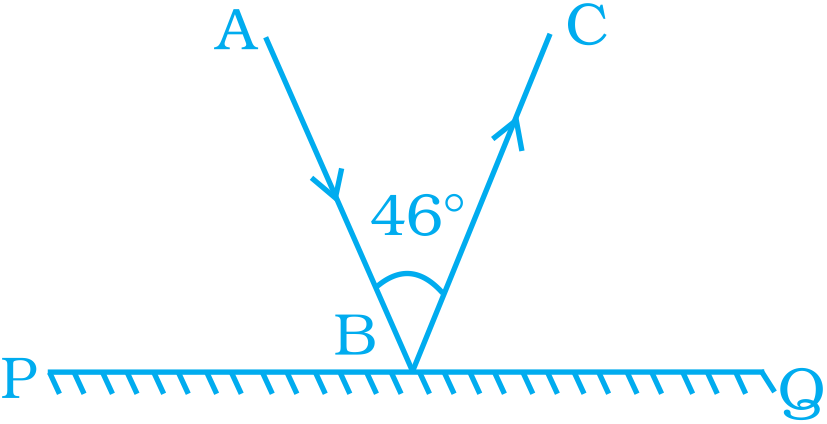
- A
$44^\circ$
- ✓
$67^\circ$
- C
$13^\circ$
- D
$62^\circ$
AnswerCorrect option: B. $67^\circ$
We know that, the angle of incidence is always equal to the angle of reflection.
$\angle\text{ABP}=\angle\text{CBQ}$
i.e. $a = b$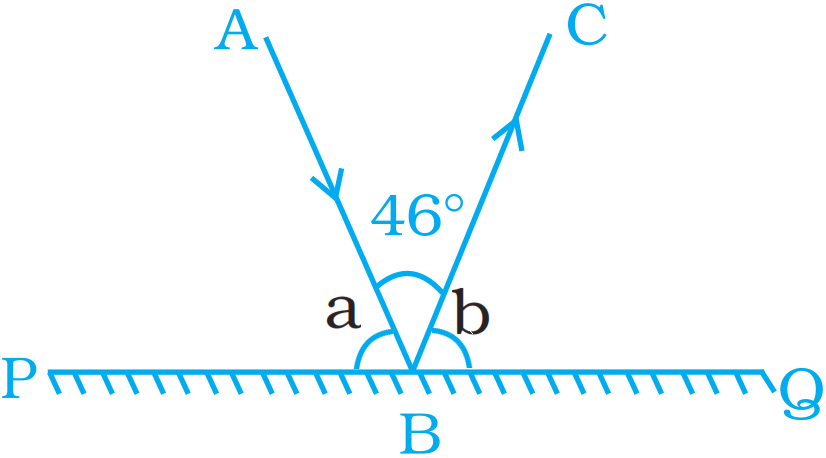
Now, sum of all the angles on a straight line is $180^\circ $
$[\therefore\angle\text{ABC}=46^\circ,\text{given}]$
$\therefore\text{a }+46^\circ+\text{b}=180^\circ$
$\Rightarrow2\text{a}=180^\circ- 46^\circ$$[\because\text{a}=\text{b}]$
$\Rightarrow2\text{a}= 134^\circ$
$\Rightarrow\text{a}=\frac{134^\circ}{2}=67^\circ$
$\therefore\angle\text{ABP}=67^\circ$ View full question & answer→MCQ 601 Mark
In Fig. if $AOB$ and $COD$ are straight lines. Then, $x + y =$ 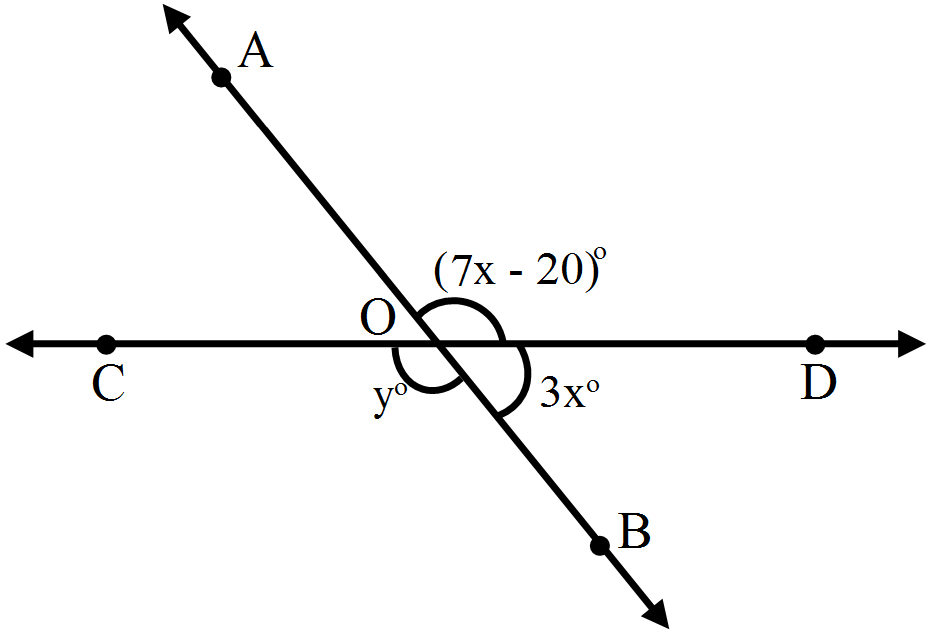
Answer$\angle \text{AOD}+\angle \text{BOD}=180^\circ$ [Linear pair angles]
$\Rightarrow (7\text{x}-20)^\circ+3\text{x}^\circ=180^\circ$
$\Rightarrow 7\text{x}-20+3\text{x}=180$
$\Rightarrow 10\text{x}=200$
$\Rightarrow \text{x}=20$
$\therefore \angle \text{AOD}=(7\times 20-20)^\circ=120^\circ$
Now, $\angle \text{AOD}=\angle \text{BOC}=120^\circ$ [Vertically opposite angles]
$\therefore \text{y}=120$
Now,$ x + y = 20 + 120$
$= 140$
Hence, the correct answer is option $(b).$
View full question & answer→MCQ 611 Mark
An angle is double of its supplement. The measure of the angle is:
- A
$60^\circ$
- ✓
$120^\circ$
- C
$40^\circ$
- D
$80^\circ$
AnswerCorrect option: B. $120^\circ$
Let the required angle be $x$
Now, supplementary of the required angle = $180^\circ$$- x$
Then,
$x = 2$($180^\circ$ $- x$)
$⇒ x =$ $360^\circ$ $- 2x$
$⇒ 3x =$ $360^\circ$
$⇒ x = $$120^\circ$
Hence, the correct answer is option $(b).$
View full question & answer→MCQ 621 Mark
The lines which lie on the same plane and do not intersect at any point are called:
AnswerWhen the distance between the two lines are equal and they never intersect at any point, then they are said to be parallel lines.
Hence, the answer is parallel lines.
View full question & answer→MCQ 631 Mark
If two complementary angles are in the ratio $3 : 5,$ then the angles are ________.
- A
$65^\circ , 35^\circ$
- ✓
$65^\circ , 25^\circ$
- C
$15^\circ , 65^\circ$
- D
$15^\circ , 85^\circ$
AnswerCorrect option: B. $65^\circ , 25^\circ$
Given that the ratio of two complementary angles is $13 : 5.$
Let the angles are $13x$ and $5x$ We know, $13x + 5x = 90^\circ $
$\Rightarrow x = 5$
Therefore, the angles are $65^\circ $ and $25^\circ .$
View full question & answer→MCQ 641 Mark
AnswerAll linear pairs are supplementarysince supplementary angles are those angles whose sum is $180$ degrees.
View full question & answer→MCQ 651 Mark
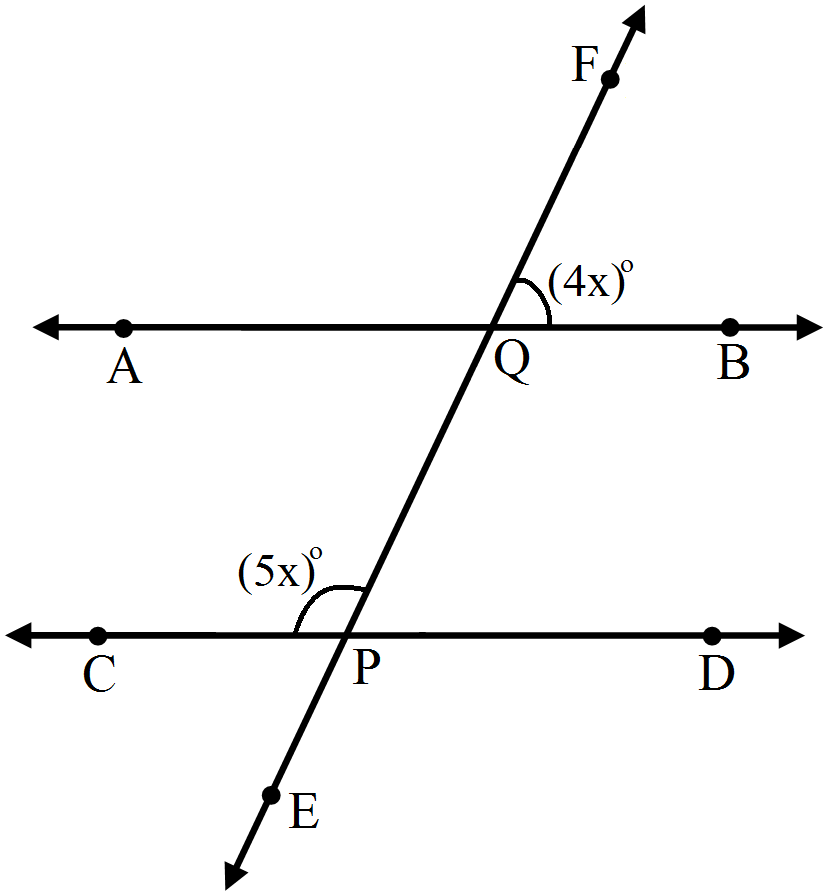
In Fig. $AB || CD$ and $EF$ is a transversal intersecting $AB$ and $CO$ at $P$ and $Q$ respectively. The measure of $\angle \text{DPQ}$ is:
- A
$100^\circ $
- ✓
$80^\circ$
- C
$110^\circ$
- D
$70^\circ$
AnswerCorrect option: B. $80^\circ$
$\angle \text{BQF}=\angle \text{AQP}=(4\text{x})^\circ$ [Vertically opposite angles]
Since, $AB || CD$
$\therefore \angle \text{AQP}+ \angle \text{CPQ}=180^\circ$ [Angles on the same side of a transversal line are supplementary]
$\Rightarrow (4\text{x})^\circ+(5\text{x})^\circ=180^\circ$
$\Rightarrow 9\text{x}=180$
$\Rightarrow \text{x}=20$
$\therefore \angle \text{BQF}=(4\times20)^\circ=80^\circ$
Now, $\angle \text{BQF}=\angle \text{DPQ}=80^\circ$ [Corresponding angles]
Hence, the correct answer is option $(b).$
View full question & answer→MCQ 661 Mark
In Fig. if $AOC$ is a straight line, then $x =$ 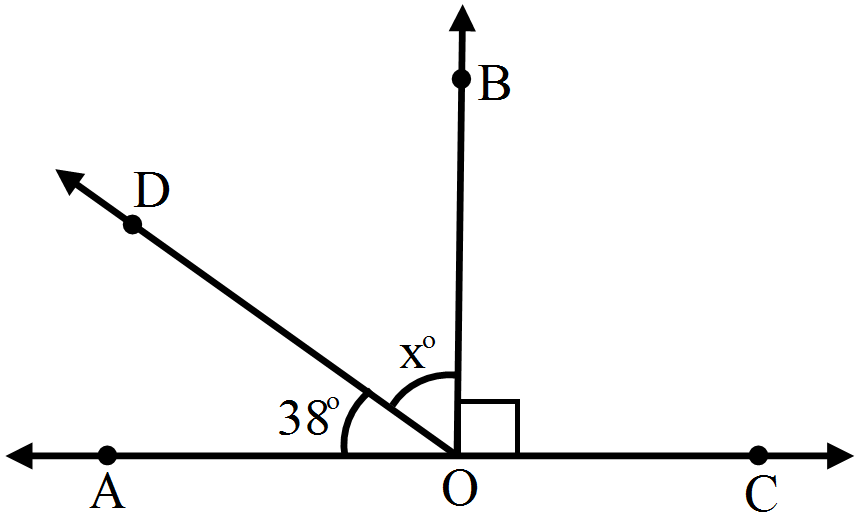
- A
$42^\circ $
- ✓
$52^\circ$
- C
$142^\circ $
- D
$38^\circ$
AnswerCorrect option: B. $52^\circ$
$\angle \text{AOD}+\angle \text{DOB}+\angle \text{BOC}=180^\circ [ \because AOC$ is a straight line$]$
$\Rightarrow 38^\circ+\text{x}+90^\circ=180^\circ$
$\Rightarrow \text{x}+128^\circ=180^\circ$
$\Rightarrow \text{x}=52^\circ$
Hence, the correct answer is option $(b).$
View full question & answer→MCQ 671 Mark
If an angle is eight times its complementary angle, then the measurement of the angle is:
- A
$90^\circ$
- B
$20^\circ$
- ✓
$80^\circ$
- D
$160^\circ$
AnswerCorrect option: C. $80^\circ$
If the angle is $x^\circ ,$ then by hypothesis
$\Rightarrow x^\circ = 8 (90^\circ - x^\circ )$
$\Rightarrow 720 = 8x^\circ + x^\circ $
or $ 9x^\circ = 720^\circ $
$\therefore x = 80^\circ $
View full question & answer→MCQ 681 Mark
The angle which exceeds its complement by $20^\circ $ is:
- A
$45^\circ$
- ✓
$55^\circ$
- C
$70^\circ$
- D
$110^\circ$
AnswerCorrect option: B. $55^\circ$
Let the angle be $x$
$\therefore$ complement $= (90 - x) x + (x + 20)$
$= 902x = 90 - 20$
$\text{x}=\frac{70}{2}$
$x = 35^\circ $
$\therefore$ other angle $= 90 - 35 = 55^\circ $
View full question & answer→MCQ 691 Mark
Instruments used to draw a pair of parallel lines are:
AnswerWe can draw parallel lines using set square and scale.
View full question & answer→MCQ 701 Mark
In fig. if $AB, CD$ and $EF$ are straight lines, then $x =$ 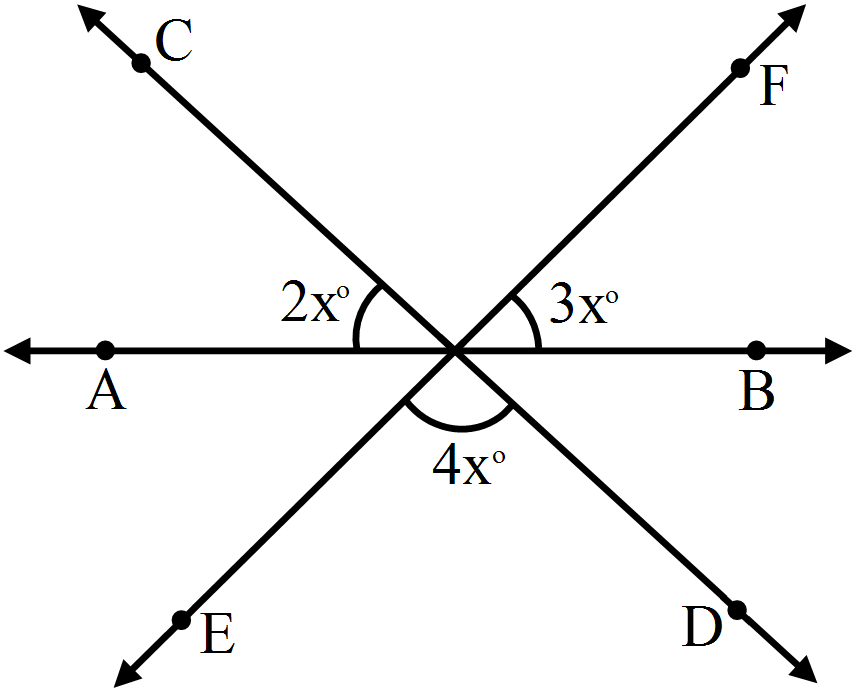
Answer Let all the lines intersect at $O.$
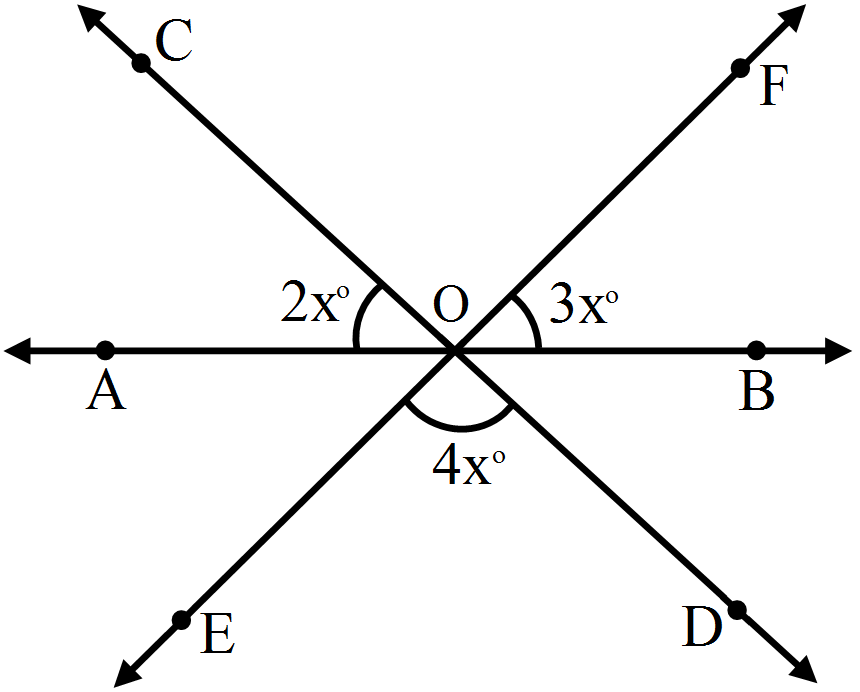
$\angle \text{COF}=\angle \text{DOE}=4\text{x}^\circ$ [Vertically opposite angles]
$\angle \text{AOC}+\angle \text{COF}+\angle \text{BOF}=180^\circ [AOB$ is a straight line$]$
$\Rightarrow 2\text{x}^\circ+4\text{x}^\circ+3\text{x}^\circ=180^\circ$
$\Rightarrow 9\text{x}^\circ=180^\circ$
$\Rightarrow9\text{x}=180$
$\Rightarrow \text{x}=20$
Hence, the correct answer is option $(c).$
View full question & answer→MCQ 711 Mark
Two supplementary angles are in the ratio $5 : 7.$ Find the smallest angle. $1^\text{st} \text{angle}=\frac{5}{12}\times180^\circ$ and $2^\text{st} \text{angles}=\frac{7}{12}\times180^\circ$
AnswerSum of supplementary angles $= 180^\circ $
Given two supplementary angles are in the ratio $5 : 7.$
$1^\text{st} \text{angle}=\frac{5}{12}\times180^\circ=5\times15=75^\circ$
$2^\text{st} \text{angles}=\frac{7}{12}\times180^\circ=7\times15=105^\circ$
View full question & answer→MCQ 721 Mark
In Fig. if $AB$ is parallel to $CD,$ then the value of $\angle \text{BPE}$ is: 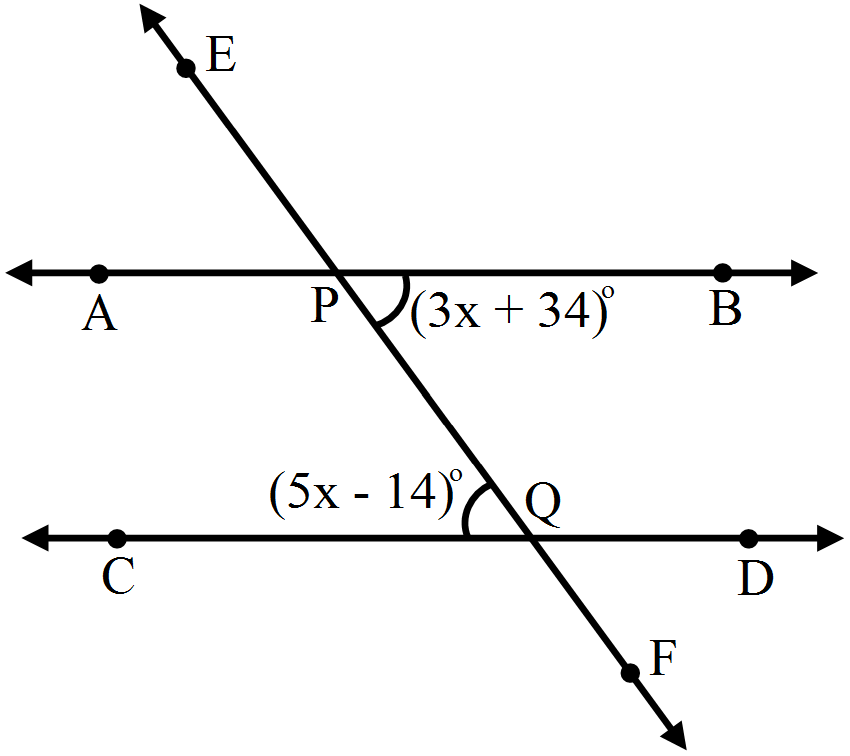
- A
$106^\circ$
- B
$76^\circ$
- ✓
$74^\circ$
- D
$84^\circ$
AnswerCorrect option: C. $74^\circ$
Since, $AB || CD$
$\therefore \angle \text{BPQ}= \angle \text{PQC}$ [Alternate interior angles]
$\Rightarrow(3\text{x}+34)^\circ=(5\text{x}-14)^\circ$
$\Rightarrow 3\text{x}+34=5\text{x}-14$
$\Rightarrow 48=2\text{x}$
$\Rightarrow \text{x}=24$
$\therefore \angle\text{BPQ}=(3\times 24+34)^\circ=106^\circ$
$\angle \text{BPQ}+\angle \text{BPE}=180^\circ$ [EF is a straight line]
$\Rightarrow 106^\circ+\angle \text{BPE}=180^\circ$
$\Rightarrow \angle \text{BPE}=74^\circ$
Hence, the correct answer is option $(c).$
View full question & answer→MCQ 731 Mark
In a pair of adjacent angles,
$(i).$ vertex is always common,
$(ii).$ one arm is always common, and
$(iii).$ uncommon arms are always opposite rays
Then
AnswerCorrect option: B. $(iii)$ is flase
Adjacent angles have a common vertex and a common arm.
but uncommon arms are only opposite in linear pair.
So, they always do not need to be opposite.
So, statement $(iii)$ is false
View full question & answer→MCQ 741 Mark
If two supplementary angles are in the ratio $4 : 5,$ then the angles are __________.
- ✓
$80^\circ , 100^\circ $
- B
$85^\circ , 95^\circ $
- C
$40^\circ , 50^\circ $
- D
$60^\circ , 120^\circ $
AnswerCorrect option: A. $80^\circ , 100^\circ $
If two angles are supplementary, then the sum of the angles is $180^\circ .$
If the ratio is $4 : 5,$ let angles are $4x$ and $5x$
Now we know, $4x + 5x = 180^\circ $
$\Rightarrow 9x = 180$
$\Rightarrow x = 20$
Therefore, angles are $100^\circ $ and $80^\circ $
View full question & answer→MCQ 751 Mark
Lines $m$ and $n$ are cut by a transversal so that $\angle{1}$ and$\angle{5}$ are corresponding angles. If $\angle1=26\text{x}-7^\circ$ and $\angle5=20\text{x}+17^\circ.$ What value of $x$ makes the lines $m$ and $n$ parallel$?$
- A
$5$
- ✓
$4$
- C
$4\frac{1}{2}$
- D
$3\frac{1}{4}$
Answer For the lines $mm$ and $nn$ to be parallel corresponding angles should be equal, i.e,
$\angle1=\angle5$
$\Rightarrow26\text{x}-7^\circ=20\text{x}+17^\circ$
$\Rightarrow6\text{x}=24^\circ$
$\Rightarrow\text{x}=4^\circ$
View full question & answer→MCQ 761 Mark
If two supplementary angles differ by $44^\circ ,$ then one of the angles is ___________.
- A
$102^\circ$
- B
$65^\circ $
- ✓
$112^\circ $
- D
$72^\circ $
AnswerCorrect option: C. $112^\circ $
Two supplementary angles differ by $44^\circ $
$\therefore x + (x + 44^\circ ) = 180^\circ $
$2x = 136^\circ $
$x = 68^\circ $
Other angle $= (x + 44^\circ ) = (68^\circ + 44^\circ ) = 112^\circ $
View full question & answer→MCQ 771 Mark
In Fig. $PQ || RS$ and $a : b = 3 : 2.$ Then, f is equal to: 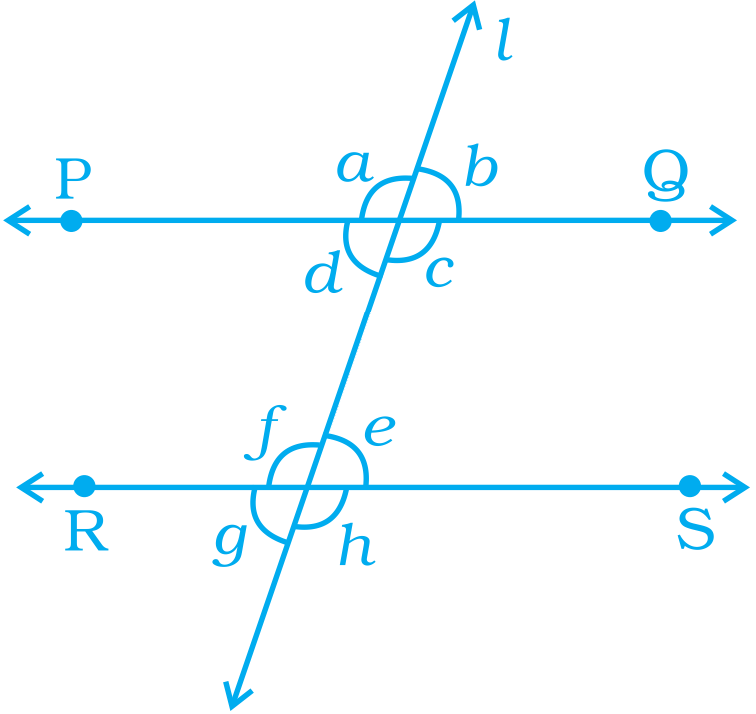
- A
$36^\circ $
- ✓
$108^\circ $
- C
$72^\circ $
- D
$144^\circ$
AnswerCorrect option: B. $108^\circ $
We have, $a : b = 3 : 2$ Let $a = 3x$ and $b = 2x.$
Since, $a$ and $b$ form a linear pair.
$\because \text{a}+\text{b} = 180^\circ$
$\Rightarrow 3\text{x} + 2\text{x} = 180^\circ$
$\Rightarrow 5\text{x} = 180^\circ [ \because$ sum of linear of angles is $180^\circ ]$
$\Rightarrow\text{x}=\frac{180°}{5}$
$\Rightarrow \text{x} = 36^\circ $
$\therefore \text {a}=3\text{x}\Rightarrow\text{a}=3\times36^\circ=108^\circ$
Now, $f = a [$Corresponding angles$]$
$\Rightarrow \text{f} = 108^\circ$
View full question & answer→MCQ 781 Mark
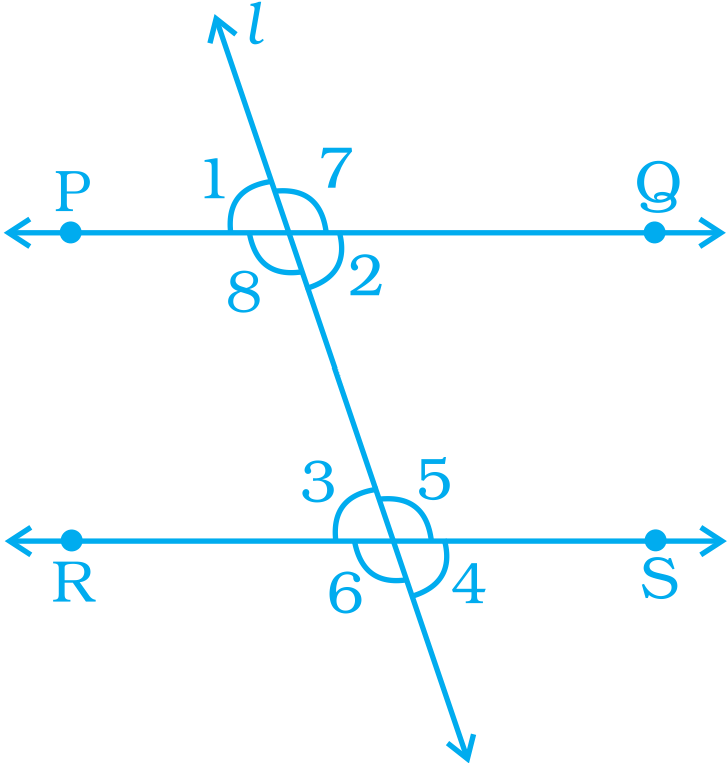
In Fig. which of the following is true?
- A
$\angle1 = \angle5 $
- B
$\angle4 = \angle8 $
- ✓
$\angle5 = \angle8$
- D
$\angle3 = \angle7$
AnswerCorrect option: C. $\angle5 = \angle8$
From the above figure, $\angle5$ and $\angle8$ are alternate interior angles.
Hence, $\angle5 = \angle8$
View full question & answer→MCQ 791 Mark
Supplementary and complementary angles need not be
Answer Supplementary angles are those whose sum is $180$ degrees.
Complementary angles are those angles whose sum is $90$ degrees.
hence they dont need to be adjacent.
View full question & answer→MCQ 801 Mark
The point of the hyperbola $\text{x}=\frac{\text{x}-1}{\text{x}+1}$ at which the tangents are parallel to $y = 2x + 1$ are
- A
$(0, -1)$ only
- B
$(-2, 3)$ only
- ✓
$(0, -1), (-2, 3)$
- D
$(2, 3), (5, 4)$
AnswerCorrect option: C. $(0, -1), (-2, 3)$
$\text{x}=\frac{\text{x}-1}{\text{x}+1}$
Slope of tangent at
$\text{(x, y)}=\frac{\text{dy}}{\text{dx}}=\frac{2}{(\text{x}+1)^2}$
for tangent to be parallel to $y = 2x + 1$
$\frac{2}{(\text{x}+1)^2}=2$
$\Rightarrow{(\text{x}+1)}^2=1$
$\Rightarrow\text{x}=0$ or $\text{x}=-2$
$\Rightarrow $ corresponding points are $(0, -1)$ & amp; $(-2, 3)$
View full question & answer→MCQ 811 Mark
In Fig. $PQ || RS.$ If $\angle1= (2\text{a} + \text{b})^\circ$ and $\angle6= (3\text{a} - \text{b})^\circ$, then the measure of $\angle2$ in terms of $b$ is: 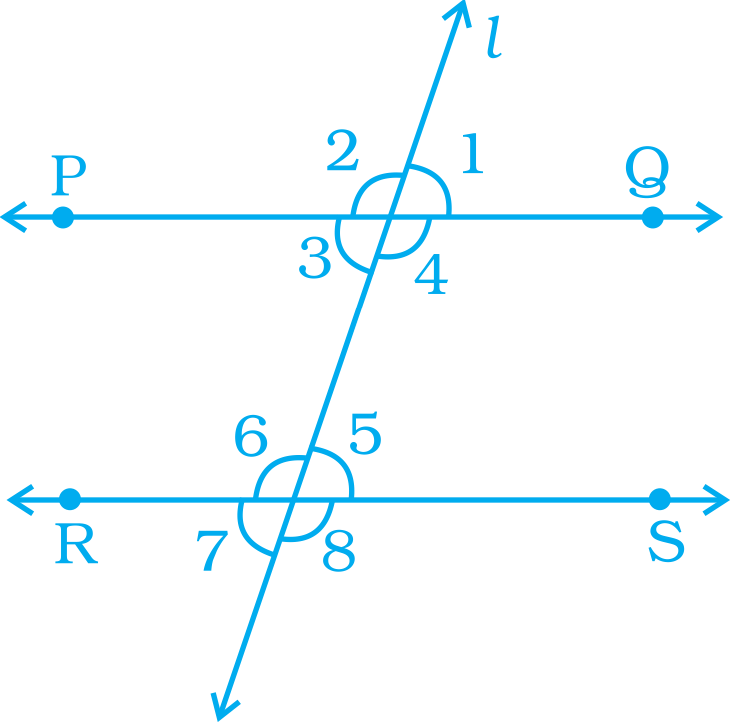
- A
$(2 + b)^\circ$
- B
$(3 – b)^\circ$
- ✓
$(108 – b)^\circ$
- D
$(180 – b)^\circ$
AnswerCorrect option: C. $(108 – b)^\circ$
From them given figure, $\angle1=\angle5$ [Corresponding angle]
$\Rightarrow\angle5 = (2\text{a}+\text{b})^\circ$
$[\because\angle1=(2\text{a}+\text{b})^\circ,\text{given}]$
Also, $\angle5+\angle6=180^\circ$ [liner paire]
$\Rightarrow (2\text{a} + \text{b})^\circ + (3\text{a} - \text{b})^\circ = 180^\circ$
$[\because\angle6=(3\text{a}-\text{b})^\circ,\text{given}]$
$\Rightarrow(2\text{a} + 3\text{a}) + (\text{b} - \text{b}) = 180^\circ$
$\Rightarrow5\text{a} = 180^\circ$
$\Rightarrow\text{a}=\frac{180^\circ}{5}$
$\Rightarrow \text{a} = 36^\circ$
Now, $\angle1+\angle2=180^\circ$ [liner paier]
$\Rightarrow\angle2=180^\circ-\angle1$
$\Rightarrow\angle2=180^\circ-(2\text{a}+\text{b})^\circ$
$[\because\angle1=(2\text{a}+\text{b})^\circ,\text{given}]$
$\Rightarrow\angle2=180^\circ-2\text{a}-\text{b}$
$\Rightarrow\angle2=180^\circ-2\times36^\circ-\text{b}$
$[\because\ \text{a}=36^\circ]$
$\Rightarrow\angle2=180^\circ-72^\circ-\text{b}$
$\Rightarrow\angle2=(180^\circ-\text{b})^\circ$
View full question & answer→MCQ 821 Mark
Which one of the following is correct $?$
AnswerIf two parallel lines are cut by a transversal, the corresponding angles are equal.
If two parallel lines are cut by a transversal, the alternate interior angles are equal.
If two parallel lines are cut by a transversal, the interior angles on the same side of the transversal are supplementary.
Hence all options are correct.
View full question & answer→MCQ 831 Mark
In Fig. if $AB || CO$ then $x =$ 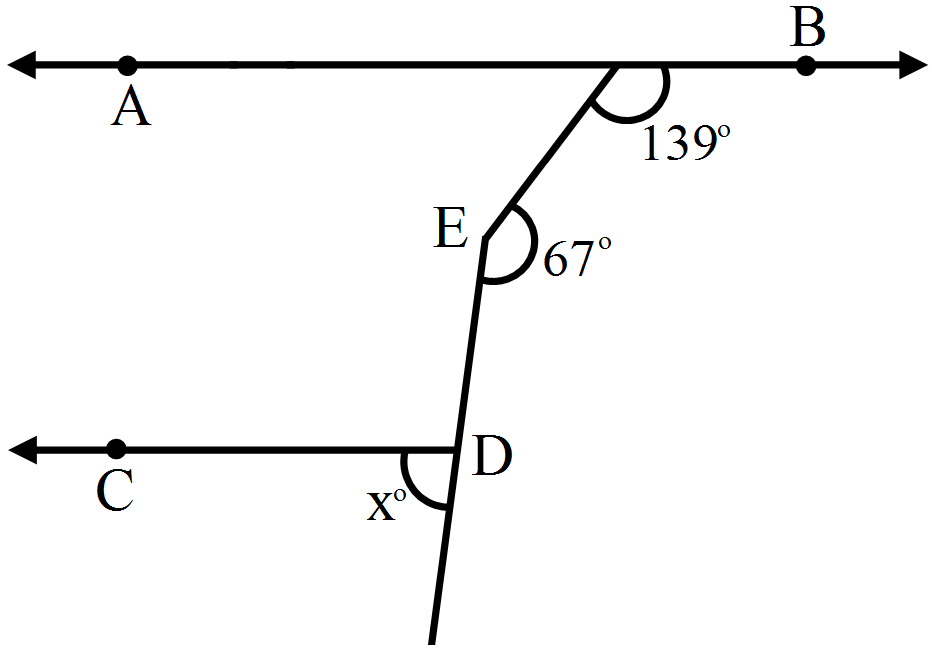
Answer 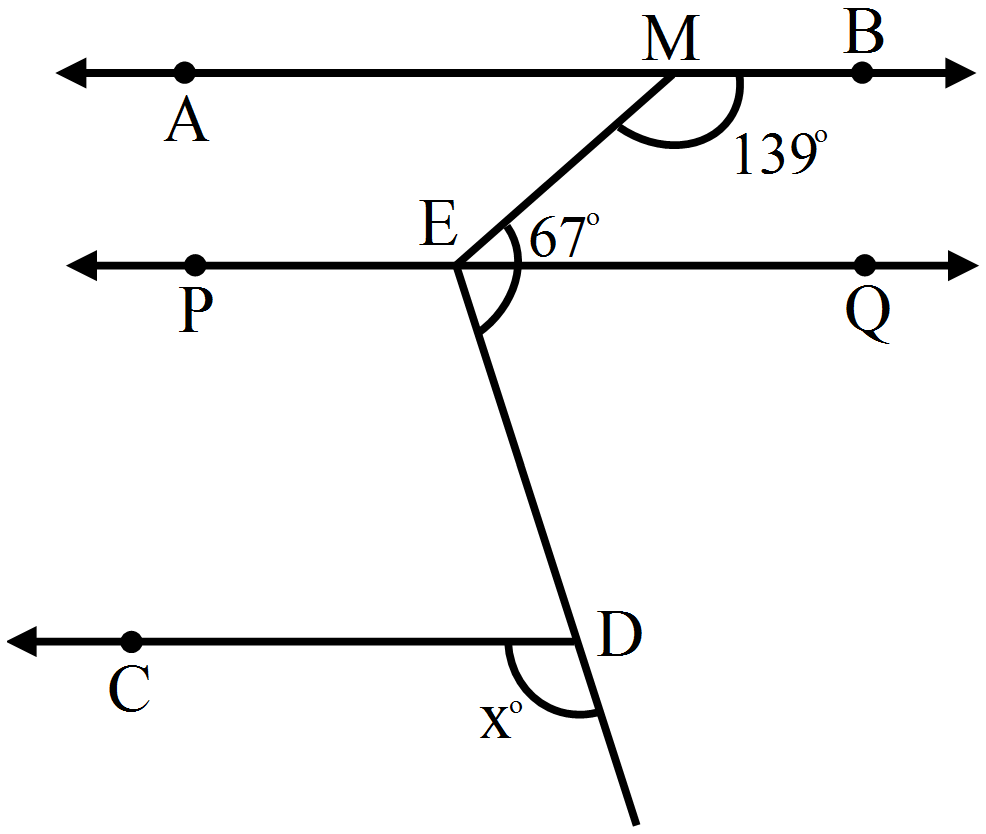
Construction: Draw a line $PQ$ parallel to $AB$ which is also parallel to $CD$
Since, $PQ || AB$
$\therefore \angle \text{AME}+\angle \text{QEM}=180^\circ$ [Angles on the same side of a transversal line are supplementary]
$\Rightarrow 139^\circ+\angle \text{QEM}=180^\circ$
$\Rightarrow \angle \text{QEM}=41^\circ$
Now, $\angle \text{QEM}+\angle \text{DEQ}=\angle \text{MED}$
$\Rightarrow 41^\circ+\angle \text{DEQ}=67^\circ$
$\Rightarrow \angle \text{DEQ}=26^\circ$
Now, $\angle \text{PED}+\angle \text{DEQ}=180^\circ$ [Linear Pair angles]
$\Rightarrow \angle \text{PED}+26^\circ=180^\circ$
$\Rightarrow \angle \text{PED}=154^\circ$
Since, $ PQ || AB$
$\therefore \text{x}^\circ=\angle \text{PED}$ [Corresponding angles]
$\Rightarrow \text{x}^\circ-154^\circ$
$\Rightarrow \text{x}=154$
Hence, the correct answer is option $(a).$
View full question & answer→MCQ 841 Mark
The angle between the internal and the external bisectors of an angle of a triangle is ___________.
- ✓
$90^\circ$
- B
$180^\circ$
- C
$270^\circ$
- D
$30^\circ$
AnswerCorrect option: A. $90^\circ$
Lets say an angle of a triangle is $\theta ,$ then after it is bisected each smaller angle will now be $\frac{\theta}{2}$.
If you take the external angle of $\theta ,$ it will be $180^\circ - \theta $ and if this is bisected the two new angles would be
$\frac{(180^\circ-\theta)}{2}$ which is equal to $\frac{90^\circ-\theta}{2}$ .
Now adding these two angles, we get $\frac{\theta}{2}+\frac{90^\circ-\theta}{2}=90^\circ.$
Hence the angle between the internal and external bisectors of an angle of a triangle is always $90^\circ .$
View full question & answer→MCQ 851 Mark
If amongst two supplementary angles, the measure of smaller angle is four times its complement, then their difference is:
- A
$30^\circ$
- ✓
$36^\circ$
- C
$43^\circ$
- D
$45^\circ$
AnswerCorrect option: B. $36^\circ$
Let $x, y$ be any two supplementary angles and $x$ be the smaller angle.
$\therefore x + y = 180^\circ $
Also, $x = 4 (360^\circ - x)$
$⟹ x = 4 \times 360^\circ - 4x$
$⟹ 5x = 4 \times 360^\circ $
$⟹ x = 4 \times 72 = 288^\circ x + y = 180^\circ $
$⟹ y = -108^\circ = 252y = -108^\circ = 252^\circ $
$\therefore x − y = 288 - 252 = 36^\circ $
View full question & answer→MCQ 861 Mark
Vertically opposite angles are always:
AnswerWhen two lines intersect, then vertically opposite angles so formed are equal.
View full question & answer→MCQ 871 Mark
If amongst two supplementary angles, the measure of smaller angle is four times its complement, then their difference is:
- A
$30^\circ$
- ✓
$36^\circ$
- C
$43^\circ$
- D
$45^\circ$
AnswerCorrect option: B. $36^\circ$
Let two angles be $x$ and $(180 - x)$
According to question,
$x = 4(90 − x)$
$\Rightarrow x = 360 − 4x$
$\Rightarrow 5x = 360$
$\Rightarrow x = 72^\circ $
$\therefore$ Angles are $72^\circ $ and $108^\circ $
Difference of these two angles $= 108^\circ - 72^\circ = 36^\circ .$
View full question & answer→MCQ 881 Mark
Two angles, which have their arms parallel are either$......$ or $.......$
AnswerTwo angles which have their arms parallel are either equal or supplementary.
View full question & answer→MCQ 891 Mark
The measure of an angle is four times the measure of its supplementary angle. Then the angles are __________.
- ✓
$36^\circ , 144^\circ$
- B
$40^\circ , 160^\circ$
- C
$18^\circ , 72^\circ$
- D
$50^\circ , 200^\circ$
AnswerCorrect option: A. $36^\circ , 144^\circ$
Two angles are called to be supplementary if the summation of both angles is $180^\circ $
say$\angle{\text{A}}$ and $\angle{\text{B}} $ are supplementary angles
$\Rightarrow\angle{\text{A}}+\angle{\text{B}}=180^\circ$
$\therefore\angle{\text{A}}=4\times\angle{\text{B}}$ (Given in question)
So, $4\times\angle{\text{B}}+\angle{\text{B}}=180^\circ$
$\Rightarrow\angle{\text{B}}=36^\circ$
Now, $\angle{\text{A}}=4\times\angle{\text{B}}$
$\Rightarrow\angle{\text{A}}=4\times36^\circ$
$\Rightarrow\angle{\text{A}}=144^\circ$
so these angles are $36^\circ , 144^\circ $
View full question & answer→MCQ 901 Mark
In Fig. $PA || BC || DT$ and $AB || DC$. Then, the values of a and b are respectively. 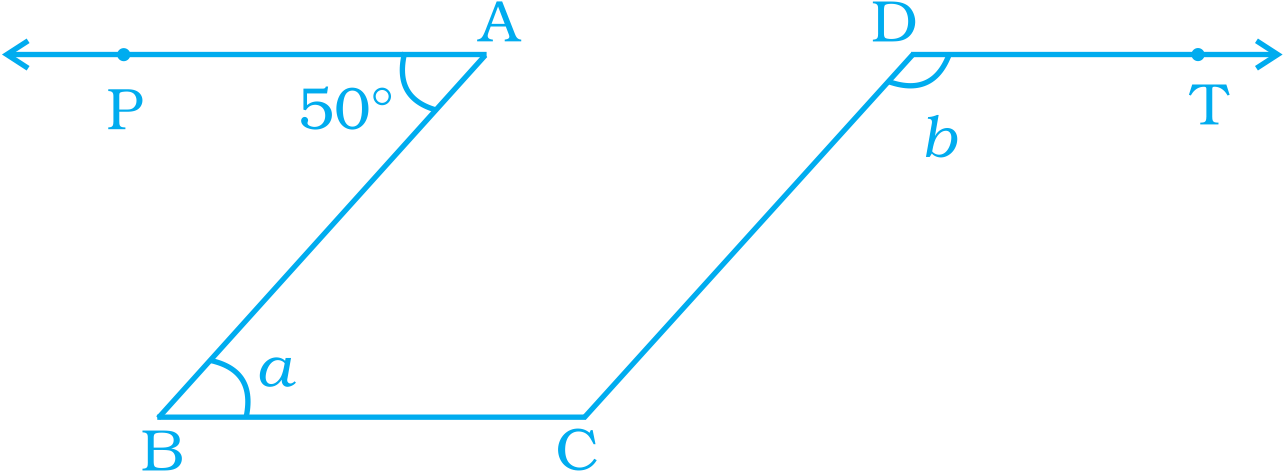
- A
$60^\circ , 120^\circ $
- ✓
$50^\circ , 130^\circ $
- C
$70^\circ , 110^\circ$
- D
$80^\circ , 100^\circ$
AnswerCorrect option: B. $50^\circ , 130^\circ $
It is given that, $PA || BC$ and $AB$ is transversal.
$\therefore\angle\text{PAB}=\angle\text{ABC}$ [Alternate interior angles]
$\Rightarrow 50^\circ=\text{a}$
Also, $AB || DC$ and $BC$ is transversal.
$\therefore\angle\text{ABC}+\angle\text{DCB}=180^\circ$ [Consecutive interior angles]
$\Rightarrow\text{a}+\angle\text{DCB}=180^\circ$
$\Rightarrow\angle\text{DCB}=180^\circ-\text{a}$
$\Rightarrow\angle\text{DCB}=180^\circ-50^\circ$ $[\because\text{a}=50^\circ]$
$\Rightarrow\angle\text{DCB}=130^\circ$
Also, $BC || DT$ and $DC$ is transversal.
$\therefore\angle \text{CDT}=\text{DCB}$ [Alternate interior angles]
$\Rightarrow \text{b}= 130^\circ$ $[\because\angle\text{DCB}=130^\circ]$
View full question & answer→MCQ 911 Mark
Mark the correct alternative of the following. In a $\triangle\text{ABC},$ if $2\angle\text{A}=3\angle\text{B}=6\angle\text{C},$ then the measure of the smallest angle is$?$
- A
$90^\circ$
- B
$60^\circ$
- C
$40^\circ$
- ✓
$30^\circ$
AnswerCorrect option: D. $30^\circ$
Given, $2\angle\text{A}=3\angle\text{B}=6\angle\text{C},$
$2\angle\text{A}=6\angle\text{C}\angle\text{A}=3\angle\text{C}$
$3\angle\text{B}=6\angle\text{CB}=2\angle\text{C}$
Now, $\angle\text{A}+\angle\text{B}+\angle\text{C}=180^\circ$
$3\angle\text{C}+2\angle\text{C}+\angle\text{C}=180^\circ$
$6\angle\text{C}=180^\circ$
$\angle\text{C}=30^\circ$
Small angle $= 30^\circ $
View full question & answer→MCQ 921 Mark
In a pair of adjacent angles, $(i)$ vertex is always common, $(ii)$ one arm is always common, and $(iii)$ uncommon arms are always opposite rays. Then,
AnswerCorrect option: B. $(iii)$ is false.
Two angles are called adjacent angles, if they have a common vertex and a common arm but no common interior points. It is not necessary that uncommon arms must be always
opposite rays.
View full question & answer→MCQ 931 Mark
If $2x + 3y + 4 = 0 \ \& \ \text{amp}; \lambda\text{x}+\text{ky}+2=0$ are identical lines then $3\lambda-2\text{k}=$
AnswerGiven,$ 2x + 3y + 4 = 0$ and $\lambda\text{x}+\text{ky}+2=0$
multiplying $2^{nd}$ equation and comparing with $1^{st},$
$2\lambda=2$ and $2\text{k}=3=>\lambda=1$ and $\text{k}=\frac{3}{2}$
Now $,3\lambda-2\text{k}=3\times1-2\times\frac{3}{2}= > 0$
View full question & answer→MCQ 941 Mark
$\angle{\text{A}}$ and $\angle{\text{B}}$ are complement of each other. Find angle $A$ and $B$ if, $A = 7x + 6$ and $B = 8x + 9.$
- ✓
$A = 41^\circ , B = 49^\circ $
- B
$A = 51^\circ , B = 39^\circ$
- C
$A = 61^\circ , B = 29^\circ$
- D
$A = 21^\circ , B = 59^\circ$
AnswerCorrect option: A. $A = 41^\circ , B = 49^\circ $
Since,$\angle{\text{A}}$ and $\angle{\text{B}}$ are complement
$\therefore\angle{\text{A}}+\angle{\text{B}}=90^\circ$
$7x + 6 + 8x + 9 = 90^\circ $
$15x + 15 = 90^\circ $
$15x = 75$
$x = 5$
$A = 7 \times 5 + 6 = 41^\circ $
$B = 8 \times 5 + 9 = 49^\circ $
View full question & answer→MCQ 951 Mark
The supplementry angle of an angle is one third of itself. Then the angle of its supplement are
- ✓
$135^\circ , 45^\circ $
- B
$60^\circ , 80^\circ $
- C
$120^\circ , 360^\circ$
- D
$60^\circ , 120^\circ$
AnswerCorrect option: A. $135^\circ , 45^\circ $
Let one angle be $x^\circ .$
Then, another angle is $\frac{\text{x}^\circ}{3}.$
Thus, $\text{x}+\frac{\text{x}}{3}=180^\circ$
$4\text{x}=180\times3\text{x}=\frac{180\times3}{4}=135^\circ$
Thus, the required angles are $135^\circ , 45^\circ .$
View full question & answer→MCQ 961 Mark
In Fig. if $AB || CD.$ The value of $x$ is: 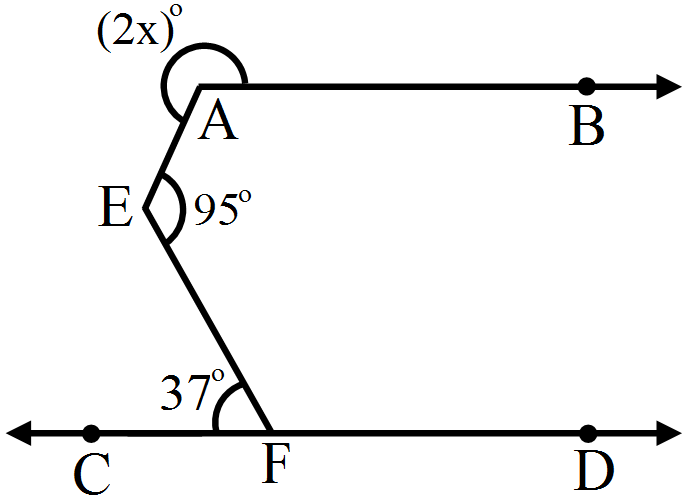
Answer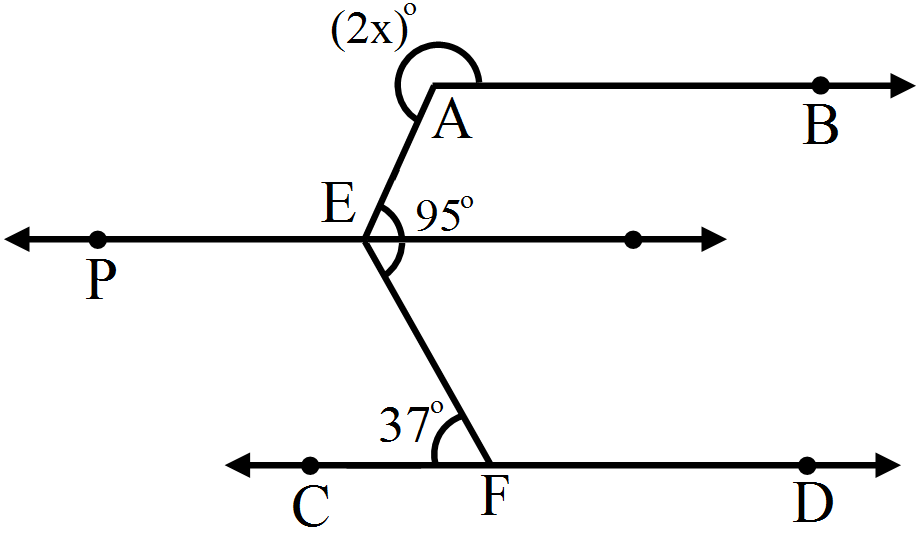
Construction: Draw a line $PQ$ parallel to $AB$ which is also parallel to $CD$
Since, $PQ || CD$
$\therefore \angle \text{EFC}=\angle \text{FEQ}=37^\circ$ [Alternate angles]
Now, $\angle \text{AEQ}+\angle \text{FEQ}=\angle \text{AEF}$
$\Rightarrow \angle \text{AEQ}+37^\circ=95^\circ$
$\Rightarrow \angle \text{AEQ}=58^\circ$
Since, $PQ || AB$
$\therefore \angle \text{EAB}+\angle \text{AEQ}=180^\circ$ [Angles on the same side of a transversal line are supplementary]
$\Rightarrow \angle\text{EAB}+58^\circ=180^\circ$
$\Rightarrow \angle\text{EAB}=122^\circ$
$\angle\text{EAB}+\text{Reflex}\angle\text{EAB}=360^\circ$ [Complete angle]
$\therefore 122^\circ+(2\text{x})^\circ=360^\circ$
$\Rightarrow 2\text{x}=238$
$\Rightarrow \text{x}=119$
Hence, the correct answer is option $(d).$
View full question & answer→MCQ 971 Mark
An angle is thrice its supplement. The measure of the angle is:
- A
$120^\circ$
- B
$105^\circ $
- ✓
$135^\circ$
- D
$150^\circ$
AnswerCorrect option: C. $135^\circ$
cLet the required angle be $x$
Then,
$x = 3(180^\circ - x)$
$\Rightarrow x = 540^\circ - 3x$
$\Rightarrow 4x = 540^\circ $
$\Rightarrow x = 135^\circ $
Hence, the correct answer is option $(c).$
View full question & answer→MCQ 981 Mark
In Fig. the value of a is:
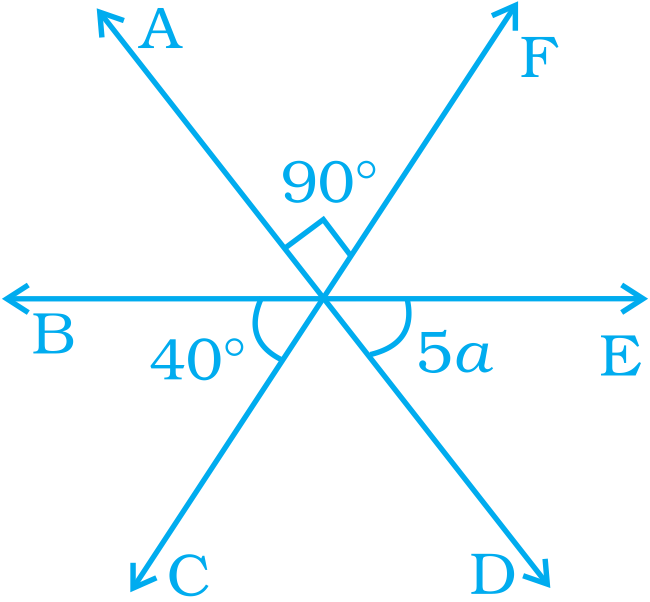
- A
$20^\circ$
- B
$15^\circ$
- C
$5^\circ$
- ✓
$10^\circ$
AnswerCorrect option: D. $10^\circ$
From the given figure, we can say that.
$\angle\text{BOC}=\angle\text{EOF} 40^\circ=\angle\text{EOF}$ [vertycally opposite angles]
$\Rightarrow40^\circ=\angle\text{EOF}$
Since, sum of all the angles on a straight line is $180^\circ $
$\therefore\angle\text{BOC} +\angle\text{FOE}+\angle\text{EOD}=180^\circ$
$\Rightarrow 90^\circ+40^\circ+5\text{a}=180^\circ$
$\Rightarrow130^\circ+5\text{a}=180^\circ\Rightarrow5\text{a}=180^\circ-130^\circ$
$\Rightarrow5\text{a}=50^\circ$
$\Rightarrow\text{a}=\frac{50^\circ}{5}=10^\circ$
View full question & answer→MCQ 991 Mark
In Fig. the value of $x$ is: 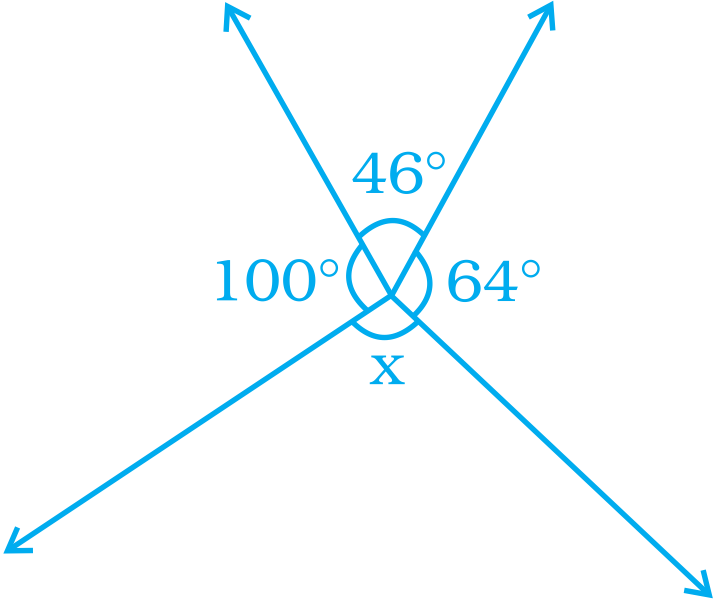
- A
$110^\circ$
- B
$46^\circ$
- C
$64^\circ$
- ✓
$150^\circ$
AnswerCorrect option: D. $150^\circ$
We know that, the sum of all angles around a point is $360^\circ .$
$\therefore100^\circ+46^\circ+64^\circ+\text{x}=360^\circ$
$\Rightarrow210^\circ+\text{x}=360^\circ$
$\Rightarrow\text{x}=360^\circ-210^\circ$
$\Rightarrow\text{x}=150^\circ$
View full question & answer→MCQ 1001 Mark
In Fig. $AB || CO, \angle \text{OAB}=150^\circ$ and $\angle \text{OCO}=120^\circ.$ Then, $\angle \text{AOC}=$ 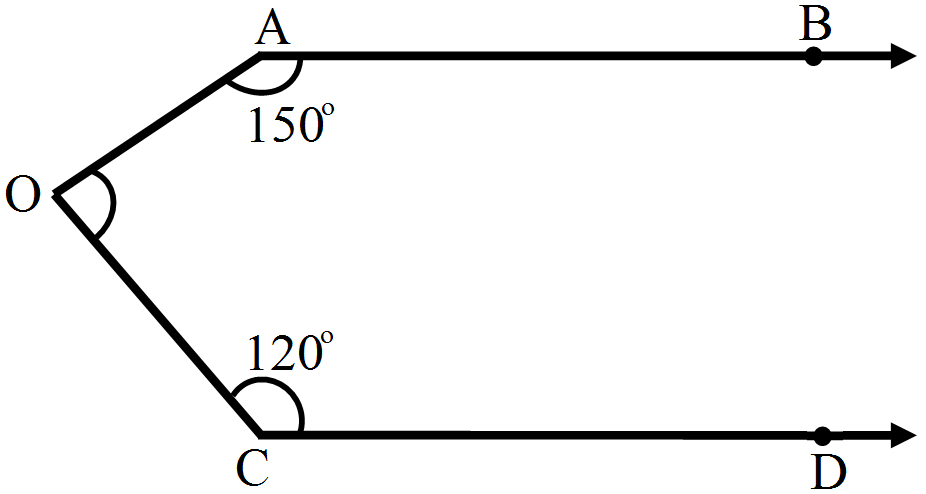
- A
$80^\circ$
- ✓
$90^\circ$
- C
$70^\circ$
- D
$100^\circ$
AnswerCorrect option: B. $90^\circ$
Construction: Draw a line $OE$ from the point $O$ parallel to $AB$ and $CD$
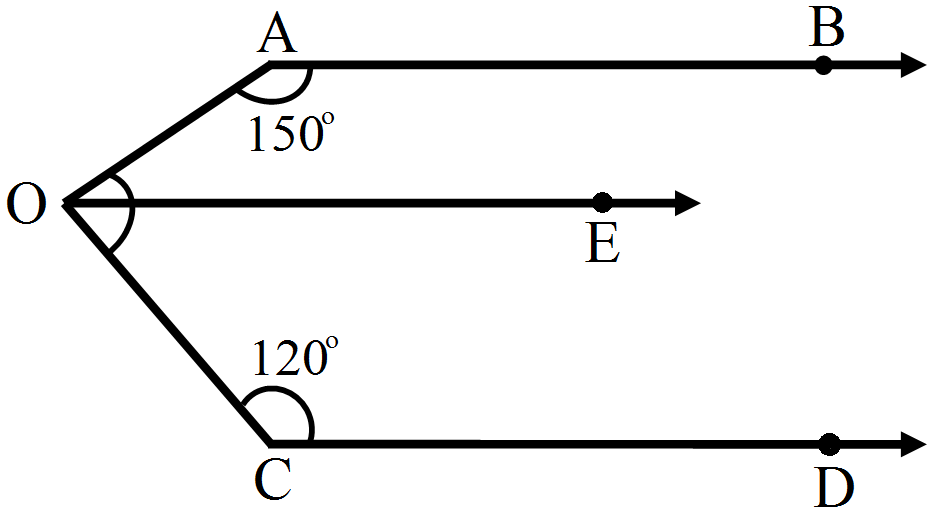
Since, $AB || OE$
$\therefore\angle \text{BAO}+\angle \text{AOE}=180^\circ$ [Angles on the same side of a transversal line are supplementary]
$\Rightarrow 150^\circ+\angle \text{AOE}=180^\circ$
$\Rightarrow \angle \text{AOE}=30^\circ$
Again, $CD || OE$
$\therefore \angle \text{DCO}+\angle \text{COE}=180^\circ$ [Angles on the same side of a transversal line are supplementary]
$\Rightarrow 120^\circ+\angle \text{COE}=180^\circ$
$\Rightarrow \angle \text{COE}=60^\circ$
Now, $\angle \text{AOC}=\angle \text{AOE}+\angle \text{COE}$
$=30^\circ+60^\circ$
$=90^\circ$
Hence, the correct answer is option $(b).$
View full question & answer→