MCQ 11 Mark
If two adjacent angles are equal, then each angle measures $90^\circ .$
Answer Answer is $(B)$
If two adjacent angles measures $90$ degrees only when lines are perpendicular to each other.
hence the above statement is False.
View full question & answer→MCQ 21 Mark
If an angle is its own complementary angle, then its measure is _________.
- A
$30^\circ $
- ✓
$45^\circ $
- C
$60^\circ $
- D
$90^\circ $
AnswerCorrect option: B. $45^\circ $
Let the angle be $X$ It is given that $X$ is its own complementary angle.
$\Rightarrow X + X = 90^\circ $
$\Rightarrow 2X = 90^\circ $
$\Rightarrow X = 45^\circ $
View full question & answer→MCQ 31 Mark
Supplementary angle of $100^\circ $ is:
- A
$180^\circ $
- B
$90^\circ $
- ✓
$80^\circ $
- D
$60^\circ $
AnswerCorrect option: C. $80^\circ $
Supplementary angles are two angles that have a sum of $180^\circ .$
The given supplementary angle is $100^\circ $ and we have to find other.
$\Rightarrow $ Supplementary angle $= 180^\circ - 100^\circ = 80^\circ .$
$\therefore$ Supplementary angle of $100^\circ $ is $80^\circ .$
View full question & answer→MCQ 41 Mark
Find the measure of the complementary angle of $90^\circ .$
- ✓
$0^\circ$
- B
$45^\circ$
- C
$90^\circ$
- D
$60^\circ$
AnswerCorrect option: A. $0^\circ$
The pair of angles is said to be complementary, when their sum is $90^\circ .$
Let $x, y$ be any two complementary angles and $\text{m}(\angle{\text{x}})=90^\circ$
$\Rightarrow\text{m}(\angle{\text{x}})+\text{m}(\angle{\text{y}})=90^\circ.....$ (By definition of complementary angles)
$\Rightarrow90^\circ+\text{m}(\angle\text{y})=90^\circ$
$\Rightarrow\text{m}(\angle{\text{y}})=0^\circ$
Hence, measure of complementary angle of $90^\circ $ is $0^\circ .$
View full question & answer→MCQ 51 Mark
Consider the following statements relating to $3$ lines $L_1 , L_2$ and $L_3$ in the same plane
$1.$ If $L_2$ and $L_3$ are both parallel to $L_1,$ then they are parallel to each other.
$2.$ If $L_2$ and $L_3$ are both perpendicular to $L_1,$ then they are parallel to each other.
$3.$ If the acute angle between $L_1$ and $L_2$ is equal to to acute angle between $L_1$ and $L_3$, then $L_2$ is parallel to $L_3$.
Of these statements:
- ✓
$(1)$ and $(2)$ are correct
- B
$(1)$ and $(3)$ are correct
- C
$(2)$ and $(3)$ are correct
- D
$(1), (2)$ and $(3)$ are correct
AnswerCorrect option: A. $(1)$ and $(2)$ are correct
$(1)$ and $(2)$ are correct
View full question & answer→MCQ 61 Mark
Two complementary angles are such that two times the measure of one is equal to three times the measure of the other. The measure of the larger angle is:
- A
$72^\circ$
- B
$108^\circ$
- C
$36^\circ$
- ✓
$54^\circ$
AnswerCorrect option: D. $54^\circ$
Let the complementary angles be $x$ and $(90^\circ − x).$
Then, $2x = 3(90^\circ − x)$
$\Rightarrow2{\text{x}}=270^\circ-3\text{x}$
$\Rightarrow5\text{x}=270^\circ$
$\Rightarrow\text{x}=\frac{270^\circ}{5}=54^\circ$
$\therefore$ The two angles are $54^\circ , 36^\circ $
View full question & answer→MCQ 71 Mark
Find the angle which measure twice of its supplement.
Answer Let the required angle be $x,$ then its supplement $= (180 - x)$ and $x = 2(180 - x)$
So, $(180 - x) + 2(180 - x) = 180$
$\Rightarrow 180 - x + 360 - 2x = 180$
$\Rightarrow -3x + 360 = 0$
$\Rightarrow -3x = -360$
$\Rightarrow 3x = 360$
$\Rightarrow x = 120^\circ $
View full question & answer→MCQ 81 Mark
The angles $x$ and $90^\circ – x$ are:
AnswerSum of the given angles $= x + 90^\circ – x = 90^\circ $
Since, the sum of given two angles is $90^\circ $
Hence, they are complementary to each other.
View full question & answer→MCQ 91 Mark
Find the measure of an angle which is one - fifth of its supplement.
- A
$15^\circ $
- ✓
$30^\circ$
- C
$45^\circ$
- D
AnswerCorrect option: B. $30^\circ$
Let the desired angle be $x.$
According to the question,
$\Rightarrow\text{x}=\frac{1}{5}(180-\text{x})$
$\Rightarrow6\text{x}=180$
$\Rightarrow\text{x}=30^\circ$
View full question & answer→MCQ 101 Mark
The sum of an angle and one third of its supplementary angle is $90^\circ$. The measure of the angle is:
- A
$135^\circ$
- B
$120^\circ$
- C
$60^\circ$
- ✓
$45^\circ$
AnswerCorrect option: D. $45^\circ$
Let the required angle be $x$
Now, supplementary of the required angle $= 180^\circ- x$
Then,
$\text{x}+\frac{1}{3}(180^\circ-\text{x})=90^\circ$
$\Rightarrow 3\text{x}+180^\circ-\text{x}=270^\circ$
$\Rightarrow 2\text{x}=90^\circ$
$\Rightarrow \text{x}=45^\circ$
Hence, the correct answer is option $(d).$
View full question & answer→MCQ 111 Mark
Line $A$ is parallel to line $B ,$ line $C$ is perpendicular to line $A,$ Line $D$ is perpendicular to line $A.$Which statement below must also be true$ ?$
- A
Line $C$ is perpendicular to line $D$
- ✓
Line $C$ is perpendicular to line $B$
- C
Line $A$ is perpendicular to line $B$
- D
Line $A$ is perpendicular to line $D$
AnswerCorrect option: B. Line $C$ is perpendicular to line $B$
Line $C$ is perpendicular to line $B$
View full question & answer→MCQ 121 Mark
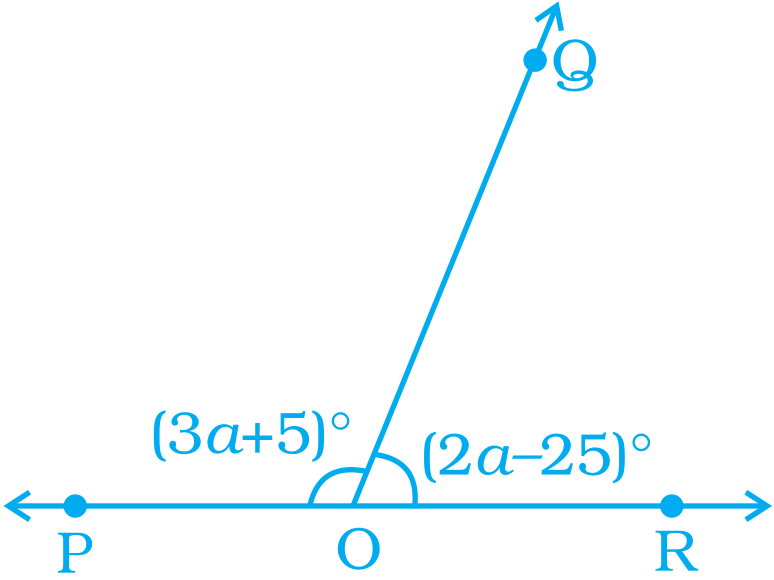
In Fig. $POR$ is a line. The value of a is:
- ✓
$40^\circ$
- B
$45^\circ$
- C
$55^\circ$
- D
$60^\circ$
AnswerCorrect option: A. $40^\circ$
Since, $POR$ is a line. So, the sum of angles forming linear pair is $180^\circ .$
$\therefore\angle\text{POQ}=\angle\text{ROQ}=180^\circ$
$\Rightarrow(3\text{a}+5)^\circ+(2\text{a}-25^\circ)=180^\circ$
$\Rightarrow3\text{a}+5^\circ+2\text{a}-25^\circ=180^\circ$
$\Rightarrow5\text{a}-20^\circ=180^\circ$
$\Rightarrow5\text{a}=180^\circ+20^\circ$
$\Rightarrow5\text{a}=200^\circ$
$\Rightarrow\text{a}=\frac{200^\circ}{5}$
$\Rightarrow\text{a}=40^\circ$
Hence, the value of a is $40^\circ .$
View full question & answer→MCQ 131 Mark
Two angles are supplementary and one angle is twice the other angle then, find the both angles.
- A
$110^\circ , 55^\circ $
- ✓
$60^\circ , 120^\circ$
- C
$70^\circ , 140^\circ$
- D
$45^\circ , 90^\circ$
AnswerCorrect option: B. $60^\circ , 120^\circ$
Let one angle be $x^\circ $
then other angle is $2x^\circ ($As twice of one angle$)$
Since two angles are supplementary
$x^\circ + 2x^\circ = 180^\circ $
$3x^\circ = 180^\circ $
$\text{x}=\frac{180}{3}=60^\circ$
One angle is $60^\circ ,$
Other angle $2x^\circ = 2 \times 60^\circ = 120^\circ $
View full question & answer→MCQ 141 Mark
Vertically opposite angles are always:
AnswerBy, property of vertically opposite angles, Vertically opposite angles are always equal.
View full question & answer→MCQ 151 Mark
If one angle of a linear pair is acute, then its other angle will be ______.
AnswerLinear pair of angles are supupsupplementary ie they add up to form $180$ degrees.
Hence one angle of linear pair is acute, other has to be obtuse angle.
View full question & answer→MCQ 161 Mark
How many degrees are there in an angle which equals one - fifth of its supplement$?$
- A
$15^\circ$
- ✓
$30^\circ$
- C
$75^\circ$
- D
$150^\circ$
AnswerCorrect option: B. $30^\circ$
Two angles which are supplementary add upto $180 .....(1)$
Let one angle be $x$ and other be $\frac{1}{5}\text{x}$
Hence, $\text{x}+\frac{1}{5}\text{x}=180....$ From $(1)$
$\Rightarrow\frac{6}{5}\text{x}=180$
$\Rightarrow\text{x}=180\times\frac{5}{6}=150$
Thus one angle is $150$ and the other angle is
$\frac{150}{5}=30^\circ$
View full question & answer→MCQ 171 Mark
In Fig. the value of $x$ is:
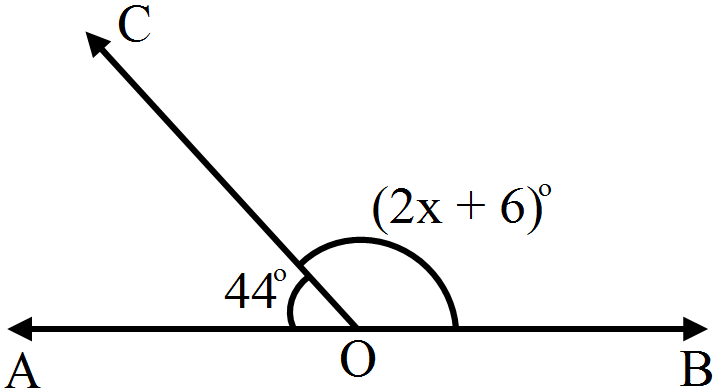
Answer$\angle \text{AOC}$ and $\angle \text{BOC}=180^\circ$ [$\because$ Linear pair angles]
$\Rightarrow 44^\circ+(2\text{x}+6)^\circ=180^\circ$
$\Rightarrow (2\text{x+6})^\circ=136^\circ$
$\Rightarrow 2\text{x}+6=136$
$\Rightarrow 2\text{x}=130$
$\Rightarrow \text{x}=65$
Hence, the correct answer is option $(b).$
View full question & answer→MCQ 181 Mark
An angle is $14^\circ $ more than its complementary angle, then angle is:
- A
$38^\circ$
- ✓
$52^\circ$
- C
$50^\circ$
- D
AnswerCorrect option: B. $52^\circ$
Let the angle be $\angle{\text{x}}$
Thus, according to the question,
$x = 14 + 90 - x$
$\Rightarrow 2x = 104$
$\Rightarrow x = 52$
Therefore, the angle is $52^\circ .$
View full question & answer→MCQ 191 Mark
Find the measure of the supplementary angle of $132^\circ .$
- ✓
$48^\circ$
- B
$32^\circ$
- C
$42^\circ$
- D
$38^\circ$
AnswerCorrect option: A. $48^\circ$
Two angles are supplementary when they add up to form $180$ degrees.
If one angle $= 132$
Let the other angle be $x$
Hence $x = 180 -132$
$= 48$
Hence supplementary angle of the following angle is $48$
View full question & answer→MCQ 201 Mark
The angle which is one - fifth of its complement is:
- ✓
$15^\circ$
- B
$30^\circ$
- C
$45^\circ$
- D
$60^\circ$
AnswerCorrect option: A. $15^\circ$
We need to find out Angle which is $\frac{1}{5}$ of its complement is:
Let, the angle be $x$
$\therefore$ Its complement is $(90 - x)$ According to the question,
$\text{x}=\frac{1}{5}\times(90-\text{x})\text{x}=18-\frac{\text{x}}{5}$
Now, $\text{x}+\frac{\text{x}}{5}=18$
$\therefore\frac{5\text{x}+\text{x}}{5}=18$
or $\frac{6\text{x}}{5}=18$
or $6\text{x}=90$
$\therefore\text{x}=15^\circ$
View full question & answer→MCQ 211 Mark
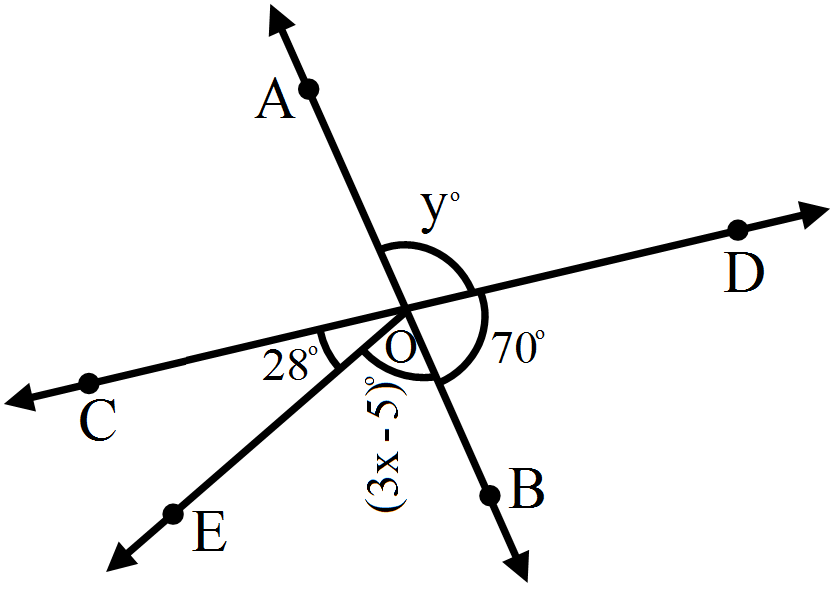
In Fig. if $AOB$ and $COD$ are straight lines, then:
- A
$x = 29, y = 100$
- B
$x = 110, y = 29$
- ✓
$x = 29, y = 110$
- D
$x = 39, y = 110$
AnswerCorrect option: C. $x = 29, y = 110$
$\angle \text{AOD}+\angle \text{BOD}=180^\circ$ [Linear pair angles]
$\Rightarrow \text{y}^\circ+70^\circ=180^\circ$
$\Rightarrow \text{y}^\circ=110^\circ$
$\Rightarrow \text{y}=110$
Now, $\angle \text{AOC}= \angle \text{BOD}=70^\circ$ [Vertically opposite angles]
Now, $\angle \text{AOC}+\angle \text{COE}+\angle \text{EOB}+\angle \text{BOD}+\angle \text{AOD}=360^\circ$ [Complete angle]
$\Rightarrow 70^\circ+28^\circ+(3\text{x}-5)^\circ+70^\circ+110^\circ=360^\circ$
$\Rightarrow (3\text{x})^\circ+273^\circ=360^\circ$
$\Rightarrow3\text{x}=87$
$\Rightarrow \text{x}=29$
Hence, the correct answer is option $(c).$
View full question & answer→MCQ 221 Mark
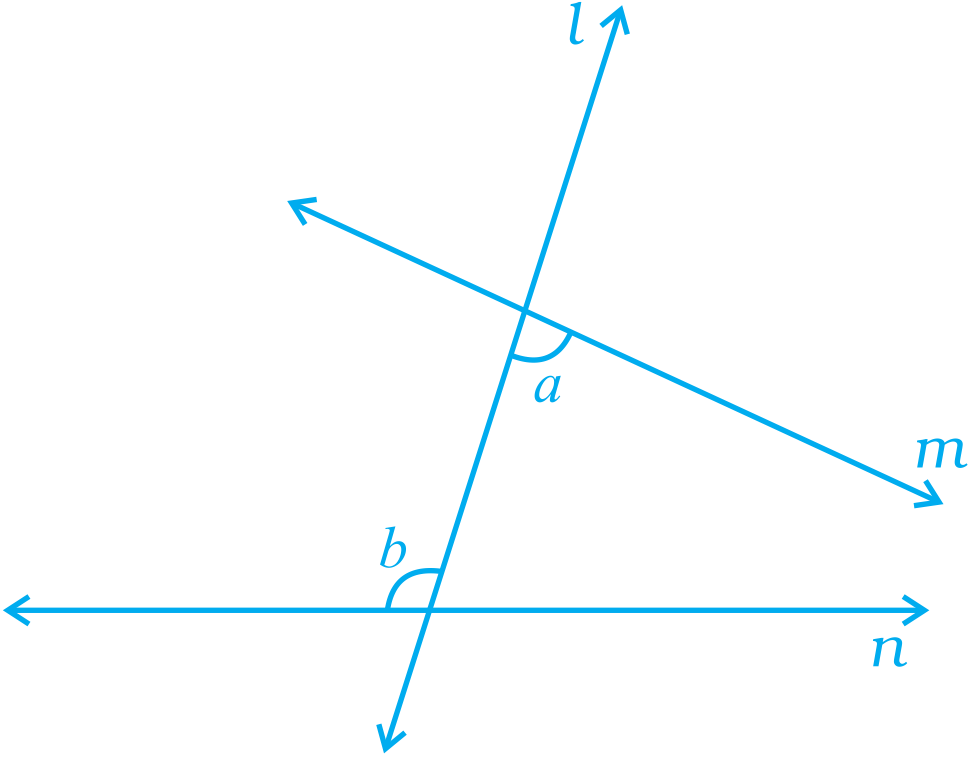
In Fig. $a$ and $b$ are:
- A
Alternate exterior angles.
- B
- ✓
Alternate interior angles.
- D
Vertically opposite angles.
AnswerCorrect option: C. Alternate interior angles.
In the given figure, $a$ and $b$ are alternate interior angles as both lie on opposite sides of transverse line.
View full question & answer→MCQ 231 Mark
The pair of complementary angles from the following options are:
- A
$30^\circ , 150^\circ$
- B
$76^\circ , 14^\circ$
- ✓
$65^\circ , 65^\circ$
- D
$120^\circ , 30^\circ$
AnswerCorrect option: C. $65^\circ , 65^\circ$
Complementary angles are those, whose measures add up to $90^\circ $ Out of the given options,
$30+150=180^\circ\neq90^\circ76+14=90^\circ\\65+65=130^\circ\neq90^\circ120+30=150^\circ\neq90^\circ$
View full question & answer→MCQ 241 Mark
Lines $PQ$ and $RS$ intersect at $O.$ If $\angle\text{POR}$ is three times $\angle\text{ROQ}$, then $\angle\text{SOQ}$ is:
- A
$120^\circ$
- B
$150^\circ$
- ✓
$135^\circ$
- D
$45^\circ$
AnswerCorrect option: C. $135^\circ$
$\angle\text{POR}=3\angle\text{ROQ}$ (Given)
$\angle\text{POR}+\angle\text{ROQ}=180^\circ$
$\Rightarrow3\angle\text{ROQ}+\angle\text{ROQ}=180^\circ$
$\Rightarrow4\angle\text{ROQ}=180^\circ$
$\Rightarrow\text{ROQ}=\frac{180^\circ}{4}=45^\circ$
Now, $\angle\text{SOQ}=\angle\text{POR}$
$=3\angle\text{ROQ }(\text{Ver. opp.}{\angle\text{S}})$
$=3\times45^\circ=135^\circ$
View full question & answer→MCQ 251 Mark
If two supplementary angles are in the ratio $2 : 7,$ then the angles are:
- A
$35^\circ , 145^\circ $
- B
$70^\circ , 110^\circ $
- ✓
$40^\circ , 140^\circ$
- D
$50^\circ , 130^\circ$
AnswerCorrect option: C. $40^\circ , 140^\circ$
Let the angles be $2x$ and $7x$
Angles are given supplementary $2x + 7x = 180^\circ $
$9x = 180^\circ $
$x = 20^\circ $
So the angles are $2 \times 20^\circ = 40^\circ $ and $7 \times 20^\circ = 140^\circ $
View full question & answer→MCQ 261 Mark
Find the measure of the supplementary angle of $138^\circ .$
- A
$48^\circ$
- ✓
$42^\circ$
- C
$52^\circ$
- D
$38^\circ$
AnswerCorrect option: B. $42^\circ$
Two angles are supplementary when they add upto form $180^\circ .$
Given, one angle $= 138.$
Let the supplement angle be $x.$
Hence, $x = 180 - 138 = 42^\circ $
Hence, supplementary angle of the following angle is $42^\circ .$
View full question & answer→MCQ 271 Mark
Two adjacent angles whose sum is $180$ is called:
- A
- ✓
- C
Vertically opposite angles
- D
AnswerThe adjacent angles whose sum is $180$ degrees is called linear pair.
View full question & answer→MCQ 281 Mark
Find the angle which is $56^\circ$ more than its complement.
- A
$22^\circ$
- B
$63^\circ$
- ✓
$73^\circ$
- D
$33^\circ$
AnswerCorrect option: C. $73^\circ$
Let unknown angle be $x^\circ .$
$\therefore$ Complement of $x = 90^\circ - x$
Acc to question,
$(90 - x)^\circ - x = 56^\circ $
$90^\circ - 2x = 56^\circ $
$-2x = -34^\circ $
$x = 17^\circ $
$\therefore (90 - x) = 90^\circ - 17^\circ = 73^\circ $
View full question & answer→MCQ 291 Mark
A line $AB$ is parallel to the line $CD$ This is symbolically written as
- A
$\overleftrightarrow{\text{AB}}\neq\overleftrightarrow{\text{CD}}$
- B
$\overleftrightarrow{\text{AB}}-\overleftrightarrow{\text{CD}}$
- C
$\overleftrightarrow{\text{AB}}\perp\overleftrightarrow{\text{CD}}$
- ✓
$\overleftrightarrow{\text{AB}}\parallel\overleftrightarrow{\text{CD}}$
AnswerCorrect option: D. $\overleftrightarrow{\text{AB}}\parallel\overleftrightarrow{\text{CD}}$
A Line $AB$ is parallel to the line $CD.$
This is symbolically written as
$\overleftrightarrow{\text{AB}}\parallel\overleftrightarrow{\text{CD}}$
View full question & answer→MCQ 301 Mark
If the sum of two adjacent angles is $100^\circ $ and one of them is $35^\circ ,$ then the other is :
- A
$70^\circ$
- ✓
$65^\circ$
- C
$135^\circ$
- D
$145^\circ$
AnswerCorrect option: B. $65^\circ$
Let the other angle be $x$
Now their sum $= 100^\circ $
$\Rightarrow x + 35^\circ = 100^\circ $
$\Rightarrow x = 100^\circ - 35^\circ = 65^\circ $
So the other angle is $65^\circ $
View full question & answer→MCQ 311 Mark
If angles of a linear pair are equal, then the measure of each angle is:
- A
$30^\circ$
- B
$45^\circ$
- C
$60^\circ$
- ✓
$90^\circ$
AnswerCorrect option: D. $90^\circ$
Let the required angle be $x$
Now, Sum of linear pair angles $= 180^\circ $
$\Rightarrow x + x = 180^\circ $
$\Rightarrow 2x = 180^\circ $
$\Rightarrow x = 90^\circ $
Hence, the correct answer is option $(d).$
View full question & answer→MCQ 321 Mark
Angles between South and West and South and East are:
- A
Vertically opposite angles.
- ✓
- C
- D
Adjacent but not supplementary.
Answer
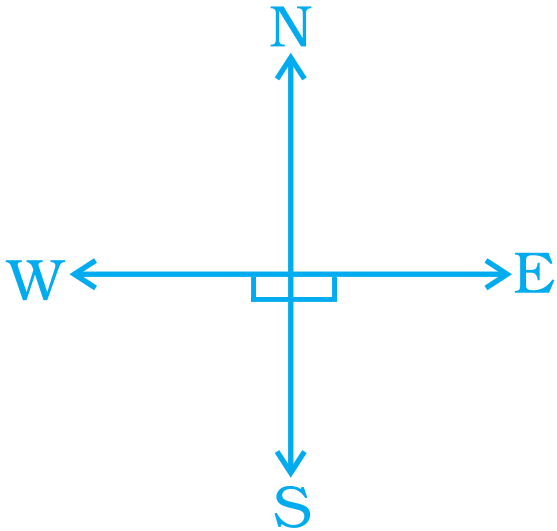
From the above figure, we can say that angle between South and West is $90^\circ $ and angle between South and East is $90^\circ .$ So, their sum is $180^\circ .$
Hence, both angles make a linear pair.
View full question & answer→MCQ 331 Mark
In Fig. lines $PQ$ and $ST$ intersect at $O.$ If $\text{POR} = 90^\circ $ and $x : y = 3 : 2,$ then $z$ is equal to: 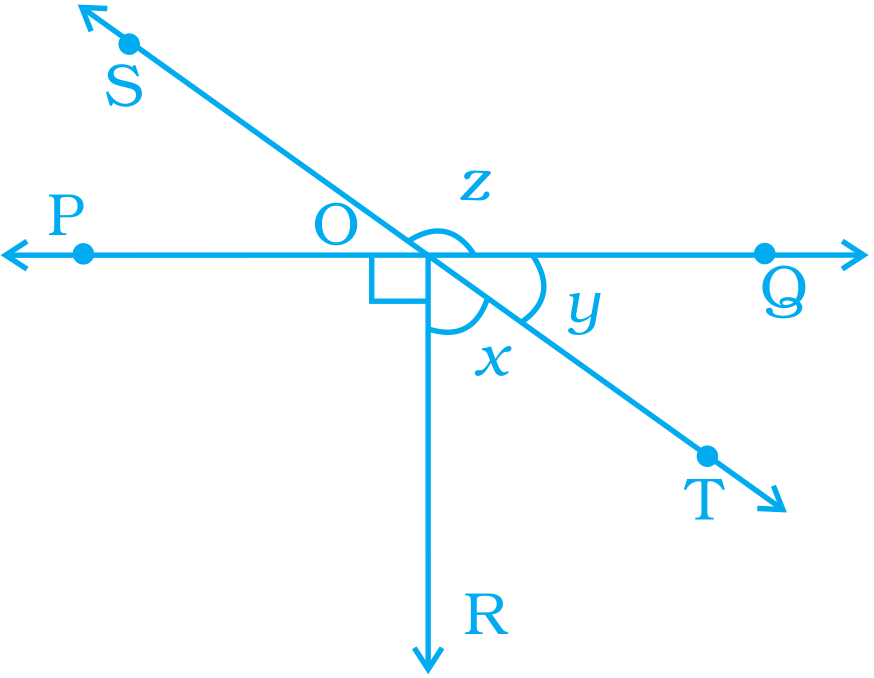
- A
$126^\circ$
- ✓
$144^\circ$
- C
$136^\circ$
- D
$154^\circ$
AnswerCorrect option: B. $144^\circ$
Since, $\angle\text{POR}, \angle\text{ROT}$ and $\angle\text{TOQ}$ lies on a straight line $POQ,$
then their sum is equal to $180^\circ .$
$\therefore\angle\text{POR}+\angle\text{ROT}+\angle\text{TOQ}=180^\circ$
$\Rightarrow 90^\circ + x + y = 180^\circ $
$\Rightarrow x + y = 180^\circ - 90^\circ $
$\Rightarrow x + y =90^\circ ...(i)$
Also, $x : y = 3 : 2 [$given$]$
Let, $x = 3a$ and $y = 2a$
$\therefore 3a + 2a = 90^\circ [$from Eq$.(i)]$
$\Rightarrow 5a = 90^\circ $
$\Rightarrow \text{a}=\frac{90^\circ}{5}=18^\circ$
Now, $x = 3a = 3 \times 18^\circ = 54^\circ $ and $y = 2a = 2 \times 18^\circ = 36^\circ $
Since, y and z from a liner pair.$\therefore y + z 180^\circ $
$\Rightarrow 36^\circ + \text{z}=180^\circ \Rightarrow \text{z}=180^\circ-36^\circ [\because\text{y}=36^\circ]$
$\Rightarrow \text{z}=144^\circ$
View full question & answer→MCQ 341 Mark
In Fig. line l intersects two parallel lines $PQ$ and $RS.$ Then, which one of the following is not true$?$ 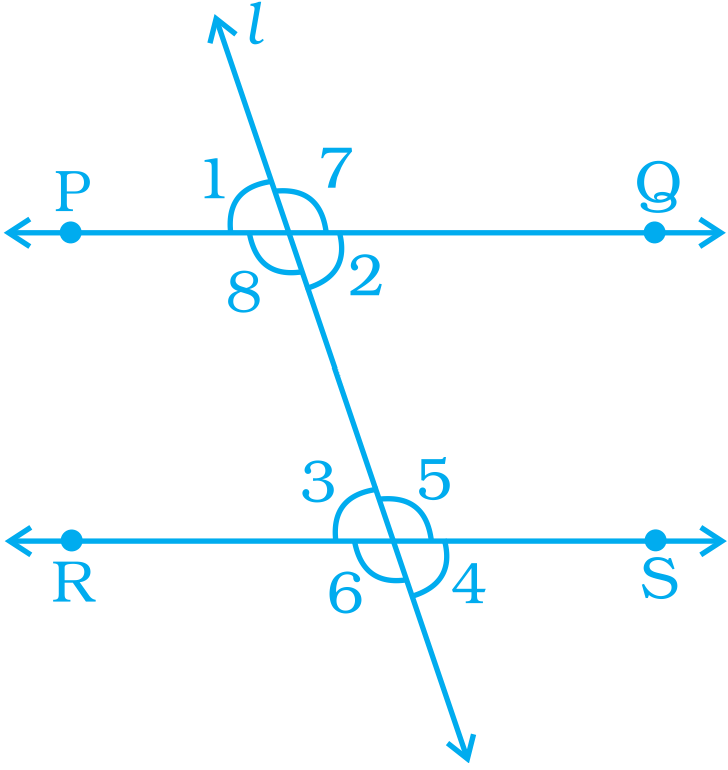
- A
$\angle1 = \angle3$
- B
$\angle2 =\angle4$
- C
$\angle6 = \angle7$
- ✓
$\angle4 = \angle8$
AnswerCorrect option: D. $\angle4 = \angle8$
From the given figure, $PQ || RS$ and l is transversal, Therefore,
$\angle1=\angle3 [$Corresponding angles$]$
$\angle2=\angle4 [$Corresponding angles$]...(i)$
Also, $\angle5=\angle6 [$Vertically opposite angles$]...(ii)$
And $\angle5=\angle7 [$Corresponding angles$]...(iii)$
$\Rightarrow\angle6=\angle7 [$From Eqs.$(ii)$ and $(iii)]$
Also, $\angle2+\angle8=180^\circ [$liner pair$]$
$\Rightarrow\angle4+\angle8=180^\circ$ $[\angle2=\angle4]$
View full question & answer→MCQ 351 Mark
If an angle is $60^\circ $ less than two times of its supplement, then the greater angle is:
- ✓
$100^\circ$
- B
$80^\circ $
- C
$60^\circ $
- D
$120$
AnswerCorrect option: A. $100^\circ$
Let the angle be $x,$ then its supplement will be $(180^\circ - x).$
It is given that, the angle $60^\circ $ less than $2$ times of its supplement.
Then, $2(180^\circ - x) - x = 60^\circ $
$\Rightarrow 360^\circ - 2x - x = 60^\circ $
$\Rightarrow 360^\circ - 3x = 60^\circ $
$\Rightarrow 360^\circ - 60^\circ = 3x$
$\Rightarrow 300^\circ = 3x$
$\Rightarrow\text{x}=\frac{300^\circ}{3}$
$\Rightarrow x = 100^\circ $
If $x = 100^\circ ,$ then other angle $= 180^\circ - x = 180^\circ - 100^\circ = 80^\circ $
So, the greater angle is $100^\circ $
View full question & answer→MCQ 361 Mark
What is the measure of complementary angle of $32^\circ ?$
- A
$48^\circ$
- B
$78^\circ$
- ✓
$58^\circ$
- D
$68^\circ$
AnswerCorrect option: C. $58^\circ$
Required Measure of complementary angle $= 90^\circ - 32^\circ = 58^\circ .$
View full question & answer→MCQ 371 Mark
Given a line and a point, not on the line, there is one and only $......$ line which passes through the given point and is $.....$ to the given line.
AnswerGiven a line and a point, not on the line, there is one and only one line.
which passes through the given point and is parallel $($or perpendicular$)$ to the given line.
View full question & answer→MCQ 381 Mark
Two supplementary angles differ by $34^\circ .$ Then the angles are __________.
- A
$74^\circ , 107^\circ$
- ✓
$107^\circ , 73^\circ $
- C
$120^\circ , 60^\circ $
- D
$72^\circ , 108^\circ$
AnswerCorrect option: B. $107^\circ , 73^\circ $
Let two supplementary angles are $x$ and $y$
We know, $x + y = 180^\circ ....(1)$
As given in the question $x - y = 34^\circ $
$\Rightarrow x = 34 + y .....(2)$
Putting the value of $x$ in terms of $y$ in the eqn $(1)$
we get $34 + y + y = 180$
$\Rightarrow 2y = 146$
$\Rightarrow y = 73^\circ $ And $x = 34 + y = 34 + 73 = 107^\circ $
Therefore, the angles are $107^\circ $ and $73^\circ $
View full question & answer→MCQ 391 Mark
Punita wants to classify a triangle according to the given clue. Two angles of the triangle are complementary. What type of triangle is the one Punita wants to classify$?$
- ✓
Right, because complementary angles add up to $90$ and the difference between $180$ and $90$ is $90.$
- B
Obtuse, because complementary angles add up to $45$ and the difference between $180$ and $45$ is $135.$
- C
Equiangular, because each of the two complementary angles is equal to $60$ and the difference between $180$ and $120$ is $60.$
- D
Acute, because complementary angles add up to $100$ and the difference between $180$ and $100$ is $80.$
AnswerCorrect option: A. Right, because complementary angles add up to $90$ and the difference between $180$ and $90$ is $90.$
Two angles are Complementary when theyadd up to $90$ degrees.
So, third angle will be $90.$
So, it will be right angle triangle.So Punita wants to classify
$(A)$ Right, because complementary angles add up to $90$ and the difference between $180$ and $90$ is $90.$
View full question & answer→MCQ 401 Mark
In Fig. $\angle\text{AOC}$ and $\angle\text{BOC}$ form a pair of: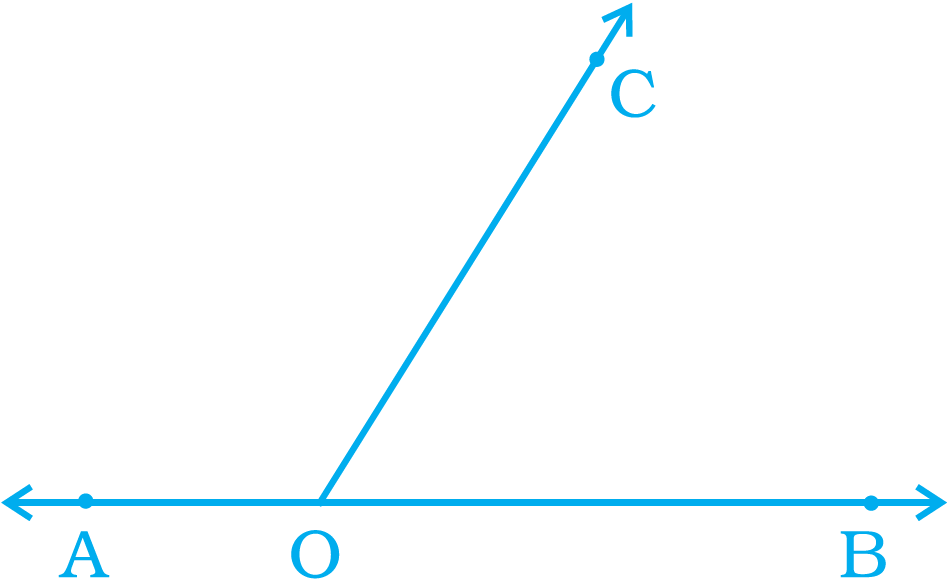
- A
Vertically opposite angles.
- B
- C
Alternate interior angles.
- ✓
AnswerSince, $\angle\text{AOC}$ and $\angle\text{BOC}$ are on the same line $\text{AOB}$ and forming linear pair.
$\therefore \angle \text{AOC}+\angle\text{BOC}=180^\circ$
Hence, $\angle\text{AOC}$ and $\angle \text{AOC}$ are supplementary angles.
View full question & answer→MCQ 411 Mark
The ratio between two complementary angles is $2 : 3$ find the smallest angle.
AnswerTwo angles whose sum is $90^\circ $ are said to be complementary.
Given two angles are in the ratio of $2 : 3.$
Let the two angles be $2x$ and $3x.$
So, $2x + 3x = 90^\circ $
$\Rightarrow 5\text{x} = 90^\circ $
$\Rightarrow\text{x}=\frac{90}{5}$
$\Rightarrow\text{x}=18$
Therefore, the two angles are $2x = 36^\circ $ and $3x = 54^\circ $
View full question & answer→MCQ 421 Mark
Two distinct $........$ in a plane cannot have more than one point in common.
AnswerIf two distinct lines are parallel then they dont have any point in common.
And if two lines are not parallel then they have only one point in common, where they cross each other.
Thus, we can say, two distinct lines in a plane cannot have more than one point in common.
View full question & answer→MCQ 431 Mark
The line which is parallel to $x -$ axis and crosses the curve $\text{y}=\sqrt{\text{x}}$ at an angle of $45^\circ$, is:
- A
$\text{x}-\frac{1}{4}$
- B
$\text{y}-\frac{1}{4}$
- ✓
$\text{y}-\frac{1}{2}$
- D
$\text{y}-1$
AnswerCorrect option: C. $\text{y}-\frac{1}{2}$
Given equation of a line parallel to $x -$ axis is $y = k$
Given equation of the curve is $\text{y}=\sqrt{\text{x}}$
On solving equation of line with the equation of curve, we get $x = k^2$
Thus the intersecting point is $(k^2, k)$
It is given that the line $y = k$ intersect the curve $\text{y}=\sqrt{\text{x}}$
at an angle of $\frac{\pi}{4}$.
This means that the slope of the tangent to $\text{y}=\sqrt{\text{x}}$ at $(k^2, k)$ is tan $\Big(+\frac{\pi}{4}\Big)=\pm1$
$\Rightarrow\Big(\frac{\text{dy}}{\text{dx}}\Big)_{(\text{k}^2-\text{k})}=\pm1$
$\Rightarrow\Big(\frac{1}{2\sqrt{\text{x}}}\Big)_{(\text{k}^2-\text{k})}=\pm1$
$=\text{k}=\pm\frac{1}{2}$
Thus $\text{y}=\pm\frac{1}{2}$
View full question & answer→MCQ 441 Mark
Find $x;$ if $\angle1=5\text{x}+15^\circ$ and $\angle2=28\text{x},$ angles form linear pair.
- A
$40^\circ$
- B
$140^\circ $
- ✓
$5^\circ $
- D
$20^\circ $
AnswerCorrect option: C. $5^\circ $
$\angle1+\angle2=180^\circ$ (Linear pair)
$\Rightarrow5\text{x}+15^\circ+28\text{x}=180^\circ$
$\Rightarrow33\text{x}=180^\circ-15=165^\circ$
$\Rightarrow\text{x}=\frac{165^\circ}{33}=5^\circ$
View full question & answer→MCQ 451 Mark
In Fig. $AB || CD$ and $EF$ is a transversal. The value of $y - x$ is: 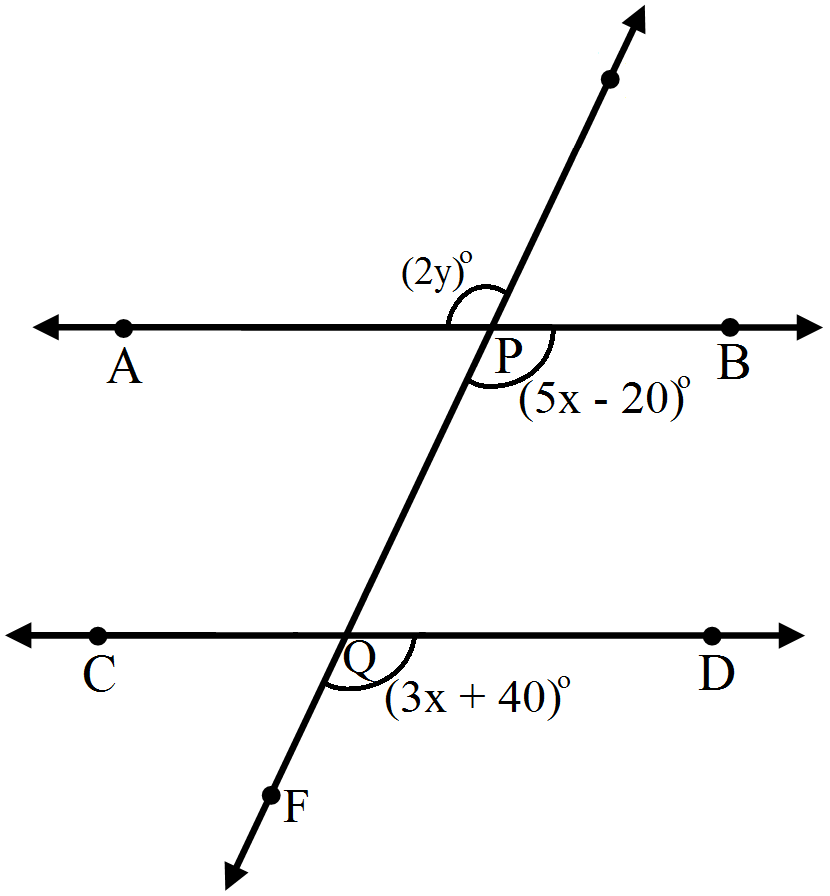
AnswerSince, $AB || CD$
$\therefore \angle \text{BPQ}=\angle \text{DQF}$ [Corresponding angles]
$\Rightarrow (5\text{x}-20)^\circ=(3\text{x}+40)^\circ$
$\Rightarrow 5\text{x}-20=3\text{x}+40$
$\Rightarrow 2\text{x}=60$
$\Rightarrow \text{x}=30$
$\therefore \text{BPQ}=(5\times 30-20)^\circ=130^\circ$
Now, $\angle \text{APE}=\angle \text{BPQ}$ [Vertically opposite angles]
$\Rightarrow 2\text{y}^\circ=130^\circ$
$\Rightarrow \text{y}=65$
$\therefore \text{y}-\text{x}=65-30$
$=35$
Hence, the correct answer is option $(b).$
View full question & answer→MCQ 461 Mark
If an angle is $28^\circ $ less than its complement, find its measure.
- ✓
$31^\circ$
- B
$131^\circ$
- C
$28^\circ$
- D
$32^\circ$
AnswerCorrect option: A. $31^\circ$
Two angles are complementary when they add upto form $90$ degrees.
If one angle $= x$
complemen of angle $= 90 - x$
Hence $x = 90 - x -28 ($given$)$
$2x = 90 - 28$
$2x = 62$
$\text{x}=\frac{62}{2}=31$
$= 31$
Hence angle is $31$ and its complementis $59$
View full question & answer→MCQ 471 Mark
The complement of $(90^\circ- a)$ is:
- A
$-a$
- B
$90^\circ + a$
- C
$90^\circ - a$
- ✓
$a$
AnswerLet the complement be $y$ Two angles are complementary if their sum is $90^\circ$
$\therefore 90^\circ - a + y = 90^\circ$
$⇒ y = a$
View full question & answer→MCQ 481 Mark
Find $n ,$ if $\angle\text{A}=11\text{n}-13^\circ$ and $\angle\text{B}=7\text{n}+39^\circ,$ where $A$ and $B$ are vertically opposite angles.
- A
$52^\circ$
- ✓
$13^\circ$
- C
$130^\circ$
- D
$14^\circ$
AnswerCorrect option: B. $13^\circ$
$\angle\text{A}=\angle\text{B }(\text{Vertically opp. angles})$
$\Rightarrow 11n - 13 = 7n + 39^\circ $
$\Rightarrow 11n - 7n = 39^\circ + 13^\circ $
$\Rightarrow 4n = 52^\circ $
$\Rightarrow n = 13^\circ $
View full question & answer→MCQ 491 Mark
The angle which exceeds its complement by $20^\circ $ is:
- A
$45^\circ$
- ✓
$55^\circ$
- C
$70^\circ$
- D
$110^\circ$
AnswerCorrect option: B. $55^\circ$
Let the required angle be $x$
Complementary angles $=$ Sum of two angles is $90^\circ $
$\therefore x = (90 - x) + 20$
$x = 90 - x + 202x = 110$
$\therefore x = 55^\circ $
View full question & answer→MCQ 501 Mark
In Fig. the value of $x$ is: 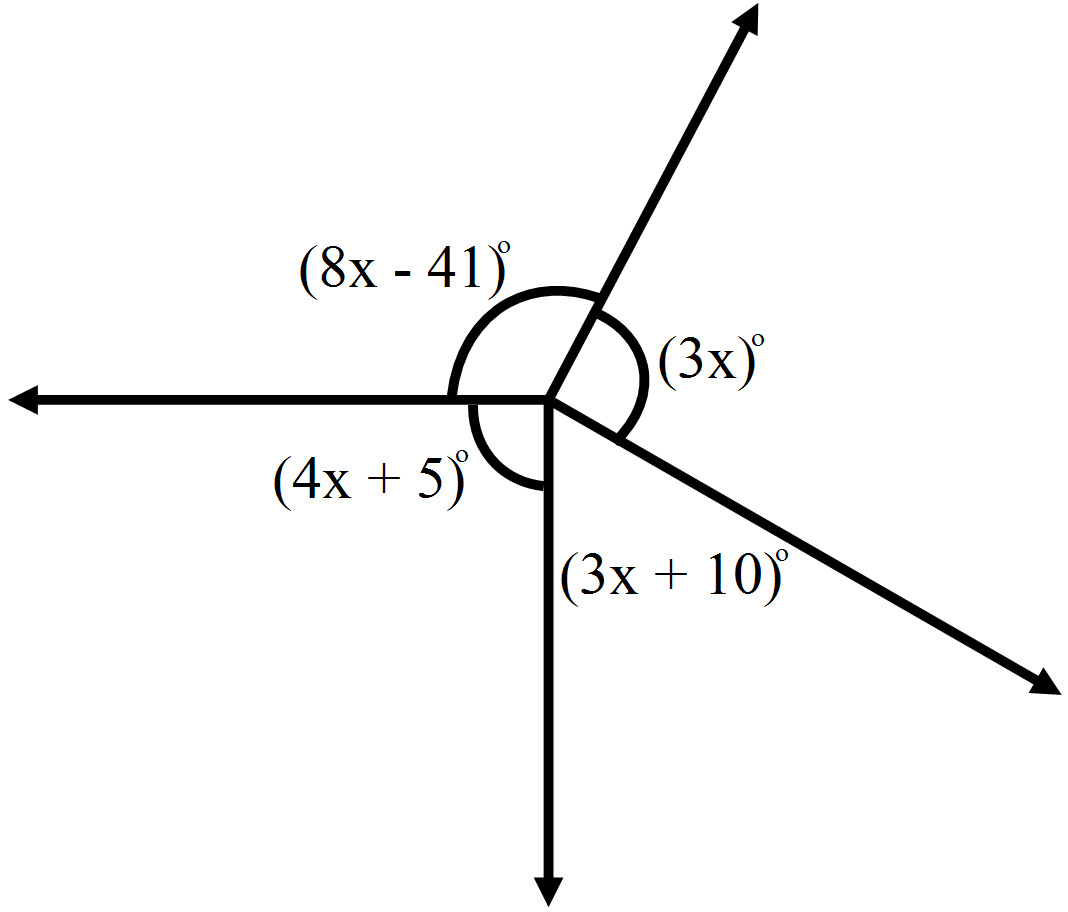
Answer$ (8x - 41)^\circ + (3x)^\circ + (3x + 10)^\circ + (4x - 5)^\circ = 360^\circ $
$\Rightarrow 8x - 41 + 3x + 3x + 10 + 4x - 5 = 360$
$\Rightarrow 18x - 36 = 360$
$\Rightarrow 18x = 396$
$\Rightarrow x = 22$
Hence, the correct answer is option $(a).$
View full question & answer→