Questions

5 Marks Questions

🎯

Test yourself on this topic

22 questions · timed · auto-graded

Question 15 Marks
Respiration can occur in two different manners. Briefly explain the process of aerobic respiration. How does it differ from anaerobic respiration?
Answer
Types of Respiration: On the basis of the presence or absence of oxygen, respiration is classified into two types:
  1. Aerobic Respiration: When breakdown of glucose occurs with the use of oxygen, it is called aerobic respiration. During aerobic respiration, glucose is completely broken down into carbon dioxide and water and energy is released. Aerobic respiration takes place in mitochondria. It can be shown by the following equation:

$\text{Glucose (food)}\xrightarrow{\text{Oxygen}}\text{Carbon dioxide}\ +\ \text{water}\ +\ \text{Energy}$

Aerobic respiration is seen in most of the organisms such as humans (man), dogs, cats, lions, elephants, cows, buffaloes, goats, snakes, earthworms, frogs, fishes, etc.

  1. Anaerobic Respiration: When breakdown of glucose takes place without using oxygen, it is called anaerobic respiration. The glucose is not completely broken down into carbon dioxide and water. An intermediate compound is formed with the release of less amount of energy during this process. It can be shown as follows:

$\text{Glucose}\xrightarrow{\text{No oxygen or air}}\text{Alcohol}\ +\ \text{Carbon dioxide}\ +\ \text{Energy}$

Yeasts such as Saccharomyces cereviseae and certain bacteria carry out anaerobic respiration. These organisms that carry out respiration in the absence of oxygen are called anaerobes.
View full question & answer
Question 25 Marks
In the figure, label the arrows and indicate the direction of
  1. Movement of air.
  2. Movement of diaphragm.
  3. Movement of ribs.
View full question & answer
Question 35 Marks
Explain the two types of respiration.
Answer
S.No. Aerobic respiration Anaerobic respiration
$1.$ An aerobic respiration takes place using oxygen, inhaled in breathing. Whereas an anaerobic respiration requires no oxygen.
$2.$ In aerobic respiration, breakdown of glucose results in production of Carbon Dioxide, Water and Energy. In anaerobic respiration, the breakdown of glucose first results in Lactic Acid and energy then lactic acid break down into carbon dioxide and water.
$3.$ An aerobic respiration uses respiratory organs such as lungs or gills. Anaerobic respiration take place at cellular or muscular level.
  • Both aerobic and anaerobic respiration are necessary for the survival of living organism.
  • In both type of respiration, the food is broken and energy is released for the functioning of an organism.
  • In both type of respiration, Carbon Dioxide, Water and Energy is produced finally.
View full question & answer
Question 45 Marks
Match the items in Column $I$ with those in Column $II:$
 
Column $I$
 
Column $I$
$(a)$
Yeast
$(i)$
Earthworm
$(b)$
Diaphragm
$(ii)$
Gills
$(c)$
Skin
$(iii)$
Alcohol
$(d)$
Leaves
$(iv)$
Chest cavity
$(e)$
Fish
$(v)$
Stomata
$(f)$
Frog
$(vi)$
Lungs and skin
 
 
$(vii)$
Tracheae
Answer
 
Column $I$
 
Column $I$
$(a)$
Yeast
$(iii)$
Alcohol
$(b)$
Diaphragm
$(iv)$
Chest cavity
$(c)$
Skin
$(i)$
Earthworm
$(d)$
Leaves
$(v)$
Stomata
$(e)$
Fish
$(ii)$
Gills
$(f)$
Frog
$(vi)$
Lungs and skin
View full question & answer
Question 55 Marks
Whales and dolphins are seen many times releasing a fountain of water sometimes at the surface of water. Why do they do so?
Answer
Sea animals like dolphins and whales live in water but unlike fishes, they do not possess gills for respiration. These possess nostrils which are called blow holes. There blow holes are located on the upper parts of their heads. These animals breathe in through their nostrils and lungs. Dolphins and whales comes to the surface of sea-water from time to time to breathe in air, sometimes whales release a function of water that moves upwards like a spray. This is because when a whale breathes air out of its blow hole it appears as a spray or misp, also called as spont. It can be seen from many miles away. Blow holes are surrounded by muscles that keep the holes closed when the whales or dolphins are under water and opens it when the animal is at the surface and needs to breathe. Human cannot survive under water because they do not possess any gills to make use of oxygen dissolved in water for breathing. When we go under water we have to take oxygen gas cylinders for breathing.
View full question & answer
Question 65 Marks
Breathing rate of a person is not always constant. Give the reason for your answer.
Answer
The number of times a person breathes in a minute is termed as breathing rate. An adult human being can inhale and exhale 15-18 times in a minute. It is the average breathing rate of an adult human being. Breathing rate of a person is not always constant. It changes according to the oxygen requirement of the body. Breathing rate is somewhat faster in women than in men and in children it is higher (20-30 times/ min) than adults. Breathing rate is slowest while sleeping (as less energy is required) while maximum during heavy exercise like running, weight lifting, etc. (much energy is required). Increased breathing rate provides greater amount of air entry into the lungs, hence blood can absorb oxygen at a faster rate. Faster breathing supplies more oxygen to the body cell for producing more energy, required for heavy exercises. During heavy exercise the breathing rate can increase upto 25 times per minute. Because of this, food gets broken down at a faster rate and thus make us feel hungry. When we feel drowsy, sleepy or tired, we yawn (i.e. open our mouth wide to take a long and deep breathe, of air), because our breathing rate slows down and body do not receives sufficient oxygen.
View full question & answer
Question 75 Marks
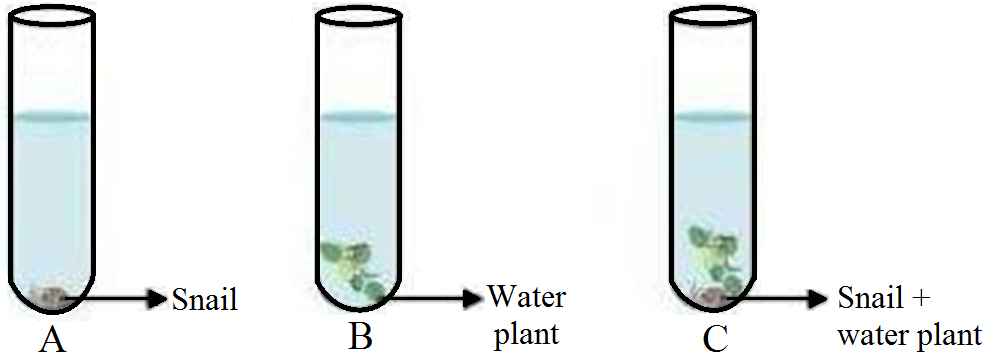
Take three test-tubes. Fill $\frac{3}{4}\text{th}$ of each with water. Label them $A, B$ and $C$. Keep a snail in test-tube A, a water plant in test-tube $B$ and in $C$, keep snail and plant both. Which test-tube would have the highest concentration of $\mathrm{CO}_2$?
Answer


Test tube A will have the highest concentration of $\mathrm{CO}_2$. This is because test tube A contains snail. Snail is an organism that breathes in $\mathrm{O}_2$ and breathes out $\mathrm{CO}_2$. Hence, $\mathrm{CO}_2$ concentration increases in test tube A . Test tube B contains a water plant, which takes in $\mathrm{CO}_2$ for food synthesis and gives out $\mathrm{O}_2$. Hence, more $\mathrm{O}_2$ concentration is found in test tube B . Test tube C contains both a snail and a plant. The $\mathrm{CO}_2$ produced by the snail is utilized by the plant for its food synthesis and the $\mathrm{O}_2$ released by the plant is utilized by the snail for respiration. Therefore, test tube A has the highest concentration of $\mathrm{CO}_2$.
View full question & answer
Question 85 Marks
List the similarities and differences between aerobic and anaerobic respiration.
Answer
Similarity between aerobic and anaerobic respiration: In both aerobic and anaerobic respiration, the food is broken down to release energy. Differences between aerobic and anaerobic respiration:
Aerobic respiration
Anaerobic respiration
It is the process of breakdown of food in the presence of oxygen.
It is the process of breakdown of food in the absence of oxygen.
Its end products are $\mathrm{CO}_2$ and $\mathrm H_2O$.
End products of anaerobic respiration can be lactic acid or $\mathrm{CO}_2$ and alcohol.
It takes longer time to release energy.
It is a fast process as compared to aerobic respiration.
It produces large amount of energy.
It produces small amount of energy as compared to aerobic respiration.
Examples: It occurs in most plants and animals.
Examples: Yeast, bacteria, human muscle cells, etc. respire an aerobically.
View full question & answer
Question 95 Marks
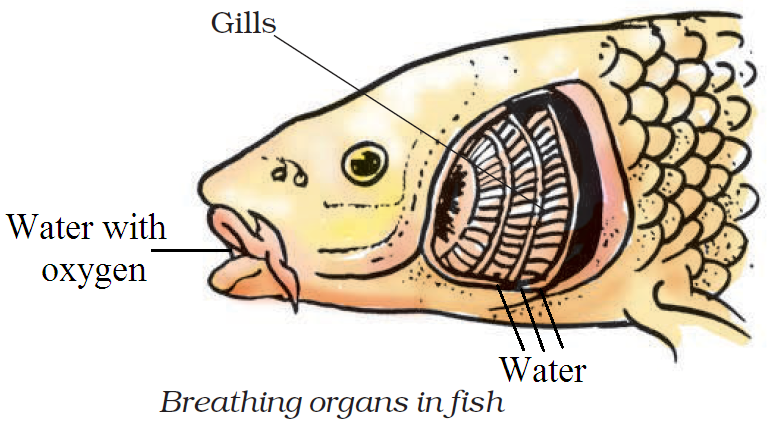
Respiration in fish is different from humans. Explain in brief how fishes can breathe through gills?
Answer

Fishes are the aquatic animals that live in water. These have a special organ for breathing called gills. The oxygen dissolved in water enters through the gills. Gills are actually the projections of skin and have blood vessels for the exchange of respiratory gases. The fishes breathes by taking in water through its mouth and sending it over the gills. The oxygen dissolved in the water is extracted by the gills and the extracted oxygen is absorbed by the blood.

This oxygen is then carried to all the parts of fishes for respiration. The carbon dioxide produced during respiration is brought back by the blood into the gills and expelled into the surrounding water.
View full question & answer
Question 105 Marks
Explain the mechanism of breathing in human beings.
Answer
In human beings, as in most vertebrates and mammals, gaseous exchange occurs in a pair of lungs. They are enclosed in an air-tight compartment called thorax (or chest). This region is bound by the ribs and the diaphragm. Several organs participate in the process of respiration in human beings. They are the nasal cavity, larynx, trachea, bronchi, alveoli and lungs. Air is inhaled or exhaled by the body as lungs are expanded or contracted by the simultaneous contraction and expansion of muscles attached to the ribs and diaphragm. The air containing oxygen is taken in through the nose where it is filtered and cleaned from dust particles, bacteria and other foreign substances by the mucus (stick liquid) and hair present in the nostrils. This air then passes through the larynx, the voice-box chamber situated in the neck region, to reach the tracheal tube or the windpipe. The trachea is a tube that runs from the larynx down the neck region into the thorax. From the thorax air reach the alveoli through bronchioles.
View full question & answer
Question 115 Marks
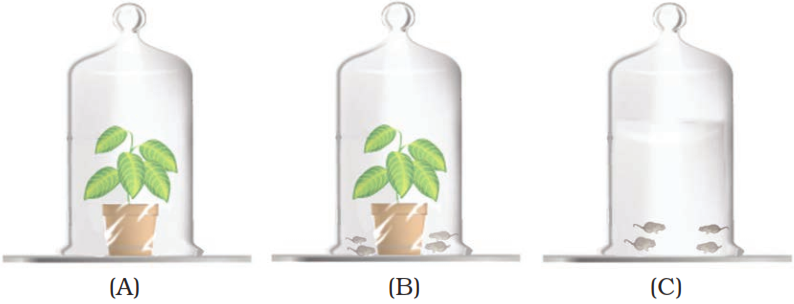
Observe Figure carefully and answer the following questions.
  1. In which jar, will the amount of $\mathrm{CO}_2$ be the highest and why?
  2. In which jar, will the amount of $\mathrm{CO}_2$ be the lowest and why?
Answer
  1. The amount of $\mathrm{CO}_2$ will be the highest in jar $C$. It is because the mice kept under the jar will breathe out $\mathrm{CO}_2$ continuously increasing its amount in the jar.
           In other jars, the $\mathrm{CO}_2$ present inside will be used up by the plants for photosynthesis.
           So, its So, amount will decrease.
  1. The amount of $\mathrm{CO}_2$ will be the lowest in jar $A$. It is because in jar $A$, $\mathrm{CO}_2$ released during respiration is used by the plant for the process of photosynthesis.
           In jar B, the $\mathrm{CO}_2$​​​​​​​ is continuously released by the rats. So, its amount will remain same. In jar $C,$
           ​​​​​​​$\mathrm{CO}_2$ released by rats is not used up at all as there is no plant.
View full question & answer
Question 125 Marks
List some animals around you. Now group them as follows:
  1. Animals that can breathe only through skin.
  2. The animal that can breathe through skin as well as through lungs.
  3. The animal that can breathe through lungs.
  4. Animals that can breathe through gills.
  5. Animals that can breathe through spiracle and tracheae?
Answer
  1. Animals that can breathe only through skin are earthworm and leech.
  2. Animals that can breathe through skin as well as through lungs are frogs.
  3. Animals that can breathe through lungs are buffaloes, human, and dolphins.
  4. Animals that can breathe through gills are tadpole and fish.
  5. Animals that can breathe through spiracles and tracheae are grasshopper, cockroaches, ants, housefly and mosquito.
View full question & answer
Question 135 Marks
The mountaineers carry oxygen with them because:
  1. At an altitude of more than $5\ km$ there is no air.
  2. The amount of air available to a person is less than that available on the ground.
  3. The temperature of air is higher than that on the ground.
  4. The pressure of air is higher than that on the ground.
Answer
The mountaineers carry oxygen with them because:
  1. At an altitude of more than $5\ km$ there is no air.
  2. The amount of air available to a person is less than that available on the ground.
  3. The temperature of air is higher than that on the ground.
  4. The pressure of air is higher than that on the ground.
View full question & answer
Question 145 Marks
Match the names of organisms in Column $I$ with their organs of breathing given in Column $II.$
 
Column $I$
 
Column $II$
$(a)$
Butterfly
$(i)$
lungs
$(b)$
Earthwarms
$(ii)$
gills
$(c)$
Sparrow
$(iii)$
spiracles
$(d)$
Fish
$(iv)$
skin
Answer
 
Column $I$
 
Column $II$
$(a)$
Butterfly
$(iii)$
spiracles
$(b)$
Earthwarms
$(iv)$
skin
$(c)$
Sparrow
$(i)$
lungs
$(d)$
Fish
$(ii)$
gills
  1. Butterfly is an insect, that has openings called spiracles on the sides of its body for taking in oxygen rich air.
  2. Earthworm breathes through its most and slimy skin.
  3. Sparrow (i.e. bird) has lungs and numerous air sacs for circulation of air.
  4. Fish has gills that are well supplied with blood vessels to use oxygen dissolved in water.
View full question & answer
Question 155 Marks
Distinguish between the following. Breathing and Respiration.
Answer
S.No.
Breathing
Respiration
$(i)$
It is a physical process.
It is a chemical process.
$(ii)$
There is no release of energy.
Energy is released.
$(iii)$
Enzymes are not involved.
Enzymes are involved.
$(iv)$
Modes of breathing differ among organisms.
Process of respiration is same in all.
View full question & answer
Question 165 Marks
A person put some warm water in an aquarium having fish during winter season. He thought that fish will be more comfortable in luke warm water than cold water. But he observed that fishes in the aquarium died. Why the fishes died in warm water?
Answer
The fishes have special type of organs for respiration called gills. These gills absorbs oxygen dissolved in water and through blood vessels, this oxygen is passed to all the parts of the body. The amount of dissolved oxygen is comparatively less in water than the amount of oxygen in air. Therefore, the rate of breathing is also high in aquatic animals. If we add warm water, to the aquarium the dissolved oxygen will dissociate and move into the atmosphere again, leaving the least percentage of oxygen into the water (as it is known that the solubility of gases in water goes down as the temperature rises). Therefore, fishes will have difficulty in breathing in the absence of oxygen and will die.
View full question & answer
Question 175 Marks
List the similarities and differences between aerobic and anaerobic respiration.
Answer
S.No.
Aerobic
Anaerobic
$1.$
It uses oxygen in the process.
Anaerobic respiration takes place in the absence of oxygen.
$2.$
In this process, glucose is completely broken down into $\mathrm{CO}_2$ , Water along with release of energy.
In this process, glucose is broken into ethyl alcohol, $\mathrm{CO}_2$ and energy.
$3.$
It occurs in all organisms like mammals.
It usually occurs in lower organisms like yeast (fungi) and bacteria. It can occur muscles of higher organisms during heavy activities.
$4.$
Glucose + Oxygen → Carbon dioxide + Water + Energy
Glucose → Ethyl alcohol + Carbon dioxide + Energy
View full question & answer
Question 185 Marks
A food stall owner was preparing dough for making bhaturas. He added a pinch of yeast and sugar to the dough and left it in a warm place. After few hours, the dough had risen. There was a sour smell too.
  1. Why did the dough rise?
  2. Why did the dough smell sour?
  3. Why was sugar added to the dough?
  4. What would have happened if the dough was kept in the refrigerator, soon after it was prepared?
Answer
  1. The dough rises due to the release of carbon dioxide during anaerobic respiration by yeast cell.
  2. Yeast, during anaerobic respiration also produces alcohol which results in the sour smell of dough.
  3. Sugar is added into the dough, because it acts as a food for yeast. Yeast upon incomplete breakdown of sugar or food produces $\mathrm{CO}_2$, alcohol and energy (in less amount).
  4. If the dough is kept in the refrigerators after it was prepared, then dough will neither raise nor become sour. Yeast requires high temperature to grow, multiply and to respire. At low temperature, the yeast will not respire to produce the byproducts of anaerobic respiration.
View full question & answer
Question 195 Marks
Smoking is considerd harmful due to certain effects. Explain in brief.
Answer
Lungs are very delicate organs and essential for breathing, thus beeping us alive. Smoking tobacco in the form of beedi, cigarette or cigar damages our lungs gradually and causes ill health. While smoking, smoke along with chemicals present in tobacco enters our body. These chemicals present in tobacco damages the lungs in many ways tike breathing becomes difficult causes lung cancer, heart diseases, etc. Smoking also affects people around smokers as they also inhale air containing tobacco. This is called passive smoking.
View full question & answer
Question 215 Marks
How does gaseous exchange take place in $(a)$ earthworms $(b)$ fish?
Answer
  • Earthworm: The earthworm inhabits burrows in damp soil and emerges to feed in the darkness. Gaseous exchange occurs through its skin. The thin, moist skin is supplied with a network of capillaries which absorb oxygen from the atmosphere and deliver it to the rest of the body. The absorbing surface or the network of capillaries also gets rid of carbon dioxide from the body.
  • Fish: Fish absorbs dissolved oxygen from the water by means of gills. Gills are projection of the skin. These are well supplied with blood vessels for exchange of gases.
View full question & answer
Question 225 Marks
How do we breathe?
Answer
We take in air through our nostrils, when we inhale air, it passes through our nostril into nasal cavity and from there it reaches our lungs through the wind pipe. Lungs are present in chest cavity which is surrounded by ribs on the sides, diaphragm forms the floor of chest cavity. Breathing involves the movement of diaphragm and the rib cage. During inhalation ribs move up and outwards and diaphragm moves down, because of this movement space in our chest cavity increases and air ruses into the lungs. During exhalation ribs move down and inward and diaphragm moves up to its former position, this reduces the size of chest cavity and air is pushed out of the lungs.
View full question & answer
5 Marks Questions - Science STD 7 Questions - Vidyadip