Questions

questions in details [4 marks ]

🎯

Test yourself on this topic

17 questions · timed · auto-graded

Question 14 Marks
What is meant by a contact force? Explain with the help of an example.
Answer
A Contact force as the name suggests acts on a point of an object by direct contact. The Contact may be Continuous or sometimes momentary. The former case is known as Continuous force and the latter case is known as impulse force.
Example: Pushing an object along the floor: This is an example of a continuous force. Here, continuously, the direct force is put on the object to move it along the floor.
View full question & answer
Question 24 Marks
Define frictional force (or friction).
Answer
Frictional Force refers to the force generated by two surfaces that contacts and slide against each other. These forces are mainly affected by the surface texture and amount of force impelling them together. The angle and position of the object affect the amount of frictional force. If an object is placed flat against an object, then the frictional force will be equal to the weight of the object. If an object is pushed against the surface, then the frictional force will be increased and becomes more than the weight of the object.
View full question & answer
Question 34 Marks
What is a rubber sucker? How does it work? State any one use of a rubber sucker.
Answer
Rubber sucker a device used in toys, sunlight blocker - suction cups, suction clamps and various other places where "sticking" is required for temporary period and when you don't want to use glue.
The principle on which Rubber suckers work: When the sucker is pressed against the surface, it squeeze out the air that is behind it. The atmospheric pressure on the outside of the sucker holds its rim firmly against the smooth surface.
View full question & answer
Question 44 Marks
What is force? State the various effects of force.
Answer
A force is a push or pull upon an object resulting from the object's interaction with another object. Various effects of force are:
$i.$ It can change shape.
$ii.$ It can change direction.
$iii.$ It can change position.
View full question & answer
Question 54 Marks
Explain why school bags are provided with wide straps to carry them.
Answer
A wider strap distributes the force throughout a greater surface area. You can do a comparison using a simple physics equation.
Pressure = Force/Area.
So take two different straps and measure the area of them.
Then find out how much weight the pack will be holding.
Then divide the Weight by the Area and you end up with pressure.
View full question & answer
Question 64 Marks
What is meant by atmospheric pressure? What is the cause of atmospheric pressure?
Answer
ATMOSPHERIC PRESSURE: The air around you has weight, and it presses against everything it touches. That pressure is called atmospheric pressure, or air pressure. It is the force forced on a surface by the air above it as gravity pulls it to Earth.
CAUSES:
$i.$ Height of altitude.
$ii.$ Density of air.
View full question & answer
Question 74 Marks
Explain why, atmospheric pressure decreases as we go higher up above the earth's surface.
Answer
The air molecules at lower altitudes are more compressed by gravity than the ones at the higher altitudes. The pressure level is highest right at the surface of the earth because the air at this level is supporting the weight of all the air above it. More weight above means a greater downward gravitational force. As we move up through levels of the atmosphere, the air has less air mass above it and gravity isn’t strong enough to pull down a greater number of particles. So the balancing pressure decreases. This is why atmospheric pressure drops as we rise in altitude.
View full question & answer
Question 84 Marks
Calculate the pressure when a force of $200N$ is exerted on an area of:
$i. 10m^2$
$ii. 5m^2$
Answer
Given: Force applied is given as: $200N$.
Now, we know that the Pressure is the force applied perpendicular to the surface of an object per unit area. or Pressure $=$ Force/ Area.
$i.$ Area $=10 \mathrm{~m}^2$
$P=200 \mathrm{~N} / 10 \mathrm{~m}^2$
or $\mathrm{P}=20 \mathrm{Nm}^2$ or $20$ Pascal.
$ii. =10 \mathrm{~m}^2$
$P=200 \mathrm{~N} / 5 \mathrm{~m}^2$
or $\mathrm{P}=40 \mathrm{Nm}^2$ or $40$ Pascal.
View full question & answer
Question 94 Marks
Give an activity to show that pressure in a liquid increases with depth.
Answer
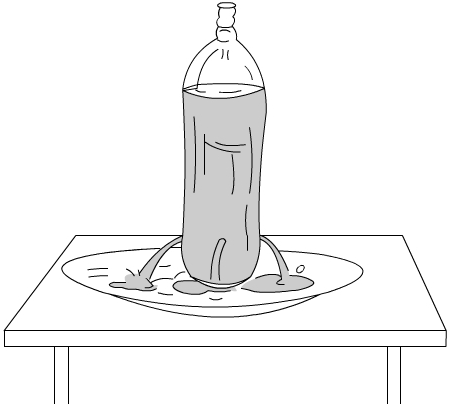
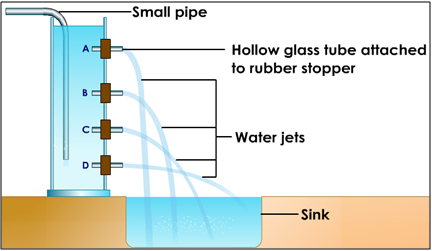
Activity: To show that pressure in a liquid increases with depth.
Theory: Pressure is force per unit area. $P$ $= gh$, where $Ø \ P$ is the water pressure at a particular depth. $Ø$ $g$ is the acceleration due to gravity. Ø h is the depth of the water at that point.
Materials Required: A plastic bottle, hammer, and nail, ruler.
Experiment: $Ø$ Make holes of the same size on the bottle with the help of hammer and nail. $Ø$ Measure the distance of holes from the bottom with the help of a ruler. $Ø$ Now fill the bottle with water. $Ø$ Measure the distance from the bottle to the distance up to which the water comes out.
Conclusion: We will notice that greater the depth, greater is the force with which water comes out of the bottle that is the water coming out will travel more distance if the depth is increased.
View full question & answer
Question 104 Marks
Name the type of forces involved in the following:
$i.$ A horse pulling a cart.
$ii.$ A sticker attached to steel almirah without glue.
$iii.$ A coin falling to the ground on slipping from hand.
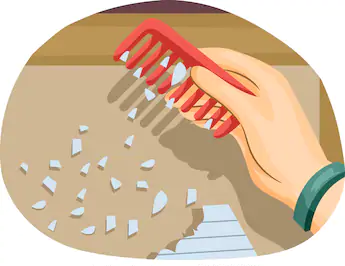
$iv.$ A plastic comb rubbed in dry hair picking up tiny pieces of paper.
$v.$ A moving boat coming to rest when rowing is stopped.
Answer
$i.$ Muscular force is a contact force due to action of muscles.
$ii.$ Magnetic force.
$iii.$ Gravitational force.
Objects fall towards the earth due to its gravity.
$iv.$ Electrostatic force.
The force acting on an object due to its charged particles.
$v.$ Frictional force.
Stream of water opposed to moving boat to stop.
View full question & answer
Question 114 Marks
Define pressure. What is the relation between pressure, force and area? State the units in which pressure is measured.
Answer
Pressure is defined as a measure of the force applied over a unit area. Pressure often is expressed in units of Pascals (Pa), newtons per square meter $(N/m^2$ or $kg/m.s^2)$, or pounds per square inch. Other units include the atmosphere (atm), torr, bar, and meters sea water (msw). In equations, pressure is denoted by the capital letter P or the lowercase letter p. Pressure is a derived unit, generally expressed according to the units of the equation:$\text{P}= \frac{\text{F}}{\text{A}}$
Where P is pressure, F is force, and A is area. P is pressure. F is the component of force perpendicular to the surface. A is the area of the surface. When a force is constant over an area, the pressure acting on that area is simply. Pressure is a scalar quantity, thus it acts in all directions at any given point. In order for pressure to create a force, the pressure must be integrated over some area.
View full question & answer
Question 124 Marks
Describe an activity to show that a liquid exerts equal pressure in all the direction at a given depth.
Answer
Activity: To show that liquid exerts equal pressure in all the direction at a given depth.
Theory: Pressure is force per unit area. At any point in a fluid, the pressure is the same in all directions. $P = gh$, where $Ø$ $P$ is the water pressure at a particular depth $Ø$ $g$ is the acceleration due to gravity $Ø$ h is the depth of the water at that point
Materials Required: A plastic bottle, hammer, and nail, ruler
Experiment: $Ø$ Make holes of the same size on the bottle with the help of hammer and nail. $Ø$ Make sure that the holes should be at the same distance from the bottom surface. $Ø$ Now fill the bottle with water. $Ø$ Measure the distance from the bottle to the distance up to which the water comes out.
Conclusion: We will notice that the distance covered by the water coming out of the holes is equal. This implies that the pressure of the liquid at given depth is the same.
View full question & answer
Question 134 Marks
Explain why, frictional force is said to be a contact force.
Answer
If life an object which is moving over a horizontal surface does not continue with constant velocity when the accelerating force is removed. Instead the object slows down and eventually stops. The deceleration is caused by a frictional force between the object and the surface on which it travels. A frictional force always acts to oppose the motion of an object over a surface and is an example of a contact force. When we try to slide one object over another, we find that there is a force which opposes the motion. This force is called friction. Whenever there is relative motion of two surfaces in contact, there is frictional resistance. When a body moves over another, it has to overcome friction. This needs energy. Hence, some energy is always wasted in overcoming friction. When two parts of a machinery rub against each other heat is produced, and the efficiency of the machine decreases. There will be a greater wear and tear in the different parts of a machine due to friction.
View full question & answer
Question 144 Marks
What is meant by a non$-$contact force? Explain with the help of an example.
Answer
An imaginary force can pull everything towards the earth surface. All the objects are pulled towards the earth without any physical contact with the objects and bodies. These are non contact forces in the most basic sense.
Example:
$i.$ Gravitational force.
$ii.$ Magnetic force.
$iii.$ Electrostatics.
$iv.$ Nuclear force.
View full question & answer
Question 154 Marks
Electric force attracts tiny bits of paper. Explain by an activity and write your observations.
Answer
Activity: To show tiny bits of paper gets attracted to electric force.
Theory: Electrostatic force is the force exerted by one stationary object having electric charge on other stationary object having electric charge. If the charge on both the objects is same, they will repel and if the charge on both the objects is different then they will attract each other. There are mainly two types of charges positive and negative.
Materials required: tiny bits of paper, plastic ruler/comb
Experiment:
Rub the plastic ruler/ comb with a sheet of paper.
This process will ensure that the ruler/ comb gets charged.
Now immediately bring the ruler/ comb towards the bits of paper.
Conclusion: We will observe that the bits of paper will be attracted towards the ruler/ comb. This happens because the charge acquired by the ruler/ comb exerts a force on the paper and thus attracts it.
View full question & answer
Question 164 Marks
How does the pressure of a liquid depend on its depth? Draw a labelled diagram to show that the pressure of a liquid (say, water) depends on its depth.
Answer
All the liquids exert pressure on the base or bottom and walls of their container. All the liquid have weight. When we pour liquid into a vessel, then the weight of liquid pushes down on the base of the vessel producing a pressure. The liquid exerts pressure on the base of the vessel. The pressure exerted by a liquid changes with depth in the liquid. The pressure exerted by a liquid increases with increasing depth inside the liquid. The pressure exerted by a liquid is small just under the surface of the liquid. But as we go we deeper in a liquid the pressure of liquid increases. As the depth of liquid increases the weight of liquid column pushing down from above increases and hence the pressure also increases.
View full question & answer
Question 174 Marks
Identify the actions involved in the following situations as push or pull, or both:
$a.$ Opening a drawer.
$b.$ A cricket ball hit by a batsman.
$c.$ Drawing a bucket of water from a well.
$d.$ moving a book placed on a table.
$e.$ A football player taking a penalty corner.
$f.$ Moving a wheel barrow.
Answer
$a.$ Pull $-$ Force is a Pull or a push on the object.
$b.$ Push $-$ Force is a Pull or a push on the object.
$c.$ Pull $-$ Force is a Pull or a push on the object.
$d.$ Ans Both push and pull $-$ Pull or push on an object is known as force.
$e.$ Push $-$ Pull or push on an object is known as force.
$f.$ Push $-$ Pull or push on an object is known as force.
View full question & answer