Question 14 Marks
In the following, using the remainder theorem, find the remainder when $f(x)$ is divided by $g(x)$ and verify the by actual division: $f(x) = 9x^3 - 3x^2 + x - 5$, $\text{g(x)}=\text{x}-\frac{2}{3}$
AnswerHere,$f(x) = 9x^3 - 3x^2 + x - 5$,
$\text{g(x)}=\text{x}-\frac{2}{3}$
From, the remainder theorem when f(x) is divided by $\text{g(x)}=\text{x}-\frac{2}{3}$
the remainder will be equal to $\text{f}\Big(\frac{2}{3}\Big)$
Let,$ g(x) = 0$
$\Rightarrow\ \text{x}-\frac{2}{3}=0$
$\Rightarrow\ \text{x}=\frac{2}{3}$
Substitute the value of x in f(x)
$\text{f}\Big(\frac{2}{3}\Big)=9\Big(\frac{2}{3}\Big)-3\Big(\frac{2}{3}\Big)^2+\Big(\frac{2}{3}\Big)-5$
$=9\Big(\frac{8}{27}\Big)-3\Big(\frac{4}{9}\Big)+\frac{2}{3}-5$
$=\Big(\frac{8}{3}\Big)-\Big(\frac{4}{3}\Big)+\frac{2}{3}-5$
$=\frac{8-4+2-15}{3}$
$=\frac{10-19}{3}$
$=\frac{-9}{3}$
$=-3$
Therefore, the remainder is $-3.$
View full question & answer→Question 24 Marks
Find the value of a, if $x + 2$ is a factor of $4x^4 + 2x^3 - 3x^2 + 8x + 5a.$
AnswerLet $g(x) = x + 2, f(x) = 4x^4 + 2x^3 - 3x^2 + 8x + 5a.$
Let $g(x) = 0$
$\Rightarrow x + 2 = 0$
$\Rightarrow x = -2,$
$\because$ $g(x)$ is a factor of $f(x)$
$\therefore$ $f(-2) = 0 f(-2) = 4(-2)^4 + 2(-2)^3 - 3(-2)^2 + 8(-2) + 5a = 0$
$\Rightarrow 4(16) + 2(-8) - 3(4) + 8(-2) + 5a = 0$
$\Rightarrow 64 - 16 - 12 - 16 + 5a = 0$
$\Rightarrow 20 + 5a = 0$
$\Rightarrow 5a = -20$
$\Rightarrow\ \text{a}=\frac{-20}{5}=-4$
$\therefore\ \text{a}=-4$
View full question & answer→Question 34 Marks
Using factor theorem, factorize the following polynomials: $2y^3 + y^2 - 2y - 1$
Answer Let $p(y) = 2y^3 + y^2 - 2y - 1$ By hit and trial method
$p(1) = 2(1)^3 + (1)^2 - 2(1) - 1$
$= 2 + 1 - 2 - 1 = 0$
So, $y -1$ is a factor of this polynomial.
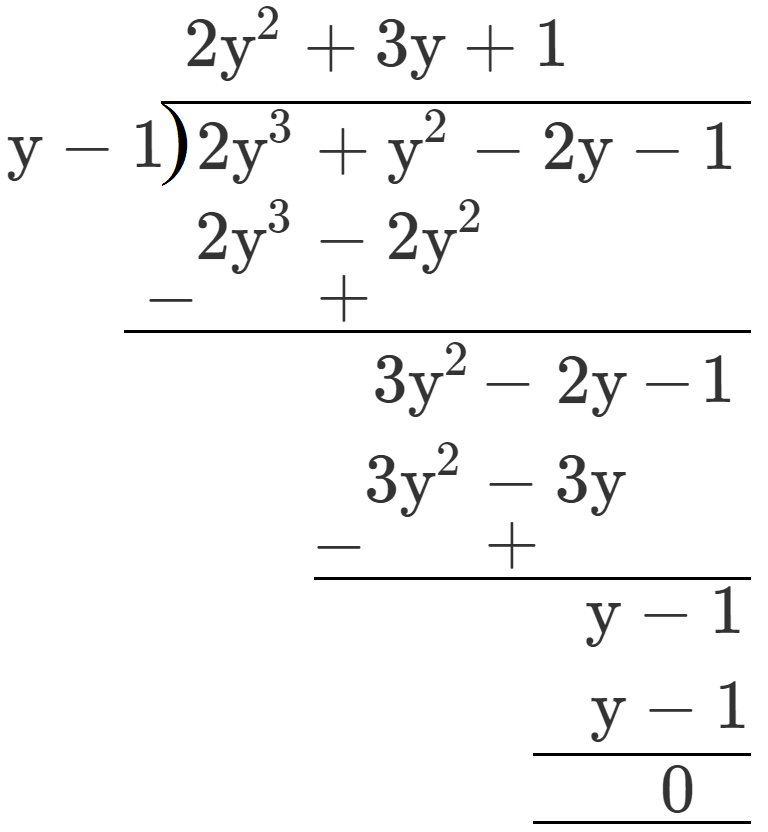
Now, By long division method,
$\therefore 2y^3 + y^2 - 2y - 1$
$= (y - 1)(2y^2 + 3y + 1)$
$= (y - 1)(2y^2 + 2y + y + 1)$
$= (y - 1)[2y(y + 1) + 1(y + 1)]$
$= (y - 1)(y + 1)(2y + 1)$ View full question & answer→Question 44 Marks
If $\text{x}=-\frac{1}{2}$ is zero of the polynomial $p(x) = 8x^3 - ax^2 - x + 2$, Find the value of a.
AnswerWe know that, $p(x) = 8x^3 - ax^2 - x + 2$ Given that the value of $\text{x}=-\frac{1}{2}$ Substitute the value of x in f(x) $\text{p}\Big(-\frac{1}{2}\Big)=8\Big(-\frac{1}{2}\Big)^3-\text{a}\Big(-\frac{1}{2}\Big)^2-\Big(-\frac{1}{2}\Big)+2$
$=-8\Big(\frac{1}{8}\Big)-\text{a}\Big(\frac{1}{4}\Big)+\Big(\frac{1}{2}\Big)+2$
$=-1-\Big(\frac{\text{a}}{4}+\frac{1}{2}+2\Big)$
$=1-\Big(\frac{\text{a}}{4}+\frac{1}{2}\Big)$
$=\frac{3}{2}-\frac{\text{a}}{4}$ To, find the value of a, equal $\text{p}\Big(-\frac{1}{2}\Big)$ to zero $\text{p}\Big(-\frac{1}{2}\Big)=0$
$\frac{3}{2}-\frac{\text{a}}{4}=0$ On taking L.C.M $\frac{6-\text{a}}{4}=0$
$\Rightarrow6-\text{a}=0$
$\Rightarrow\text{a}=6$
View full question & answer→Question 54 Marks
In the following, using the remainder theorem, find the remainder when $f(x)$ is divided by $g(x)$ and verify the by actual division: $f(x) = x^3 + 4x^2 - 3x + 10, g(x) = x + 4$
AnswerHere, $f(x) = x^3 + 4x^2 - 3x + 10 g(x) = x + 4$ From,
the remainder theorem when $f(x)$ is divided by $g(x) = x - (-4)$
the remainder will be equal to $f(-4)$ Let, $g(x) = 0$
$\Rightarrow x + 4 = 0$
$\Rightarrow x = -4$
Substitute the value of x in $f(x) f(-4)$
$= (-4)^3 + 4(-4)^2- 3(-4) + 10$
$= - 64 + (4 \times 16) + 12 + 10$
$= - 64 + 64 + 12 + 10$
$= 12 + 10 = 22$
Therefore, the remainder is $22.$
View full question & answer→Question 64 Marks
In the following, using the remainder theorem, find the remainder when $f(x)$ is divided by $g(x)$ and verify the by actual division: $\text{f(x)}=3\text{x}^4+2\text{x}^3-\frac{\text{x}^3}{3}-\frac{\text{x}}{9}+\frac{2}{27},$
$\text{g(x)}=\text{x}+\frac{2}{3}$
AnswerHere, $\text{f(x)}=3\text{x}^4+2\text{x}^3-\frac{\text{x}^3}{3}-\frac{\text{x}}{9}+\frac{2}{27},$
$\text{g(x)}=\text{x}+\frac{2}{3}$ From, the remainder theorem when f(x) is divided by $\text{g(x)}=\text{x}-\Big(-\frac{2}{3}\Big),$ the remainder will be equal to $\text{f}\Big(-\frac{2}{3}\Big)$ Substitute the value of x in f(x) $\text{f}\Big(-\frac{2}{3}\Big)=3\Big(-\frac{2}{3}\Big)^4+2\Big(-\frac{2}{3}\Big)^3$
$-\frac{\Big(-\frac{2}{3}\Big)^3}{3}-\Bigg[\frac{\big(-\frac{2}{3}\big)}{9}+\frac{22}{7}\Big(\frac{2}{27}\Big)\Bigg]$
$=3\Big(\frac{16}{81}\Big)+2\Big(\frac{-8}{27}\Big)-\frac{4}{(9\times3)}-\Big(\frac{-2}{(9\times3)}\Big)+\frac{2}{27}$
$=\Big(\frac{16}{27}\Big)-\Big(\frac{16}{27}\Big)-\frac{4}{27}+\Big(\frac{2}{27}\Big)+\frac{2}{27}$
$=\Big(\frac{4}{27}\Big)-\Big(\frac{4}{27}\Big)$
$=0$ Therefore, the remainder is 0.
View full question & answer→Question 74 Marks
Using factor theorem, factorize the following polynomials: $3x^3 - x^2 - 3x + 1$
AnswerLet $f(x)=3 x^3-x^2-3 x+1$
The factor of the coefficient of $x^3$ is $3 .$
So, the possible rational roots of $f(x)$ are $\pm 1$ and $\pm \frac{1}{3}$
We have, $f(1)=3-1-3+1=0$
$\Rightarrow(x-1)$ is a factor of $f(x) f(-1)=-3-1+3+1$
$\Rightarrow(x+1)$ is a factor of $f(x)$
So, $(x-1)$ and $(x+1)$ are factors of $f(x)$
$\Rightarrow(x-1)(x+1)$ is a also a factor of $f(x)$
$\Rightarrow x^2-1$ is a factor of $f(x)$.
Let us now divide $f(x)=3 x^3-x^2-3 x+1$ by $x^2-1$ to get
the other factors of $f(x)$. By long division, we have:
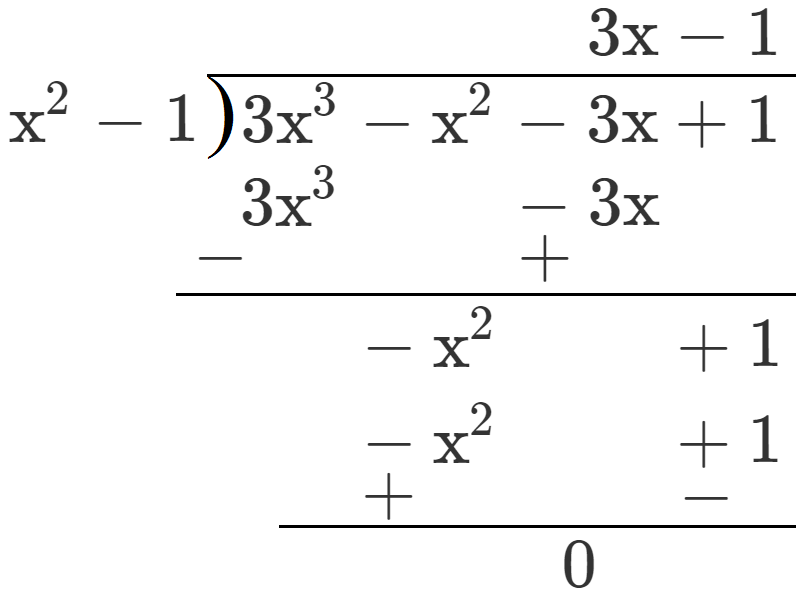
Therefore, $3x^3 - x^2 - 3x + 1 = (x^2 - 1)(3x - 1)$
Now, $(x^2 - 1) = (x - 1)(x + 1)$
Hence, $3x^3 - x^2 - 3x + 1 = (x - 1)(x + 1)(3x - 1)$ View full question & answer→Question 84 Marks
What must be added to $x^3 - 3x^2 - 12x + 19$ so that the result is exactly divisibly by $x^2 + x - 6?$
AnswerLet $p(x)=x^3-3 x^2-12 x+19$ and $q(x)=x^2+x-6$
When $p(x)$ is divided $q(x)$ then the remainder is a linear equation, $r(x)$. .
Let $r(x)=a x+b$ when added to $p(x)$
we get an expression which is divisible by $q(x) . f(x)$
$= p(x) + r(x) f(x)$
$= x^3 - 3x^2 - 12x + 19 + ax + b$
$= x^3 - 3x^2 - 12x + ax + 19 + b$
$= x^3 - 3x^2 - x(12 - a) + 19 + b$
Now, $q(x) = x^2 + x - 6$
$= x^2 + 3x - 2x - 6$
$= (x + 3)(x - 2)$
Also, $f(x)$ is divisible $q(x)$
$\therefore$ $f(-3)= 0, f(2) = 0 f(-3) = (-3)^3 - 3(-3)^2 - 12(-3) + 19 + a(-3) + b = 0$
$\Rightarrow -27 + 27 + 36 + 19 - 3a + b = 0$
$\Rightarrow b = 3a + 27 + 27 - 36 - 19$
$\Rightarrow b = 3a - 1 ...(1)$
$f(2) = 2^3 - 3(2)^2 - 12(2) + 19 + 2a + b = 0$
$\Rightarrow 8 - 12 - 24 + 19 + 2a + b = 0$
$\Rightarrow b = 9 - 2a ...(2)$ Equating $(1)$ and $(2) 3a - 1 = 9 - 2a$
$\Rightarrow 5a = 10$
$\Rightarrow a = 2$
$\therefore$ $b = 3a - 1 3(2) - 1 = 5$ [Substituting $b = 5,$ in equation $1$]
Hence, $a x+b=2 x+5$
View full question & answer→Question 94 Marks
Using factor theorem, factorize the following polynomials: $x^4 - 7x^3_+ 9x^2 + 7x - 10$
AnswerLet $f(x)=x^4-7 x^3+9 x^2+7 x-10$ The factors of constant term in $f ( x )$ are $\pm 1, \pm 2, \pm 5$ and $\pm 10$.
We have, $f(1)=1-7+9+7-10=0$
$\Rightarrow( x -1)$ is a factor of $f ( x ) f (-1)=1+7+9-7-10=0$
$\Rightarrow(x+1)$ is a factor of $f(x) f(2)=16-56+36+14-10=0$
$\Rightarrow( x -2)$ is a factor of $f ( x ) f (-2)=16+56-36-14-10=10$
$\Rightarrow(x+2)$ is not a factor of $f(x) f(5)=625-875+225+35-10=0$
$\Rightarrow(x-5)$ is a factor of $f(x)$ Since $f(x)$ is a polynomial of degree 4.
So, it cannot have more than 4 linear factors.
Thus, factors of $f(x)$ are $(x-1),(x+1),(x-2)$ and $(x-5)$.
Therefore, $f(x)=k(x-1)(x+1)(x-2)(x-5) x^4-7 x^3+9 x^2+7 x-10$ $=k(x-1)(x+1)(x-2)(x-5) \ldots(1)$
Putting $x=0$ on both sides,
we get, $-10=k(-1)(1)(-2)(-5)-10=-10 k k=1$
Substituting $k=1$ in $(1),$
we get, $x^4-7 x_{+}^3 9 x^2+7 x-10$
$=(x-1)(x+1)(x-2)(x-5)$
View full question & answer→Question 104 Marks
Using factor theorem, factorize the following polynomials:
$x^3 - 23x^2 + 142x - 120$
AnswerLet $p(x) = x^3 - 23x^2 + 142x - 120$
We shall now look for all the factors of -120. Some of these are $1,\pm2,\pm3,\pm,\pm4,\pm5,\pm6,\pm8\\\pm12,\pm15,\pm20,\pm24,\pm30,\pm,60$
By trial, we find that $p(1) = 0.$
So $x - 1 $is a factor of $p(x).$
Now, we see that $x^3 - 23x^2 + 142x - 120 = x^3 - x^2- 22x^2 + 22x +120x - 120$
$= x^2(x - 1) - 22x(x - 1) + 120(x - 1)$
$= (x - 1)(x^2 - 22x + 120)$ [Taking (x - 1) common]
We could have also got this by dividing p(x) by $x - 1.$
Now $x^2 - 22x + 120$ can be factorised either by splitting the middle term or by using the factor theorem.
By splitting the middle term, we have:
$x^2 - 22x + 120 = x^2 - 12x - 10x+ 120$
$= x(x - 12) - 10(x - 12)$
$= (x - 12)(x - 10)$
So,
$x^3 - 23x^2 + 142x - 120 = (x - 1)(x - 10)(x - 12)$
View full question & answer→Question 114 Marks
In the following, use factor theorem to find whether polynomial $g(x)$ is a factor of polynomial $f(x)$ or, not:$ f(x) = x^3 - 6x^2 + 11x - 6, g(x) = x^2 - 3x + 2$
Answer$g(x) = x^2 - 3x + 2 = x^2 - 2x - x + 2$
$= x(x - 2) - 1(x - 2) = (x - 2)(x - 1)$
Let $g(x) = 0$
$\Rightarrow (x - 2)(x - 1) = 0 If x - 2 = 0$
$\Rightarrow x = 2 If x - 1 = 0$
$\Rightarrow x = 1 f(2)$
$= 2^3 - 6(2)^2 + 11(2) - 6$
$= 8 - 24 + 22 - 6 = 30 - 30$
$= 0 f(1) = 1^3 - 6(1)^2 + 11(1) - 6$
$= 1 - 6 + 11 - 6 = 0$
$\because f(2)=0$ and $f(1)=0$,
by factor theorem, $(x-2)$ and $(x-1)$ both are factors of $f(x)$.
Hence, $(x-2)(x-1)$ is a factor of $f(x)$.
View full question & answer→Question 124 Marks
Using factor theorem, factorize the following polynomials: $y^3 - 7y + 6$
AnswerLet $f(y) = y^3 - 7y + 6$
The factors of constant term in f(y) are $\pm1,\pm,2,\pm3$ and $\pm6.$
We have, $f(1)=1-7+6=0$
$\Rightarrow(y-1)$ is a factor of $f(y) f(-1)=-1+7+6=12$
$\Rightarrow(y+1)$ is a factor of $f(y) f(2)=8-14+6=0$
$\Rightarrow(y-2)$ is a factor of $f(y) f(-2)=-8+14+6=12$
$\Rightarrow(y+2)$ is not a factor of $f(y) f(3)=27-21+6=12$
$\Rightarrow(y-3)$ is not a factor of $f(y) f(-3)=-27+21+6=0$
$\Rightarrow(y+3)$ is a factor of $f(y)$ since $f(y)$ is a polynomial of degree $3.$
So, it cannot have more than $3$ linear factors.
Thus, factors of $f(y)$ are $(y-1)(y-2)$ and $(y+3)$.
Therefore, $f(y)=k(y-1)(y-2)(y+3) y^3-7 y+6$
$=k(y-1)(y-2)(y+3) \ldots(1)$ Putting $y=0$ on both sides,
we get, $6=k(-1)(-2)(3) 6=6 k k=1$
Substituting $k=1$ in $(1),$
we get, $y^3-7 y+6=(y-1)(y-2)(y+3)$
View full question & answer→Question 134 Marks
Find the values of $a$ and $b$, if $x^2-4$ is a factor of $a x^4+2 x^3-3 x^2+b x-4$
AnswerLet $g(x) = x^2 - 4$ is, $f(x) = ax^4 + 2x^3 - 3x^2 + bx - 4.$
Let $g(x) = 0$
$\Rightarrow x^2 - 4 = 0$
$\Rightarrow x^2 = 4,$
$\Rightarrow \text{x}=\pm2$
Since $(x^2 - 4)$ is a factor of $f(x).$
$\therefore$ $f(2) = 0$ and $f(-2) = 0 f(2)$
$= a(2)^4 + 2(2)^3 - 3(2)^2 + b(2) - 4 = 0$
$\Rightarrow 16a + 16 - 12 + 2b - 4 = 0$
$\Rightarrow 16a + 2b = 0$
$\Rightarrow 16a = -2b$
$\Rightarrow\ \text{a}=\frac{-2\text{b}}{16}=\frac{-\text{b}}{8}\dots(1)$
Also, $f(-2) = 0 f(-2) = a(-2)^4 + 2(-2)^3 - 3(-2)^2 + b(-2) - 4 = 0$
$\Rightarrow 16a - 16 - 12 - 2b - 4 = 0$
$\Rightarrow 16a - 2b - 32 = 0$
$\Rightarrow 16a = 2b + 32$
$\Rightarrow\ \frac{2\text{b}+32}{16}\dots(2)$ Equating equations $(1)$ and $(2)$
$\Rightarrow\ \frac{-\text{b}}{8}=\frac{2\text{b}+32}{16}$
$\Rightarrow\ \frac{-16\text{b}}{8}=2\text{b}+32$
$\Rightarrow -2b = 2b + 32$
$\Rightarrow -4b = 32$
$\Rightarrow b = -8$ Substituting $b = -8$ in equation $(1)$
$\text{a}=\frac{-\text{b}}{8}=\frac{-(-8)}{8}=\frac{8}{8}=1$
$\therefore\text{a}=1,\text{b}=-8$
View full question & answer→Question 144 Marks
In the following, using the remainder theorem, find the remainder when $f(x)$ is divided by $g(x)$ and verify the by actual division: $f(x) = 2x^4 - 6x^3 + 2x^2 - x + 2, g(x) = x + 2$
AnswerHere, $f(x) = 2x^4 - 6x^3 + 2x^2 - x + 2 g(x) = x + 2$ From,
the remainder theorem when f(x) is divided by $g(x) = x - (-2)$
the remainder will be equal to $f(-2)$
Let, $g(x) = 0$
$\Rightarrow x + 2 = 0$
$\Rightarrow x = -2$
Substitute the value of x in $f(x) f(-2)$
$= 2(-2)^4 - 6(-2)^3 + 2(-2)^2 - (-2) + 2$
$= (2 \times 16) - (6 \times (-8)) + (2 \times 4) + 2 + 2$
$= 32 + 48 + 8 + 2 + 2 = 92$
Therefore, the remainder is $92.$
View full question & answer→Question 154 Marks
$2x^4 - 7x^3 - 13x^2 + 63x - 45$
AnswerLet $f(x)=2 x^4-7 x^3-13 x^2+63 x-45$ be the given polynomial.
Now, putting $x=1$, we get $f(1)=2(1)^4-7(1)^3-13(1)^2+63(1)-45$
$=2-7-13+63-45=65-65=0$
Therefore, $(x-1)$ is a factor of polynomial $f(x)$.
Now, $f(x)=2 x^3(x-1)-5 x^2(x-1)-18 x(x-1)+45(x-1)$
$=(x-1)\left(2 x^3-5 x^2-18 x+45\right)=(x-1) g(x) \ldots(1)$
$\text { Where } g(x)=2 x^3-5 x^2-18 x+45 \text { Putting } x=3 \text {, }$
$\text { we get: } g(3)=2(3)^3-5(3)^2-18(3)+45$
$=54-45-54+45=0$
Therefore, $(x-3)$ is the factor of $g(x)$.
Now, $g(x)=2 x^2(x-3)+x(x-3)-15(x-3)$
$=(x-3)\left(2 x^2+x-15\right)$
$=(x-3)\left(2 x^2+6 x-5 x-15\right)$
$=(x-3)(x+3)(2 x-5) \ldots(2)$
From equation (1) and (2),
we get: $f(x)=(x-1)(x-3)(x+3)(2 x-5)$
Hence, $(x-1),(x-3),(x+3)$ and $(2 x-5)$ are the factors of polynomial $f(x)$.
View full question & answer→Question 164 Marks
Using factor theorem, factorize the following polynomials: $x^3 + 6x^2 + 11x + 6$
Answer Let x = 1 $\text{f(1)}=1^3+6(2)^2+11(1)+6\neq0$
Let $x = -1 f(-1) = (-1)^3 + 6(-1)^2 + 11(-1) + 6 = 12 - 12 = 0$
$\therefore$ $x = -1$ is a solution
$\Rightarrow x + 1 = 0 i. e (x + 1)$ is a factor of $f(x)$
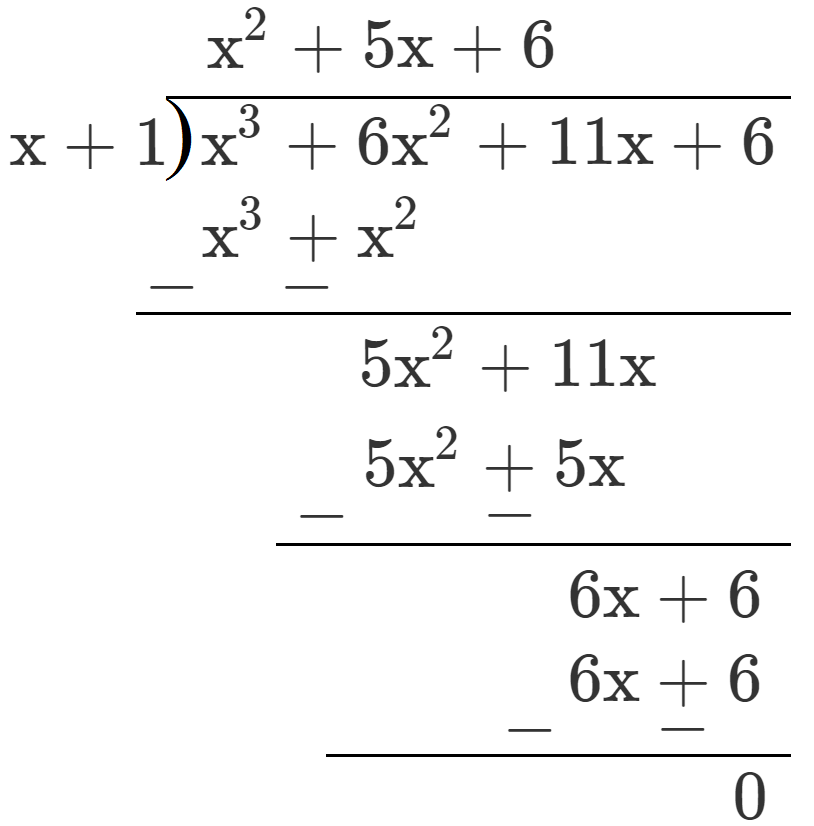
By division algorithm $x^3 + 6x^2 + 11x + 6$
$= (x + 1)(x^2 + 5x + 6)$
$= (x + 1)(x^2 + 2x + 3x + 6)$
$= (x + 1)(x(x + 2) + 3(x + 2))$
$= (x + 1)(x + 2)(x + 3)$
$\therefore x^3 + 6x^2 + 11x + 6$
$=(x + 1)(x + 2)(x + 3)$ View full question & answer→Question 174 Marks
$x^4 - 2x^3 - 7x^2 + 8x + 12.$
AnswerLet $f(x)=x^4-2 x^3-7 x^2+8 x+12$
The factors of constant term in $f(x)$ are $\pm 1, \pm 2, \pm 3, \pm 4, \pm 6$ and $\pm 12$.
We have,
$f(1)=1-2-7+8+12=12$
$\Rightarrow( x -1)$ is not a factor of $f ( x )$
$f(-1)=1+2-7-8+12=0$
$\Rightarrow(x+1)$ is a factor of $f(x)$
$f(2)=16-16-28-16+12=0$
$\Rightarrow(x-2)$ is a factor of $f(x)$
$f(-2)=16+16-28-16+12=0$
$\Rightarrow(x+2)$ is a factor of $f(x)$
$f(3)=81-54-63+24+12=0$
$\Rightarrow(x-3)$ is a factor of $f(x)$
Since $f(x)$ is a polynomial of degree $4$ . So, it cannot have more than $4$ linear factors.
Thus, factors of $f(x)$ are $(x+1),(x-2),(x+2)$ and $(x-3)$.
Therefore,
$f(x)=k(x+1)(x+2)(x-2)(x-3)$
$x^4-2 x^3-7 x^2+8 x+12=k(x+1)(x+2)(x-2)(x-3)$
Putting $x=0$ on both sides, we get,
$12=k(1)(2)(-2)(-3)$
$12=12 k$
$k=1$
Substituting $k =1$ in $(1)$, we get,
$x^4-2 x^3-7 x^2+8 x+12=k(x+1)(x+2)(x-2)(x-3)$
View full question & answer→Question 184 Marks
Using factor theorem, factorize the following polynomials: $x^3 - 3x^2 - 9x - 5$
AnswerLet $p(x) = x^3 - 3x^2 - 9x - 5$
The factors of 5 are $\pm1,\pm5.$ By hit and trial method
$p(-1) = (-1)^3 - 3(-1)^2 - 9(-1) - 5$
$= -1 - 3 + 9 - 5 = 0$
So $x + 1$ is a factor of this polynomial $p(x).$
Let us find the quotient while dividing $x^3 - 3x^2 - 9x - 5 by x + 1$ By long division
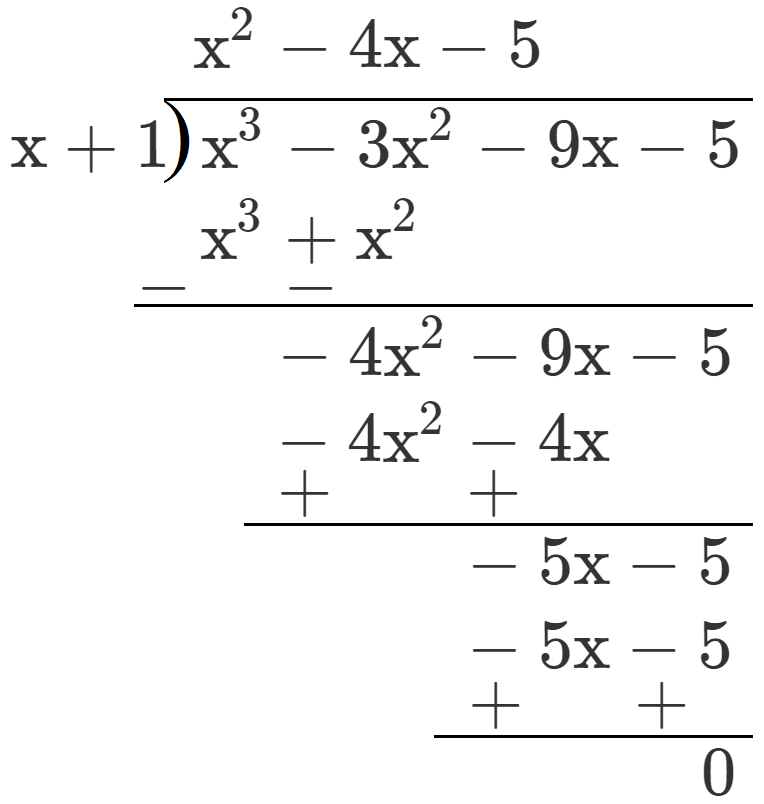
Now, Dividend = Divisor × Quotient + Remainder
$\therefore x^3 - 3x^2 - 9x - 5$
$= (x + 1)(x^2 - 4x - 5) + 0$
$= (x + 1)(x^2 - 5x + x - 5)$
$= (x + 1)[x(x - 5) + 1(x - 5)]$
$= (x + 1)(x - 5)(x + 1)$
$= (x - 5)(x + 1)(x + 1)$ View full question & answer→Question 194 Marks
Verify whether the indicated numbers are zeros of the polynomials corresponding to them in the following case: $p(x) = x^3 - 6x^2 + 11x - 6, x = 1, 2, 3$
Answer $p(x)=x^3-6 x^2+11 x-6, x=1,2,3$
We know that, $p(x)=x^3-6 x^2+11 x-6$
given that the values of $x$ are $1,2,3$
substitute $x=1$ in $p(x) p(1)$
$=1^3-6(1)^2+11(1)-6$
$=1-(6 \times 1)+11-6=1-6+11-6=0$
Now, substitute $x=2$ in $p(x) P(2)=2^3-6(2)^2+11(2)-6$
$=(2 \times 3)-(6 \times 4)+(11 \times 2)-6=8-24-22-6=0$
Now, substitute $x=3$ in $p ( x ) P (3)$
$=3^3-6(3)^2+11(3)-6$
$=(3 \times 3)-(6 \times 9)+(11 \times 3)-6$
$=27-54+33-6=0$
Since, the result is 0 for $x=1,2,3$
these are the roots of $x^3-6 x^2+11 x-6$
View full question & answer→Question 204 Marks
If the polynomials $a x^3+3 x^2-13$ and $2 x^3-5 x+a$, when divided by $(x-2)$ leave the same remainder, Find the value of a.
AnswerHere, The polynomials are: $f(x) = ax^3 + 3x^2 − 13$
$p(x) = 2x^3 − 5x + a$ equate, $x - 2 = 0 x = 2$ substitute the value of $x$ in $f(x)$ and
$p(x) f(2) = (2)^3 + 3(2)^2 − 13$
$= 8a + 12 - 13$
$= 8a - 1 ...(1) p(2)$
$= 2(2)^3 - 5(2) + a$
$= 16 - 10 + a$
$= 6 + a ...(2) f(2) = p(2)$
$\Rightarrow 8a - 1 = 6 + a$
$\Rightarrow 8a - a = 6 + 1$
$\Rightarrow 7a = 7$
$\Rightarrow a = 1$
The value of $a = 1.$
View full question & answer→Question 214 Marks
Find the rational roots of the polynomial $f(x) = 2x^3 + x^2 - 7x - 6$
AnswerGiven that $f(x) = 2x^3 + x^2 - 7x - 6 f(x) $is a cubic polynomial with an integer coefficient.
If the rational root in the form of $\frac{\text{p}}{\text{q}},$
the values of p are limited to factors of 6 which are $±1, ±2, ±3, ±6$ and the values of q are limited to the highest degree coefficient
i.e 2 which are $±1, ±2$ here, the possible rational roots are $±1, ±2, ±3, ±6, ±\frac{1}{2}, ±\frac{3}{2}$
Let, $x = -1 f(-1)$
$= 2(-1)^3 +(-1)^2- 7(-1) - 6$
$= -2 + 1 + 7 - 6$
$= -8 + 8 = 0$
Let, $x = 2 f(-2)$
$= 2(2)^3 + (2)^2- 7(2) - 6$
$= (2 \times 8) + 4 - 14 - 6$
$= 16 + 4 -14 - 6$
$= 20 - 20$
$ = 0$
Let, $\text{x}=-\frac{3}{2}$
$\text{f}=\Big(-\frac{3}{2}\Big)=2\Big(-\frac{3}{2}\Big)^3+\Big(-\frac{3}{2}\Big)^2-7\Big(-\frac{3}{2}\Big)-6$
$=2\Big(-\frac{27}{4}\Big)+\frac{9}{4}-7\Big(-\frac{3}{2}\Big)-6$
$=2\Big(-\frac{27}{4}\Big)+\frac{9}{4}-\Big(-\frac{21}{2}\Big)-6$
$=-6.75+2.25+10.5-6$
$=12.75-12.75$
$=0$ But from all the factors only $-1, 2$ and $-\frac{3}{2}$
gives the result as zero
So, the rational roots of $2x^3 + x^2 - 7x - 6$ are $ -1, 2$ and $-\frac{3}{2}$
View full question & answer→Question 224 Marks
Using factor theorem, factorize the following polynomials: $x^3 + 2x^2 - x - 2$
AnswerLet $x = 1 f(1) = 1^3 + 2(1)^2 - 1 - 2 = 0$
$\therefore x = 1$ is a solution
$\Rightarrow x - 1 = 0$ i. $e (x - 1)$ is a factor of $f(x)$
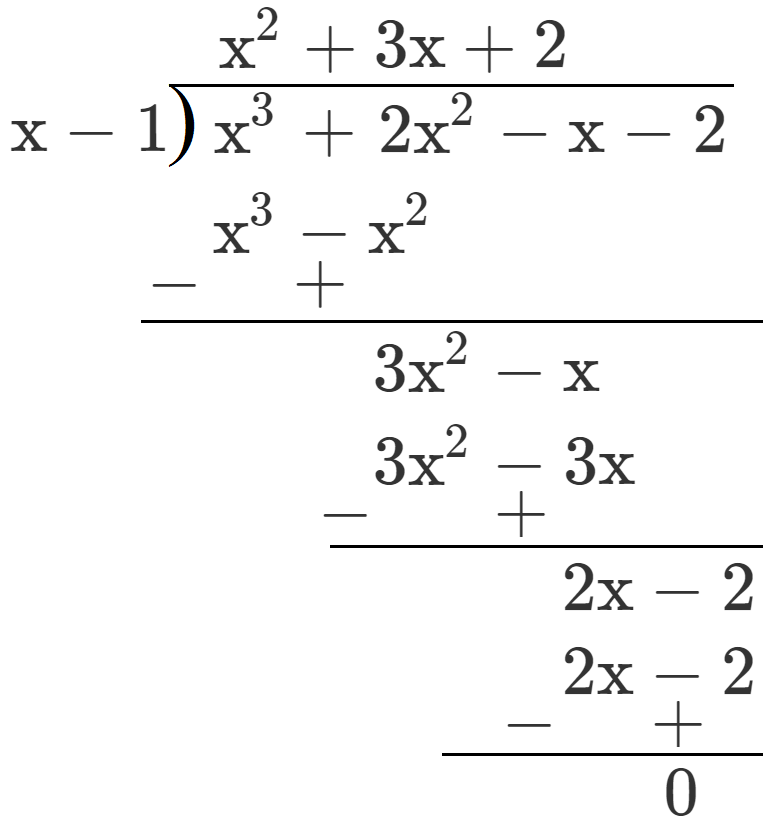
By division algorithm $x^3 + 2x^2 - x - 2$
$= (x - 1)(x^2 + 3x + 2)$
$= (x - 1)(x^2 + 2x + x + 2)$
$= (x - 1)(x(x + 2) + 1(x + 2))$
$= (x - 1)(x + 2)(x + 1)$
$\therefore x^3 + 2x^2 - x - 2$
$= (x - 1)(x + 2)(x + 1)$ View full question & answer→Question 234 Marks
Factorize the following polynomials: $x^3 + 13x^2 + 31x - 45$ given that $x + 9$ is a factor.
Answer Let $f(x) = x^3 + 13x^2 + 31x - 45$ be the given polynomial.
Therefore, $(x + 9)$ is a factor of the polynomial $f(x).$
Now, $f(x) = x^2(x + 9) + 4x(x + 9) - 5(x + 9)$
$= (x + 9)(x^2 + 4x - 5)$
$= (x + 9)(x^2 +5x - x - 5)$
$= (x + 9)(x - 1)(x + 5)$
Hence $(x - 1), (x + 5)$ and $(x + 9)$ are the factors of polynomial $f(x).$
View full question & answer→Question 244 Marks
If both $x+1$ and $x-1$ are factors of $a x^3+x^2-2 x+b$, find the values of $a$ and $b$.
AnswerLet, $x + 1 = 0 x = -1$
$\because$ $(x + 1)$ is a factor of $p(x) = ax^3 + x^2 - 2x + b$
$\therefore$ $p(-1) = 0 p(-1) = a(-1)^3 + (-1)^2 - 2(-1) + b = 0$
$\Rightarrow -a + 1 + 2 + b = 0$
$\Rightarrow -a + 3 + b = 0$
$\Rightarrow a = 3 + b ...(1)$
$Let, x - 1 = 0 x = 1$
$\because$ (x - 1) is a factor of $p(x)$
$\therefore$ $p(1) = 0 p(1) = a(1)^3 + 1^2 -2(1) + b = 0$
$\Rightarrow a + 1 - 2 + b = 0$
$\Rightarrow a = -b + 1 ...(2)$ Equating $(1)$ and $(2)$
$\Rightarrow 3 + b = -b + 1$
$\Rightarrow b + b = 1 - 3$
$\Rightarrow 2b = -2$
$\Rightarrow b = -1$
Substituting $b = -1$ in equation $(2)$
$a = -(-1) + 1 = 1 + 1 = 2$
$\therefore$ $a = 2, b = -1$
View full question & answer→Question 254 Marks
Using factor theorem, factorize the following polynomials:$ x^3 - 2x^2 - x + 2$
AnswerLet $f(x) = x^3 - 2x^2 - x + 2$
The factors of constant term in f(x) are $\pm1,\pm2.$
We have $f(1)=1-2-1+2=0$
$\Rightarrow(x-1)$ is a factor of $f(x) f(-1)=-1-2+1+2=0$
$\Rightarrow(x+1)$ is a factor of $f(x) f(2)=8-8-2+2=0$
$\Rightarrow(x-2)$ is a factor of $f(x)$ Since $f(x)$ is a polynomial of degree $3.$
So, it cannot have more than 3 linear factors.
Thus, factors of $f(x)$ are $(x-1),(x+1)$ and $(x-2)$.
Therefore, $f(x)=k(x-1)(x+1)(x-2) x^3-2 x^2-x+2$
$=k(x-1)(x+1)(x-2) \ldots(1)$ Putting $x=0$ on both sides,
we get, $2=k(-1)(1)(-2) 2=2 k k=1$
Substituting $k =1$ in (1),
we get, $x^3-2 x^2-x+2=(x-1)(x+1)(x-2)$
View full question & answer→Question 264 Marks
If the polynomial $2x^3 + ax^2 + 3x - 5$ and $x^3 + x^2 - 4x + a$ leave the same remainder when divided by $x - 2$, Find the value of a.
AnswerGiven, the polymials are: $f(x)=2 x^3+a x^2+3 x-5$
$p(x)=x^3+x^2-4 x+a$
The remainders are $f(2)$ and $p(2)$
when $f(x)$ and $p(x)$ are divided by $x-2$
We know that, $f(2)=p(2)$ (given in problem)
we need to calculate $f(2)$ and $p(2)$ for, $f(2)$
substitute $(x = 2) in f(x) f(2) = 2(2)^3 + a(2)^2+ 3(2) - 5$
$= (2 \times 8) + 4a + 6 - 5$
$= 16 + 4a + 1$
$= 4a + 17 ...(1)$ for, $p(2)$ substitute $(x = 2)$ in
$p(x) p(2) = 2^3 + 2^2- 4(2) + a$
$= 8 + 4 - 8 + a = 4 + a ...(2)$
Since, $f(2) = p(2)$ Equate equation $1$ and $2$
$\Rightarrow 4a + 17 = 4 + a$
$\Rightarrow 4a - a = 4 - 17$
$\Rightarrow 3a = -13$
$\Rightarrow\ \text{a}=\frac{-13}{3}$
The value of $\text{a}=\frac{-13}{3}.$
View full question & answer→Question 274 Marks
In the following, using the remainder theorem, find the remainder when $f(x)$ is divided by $g(x)$ and verify the by actual division: $f(x) = x^4 - 3x^2 + 4, g(x) = x - 2$
AnswerHere, $f(x)=x^4-3 x^2+4 g(x)=x-2$ From, the remainder theorem when $f(x)$ is divided by $g(x)=x-2$ the remainder will be equal to $f(2)$ Let, $g(x)=0$
$\Rightarrow x-2=0$
$\Rightarrow x=2$
Substitute the value of $x$ in $f(x) f(2)=2^4-3(2)^2+4=16-(3 \times 4)+4=16-12+4=20-12=8$
Therefore, the remainder is $8 .$
View full question & answer→Question 284 Marks
Using factor theorem, factorize the following polynomials: $y^3 - 2y^2 - 29y - 42$
AnswerLet $f(y) = y^3 - 2y^2 - 29y - 42$ be the given polynomial.
Now, putting $y = -2,$
we get $f(-2) = (-2)^3 - 2(-2)^2 - 29(-2) - 42$
$= -8 - 8 + 58 - 42$
$= -58 + 58 = 0$
Therefore, $(y + 2)$ is a factor of polynomial $f(y).$
Now, $f(y) = y^2(y + 2) + 4y(y + 2) - 2(y + 2)$
$= (y + 2)(y^2 - 4y - 21)$
$= (y + 2)(y^2 - 7y + 3y - 21)$
$= (y + 2)(y + 3)(y - 7)$
Hence $(y + 2), (y + 3)$ and $(y - 7)$ are the factors of polynomial $f(y).$
View full question & answer→Question 294 Marks
Show that $(x-2),(x+3)$ and $(x-4)$ are factors of $x^3-3 x^2-10 x+24$
Answer$F(x) = x^3 - 3x^2 - 10x + 24$
Let, $x - 2 = 0$
$\Rightarrow x = 2 f(2) = 2^3 - 3(2)^2 - 10(2) + 24$
$= 8 - 12 - 20 + 24$
$= 32 - 32 = 0$
Let, $x + 3 = 0$
$\Rightarrow x = -3 f(-3)$
$= (-3)^3 - 3(-3)^2 - 10(-3) + 24$
$= -27 - 3(9) + 30 + 24$
$= -27 - 27 + 30 + 24$
$= -54 + 54 = 0$
Let, $x - 4 = 0$
$\Rightarrow x = 4 f(4) = 4^3 - 3(4)^2 - 10(4) + 24$
$= 64 - 3(16) - 40 + 24$
$= 64 - 48 - 40 + 24$
$= 88 - 88$
$= 0$
$\because$ $f(2)= 0, f(-3) = 0, f(4) = 0$
$\therefore$ By factore theoram $(x - 2), (x + 3)$ and $(x - 4)$ are factors of $x^3 - 3x^2 - 10x + 24.$
View full question & answer→Question 304 Marks
Using factor theorem, factorize the following polynomials: $x^3 + 13x^2 + 32x + 20$
AnswerLet $p(x) = x^3 + 13x^2+ 32x + 20$
The factors of 20 are $\pm1,\pm2,\pm4,\pm5\dots$ By hit and trial method $p(-1) = (-1)^3 + 13(-1)^2 + 32(-1) + 20 = -1 + 13 - 32 + 20 = 33 - 33 = 0 As p(-1)$ is zero,
so $x + 1$ is a factor of this polynomial $p(x).$
Let us find the quotient while dividing $x^3 + 13x^2 + 32x + 20 by (x + 1)$ By long division
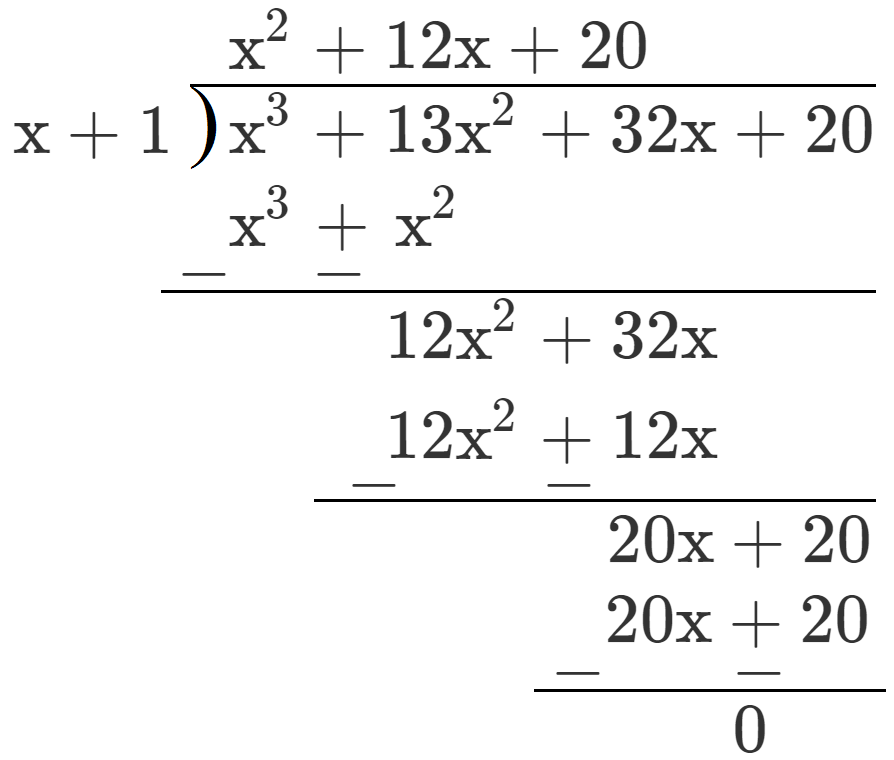
We know that Dividend = Divisor $\times $ Quotient + Remainder
$x^3 + 13x^2 + 32x + 20 $
$= (x + 1)(x^2 + 12x + 20) + 0 $
$= (x + 1)(x^2 + 10x + 2x + 20) $
$= (x + 1)[x(x + 10) + 2(x + 10)] $
$= (x + 1)(x + 10)(x + 2) $
$= (x + 1)(x + 2)(x + 10)$ View full question & answer→Question 314 Marks
In the following, using the remainder theorem, find the remainder when $f(x)$ is divided by $g(x)$ and verify the by actual division: $f(x) = 4x^4 - 3x^3 - 2x^2 + x - 7, g(x) = x - 1$
AnswerHere, $f(x) = 4x^4 - 3x^3 - 2x^2 + x -7 g(x) = x - 1$ From, the remainder theorem
when f(x) is divided by $g(x) = x - (-1)$ the remainder will be equal to $f(1)$
Let, $g(x) = 0$
$\Rightarrow x - 1 = 0$
$\Rightarrow x = 1$
Substitute the value of x in
$f(x) f(1) = 4(1)^4- 3(1)^3- 2(1)^2 + 1 - 7$
$= 4 - 3 - 2 + 1 - 7$
$= 5 - 12$
$= -7$
Therefore, the remainder is $7.$
View full question & answer→Question 324 Marks
$x^4 + 10x^3 + 35x^2 + 50x + 24.$
AnswerLet $f(x) = x^4 + 10x^3 + 35x^2 + 50x + 24$
Now, putting $x = -1,$
we get $f(-1) = (-1)^4 + 10(-1)^3 + 35(-1)^2 + 50(-1) + 24$
$= 1 - 10 + 35 - 50 + 24$
$= 60 - 60$
$= 0$
Therefore, $(x + 1)$ is a factor of polynomial $f(x).$
Now, $f(x) = x^3(x + 1) + 9x^2(x + 1) + 26(x + 1) + 24(x + 1)$
$= (x + 1)(x^3 + 9x^2 + 26x + 24)$
$= (x + 1)g(x) ...(1)$
Where $g(x) = x^3 + 9x^2 + 26x + 24$
Putting $x = -2,$
we get: $g(-2)$
$= (-2)^3 + 9(-2)^2 + 26x(-2) + 24$
$= -8 + 36 - 52 + 24$
$= 60 - 60$
$= 0$
Therefore, $(x + 2)$ is the factor of $g(x).$
Now, $g(x) = x^2(x + 2) + 7x(x + 2) + 12(x + 2)$
$= (x + 2)(x^2 + 7x + 12)$
$= (x + 2)(x^2 + 4x + 3x + 12)$
$= (x + 2)(x + 3)(x + 4) ...(2)$
From equation $(1)$ and $(2),$
we get:$ f(x) = (x + 1)(x + 2)(x + 3)(x + 4)$
Hence, $(x + 1), (x + 2), (x + 3)$ and $(x + 4)$ are the factors of polynomial $f(x).$
View full question & answer→Question 334 Marks
If $x^3 + ax^2 - bx + 10$ is divisible by $x^2 - 3x + 2$, find the values of $a$ and $b.$
AnswerLet, $p(x)=x^3+a x^2-b x+10 g(x)=x^2-3 x+2$
Let $g(x)=0 \Rightarrow x^2-3 x+2=0$
$\Rightarrow x^2-2 x-x+2$
$\Rightarrow x(x-2)-1(x-2)=0$
$\Rightarrow x-2=0, x$
$-1=0 \therefore x=2, x=1$
Since $x^2-3 x+2$ is a factor of
$\therefore$ $(x - 2)(x - 1)$ is a factor of $p(x)$
Hence, $p(2) = 0, p(1) = 0$
$p(2) = 2^3 + a(2)^2 - b(2) + 10 = 0$
$\Rightarrow 8 + 4a - 2b + 10 = 0$
$\Rightarrow 4a - 2b + 18 = 0$
$\Rightarrow 4a = -18 + 2b$
$\Rightarrow\ \text{a}=\frac{-18+2\text{b}}{4}=\frac{2(-9+\text{b})}{4}=\frac{-9+\text{b}}{2}\dots(1)$
$p(1) = 13 + a(1)2 - b(1) + 10 = 0$
$\Rightarrow a - b + 11 = 0$
$\Rightarrow a = b - 11 ...(2)$
Equadting $(1)$ and $(2)$
$\frac{-9+\text{b}}{2}=\text{b}-11$
$\Rightarrow -9 + b = 2b - 22$
$\Rightarrow -9 + 22 = 2b - b$
$\Rightarrow 13 = b$
Subsitituting $b = 13$ in equation $(2)$
$a = b - 11 = 13 - 11 = 2$
$\therefore a = 2, b = 13$
View full question & answer→Question 344 Marks
Using factor theorem, factorize the following polynomials: $2y^3 - 5y^2 - 19y + 42$
Answer Let $f(y)=2 y^3-5 y^2-19 y+42$ be the given polynomial.
Now, putting $y =2$,
we get $f(2) = 2(2)^3 - 5(2)^2 - 19(2) + 42 $
$= 16 - 20 - 38 + 42 = -58 + 58 = 0$
Therefore, $(y-2)$ is a factor of polynomial $f(y)$.
Now, $f(y) = 2y^2(y - 2) - y(y - 2) - 21(y - 2) $
$= (y - 2)(2y^2 - y - 21) $
$= (y - 2)(2y^2 - 7y + 6y - 21)$
$ = (y - 2)(y + 3)(2y - 7)$
Hence $(y-2),(y+3)$ and $(2 y-7)$ are the factors of polynomial $f(y)$.
View full question & answer→Question 354 Marks
Using factor theorem, factorize the following polynomials:
$x^3 - 10x^2 - 53x - 42$
AnswerLet $f(x) = x^3 - 10x^2 - 53x - 42$ be the given polynomial.
Now, putting $x = -1$, we get
$f(-1) = (-1)^3 - 10(-1)^2 - 53(-1) - 42$
$= -1 - 10 + 53 - 42$
$= -53 + 53 = 0$
Therefore, $(x + 1)$ is a factor of polynomial$ f(x).$
Now,
$f(x) = x^2(x + 1) - 11x(x + 1) - 42(x + 1)$
$= (x + 1)(x^2 - 11x - 42)$
$= (x + 1)(x^2 - 14x + 3x - 42)$
$= (x + 1)(x + 3)(x - 14)$
Hence $(x + 1), (x + 3)$ and $(x - 14)$ are the factors of polynomial$ f(x).$
View full question & answer→Question 364 Marks
If $x = 0$ and $x = -1$ are the roots of the polynomial $f(x) = 2x^3- 3x^2 + ax + b$, Find the of $a$ and $b.$
AnswerWe know that, $f(x)=2 x^3-3 x^2+a x+b$
Given, the values of $x$ are 0 and -1 Substitute $x=0$ in
$f(x) f(0)=2(0)^3-3(0)^2+a(0)+b=0-0+0+b=b \ldots(1)$
Substitute $x=(-1)$ in $f(x) f(-1)=2(-1)^3-3(-1)^2+a(-1)+b=-2-3-a+b=-5-a+b \ldots(2)$
We need to equate equations 1 and 2 to zero $b=0$ and $-5-a+b=0$
since, the value of $b$ is zero substitute $b=0$ in equation $2$
$\Rightarrow -5 - a = -b$
$\Rightarrow -5 - a$
$= 0 a$
$= -5$
the values of $a$ and $b$ are$ -5 $and $0$ respectively.
View full question & answer→Question 374 Marks
Using factor theorem, factorize the following polynomials: $x^3 - 6x^2 + 3x + 10$
AnswerLet $x = 2 f(2) = 2^3 + 6(2)^2 + 3(2) + 10 = 8 - 24 + 6 + 10 = 0$
$\therefore x = 2$ is a solution $f(x)$ i. e $(x - 2)$ is a factor of $f(x)$
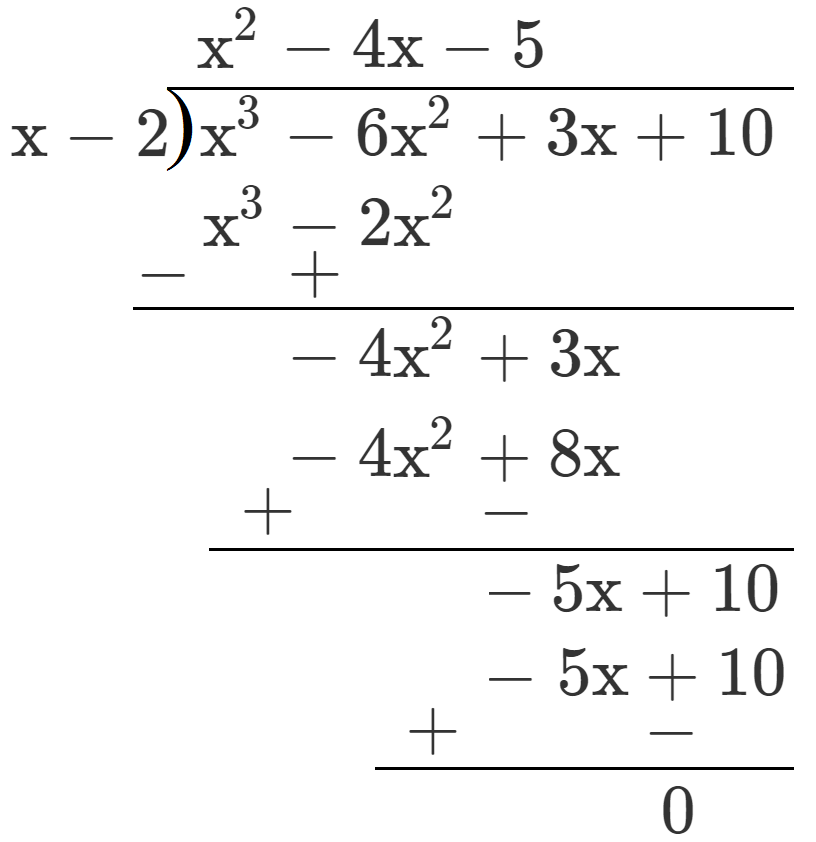
By division algorithm $x^3 - 6x^2 + 3x + 10$
$= (x - 2)(x^2 - 4x - 5)$
$= (x - 2)(x^2 - 5x + x - 5)$
$= (x - 2)(x(x - 5) + 1(x - 5))$
$= (x - 2)(x - 5)(x + 1)$
$\therefore x^3 - 6x^2 + 3x + 10 = (x - 2)(x - 5)(x + 1)$ View full question & answer→Question 384 Marks
Find the integral roots of the polynomial $f(x) = x^3+ 6x^2 + 11x + 6$
AnswerGiven, that $f(x) = x^3 + 6x^2 + 11x + 6$ Clearly we can say that,
the polynomial f(x) with an integer coefficient and the highest degree term coefficient which is known as leading factor is $1$.
So, the roots of f(x) are limited to integer factor of $6$, they are $±1, ±2, ±3, ±6$
Let $x = -1 f(-1) $
$= (-1)^3 + 6(-1)^2 + 11(-1) + 6 $
$= -1 + 6 - 11 + 6 $
$= 0$
Let$ x = -2 f(-2) $
$= (-2)^3 + 6(-2)^2 + 11(-2) + 6 $
$= -8 - (6 \times 4) - 22 + 6 $
$= -8 + 24 - 22 + 6 = 0$
Let$ x = -3 f(-3) $
$= (-3)^3 + 6(-3)^2 + 11(-3) + 6 $
$= -27 - (6 \times 9) - 33 + 6 $
$= –27 + 54 - 33 + 6 $
$= 0$
But from all the given factors only $-1, -2, -3$ gives the result as zero.
So, the integral multiples of $x^3 + 6x^2 + 11x + 6$ are $-1, -2, -3.$
View full question & answer→