MCQ 11 Mark
$x = 2, y = -1$ is a solution of the linear equation:
- ✓
$x + 2y = 0$
- B
$x + 2y = 4$
- C
$2x + y = 0$
- D
$2x + y = 5$
AnswerCorrect option: A. $x + 2y = 0$
Substituting $x = 2$ and $y = -1$ in the following equations:
$L.H.S. = x + 2y = 2 + 2(-1) = 2 - 2 = 0 = R.H.S.$
$L.H.S. = x + 2y = 2 + 2(-1) = 2 - 2 = 0 ≠ 4 ≠ R.H.S.$
$L.H.S. = 2x + y = 2(2) + (-1) = 4 - 1 = 3 ≠ 0 ≠ R.H.S.$
$L.H.S. = 2x + y = 2(2) + (-1) = 4 - 1 = 3 ≠ 5 ≠ R.H.S.$
Hence, correct option is $(a).$
View full question & answer→MCQ 21 Mark
The equation of the $y-$axis is:
- ✓
$x = 0$
- B
$y = 0$
- C
$x + y = 0$
- D
$x = y$
AnswerCorrect option: A. $x = 0$
Since the $x-$coordinate of any point on $y-$axis is always $0.$
So, the equation of the $y-$axis is $x = 0.$
View full question & answer→MCQ 31 Mark
The equation $2x + 5y = 7$ has a unique solution, if $x$ and $y$ are:
AnswerThe equation $2x + 5y = 7$ has a unique solution, if $x$ and $y$ are natural numbers.
If we take $x = 1$ and $y = 1$, the given equation is satisfied.
View full question & answer→MCQ 41 Mark
The graph of the linear equation $2x + 5y = 10$ meets the $x-$axis at the point.
- A
$(0, 5)$
- ✓
$(5, 0)$
- C
$(0, 2)$
- D
$(2, 0)$
AnswerCorrect option: B. $(5, 0)$
If the graph of the linear equation $2x + 5y = 10$ meets the $x-$axis, then $y = 0.$
Substituting the value of $y = 0$ in equation $2x + 5y = 10$, we get
$2x + 5(0) = 10$
$\Rightarrow 2x = 10$
$\Rightarrow\text{x}=\frac{10}{2}$
$\Rightarrow x = 5$
So, the point of meeting is $(5, 0).$
View full question & answer→MCQ 51 Mark
The graph of the linear equation $2x + 3y = 6$ is a line which meets the $x-$axis at the point.
- A
$(0, 2)$
- B
$(0, 3)$
- ✓
$(3, 0)$
- D
$(2, 0)$
AnswerCorrect option: C. $(3, 0)$
$2x + 3y = 6$ meets the $x-$axis.
Put $y = 0,$
$2x + 3(0) = 6$
$x = 3$
Therefore, graph of the given line meets x-axis at $(3, 0).$
View full question & answer→MCQ 61 Mark
All linear equations in two variables have __________.
- A
- ✓
Infinitely many solutions
- C
- D
AnswerCorrect option: B. Infinitely many solutions
Infinitely many solutions
View full question & answer→MCQ 71 Mark
The graph of the equation$ x + y = 4.$
- ✓
Intersects both the axis.
- B
Parallel to the $x-$axis.
- C
Intersects $x-$axis only.
- D
Intersects $y-$axis only.
AnswerCorrect option: A. Intersects both the axis.
The graph of the equation $x + y = 4,$
Put $x = 0$ cut $y$ axis at $y = 4,$
Put $y = 0$ cut $x$ axis at $x = 4.$
View full question & answer→MCQ 81 Mark
A linear equation in two variables $x$ and $y$ is of the form $ax = by + c = 0$, where:
- ✓
$\text{a}\neq0,\ \text{b}\neq0$
- B
$\text{a}\neq0,\ \text{b}=0$
- C
$\text{a}=0,\ \text{b}\neq0$
- D
$\text{a}=0,\ \text{c}=0$
AnswerCorrect option: A. $\text{a}\neq0,\ \text{b}\neq0$
A linear equation in tow variables $x$ and $y$ is of the form $ax + by + c = 0$, where $\text{a}\neq0$ and $\text{b}\neq0,$ since if either a or be is $0$, the degree of the equation would be but it would not be a linear equation in tow variables.If both $a$ and $b$ are $0$, then the equation is not linear.
View full question & answer→MCQ 91 Mark
How many lines pass through two points?
AnswerOnly one because if a line is passing through two points then that two points are solution of a single linear equation so only one line passes over two given points.
View full question & answer→MCQ 101 Mark
Write the correct answer in the following:
Any point on the $X-$axis is of the form,
- A
$(x, y)$
- B
$(0, y)$
- ✓
$(x, 0)$
- D
$(x, x)$
AnswerCorrect option: C. $(x, 0)$
Every point on the $X-$axis has its $y-$coordinate equal to zero. i.e., $y = 0.$
View full question & answer→MCQ 111 Mark
Any point on the $x-$axis is of the form:
- A
$(x, y)$
- B
$(0, y)$
- ✓
$(x, 0)$
- D
$(x, x)$
AnswerCorrect option: C. $(x, 0)$
Any point on x-axis is of the form $(x, 0)$, where $\text{x}\neq0,$
Since its $y-$coordinate will be $0$ always.
View full question & answer→MCQ 121 Mark
The cost of a notebook is twice the cost of a pen. The equation to represent this statement is:
- A
$x = 3y$
- ✓
$x - 2y = 0$
- C
$2x = 3y$
- D
AnswerCorrect option: B. $x - 2y = 0$
Let the cost of the notebook is $₹ x$ and pen is $₹ y$ and we have given that the cost of a notebook is twice the cost of a pen.
So we have
$x = 2y$
Or $x - 2y = 0.$
View full question & answer→MCQ 131 Mark
If $(a, 4)$ lies on the graph of $3x + y = 10$, then the value of a is:
Answer$3x + y = 10$
If $(a, 4)$ lies on its graph, then it must satisfy the equation.
Thus, we have
$3(a) + 4 = 10$
i.e. $3a = 6$
i.e. $a = 2$
Hence, correct option is $(c).$
View full question & answer→MCQ 141 Mark
The graph of $y + 2 = 0$ is a line.
- A
Parallel to the $y-$axis at a distance of $2$ units to the left of $y-$axis.
- B
Parallel to the $x-$axis at a distance of $2$ units below the $x-$axis.
- C
Making an intercept of $-2$ on the $x-$axis.
- ✓
Making an intercept of $-2$ on the $y-$axis.
AnswerCorrect option: D. Making an intercept of $-2$ on the $y-$axis.
As, the graph of $y+2=0$ or $y=-2$ is a line parallel to $x$-axis i.e. $y=0$.
$\Rightarrow$ The line represented by the equation $y=-2$ is parallel to $x$-axis and intersects $y$-axis at $y=-2$.
So, the graph of $y+2=0$ is a line parallel to the $x$-axis at a distance of 2 units below the $x$-axis making an intercept -2 on the $y$-axis.
View full question & answer→MCQ 151 Mark
The linear equation $3x - 5y = 15$ has:
- A
- B
- ✓
Infinitely many solutions.
- D
AnswerCorrect option: C. Infinitely many solutions.
The linear equation $3x - 5y = 15$ has infinitely many solutions since any every point on this line will be a solution of this equation.
For different values of $x$, we will get get the corresponding different values of $y.$
Since $x$ can take infinitely many values, $y$ will also have infinite values.
Hence, the line will have infinitely many solutions.
View full question & answer→MCQ 161 Mark
If $x$ represents the age of father and $y$ represents the present age of the son, then the statement for ‘present age of father is $5$ more than 6 times the age of the son’ in terms of mathematical equation is
- A
$6x + y = 5$
- ✓
$x = 6y + 5$
- C
$x + 6y = 5$
- D
$x - 6 = 5$
AnswerCorrect option: B. $x = 6y + 5$
$x = 6y + 5$
View full question & answer→MCQ 171 Mark
The value of $y$ at $x = -1$ in the equation $5y = 2$ is:
- A
$\frac{5}{2}$
- ✓
$\frac{2}{5}$
- C
$10$
- D
$0$
AnswerCorrect option: B. $\frac{2}{5}$
$\frac{2}{5}$
View full question & answer→MCQ 181 Mark
$x = 0$ is the equation of:
AnswerCorrect option: D. $y-$axis.
$x = 0$ is a line of $y-$axis because $x-$coordinates of all points lie on $y-$axis are zero.
View full question & answer→MCQ 191 Mark
Equation of a line which is $5$ units distance above the $x -$ axis is:
- A
$x = 5$
- B
$x + 5 = y$
- ✓
$y - 5$
- D
$x - y = 0$
AnswerCorrect option: C. $y - 5$
$y - 5$
View full question & answer→MCQ 201 Mark
The equation of a line parallel to $y-$axis and $4$ units to the right of origin is:
- ✓
$x = 4$
- B
$x = -4$
- C
$y = -4$
- D
$y = 4$
AnswerCorrect option: A. $x = 4$
The equation of a line parallel to $y$-axis at a distance of $4$ units from it, to its right from the origin.
$x=4$
Because when a line parallel toy axis in that case equation of line is $x=4$
So required equation is $x=4$
View full question & answer→MCQ 211 Mark
The point which lies on $y-$axis at a distance of $6$ units in the positive direction of $y-$axis is:
- ✓
$(0, 6)$
- B
$(-6, 0)$
- C
$(6, 0)$
- D
$(0, -6)$
AnswerCorrect option: A. $(0, 6)$
At $y-$axis the value of $x$ co-ordinate is $0$ and $y-$axis at a distance of $6$ units in the positive direction so the co-ordinate of the $y-$axis is 6. So the co-ordinate of point is $(0, 6).$
View full question & answer→MCQ 221 Mark
If the line represented by the equation $3x + ky = 9$ passes through the points $(2, 3)$, then the value of $'k'$ is:
AnswerIf the line represented by the equation $3x + ky = 9$ passes through the points $(2, 3)$ then $(2, 3)$ will satisy the equation
$3x + ky = 93(2) + 3k = 9$
$\Rightarrow 6 + 3k = 9$
$\Rightarrow 3k - 9 - 6$
$\Rightarrow 3k = 3$
$\Rightarrow k = 1$
View full question & answer→MCQ 231 Mark
For what value of $‘k’, x = 2$ and $y = -1$ is a solution of $x + 3y - k = 0?$
AnswerFor finding value of $‘k’,$ we put $x = 2$ and $y = -1$ in a equation
$x + 3y - k = 0.$
$x + 3y - k = 0$
$2 + 3(-1) = k$
$2 - 3 = k$
$k = -1.$
View full question & answer→MCQ 241 Mark
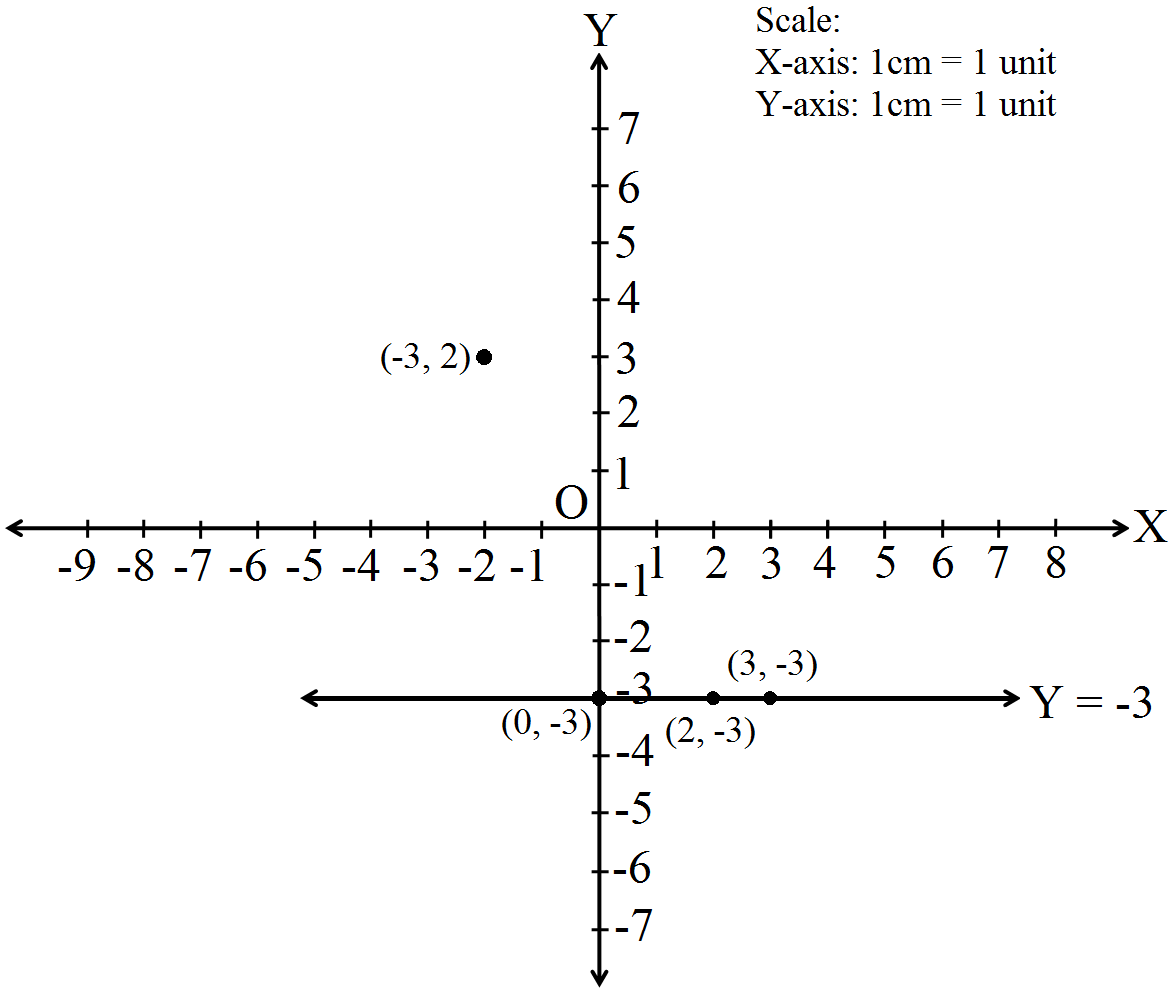
The graph of the line $y = -3$ does not pass through the point:
- A
$(2, -3)$
- B
$(3, -3)$
- C
$(0, -3)$
- ✓
$(-3, 2)$
AnswerCorrect option: D. $(-3, 2)$
The line $y = -3$ does not pass through the point $(-3, 2)$ since $\text{y}\neq2.$
View full question & answer→MCQ 251 Mark
The point of the form $(a, a)$, where a lies on:
- ✓
The line $y = x.$
- B
The line $x + y = 0.$
- C
The $x-$axis.
- D
The $y-$axis.
AnswerCorrect option: A. The line $y = x.$
The point $(a, a)$ lies on line $x=y$ or $x-y=0$
Here, is the verification
Put $x=a$ in equation
$x - y = 0$
$a - y = 0$
$-y = -a$
$y = a$
Hence, it is prove that $(a, a)$ is a solution of $x-y=0$ or $x=y$.
View full question & answer→MCQ 261 Mark
Express $y$ in terms of $x$ in the equation$ 5x - 2y = 7.$
- A
$\text{y}=\frac{5\text{x}+7}{2}$
- B
$\text{y}=\frac{7\text{x}+5}{2}$
- ✓
$\text{y}=\frac{5\text{x}-7}{2}$
- D
$\text{y}=\frac{7-5\text{x}}{2}$
AnswerCorrect option: C. $\text{y}=\frac{5\text{x}-7}{2}$
$5x - 2y = 7$
$-2y = 7 - 5x$
$2y = 5x - $7
$\text{y}=\frac{5\text{x}-7}{2}.$
View full question & answer→MCQ 271 Mark
Write the correct answer in the following: The graph of $y = 6$ is a Line,
- ✓
Parallel to $X-$axis at a distance $6$ units from the origin.
- B
Parallel to $Y-$axis at a distance $6$ units from the origin.
- C
Making an intercept $6$ on the $X-$axis.
- D
Making an intercept $6$ on both axes.
AnswerCorrect option: A. Parallel to $X-$axis at a distance $6$ units from the origin.
The given equation $y = 6$ does not contain $x$. Its graph is a line parallel to $X-$axis.
So, the graph of $y = 6$ is a line parallel to $X-$axis at a distance $6$ units from the origin.
View full question & answer→MCQ 281 Mark
The graph of the linear equation $x - y = 0$ passes through the point:
- A
$(-1,1)$
- ✓
$\Big(\frac{1}{1},\frac{1}{2}\Big)$
- C
$\Big(\frac{1}{1},-\frac{1}{2}\Big)$
- D
$(0,1)$
AnswerCorrect option: B. $\Big(\frac{1}{1},\frac{1}{2}\Big)$
The graph of the linear equation $x - y = 0$ passes through the point $\Big(\frac{1}{1},\frac{1}{2}\Big)$ because the co-ordinate of x and y axis satisfy the given equation $x - y = 0.$
$\frac{1}{1}-\frac{1}{2}=0$
$0 = 0$
So we can say $\Big(\frac{1}{1},\frac{1}{2}\Big)$ is a solution of above equation.
So we can say the value of x co-ordinate must be equal to y co-ordinate.
View full question & answer→MCQ 291 Mark
If $(2, 0)$ is a solution of the linear equation $2x + 3y = k$, then the value of $k$ is:
AnswerSubstitute $x = 2$ and $y = 0$ in the given equation, we get2 $(2) + 3 (0) = k$
$k = 4 + 0$
$k = 4$.
Hence, the value of $k$ is $4$.
Stay tuned with $BYJU’S –$ The Learning App and download the app today to get more class - wise concepts.
View full question & answer→MCQ 301 Mark
The equation $2x + 5y = 7$ has a unique solution, if $x, y$ are:
AnswerThere is only one pair i.e., $(1, 1)$ which satisfies the given equation but in positive real numbers, real numbers and rational numbers there are many pairs to satisfy the given linear equation. Hence, unique solution is possible only in case of Natural numbers.
View full question & answer→MCQ 311 Mark
Which of the following is a linear equation in two variables?
- A
$x + 5 = 8$
- ✓
$2x - 5y = 0$
- C
$x ^2 = 5x + 3$
- D
$5x = y ^2 + 3$
AnswerCorrect option: B. $2x - 5y = 0$
In linear equation power of variable $x$ and $y$ should be $1$ and here, the given linear equation has two variable $x$ and $y.$
View full question & answer→MCQ 321 Mark
Write the correct answer in the following: The equation of $X-$axis is of the form,
- A
$x = 0$
- ✓
$y = 0$
- C
$x + y = 0$
- D
$x = y$
AnswerCorrect option: B. $y = 0$
$y = 0$ is the equation of $x-$axis.
View full question & answer→MCQ 331 Mark
If a linear equation has solutions $(1, 2), (-1, -16)$ and $(0, -7)$, then it is of the form:
- ✓
$y = 9x - 7$
- B
$9x - y + 7 = 0$
- C
$x - 9y = 7$
- D
$x = 9y - 7$
AnswerCorrect option: A. $y = 9x - 7$
Since all the given co- ordinate $(1, 2), (-1, -16)$ and $(0, -7)$ satisfy the given line $y = 9x - 7$
For point $(1, 2)$
$y = 9x - 7$
$2 = 9(1) - 7$
$2 = 9 - 7$
$2 = 2$
Hence $(2, 1)$ is a solution.
For point $(-1, -16)$
$y = 9x - 7$
$-16 = 9(-1) - 7$
$-16 = -9 - 7$
$-16 = -16$
Hence $(-1, -16)$ is a solution.
For point $(0, -7)$
$y = 9x - 7$
$-7 = 9(0) -7$
$-7 = -7$
Hence $(0, -7)$ is a solution.
View full question & answer→MCQ 341 Mark
The maximum number of points that lie on the graph of a linear equation in two variables is:
MCQ 351 Mark
The equation $x = 7$ in two variables can be written as:
- A
$1.x + 1.y = 7$
- ✓
$1.x + 0.y = 7$
- C
$0.x + 1.y = 7$
- D
$0.x + 0.y = 7$
AnswerCorrect option: B. $1.x + 0.y = 7$
The equation $x=7$ in two variables can be written as exactly $1 . x+0 . y=7$ because it contain two variable $x$ and $y$ and coefficient of $y$ is zero as there is no term containing yin equation $x=7$
View full question & answer→MCQ 361 Mark
$x - 4$ is the equation of:
AnswerCorrect option: D. A line parallel to $y-$axis.
We know that the line parallel to $y-$axis is given by $x = a$
$x - 4 = 0$
$x = 4$
So it is a line parallel to $y-$axis, at a distance of $4$ units from it, to the right.
View full question & answer→MCQ 371 Mark
Write the correct answer in the following:
The graph of the linear equation $2x + 3y = 6$ cuts the $Y-$axis at the point,
- A
$(2, 0)$
- B
$(0, 3)$
- C
$(3, 0)$
- ✓
$(0, 2)$
AnswerCorrect option: D. $(0, 2)$
The graph of the linear equation $2x + 3y = 6$ cuts the y-axis at the point where x coordinate is zero.
Putting $x = 0$ in $2x + 3y = 6$, we get
$2(0) + 3y = 6 $
$\Rightarrow 3y = 6 $
$\Rightarrow y = 6 ÷ 3 = 2$
View full question & answer→MCQ 381 Mark
If a linear equation has solutions $(-2, 2), (0, 0)$ and $(2, -2)$, then it is of the form:
- A
$-x + 2y = 0$
- ✓
$x + y = 0$
- C
$x - y = 0$
- D
$-2x + y = 0$
AnswerCorrect option: B. $x + y = 0$
Linear equation has solutions $(-2, 2), (0, 0)$ and $(2, -2)$, then the equation will be $x + y = 0.$
As all the given three points satisfy the given equation.
View full question & answer→MCQ 391 Mark
Express $‘x’$ in terms of $‘y’$ in the equation $2x - 3y - 5 = 0.$
- A
$\text{x}=\frac{5-3\text{y}}{2}$
- B
$\text{x}=\frac{5+3\text{y}}{2}$
- ✓
$\text{x}=\frac{3\text{y}+5}{2}$
- D
$\text{x}=\frac{3\text{y}-5}{2}$
AnswerCorrect option: C. $\text{x}=\frac{3\text{y}+5}{2}$
$2x - 3y -5 = 0$
$2x = 3y + 5$
$\text{x}=\frac{3\text{y}+5}{2}.$
View full question & answer→MCQ 401 Mark
If the point $(3, 4)$ lies on the graph of $3y = ax + 6$, then the value of ‘a’ is:
AnswerThe point $(3, 4)$ lies on the graph of $3y = ax + 6$
So it will satisfy the equation
$3y = ax + 6$
$3(y) = ax + 6$
$12 = 3a + 6$
$12 - 6 = 3a$
$3a = 6$
$\text{a}=\frac{6}{3}$
$a = 2$
View full question & answer→MCQ 411 Mark
The distance between the graph of the equations $x = -3$ and $x = 2$ is:
AnswerDistance between the graph of the equations $x = -3$ and $x = 2$ is $= 2 - (-3) = 5$ units.
View full question & answer→MCQ 421 Mark
Write the correct answer in the following: The graph of the linear equation $2x + 3y = 6 $ is a line which meets the $X-$axis at the point.
- A
$(0, 2)$
- B
$(2, 0)$
- ✓
$(3, 0)$
- D
$(0, 3)$
AnswerCorrect option: C. $(3, 0)$
Since, the graph of linear equation $2x + 3y = 6$ meets the $X-$axis.
So, we put $y = 0$ in $2\text{x} + 3\text{y} = 6 \Rightarrow 2\text{x} + 3(0) = 6$
$\Rightarrow2\text{x}+0=6$
$\Rightarrow\text{x}=\frac{6}{2}\Rightarrow\text{x}=3$
View full question & answer→MCQ 431 Mark
The point of the form $(a, a)$, where a lies on:
- A
The $x-$axis
- ✓
The line $y = x$
- C
The $y-$axis
- D
The line $x + y = 0$
AnswerCorrect option: B. The line $y = x$
The point $(a, a)$ lies on line $x=y$ or $x-y=0$
here is the verification
Put $x=a$ in equation
$x-y=0$
$a-y=0$
$- y =- a$
$y=a$
hence it is prove that $(a, a)$ is a solution of $x-y=0$ or $x=y$
View full question & answer→MCQ 441 Mark
Any point on line $x = y$ is of the form:
- A
$(k, -k)$
- B
$(0, k)$
- C
$(k, 0)$
- ✓
$(k, k)$
AnswerCorrect option: D. $(k, k)$
$(k, k)$
View full question & answer→MCQ 451 Mark
The point of the form $(\text{a},-\text{a}),\ \text{a}\neq0$ lies on:
- A
The $x-$axis
- B
The $y-$axis
- C
The line $y = x$
- ✓
The line $x + y = 0$
AnswerCorrect option: D. The line $x + y = 0$
A point which lies on the $x$-axis has its $y$-coordinate $=0$ While a point which lies on the $y$-axis has its $x$-coordinate $=$ 0 .
So, the points of the form $(a,-a)$ will not lie on either axes.
Also, it does not satisfy the equation on of the line $y=x$.
The point of the form $(a,-a)$ lies on the line $x+y=0$ since it satisifes the equation of the given line.
View full question & answer→MCQ 461 Mark
The graph of the equation $2x + 3y = 6$ cuts the $x -$ axis at the point.
- A
$(0, 3)$
- ✓
$(3, 0)$
- C
$(2, 0)$
- D
$(0, 2)$
AnswerCorrect option: B. $(3, 0)$
$(3, 0)$
View full question & answer→MCQ 471 Mark
If $(4, 19)$ is a solution of the equation $y = ax + 3$, then $a =$
Answer$y = ax + 3$If $(4, 19)$ is its solution, then it must satisfy the equation.
Thus, we have
$19 = a × 4 + 3$
i.e. $4a = 16$
i.e. $a = 4$
Hence, correct option is $(b).$
View full question & answer→MCQ 481 Mark
Any point on the line $y = 3x$ is of the form.
- ✓
$(\text{a}, 3\text{a})$
- B
$(3\text{a}, \text{a})$
- C
$(\text{a}, \frac{\text{a}}{3})$
- D
$(\frac{\text{a}}{3}, \text{-a})$
AnswerCorrect option: A. $(\text{a}, 3\text{a})$
$(\text{a}, 3\text{a})$
View full question & answer→MCQ 491 Mark
The line represented by the equation $x + y = 16$ passes through $(2, 14)$. How many more lines pass through the point $(2, 14).$
AnswerThere are many lines pass through the point $(2, 14)$
$x - y = -12$
$2x + y = 18$
and many more
View full question & answer→MCQ 501 Mark
The graph of $x = 4$ is a line:
- A
Making an intercept $4$ on the $x-$axis.
- B
Making an intercept $4$ on the $y-$axis.
- C
Parallel to the $x-$axis at a distance of $4$ units from the origin.
- ✓
Parallel to the $y-$axis at a distance of $4$ units from the origin.
AnswerCorrect option: D. Parallel to the $y-$axis at a distance of $4$ units from the origin.
The graph of $x = 4$ is a line parallel to the $y-$axis at a distance of $4$ units from the origin.
View full question & answer→