MCQ 511 Mark
Find the value of k, if $x = 1, y = 2$ is a solution of the equation $2x + 3y = k.$
View full question & answer→MCQ 521 Mark
The equation $y = 2x - 7$ has:
Answer$y = 2x - 7$Has many solutions because for different value of $x$ we have different value of $y$ for example.
At $x = 1$
$y = 2 (1) - 7$
$y = 2 - 7$
$y = -5$
At $x = 2$
$y = 2(2) - 7$
$y = 4 - 7$
$y = -3$
So we can say for many value of $x$ there is many value of $y.$
View full question & answer→MCQ 531 Mark
The graph of $x + 3 = 0$ is a line.
- A
Making an intercept $-3$ on the $y-$axis.
- B
Parallel to the $x-$axis at a distance of $3$ units below the $x-$axis.
- ✓
Making an intercept $-3$ on the $x-$axis.
- D
Parallel to the $y-$axis at a distance of $3$ units to the left of $y-$axis.
AnswerCorrect option: C. Making an intercept $-3$ on the $x-$axis.
As, the graph of $x+3=0$ or $x=-3$ is a line parallel to $y$-axis i.e. $x=0$.
$\Rightarrow$ The line represented by the equation $x=-3$ is parallel to $y$-axis and intersects $x$-axis at $x=-3$.
So, the graph of $x+3=0$ is a line parallel to the $y$-axis at a distance of 3 units to the left of $y$-axis making an intercept -3 on the $x$-axis.
View full question & answer→MCQ 541 Mark
The equation of a line parallel to $x-$axis and $3$ units above the origin is:
- A
$x = 3$
- ✓
$y = 3$
- C
$x = -3$
- D
$y = -3$
AnswerCorrect option: B. $y = 3$
The equation of a line parallel to $x$-axis and $3$ units above the origin is $y=3$.
Because when a line parallel to $x$ axis in that case equation of line is $y=a$
where $a$ is the co-ordinate of $y$-axis and $3$ units above the origin value $x$-coordinate is $3$ so required equation is $y=3$.
View full question & answer→MCQ 551 Mark
The equation of a line parallel to $y-$axis and $7$ units to the left of origin is:
- ✓
$x = -7$
- B
$y = 7$
- C
$y = -7$
- D
$x = 7$
AnswerCorrect option: A. $x = -7$
The equation of a line parallel to $y$-axis and $7$ units to the left of the origin is $x=-7$. Because when a line parallel to $y$-axis in that case equation of line is $x=a$.
Where $a$ is the co-ordinate of $x$-axis and $7$ units to the left of the origin value $x$-co-ordinate is $-7$ .
So required equation is $x=-7$.
View full question & answer→MCQ 561 Mark
Any solution of the linear equation $2x + 0y + 9 = 0$ in two variables is of the form:
- A
$\Big(0,-\frac{9}{2}\Big)$
- B
$(-9,0)$
- C
$\Big(\text{n},-\frac{9}{2}\Big)$
- ✓
$\Big(-\frac{9}{2},\text{m}\Big)$
AnswerCorrect option: D. $\Big(-\frac{9}{2},\text{m}\Big)$
$2x + 9 = 0 \Rightarrow\text{x}=\frac{-9}{2}$ And $y = m$, where m is any real number,
Hence, $\Big(-\frac{9}{2},\text{m}\Big)$ is the solution of the given equation.
View full question & answer→MCQ 571 Mark
The linear equation $2x - 5y = 7$ has:
- A
- ✓
Infinitely many solutions.
- C
- D
AnswerCorrect option: B. Infinitely many solutions.
Given equation is $2x - 5y = 7$,There is no given value of $x$ and $y$ so we can take any values. For every value of $x$, we get a corresponding value of $y$ and vice-versa.
Therefore, it has infinitely many solutions.
View full question & answer→MCQ 581 Mark
Write the correct answer in the following: The positive solutions of the equation $ax + by + c = 0$ always lie in the,
- ✓
I$^{st}$ quadrant.
- B
II$^{nd}$ quadrant.
- C
III$^{rd}$ quadrant.
- D
IV$^{th}$ quadrant.
AnswerCorrect option: A. I$^{st}$ quadrant.
We know that, if a line passes through the Ist quadrant, then all solution lying on the line in first quadrant must be positive because the coordinate of all points in the Ist quadrant are positive.
View full question & answer→MCQ 591 Mark
The point on the graph of the linear equation $2x + 5y = 19$, whose ordinate is $1^{\frac{1}{2}}$ times its abscissa is:
- A
$(-2, -3)$
- ✓
$(2, 3)$
- C
$(4, 6)$
- D
AnswerCorrect option: B. $(2, 3)$
Ordinate means y-coordinate. It means we need to find a point on the given line where y-coordinte $=\frac{3}{2}$ ex-coordinate).Just put $\text{y}=\Big[\frac{3}{2}\Big].\text{x}$ in the given eqn.
$2\text{x}+5\times\frac{3}{2}\text{x}=19$
$2\text{x}+\frac{15}{2}\text{x}=19$
$\frac{19\text{x}}{2}=19$
$\text{x}=\frac{19\times2}{19}$
$\text{y}=\frac{3}{2}\text{x}$
$\text{y}=\frac{3}{2}\times2$
$\text{y}=3$
So the co-ordinate are $(2, 3)$
View full question & answer→MCQ 601 Mark
How many lines pass through one point?
AnswerBecause one point can be solution of many equations. So many equations can be pass from one point.
View full question & answer→MCQ 611 Mark
For the equation $5x + 8y = 50$, if $y = 10$, then the value of $x$ is:
AnswerFor the equation $5x + 8y = 50$, if $y = 10$
Put $y = 10$ in given equation
$5x + 8 × 10 = 50$
$5x + 80 = 50$
$5x = 50 - 80$
$5x = -30$
$\text{x} = -\frac{30}{5}$
$x = -6$
View full question & answer→MCQ 621 Mark
The graph of the linear equation $y = 3x$ passes through the point.
- A
$(0,-\frac{2}{3})$
- ✓
$(\frac{2}{3},2)$
- C
$(,-\frac{2}{3},0)$
- D
$(0,\frac{2}{3})$
AnswerCorrect option: B. $(\frac{2}{3},2)$
$\text{y}=3\text{x}$
$\frac{\text{y}}{3}=\text{x}$
For $\text{x}=\frac{2}{3},$ the value of $\text{y}=3\times\frac{2}{3}=2$
So $(\frac{2}{3},2).$
View full question & answer→MCQ 631 Mark
Any point on the $y -$ axis is of the form.
- A
$(y, y)$
- ✓
$(0, y)$
- C
$(x, y)$
- D
$(x, 0)$
AnswerCorrect option: B. $(0, y)$
Any point on the $y -$ axis is of the form $(0, y).$
On the $y$ - axis, $y$ can take any values and $x$ should be equal to $0.$
View full question & answer→MCQ 641 Mark
Which of the following is the equation of a line parallel to $y -$ axis?
- A
$y = 0$
- B
$x + y = z$
- C
$y = x$
- ✓
$x = a$
AnswerCorrect option: D. $x = a$
$x = a$
View full question & answer→MCQ 651 Mark
If the graph of the equation $4x + 3y = 12$ cuts the coordinate axes at $A$ and $B$, then hypotenuse of right triangle $AOB$ is of length.
- A
$3$ units.
- B
$4$ units.
- ✓
$5$ units.
- D
AnswerCorrect option: C. $5$ units.
According to the given question, triangle so formed has sides of units $3$ and $4$, using pythagoras theorem, the largest side is of $5$ units.
View full question & answer→MCQ 661 Mark
If $(2k - 1, k)$ is a solution of the equation $10x - 9y = 12$, then $k =$
AnswerIf $(2k - 1, k)$ is solution of equation $10x - 9y = 12$, then it must satisfy this equation.
Thus, we have
$10(2k - 1) - 9k = 12$
$20k - 10 - 9k = 12$
$11k = 22$
$k = 2$
Hence, correct option is $(b).$
View full question & answer→MCQ 671 Mark
$x = 5$ and $y = -2$ is the solution of the linear equation.
- A
$x + 3y = 1$
- B
$2x + y = 9$
- C
$3x + y = 0$
- ✓
$2x - y = 12$
AnswerCorrect option: D. $2x - y = 12$
$x = 5$ and $y = -2$ is the solution of the linear equation $2x - y = 12$
$2x - y = 12$
$LHS = 2x - y$
$2.5 - (-2)$
$10 + 2$
$12$
$RHS = 12$
$LHS = RHS$
It means that $x = 5$ and $y = -2$ is the solution of the linear equation $2x - y = 12.$
View full question & answer→MCQ 681 Mark
The area of the triangle formed by the line $2x + 5y = 10$ and the co-ordinate axis is:
- A
$4$ sq. units.
- B
$10$ sq. units.
- C
$3$ sq. units.
- ✓
$5$ sq. units.
AnswerCorrect option: D. $5$ sq. units.
To find the area of the triangle formed by the line $2 x+5 y=10$ and co-ordinate axis. We put $x=0$ in given equation at $x=0$, we get $y=2$ at $y=0$ we get $x=5$. So the line cut $y$-axis at 2 and $x$-axis at 5 .
So the height of the triangle is 2 units and the base is 5 units.
Area of triangle $=\frac{1}{2}$ base $\times$ heigh,
$=\frac{1}{2}\times2\times5$
$= 5 sq$. units.
View full question & answer→MCQ 691 Mark
The graph of a linear equation $\text{y}=\frac{9}{5}\text{x}+32$ cuts the $y-$axis at the point:
- ✓
$(0, 32)$
- B
$(-32, 0)$
- C
$(0, -32)$
- D
$(32, 0)$
AnswerCorrect option: A. $(0, 32)$
When the graph cut at y axis in that case the value of $x-$ coordinate is $0.$
$\text{y}=\frac{9}{5}\text{x}+32$
$\text{y}=\frac{9}{5}.0+\text{32}$
$\text{y}=32$
So, the co-ordinates are $(32, 0)$
View full question & answer→MCQ 701 Mark
Write the correct answer in the following: The graph of the linear equation $y = x$ passes through the point.
- A
$\Big(\frac{3}{2},\frac{-3}{2}\Big)$
- B
$\Big(0,\frac{3}{2}\Big)$
- ✓
$(1,1)$
- D
$\Big(\frac{-1}{2},\frac{1}{2}\Big)$
AnswerCorrect option: C. $(1,1)$
We know that any point on the line $y = x$ will have $x$ and $y$ coordinates same.So, the graph of the linear equation $y = x$ passes through the point$ (1, 1).$
View full question & answer→MCQ 711 Mark
The graph of the linear equation $2x + 3y = 6$ meets the $y-$axis at the point.
- A
$(0, 3)$
- B
$(2, 0)$
- C
$(3, 0)$
- ✓
$(0, 2)$
AnswerCorrect option: D. $(0, 2)$
If the graph of the linear equation $2x + 3y = 6$ meets the $y-$axis, then $x = 0.$
Substituting the value of $x = 0$ in equation $2x + 3y = 6,$ we get
$2(0) + 3y = 6$
$\Rightarrow 3y = 6$
$\Rightarrow\text{y}=\frac{6}{3}$
$\Rightarrow y = 2$
So, the point of meeting is $(0, 2).$
View full question & answer→MCQ 721 Mark
If $(4, 19)$ is a solution of the equation $y = ax + 3$, then $a =$
AnswerGiven, $(4, 19)$ is a solution of the equation $y = ax + 3= 19 = 4a + 3$
$= a = 4.$
View full question & answer→MCQ 731 Mark
The graph of the linear equation $y = 3x$ passes through the point.
- A
$\Big(0,-\frac{2}{3}\Big)$
- B
$\Big(-\frac{2}{3},0\Big)$
- C
$\Big(0,\frac{2}{3}\Big)$
- ✓
$\Big(\frac{2}{3},2\Big)$
AnswerCorrect option: D. $\Big(\frac{2}{3},2\Big)$
$\text{y}=3\text{x}$
$\frac{\text{y}}{3}=\text{x}$
For, $y = 2$, the value of x will be $\frac{2}{3}$
So, $\Big(\frac{2}{3},2\Big)$
View full question & answer→MCQ 741 Mark
The graph of the line $x - y = 0$ passes through the point:
- A
$\Big(\frac{-1}{2},\frac{1}{2}\Big)$
- B
$\Big(\frac{3}{2},\frac{-3}{2}\Big)$
- C
$(0,-1)$
- ✓
$(1, 1)$
AnswerCorrect option: D. $(1, 1)$
The given linear equation is $x = y = 0.$
We have to check which of the point satisfy the given equation.
consider option (a):
Substituting $\text{x}=-\frac{1}{2}$ and $\text{y}=\frac{1}{2}$ in the $LHS$ if the given linear equation
$\therefore\ \text{x}-\text{y}=-\frac{1}{2}-\frac{1}{2}=-1\neq\text{RHS}$
$\therefore\ \text{x}=-\frac{1}{2}$ and $\text{y}=\frac{1}{2}$ does not satisfy the given linear equation.
Consider option (b):
Substituting $\text{a}=\frac{3}{2}$ and $\text{y}=-\frac{3}{2}$ in the $LHS$ if the given linear equation on
$\therefore\ \text{x}-\text{y}=\frac{3}{2}+\frac{3}{2}=3\neq\text{RHS}$
$\therefore\ \text{x}=-\frac{3}{2}$ and $\text{y}=-\frac{3}{2}$ does not satisfy the given linear eqation on.
Consider option (d):
Substitution $x = 1 $and $y = 1$ in the $LHS$ if the given linear equation
$\therefore\ $$x - y = 1 - 1 = 0 = RHS$
$\therefore\ $$x = 1$ and $y = 1$ satisfies the given linear equation.
View full question & answer→MCQ 751 Mark
The graph of $y = 5$ is a line.
- A
Parallel to the $x-$axis at a distance of $6$ units from the origin.
- B
Making an intercept $5$ on the $x-$axis.
- C
Parallel to the $y-$axis at a distance of $5$ units from the origin.
- ✓
Making an intercept $5$ on the $y-$axis.
AnswerCorrect option: D. Making an intercept $5$ on the $y-$axis.
As, the graph of $y=5$ is a line parallel to $x$-axis i.e. $y=0$.
$\Rightarrow$ The line represented by the equation $y=5$ is parallel to $x$-axis and intersects $y$-axis at $y=5$. So, the graph of $y=5$ is a line parallel to the $x$-axis at a distance of 5 units from the origin making an intercept 5 on the $y$-axis.
View full question & answer→MCQ 761 Mark
The graph of $x = 3$ is a line:
- A
Parallel to $x -$ axis at a distance of $3$ units from the origin.
- ✓
Parallel to $y -$ axis at a distance of $3$ units from the origin.
- C
Makes an intercept $3$ on $x -$ axis.
- D
Makes an intercept $3$ on $y -$ axis.
AnswerCorrect option: B. Parallel to $y -$ axis at a distance of $3$ units from the origin.
Parallel to $y -$ axis at a distance of $3$ units from the origin.
View full question & answer→MCQ 771 Mark
The point which lies on $x-$axis at a distance of $4$ units in the negative direction of $x-$axis is:
- A
$(0, -4)$
- B
$(0, 4)$
- ✓
$(-4, 0)$
- D
$(4, 0)$
AnswerCorrect option: C. $(-4, 0)$
At $x$-axis the value of $y$ co-ordinate is $0 x$-axis at a distance of $4$ units in the negative direction so the co-ordinate of $x$-axis is $-4$ . So the co-ordinate of point is $(-4,0)$.
View full question & answer→MCQ 781 Mark
The line represented by the equation $x + y = 16$ passes through $(2, 14).$ How many more lines pass through the point $(2, 14).$
AnswerThere are many lines pass through the point $(2, 14).$
For example
$x - y = -12$
$2x + y = 18$
And many more.
View full question & answer→MCQ 791 Mark
Which of the following is not a solution of $2x - 3y = 12?$
- A
$(6, 0)$
- B
$(3, -2)$
- C
$(0, -4)$
- ✓
$(2, 3)$
AnswerCorrect option: D. $(2, 3)$
We have to check $(2,3)$ is a solution of $2 x-3 y=12$ if $(2,3)$ satisfy the equation then $(2,3)$ solution of $2 x-3 y=12$.
$LHS = 2x - 3y$
$2 × 2 - 3 × 3$
$4 - 9 = -5$
$RHS = -5$
$LHS ≠ RHS$
So $(2,3)$ is not a solution of $2 x-3 y=12$.
View full question & answer→MCQ 801 Mark
The linear equation $3x - y = x - 1$ has:
- A
- B
- C
- ✓
Infinitely many solutions
AnswerCorrect option: D. Infinitely many solutions
The linear equation $3x - y = x - 1$ has infinitely many solutions.
On simplification, the given equation becomes $2x - y = -1$, which is a single equation with two variables.
Thus, $3x - y = x - 1$ has infinitely many solutions.
View full question & answer→MCQ 811 Mark
The equation of a line parallel to $y-$axis and $4$ units to the right of origin is:
- A
$x = -4$
- B
$y = -4$
- C
$y = 4$
- ✓
$x = 4$
AnswerCorrect option: D. $x = 4$
The equation of a line parallel to $y$-axis at a distance of $4$ units from it, to its right from the origin.
$x=4$
Because when a line parallel to $y$-axis in that case equation of line is $x=4$. So required equation is $x=4$.
View full question & answer→MCQ 821 Mark
Write the correct answer in the following: Any solution of the linear equation $2x + 0y + 9 = 0$ in two variables is of the form,
- ✓
$\Big(-\frac{9}{2},\text{m}\Big)$
- B
$\Big(\text{n},-\frac{9}{2}\Big)$
- C
$\Big(0,-\frac{9}{2}\Big)$
- D
$(-9,0)$
AnswerCorrect option: A. $\Big(-\frac{9}{2},\text{m}\Big)$
The given linear equation is
$2x + 0y + 9 = 0$
$\Rightarrow 2x + 9 = 0$
$\Rightarrow 2x = -9$
$\Rightarrow x = -\frac{9}{2}$ and $y$ can be any real number.
View full question & answer→MCQ 831 Mark
Which of the following is a linear equation in two variables?
- ✓
$2x - 5y = 0$
- B
$x + y = 8$
- C
$x ^2 = 5x + 3$
- D
$5x = y^2 + 3$
AnswerCorrect option: A. $2x - 5y = 0$
In linear equation power of variable $x$ and $y$ should be $1$ and here, the given linear equation has two variable $x$ and $y.$
View full question & answer→MCQ 841 Mark
If we divide both sides of a linear equation with a non-zero number, then the solution of the linear equation.
- A
- ✓
- C
- D
Gets divided by the number.
AnswerIf then for any non-zero c.
We can divide both sides of an equation by a non-zero number c, without changing the equation.
View full question & answer→MCQ 851 Mark
The linear equation $3x - 11y = 10$ has:
- A
- B
- ✓
Infinitely many solutions
- D
AnswerCorrect option: C. Infinitely many solutions
$3\text{x}-11\text{y}=10$$\text{y}=\frac{(3\text{x}-10)}{11}$
Now for infinite values of x, y will also have infinite solutions.
View full question & answer→MCQ 861 Mark
$x = 3$ and $y = -2$ is a solution of the equation $4px - 3y = 12$, then the value of $p$ is:
- A
$0$
- ✓
$\frac{1}{2}$
- C
$2$
- D
$3$
AnswerCorrect option: B. $\frac{1}{2}$
$\frac{1}{2}$
View full question & answer→MCQ 871 Mark
Express $'y'$ in terms of $'x'$ in the equation $5y - 3x - 10 = 0.$
- A
$\text{y}=\frac{3-10\text{x}}{5}$
- B
$\text{y}=\frac{3+10\text{x}}{5}$
- C
$\text{y}=\frac{3\text{x}-10\text{}}{5}$
- ✓
$\text{y}=\frac{3\text{x}+10}{5}$
AnswerCorrect option: D. $\text{y}=\frac{3\text{x}+10}{5}$
$(D) \text{y}=\frac{3\text{x}+10}{5}$
$5y - 3, x - 10 = 0$
$5y - 3, x = 10$
$5y = 10 + 3x$
$\text{y}=\frac{3\text{x}+10}{5}$
View full question & answer→MCQ 881 Mark
The graph of the linear equation $3x - 5y = 15,$ cuts the $y-$axis at the point:
- A
$(2, 0)$
- B
$(-2, 0)$
- C
$(0, 3)$
- ✓
$(0, -3)$
AnswerCorrect option: D. $(0, -3)$
The graph of the linear equation $3x - 5y = 15$, cuts the $y-$axis at the point when line cut $y-$axis the co-ordinate of $x$ becomes zero.
So we put $x = 0$ in given equation to find the co-ordinate.
$3x - 5y = 15$
$3(0) - 5y = 15$
$-5y = 15$
$\text{y} = −\frac{15}{5}$
$y = -3$
So the required cordinate is $(0, -3).$
View full question & answer→MCQ 891 Mark
The graph of $x = 3 $is a line:
- A
Parallel to the $x -$ axis at a distance of $3$ units from the origin.
- ✓
Parallel to the $y -$ axis at a distance of $3$ units from the origin.
- C
Makes an intercept $3$ on the $x -$ axis.
- D
Makes an intercept $3$ on the $y -$ axis.
AnswerCorrect option: B. Parallel to the $y -$ axis at a distance of $3$ units from the origin.
Parallel to the $y -$ axis at a distance of $3$ units from the origin.
View full question & answer→MCQ 901 Mark
If we multiply both sides of a linear equation with a non-zero number, then the solution of the linear equation:
- A
Gets multiplied by the number.
- ✓
- C
- D
AnswerIf for any c. where c is any natural number.
Like addition and subtraction, we can multiply and divide both sides of an equation by a number, c, without changing the equation, where c is any natural number
View full question & answer→MCQ 911 Mark
The linear equation $3x - 5y = 15$ has:
- A
- B
- C
- ✓
Infinitely many solutions.
AnswerCorrect option: D. Infinitely many solutions.
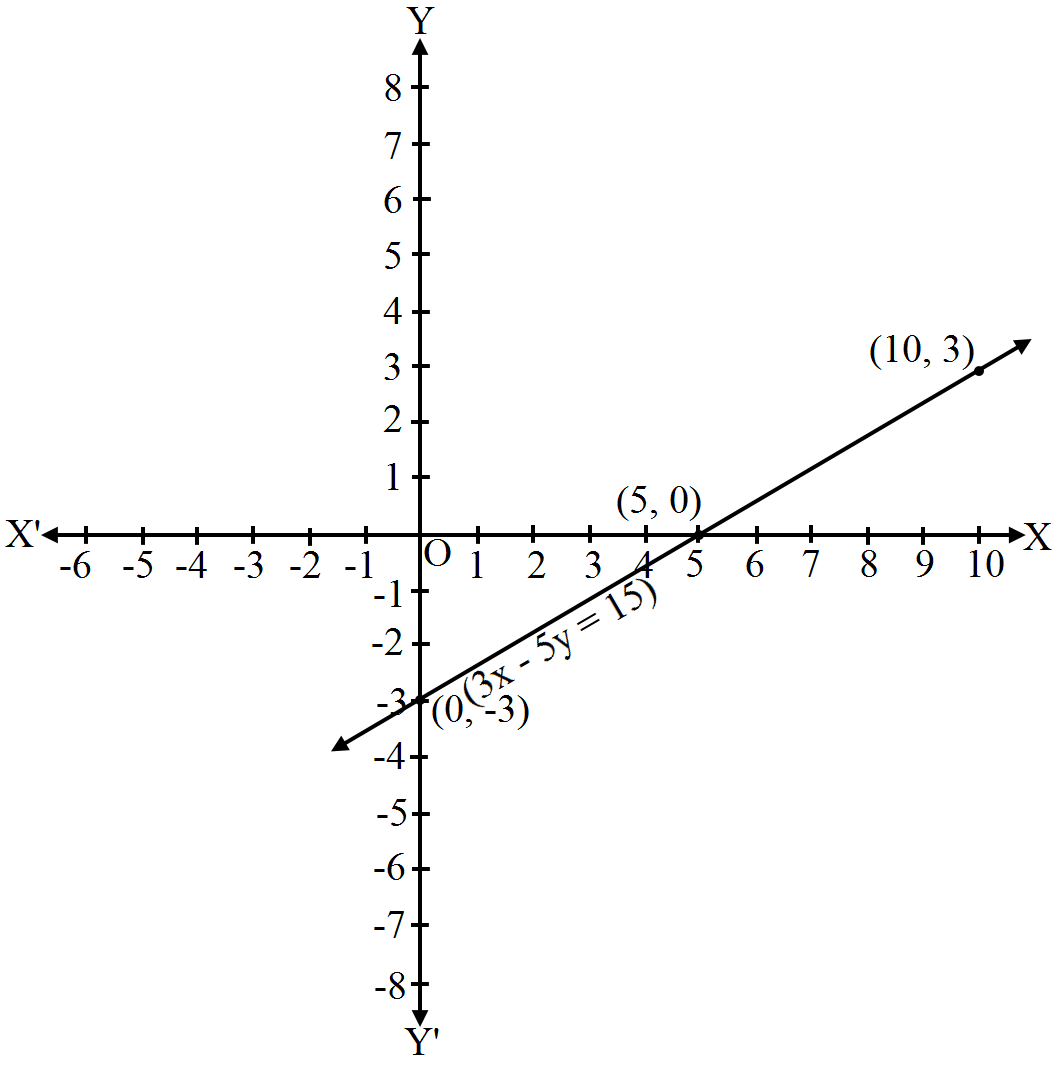
Given linear equation: $3x - 5y = 15$
Or, $\text{x}=5\text{y}+\frac{15}{3}$
When $y = 0, x = 153 = 5$
When $y = 3, x = 303 = 10$
When $y = - 3, x = 03 = 0$
|
$xx$
|
$5$
|
$10$
|
$0$
|
|
$yy$
|
$0$
|
$3$
|
$-3$
|
Plot the points $A(5, 0), B(10, 3)$ and $C(0, -3)$. Join the points and extend them in both the directions.
We get infinite points that satisfy the given equation.
Hence, the linear equation has infinitely many solutions.
View full question & answer→MCQ 921 Mark
$x = 2, y = 5$ is a solution of the linear equation.
- A
$x + 2y = 7$
- ✓
$x + y = 7$
- C
$5x + y = 7$
- D
$5x + 2y = 7$
AnswerCorrect option: B. $x + y = 7$
$x = 2$ and $y = 5$ satisfy the given equation.
View full question & answer→MCQ 931 Mark
Write the correct answer in the following: Any point on the line $y = x$ is of the form,
- ✓
$(a, a)$
- B
$(0, a)$
- C
$(a, 0)$
- D
$(a, -a)$
AnswerCorrect option: A. $(a, a)$
Every point on the line $y = x$ has same value of $x-$and $y-$coordinates i.e., $x = a$ and $y = a.$
View full question & answer→MCQ 941 Mark
The equation $x - 2 = 0$ on number line is represented by:
Answer$x - 2 = 0$
$x = 2$ is a point on the number line.
View full question & answer→MCQ 951 Mark
If the point $(3, 4)$ lies on the graph of $3y = ax + 6$, then the value of $'a'$ is:
AnswerThe point $(3, 4)$ lies on the graph of $3y = ax + 6$So, it will satisfy the equation
$3y = ax + 6$
$3(y) = ax + 6$
$12 = 3a + b$
$12 - 6 = 3a$
$3a = 6$
$\text{a}=\frac{6}{3}$
$\text{a}=2$
View full question & answer→MCQ 961 Mark
The graph of $x = 4$ is a line.
- A
Making an intercept $4$ on the $y-$axis.
- B
Parallel to the $y-$axis at a distance of $5$ units from the origin.
- ✓
Making an intercept $4$ on the $x-$axis.
- D
Parallel to the $x-$axis at a distance of $4$ units from the origin.
AnswerCorrect option: C. Making an intercept $4$ on the $x-$axis.
As, the graph of $x=4$ is a line parallel to $y$-axis i.e. $x=0$.
$\Rightarrow$ The line represented by the equation $x=4$ is parallel to $y$-axis and intersects $x$-axis at $x=4$.
So, the graph of $x=4$ is parallel to $y$-axis at a distance of 4 units from the origin making an intercept 4 on the $x$-axis.
View full question & answer→MCQ 971 Mark
If we multiply or divide both sides of a linear equation with a non-zero number, then the solution of the linear equation:
- A
- ✓
- C
Only changes in case of multiplication.
- D
Only changes in case of division.
AnswerIf we multiply or divide both sides of a linear equation with a non-zero number, then the solution of the linear equation remains the same.
View full question & answer→MCQ 981 Mark
The point of the form $(-a, a)$, where a lies on
- ✓
The line$ x + y = 02$
- B
The $y-$axis
- C
The $x-$axis
- D
The line $y = x$
AnswerCorrect option: A. The line$ x + y = 02$
The point $(a,-a)$ lies on line $x+y=0$
Here is the verification
Put $x=a$ in equation
$x + y = 0$
$a + y = 0$
$y = -a$
Hence it is prove that $(a,-a)$ is a solution of $x+y=0$
View full question & answer→MCQ 991 Mark
If $x$ and $y$ are both positive solutions of equation $ax + by + c = 0$, always lie in the:
View full question & answer→MCQ 1001 Mark
The linear equation $3x - 11y = 10$ has:
- A
- B
- ✓
Infinitely many solutions
- D
AnswerCorrect option: C. Infinitely many solutions
Infinitely many solutions
View full question & answer→