MCQ 1011 Mark
The distance between the graphs of the equations $y = -1$ and $y = 3$ is:
AnswerDistance between the graphs of the equations $y = -1$ and $y = 3$ is $= 3 - (-1) = 4$ units.
View full question & answer→MCQ 1021 Mark
The area of the triangle formed by the line $3x + 4y = 12$ and the co-ordinate axis is:
- ✓
$6$ sq. units.
- B
$12$ sq. units.
- C
$4$ sq. units.
- D
$3$ sq. units.
AnswerCorrect option: A. $6$ sq. units.
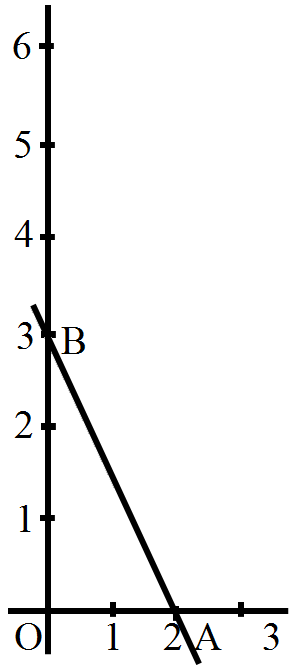
To find the area of the triangle $A O B$ formed by the line $3 x+4 y=12$ and co-ordinate axis we put $x=0$ in given equation to find the point on $y$ axies.
So, at $x=0$
$3(0) + 4y = 12$
$4y = 12$
We get $y = 3$
$At y = 0$
$3x + 4(0) = 12$
$3x = 12$
We get $x=4$
So the line cut $y$ axis at 3 and $x$ axis at $4$
So the hight of triangle $A O B$ is $O B=3$ unit and base $O A=4$ unit
Area ot triangle $A O B=12$ (base $\times$ height)
$= 12 \times 4 \times 3$
$= 6$ unit square. View full question & answer→MCQ 1031 Mark
If $(2, 0)$ is a solution of the linear equation $2x + 3y = k$ then the value of $k$ is:
AnswerSince, $(2, 0)$ is a solution of the linear equation $2x + 3y = k$, substituting $x = 2$ and $y = 0$ in the given equation,We have:
$2(2) + 3(0) = k$
$\Rightarrow 4 + 0 = k$
$\Rightarrow k = 4$
View full question & answer→MCQ 1041 Mark
The distance between the graph of the equations $x = -3$ and $x = 2$ is:
AnswerThe distance between the graph of the equations $x = -3$ and $x = 2= 2 - (-3)$
$= 2 + 3$
$= 5$
Hence, correct option is $(d).$
View full question & answer→MCQ 1051 Mark
Cost of book $(x)$ exceeds twice the cost of pen $(y)$ by Rs $10$. This statement can be expressed as linear equation.
- ✓
$x - 2y - 10 = 0$
- B
$2x - y - 10 = 0$
- C
$2x + y - 10 = 0$
- D
$x - 2y + 10 = 0$
AnswerCorrect option: A. $x - 2y - 10 = 0$
$x - 2y - 10 = 0$
View full question & answer→MCQ 1061 Mark
The graph of the line $y = 3$ passes through the point:
- A
$(3, 0)$
- B
$(3, 2)$
- ✓
$(2, 3)$
- D
AnswerCorrect option: C. $(2, 3)$
Since, the $y$ coordinate is $3$, the graph of the line $y = 3$ passes through the point $(2, 3).$
View full question & answer→MCQ 1071 Mark
Point $(3, 4)$ lies on the graph of the equation $3y = kx + 7$. The value of $k$ is:
- A
$\frac{4}{3}$
- ✓
$\frac{5}{3}$
- C
$3$
- D
$\frac{6}{3}$
AnswerCorrect option: B. $\frac{5}{3}$
$\frac{5}{3}$
View full question & answer→MCQ 1081 Mark
The graph of the linear equation $x + y = 0$ passes through the point.
- ✓
$(1, -1)$
- B
$(1, 1)$
- C
$(1, 0)$
- D
$(0, 1)$
AnswerCorrect option: A. $(1, -1)$
The graph of the linear equation $x+y=0$ passes through the point $(1,-1)$ because the co-ordinate of $x$ and $y$ axis satisfy the given equation. $x+y=0$
$1-1=0$
So we can say $(1,-1)$ is a solution of above equation
View full question & answer→MCQ 1091 Mark
The graph of every linear equation in two variables is a:
AnswerBecause for one value of one variable their is only one and unique value of other variables.
View full question & answer→MCQ 1101 Mark
The equation of the $y-$axis is:
- A
$x = 0$
- ✓
$y = 0$
- C
$x = y$
- D
$x + y = 0$
AnswerCorrect option: B. $y = 0$
The equation of the $y-$axis is $x = 0.$
View full question & answer→MCQ 1111 Mark
How many linear equation in x and $y$ can be satisfied by $x = 1$ and $y = 2?$
View full question & answer→MCQ 1121 Mark
The equation $x = 7$ in two variables can be written as:
- A
$0.x + 0.y = 7$
- ✓
$1.x + 0.y = 7$
- C
$1.x + 1.y = 7$
- D
$0.x + 1.y = 7$
AnswerCorrect option: B. $1.x + 0.y = 7$
The equation $x =7$ in two variables can be written as exactly $1 . x +0 . y =7$ because it contain two variable $x$ and $y$ and coefficient of $y$ is zero as there is no term containing $y$ in equation $x =7$.
View full question & answer→MCQ 1131 Mark
$x = 5, y = 2$ is a solution of the linear equation:
- A
$x + 2y = 7$
- B
$5x + 2y = 7$
- ✓
$x + y = 7$
- D
$5x + y = 7$
AnswerCorrect option: C. $x + y = 7$
Substituting $x = 5$ and $y = 2$ in $L.H.S.$ of equation $x + y = 7,$
We get:
$LHS$
$= 5 + 2$
$7 = RHS$
Hence, $x = 5$ and $y = 2$ is a solution of the linear equation $x + y = 7.$
View full question & answer→MCQ 1141 Mark
$3x + 10 = 0$ will have:
- ✓
- B
- C
Infinitely many solutions
- D
Answer$3\text{x}+10 = 0$
$\text{x}=\frac{-10}{3}.$
Hence, only one solution is possible.
View full question & answer→MCQ 1151 Mark
In equation, $y = mx + c, m$ is:
View full question & answer→MCQ 1161 Mark
How many linear equations can be satisfied by $x = 2$ and $y = 3?$
AnswerThere are infinite many eqution which satisfy the given value $x = 2, y = 3$For example
$x + y = 5$
$x - y = -1$
$3x - 2y = 0$
Etc..
View full question & answer→MCQ 1171 Mark
The graph of a linear equation $x - 5y + 3 = 0$ cuts the $x-$axis at the point.
- A
$(-5, 0)$
- B
$(5, 0)$
- ✓
$(-3, 0)$
- D
$(3, 0)$
AnswerCorrect option: C. $(-3, 0)$
When a line cuts $x-$axis in that case $y$ co-ordinate is $0.$
So to find the co-ordinate of $x$ we put $y = 0$ in given equation,
$x - 5y + 3 = 0$
at $y = 0$
$x - 5.0 + 3 = 0$
$x + 3 = 0$
$x = -3$
So the co-ordinate are $(-3, 0)$
View full question & answer→MCQ 1181 Mark
lf the graph of the equation $4x + 3y = 12$ cuts the coordinate axes at $A$ and $B,$ then hypotenuse of right triangle $AOB$ is of length:
- A
$4$ units.
- B
$3$ units.
- ✓
$5$ units.
- D
AnswerCorrect option: C. $5$ units.
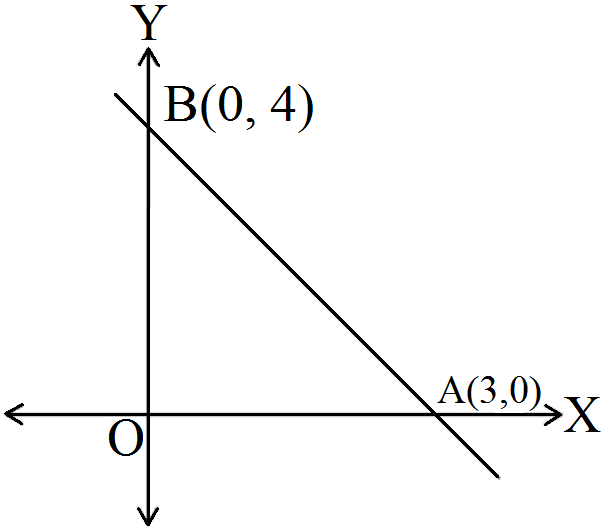
$4x + 3y = 12$
At $x = 0, 3y = 12 $
$\Rightarrow y = 4$ units
At $y = 0, 4x = 12$
$ \Rightarrow x = 3$ units
The triangle formed is $\triangle\text{AOB},$ where
$OB = 4$ units
$OA = 3$ units
Hypotenuse $=\text{AB}=\sqrt{\text{OB}^2+\text{OA}^2}=\sqrt{16+9}=5\text{ units}$
Hence, correct option is $(c).$ View full question & answer→MCQ 1191 Mark
The taxi fare in a city is as follows: For the first kilometer, the fare is $₹ 8$ and for the subsequent distance it is $₹ 5$ per kilometer. Taking the distance covered as $x \ km$ and total fare as $₹ y$, write a linear equation for this information.
- A
$x = 5y - 3$
- ✓
$y = 5x + 3$
- C
$x = 5y + 3$
- D
$y = 5x - 3$
AnswerCorrect option: B. $y = 5x + 3$
Taxi fare for first kilometer $= ₹ 8$
Taxi fare for subsequent distance $= ₹ 5$
Total distance covered $= x$
Total fare $= y$
Since the fare for first kilometer $= ₹ 8$
According to problem, Fare for $(x - 1)$ kilometer $= 5(x - 1)$
So, the total fare $y = 5(x - 1) + 8$
$\Rightarrow y = 5(x - 1) + 8$
$\Rightarrow y = 5x - 5 + 8$
$\Rightarrow y = 5x + 3$
Hence, $y = 5x + 3$ is the required linear equation.
View full question & answer→MCQ 1201 Mark
The graph of $y = 6$ is a line.
- A
Parallel to $y-$axis at a distance $6$ units from the origin.
- B
Making an intercept $6$ on both the axes.
- C
Making an intercept $6$ on the $x-$ axis.
- ✓
Parallel to $x-$axis at a distance $6$ units from the origin.
AnswerCorrect option: D. Parallel to $x-$axis at a distance $6$ units from the origin.
As $y = a$ is an equation of a line parallel to $x-$axis at a distance of a unit from the origin.
View full question & answer→MCQ 1211 Mark
For the equation $5x - 7y = 35$, if $y = 5$, then the value of $‘x’$ is:
AnswerFor the equation $5x - 7y = 35$, if $y = 5,$
$5x - 7y = 35$
$y = 55$
$x - 7.5 = 35$
$5x - 35 = 35$
$5x = 35 + 35$
$5x = 70$
$\text{x}=\frac{70}{5}=14$
$x = 14.$
View full question & answer→MCQ 1221 Mark
If $(a, 4)$ lies on the graph of $3x + y = 10$, then the value of a is:
AnswerGiven, $(a, 4)$ lies on the graph of $3x + y = 10$
Thus it is a solution
$= 3a + 4 = 10$
$= a = 2.$
View full question & answer→MCQ 1231 Mark
The solution of equation $x - 2y = 4$ is:
- A
$(0, 2)$
- B
$(2, 0)$
- ✓
$(4, 0)$
- D
$(1, 1)$
AnswerCorrect option: C. $(4, 0)$
Explanation: Putting $x = 4$ and $y = 0$, on the
$L.H.S$. of the given equation, we get;
$4 - 2 (0) = 4 - 0 = 4$
Which is equal to $R.H.S.$
View full question & answer→MCQ 1241 Mark
The equation of a line parallel to $x -$ axis and $3$ units above the origin is:
- A
$x = -3$
- B
$x = 3$
- C
$y = -3$
- ✓
$y = 3$
AnswerCorrect option: D. $y = 3$
$y = 3$
View full question & answer→MCQ 1251 Mark
Which of the following pair is a solution of the equation $3x - 2y = 7?$
- A
$(-2, 1)$
- B
$(5, 1)$
- ✓
$(1, -2)$
- D
$(1, 5)$
AnswerCorrect option: C. $(1, -2)$
Solution of the equation $3x - 2y = 7$ is $(1, -2)$ as it satisfy the given equation,
$3x - 2y = 7$
$\Rightarrow 3(1) - 2(-2) = 7$
$\Rightarrow 3 + 4 = 7$
$LHS = RHS.$
View full question & answer→MCQ 1261 Mark
If $(k, -3)$ lies on the line $3x - y = 6,$ then the value of $‘k’$ is:
Answer$(k, -3)$ lies on the line $3x - y = 6$, it means that $(k, -3)$ is a solutio of a line $3x - y = 6,$
So,
$3k -(-3) = 6$
$3k + 3 = 6$
$3k = 6 - 3$
$3k = 3$
$\text{k}=\frac{3}{3}=1$
$k = 1.$
View full question & answer→MCQ 1271 Mark
Write the correct answer in the following: The linear equation $2x – 5y = 7$ has,
- A
- B
- ✓
Infinitely many solutions.
- D
AnswerCorrect option: C. Infinitely many solutions.
$2x – 5y = 7$ is a linear equation in two variables. A linear equation in two variables has infinitely many solutions.
View full question & answer→MCQ 1281 Mark
A linear equation in two variables has maximum:
MCQ 1291 Mark
If $(2, 0)$ is a solution of the linear equation $2x + 3y = k$, then the value of $k$ is:
Answer$(2, 0)$ is a solution of the linear equation $2x + 3y = k,$
$\Rightarrow 4 = k.$
View full question & answer→MCQ 1301 Mark
Write the correct answer in the following: The equation $2x + 5y = 7$ has a unique solution, if $x$ and $y$ are,
AnswerThe equation $2x + 5y = 7$ has a unique solution if $x, y$ are natural numbers.
View full question & answer→MCQ 1311 Mark
Equation of a line passing through origin is:
- A
$x + y = 1$
- B
$x = 2y - 4$
- ✓
$x + y = 0$
- D
$y = x - 1$
AnswerCorrect option: C. $x + y = 0$
$x + y = 0$
View full question & answer→MCQ 1321 Mark
If $(2, 0)$ is a solution of the linear equation $2x +3y = k$, then the value of $k$ is:
View full question & answer→MCQ 1331 Mark
The graph of the linear equation $3x - 2y = 6$, cuts the $x-$axis at the point:
- ✓
$(2, 0)$
- B
$(0, 2)$
- C
$(0, -2)$
- D
$(-2, 0)$
AnswerCorrect option: A. $(2, 0)$
The linear equation $3x - 2y = 6$, cuts the $x-$axis when $y$ co-ordinate is $0$.So we put $y = 0$ in given equation $3x - 2y = 6$
$3x - 2.0 = 6$
$3x = 6$
$\text{x}=\frac{6}{3}$
$x = 2$
So the co-ordinates are $(2, 0).$
View full question & answer→MCQ 1341 Mark
The linear equation $2x + 3y = 6$ has:
- ✓
Infinitely many solutions.
- B
- C
- D
AnswerCorrect option: A. Infinitely many solutions.
$2x + 3y = 62x = 6 - 3y$
$\text{x}=\frac{6-3\text{y}}{2}$
|
$x$
|
$0$
|
$3232$
|
$3$
|
|
$y$
|
$2$
|
$1$
|
$0$
|
This table continues for infinite terms for different values of $x$ and $y$. So for infinite value of $y$ we have infinite value of $x.$
Therefore, this equation has Infinitely many solutions. View full question & answer→MCQ 1351 Mark
The graph of the linear equation $2x - 3y = 6$, cuts the $y-$axis at the point:
- A
$(2, 0)$
- B
$(0, 2)$
- ✓
$(0, -2)$
- D
$(-2, 0)$
AnswerCorrect option: C. $(0, -2)$
The linear equation $2x - 3y = 6$, cuts the $y-$axis when $x$ co-ordinate is $0.$
So we put $x = 0$ in given equation $2x - 3y = 6$
$2 × 0 - 3y = 6$
$0 - 3y = 6$
$-y = 63$
$-y = 2$
$y = -2$
So the co-ordinates are $(0, -2).$
View full question & answer→MCQ 1361 Mark
The graph of the line $x = -2$ passes through:
- A
$(0, 4)$
- ✓
$(-2, 3)$
- C
$(-1, 4)$
- D
$(3, -2)$
AnswerCorrect option: B. $(-2, 3)$
Because value of $x$ co-ordinate is $-2.$
View full question & answer→MCQ 1371 Mark
The equation $3x + 4y = 7$ has a unique solution, if $x$ and $y$ are:
Answer$3x + 4y = 7$
$3x = 7 - 4y$
$\text{x} = 7−\frac{4\text{y}}{3}$
The equation will have a unique solution only if $x$ and $y$ are natural numbers with only one value which is,
For $y = 1.$
$\text{x} = 7−\frac{4.1}{3}$
$\text{x} = 7−\frac{4}{3}$
$\text{x} = \frac{3}{3} = 1$
$x = 1$
I.e., $x = 1, y = 1$ will be unique value for this equation.
View full question & answer→MCQ 1381 Mark
Which of the following is not a solution of $3x + 4y = 12?$
- A
$(0, 3)$
- ✓
$(2, 3)$
- C
$(4, 0)$
- D
$(8, -3)$
AnswerCorrect option: B. $(2, 3)$
The given co-ordinate is solution of a eqution if on puting the co-ordiates $L.H.S = R.H.S$
$3x + 4y = 12$
Put co-ordinate $(2, 3)$ in given equation,
$L.H.S$
$3.2 + 4.3$
$6 + 12 = 18$
$L.H.S ≠ R.H.S$
So we can say $(2, 3)$ is a not a solution of $3x + 4y = 12.$
View full question & answer→MCQ 1391 Mark
Write the linear equation such that each point on its graph has an ordinate $5$ times it's abscissa.
- A
$5x + y = 2$
- B
- ✓
$y = 5x$
- D
$x = 5y$
AnswerCorrect option: C. $y = 5x$
$y = 5x$
$At x = 1$
$y = 5.1 = 5$
$y = 5$
$(1, 5)$
$At x = 2$
$y = 5.2 = 10$
$y = 10$
$(2, 10)$
$At x = 3$
$y = 5.3 = 15$
$y = 15$
$(3, 15).$
View full question & answer→MCQ 1401 Mark
The point of the form $(a, -a)$, where a lies on:
- A
The line $x = y.$
- B
The $x-$axis.
- ✓
The line $y + x = 0.$
- D
The $y-$axis.
AnswerCorrect option: C. The line $y + x = 0.$
The point (a, -a) lies on line $x + y = 0$
Here, is the verification
Put $x = a$ in equation
$x + y = 0$
$a + y = 0$
$y = -a$
Hence, it is prove that $(a, -a)$ is a solution of $x + y = 0.$
View full question & answer→MCQ 1411 Mark
The value of k if $x = 2, y = 1$ is a solution of equation $2x - k = -3y$ is:
View full question & answer→MCQ 1421 Mark
The graph of the linear equation $2x - y = 4$ cuts $x-$axis at:
- ✓
$(2, 0)$
- B
$(-2, 0)$
- C
$(0, -4)$
- D
$(0, 4)$
AnswerCorrect option: A. $(2, 0)$
On $x-$axis, the $y-$co-ordinate is always $0.$
So, $2x - y = 4$ will cut the x-axis where $y = 0$
i.e. $2x = 4$
i.e. $x = 2$
Thus, $2x - y = 4$ will cut the $x-$axis at $(2, 0).$
Hence, correct option is $(a).$
View full question & answer→MCQ 1431 Mark
The positive solutions of the equation $ax + by + c = 0$ always lie in the:
- A
$2$nd quadrant.
- ✓
$1$st quadrant.
- C
$3$rd quadrant.
- D
$4$th quadrant.
AnswerCorrect option: B. $1$st quadrant.
The positive solutions of the equation $a x+b y+c=0$ always lie in the $1$ st quadrant. Because in $1$st quadrant both $x$ and $y$ have positive value.
View full question & answer→MCQ 1441 Mark
The distance between the graphs of the equations $y = -1$ and $y = 3$ is:
AnswerThe distance between given two graphs
$= 3 - (-1)$
$= 3 + 1$
$= 4$
Hence, correct option is $(b).$
View full question & answer→MCQ 1451 Mark
The graph of $y = 4x$ will:
- A
Intersect $x-$axis.
- ✓
- C
- D
Intersect $y-$axis.
AnswerThe graph of $y = 4x$ will pass through the origin $(0, 0)$
$y = 4x$
At $x = 0$
$y = 4.0$
$y = 0$
So the graph $y = 4x$ will pass from point $(0, 0).$
View full question & answer→MCQ 1461 Mark
Write the linear equation such that each point on its graph has an ordinates times its abscissa.
- ✓
$y = 5x$
- B
$x = 5y$
- C
$5x + y = 2$
- D
AnswerCorrect option: A. $y = 5x$
At $x = 1$
$y = 5.1 = 5$
$y = 5$
$(1, 5)$
At $x = 2$
$y = 5.2 = 10$
$y = 10$
$(2, 10)$
At $x = 3$
$y = 5.3 = 15$
$y = 15$
$(3, 15)$
View full question & answer→MCQ 1471 Mark
Which of the following ordered pairs is a solution of the equation $x - 2y - 6?$
- A
$(2, 4)$
- B
$(0, 3)$
- C
$(-4, 1)$
- ✓
$(4, -1)$
AnswerCorrect option: D. $(4, -1)$
$(4, -1)$
View full question & answer→MCQ 1481 Mark
The equation $x - 2 = 0$ on number line is represented by:
AnswerThe equation $x - 2 = 0$ is represented by a point on the number line.
Therefore, the correct answer is $(b).$
View full question & answer→MCQ 1491 Mark
Write the correct answer in the following: The equation $x = 7$, in two variables can be written as,
- A
$1 - x + 1.y = 7$
- B
$1 - x + 0.y = 7$
- C
$0 - x + 1.y = 7$
- ✓
$0 - x + 0.y = 7$
AnswerCorrect option: D. $0 - x + 0.y = 7$
The equation $x = 7$ in two variables can be expressed as $1.x + 0.y = 7.$
View full question & answer→MCQ 1501 Mark
Point $(3, 4)$ lies on the graph of the equation $3y = kx + 7$. The value of $k$ is:
- A
$\frac{4}{3}$
- ✓
$\frac{5}{3}$
- C
$3$
- D
$\frac{7}{3}$
AnswerCorrect option: B. $\frac{5}{3}$
$3y = kx + 7$
Here, $x = 3$ and $y = 4$
Hence,
$(3 × 4) = (kx3) + 7$
$12 = 3k + 7$
$3k = 12 - 7$
$3k = 5$
$\text{k}=\frac{5}{3}$
View full question & answer→