Question 15 Marks
If the distance between two masses is increased by a factor of $5,$ by what factor would the mass of one of them have to be altered to maintain the same gravitational force$?$ Would this be an increase or decrease in the mass$?$
Answer
View full question & answer→Gravitational force is given by:
Distance between two masses is increased $s.t.$ new distance is $=5 \mathrm{~d}$
New gravitational force $F_1=F$
Let on of the mass is changed to $m_1$ so as to maintain the same gravitational force.
$\mathrm{F}_1=\mathrm{G} \times \frac{\mathrm{m}_1 \times \mathrm{M}}{\mathrm{D}^2}$
$\mathrm{D}=5 \mathrm{~d}$
$\mathrm{~F}=\mathrm{F}_1$
$\mathrm{G} \times \frac{\mathrm{m} \times \mathrm{M}}{\mathrm{~d}^2}=\mathrm{G} \times \frac{\mathrm{m}_1 \times \mathrm{M}}{\mathrm{D}^2}$
$\mathrm{G} \times \frac{\mathrm{m} \times \mathrm{M}}{\mathrm{~d}^2}=\mathrm{G} \times \frac{\mathrm{m}_1 \times \mathrm{M}}{25 \mathrm{~d}^2}$
$\frac{\mathrm{~m}_1}{\mathrm{~m}}=25$
$\mathrm{~m}_1=25 \mathrm{~m}$
Hence one of the masses should be increased by $25$ times in order to have the same gravitational force.
Distance between two masses is increased $s.t.$ new distance is $=5 \mathrm{~d}$
New gravitational force $F_1=F$
Let on of the mass is changed to $m_1$ so as to maintain the same gravitational force.
$\mathrm{F}_1=\mathrm{G} \times \frac{\mathrm{m}_1 \times \mathrm{M}}{\mathrm{D}^2}$
$\mathrm{D}=5 \mathrm{~d}$
$\mathrm{~F}=\mathrm{F}_1$
$\mathrm{G} \times \frac{\mathrm{m} \times \mathrm{M}}{\mathrm{~d}^2}=\mathrm{G} \times \frac{\mathrm{m}_1 \times \mathrm{M}}{\mathrm{D}^2}$
$\mathrm{G} \times \frac{\mathrm{m} \times \mathrm{M}}{\mathrm{~d}^2}=\mathrm{G} \times \frac{\mathrm{m}_1 \times \mathrm{M}}{25 \mathrm{~d}^2}$
$\frac{\mathrm{~m}_1}{\mathrm{~m}}=25$
$\mathrm{~m}_1=25 \mathrm{~m}$
Hence one of the masses should be increased by $25$ times in order to have the same gravitational force.
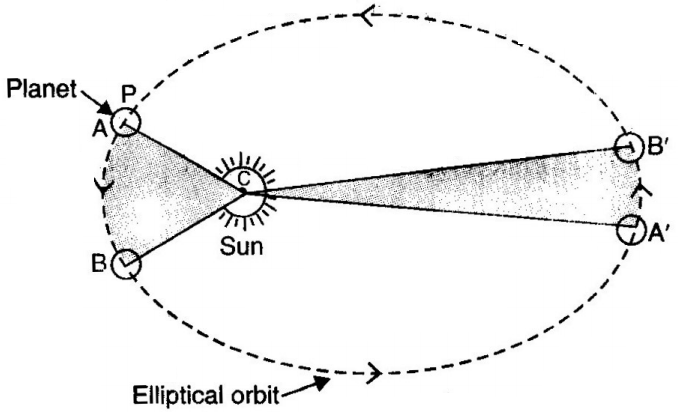
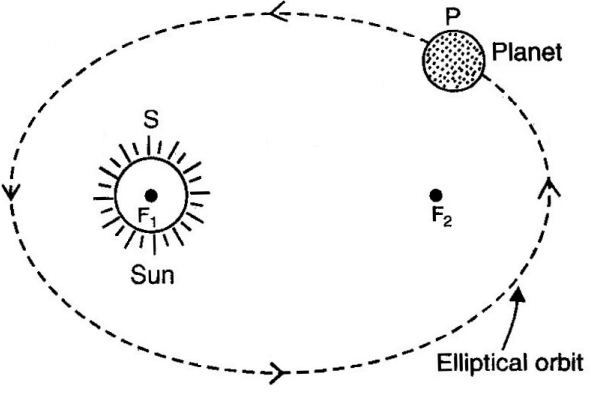 Kepler's Second law states that: Each planet revolves around the sun in such a way that the line joining the planet to the sun sweeps over equal areas in equal intervals of time. This means that a planet does not move with constant speed around the sun. The speed is greater when the planet is nearer the sun, and less when the planet is farther away from the sun.
  Kepler's Third Law states that: The cube of the mean distance of a planet from the sun is directly proportional to the square of time it takes to move around the sun.$\text{r}^3\propto\text{T}^2$