Questions

M.C.Q (1 Marks)

Take a timed test

18 questions · 16 auto-graded MCQ + 2 self-marked written.

MCQ 11 Mark
The median class for the data given below is:
Class20- 4040 - 6060 - 8080 - 100100 - 120
Frequency1012141317
  • A
    80 - 100
  • 60 - 80
  • C
  • D
    40 - 60
Answer
Correct option: B.
60 - 80
(B) 60 - 80
Explanation: Total frequencies (N) = 10 + 12 + 14 + 13 + 17= 66
So, $\frac{N}{2}=\frac{66}{2}=33$
c.f. Just greater than 33 is 36 and the corresponding class is 60 - 80
hence, median class = 60 - 80
View full question & answer
MCQ 21 Mark
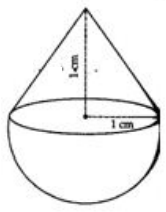
A solid is in the shape of a cone standing on a hemisphere with both their radii being equal to $1\ cm$ and the height of the cone is equal to its radius. The volume of the solid is
  • $\pi \ cm ^3$
  • B
    $4 \pi \ cm^3$
  • C
    $2 \pi \ cm^3$
  • D
    $3 \pi \ cm^3$
Answer
Correct option: A.
$\pi \ cm ^3$
Image
Radii of cone $= r =1 \ cm$
Radius of hemisphere $= r =1 \ cm( h )=1 \ cm$
Height of cone $(h)=1 h=1 \ cm$
Volume of solid $=$ Volume of cone $+$  Volume of a hemisphere 
$=\frac{1}{3} \pi r^2 h+\frac{2}{3} \pi r^3$
$=\frac{1}{3} \pi r^2(h+2 r)$
$=\frac{1}{3} \times \pi \times(1)^2(1+2 \times 1)$
$=\frac{1}{3} \times \pi \times 3$
$=\pi \ cm ^3$
View full question & answer
MCQ 31 Mark
In a data, if $l =60, h=15, f _1=16, f _0=6, f _2=6$, then the mode is
  • $67.5$
  • B
    $72$
  • C
    $60$
  • D
    $62$
Answer
Correct option: A.
$67.5$
$=l+\left(\frac{f_1-f_0}{2 f_1-f_0-f_2}\right) \times h$
$=60+\frac{16-6}{2 \times 16-6-6} \times 15$
$=60+\frac{10}{32-12} \times 15$
$=60+\frac{10}{20} \times 15$
$=60+7.5$
$=67.5$
View full question & answer
MCQ 41 Mark
One card is drawn at random from a well-shuffled deck of 52 cards. What is the probability of getting a black face card?
  • $\frac{3}{13}$
  • B
    $\frac{3}{14}$
  • C
    $\frac{3}{26}$
  • D
    $\frac{1}{26}$
Answer
Correct option: A.
$\frac{3}{13}$
(A) $\frac{3}{26}$
Explanation: Total number of cards = 52.
Number of black face cards = 6
( 2 kings +2 queens +2 jacks).
$\therefore P ($ getting a face card $)=\frac{6}{52}=\frac{3}{26}$
View full question & answer
MCQ 51 Mark
Find the area of the sector if the radius is $5 \ cm$ and with an angle of $50^{\circ}$.
  • $10.90 \ cm$
  • B
    $12.90 \ cm$
  • C
    $13.90 \ cm$
  • D
    $11.90 \ cm$
Answer
Correct option: A.
$10.90 \ cm$
The area of the sector $=\frac{x^{\circ}}{360^{\circ}} \times \pi r^2$
$=\frac{50^{\circ}}{360^{\circ}} \times \frac{22}{7} \times 5^2$
$=10.90 \ cm$
View full question & answer
MCQ 61 Mark
The area of a quadrant of a circle whose circumference is $616 \ cm$ will be
  • $7546 \ cm^2$
  • B
    $7500 \ cm^2$
  • C
    $7564 \ cm^2$
  • D
    $7456 \ cm^2$
Answer
Correct option: A.
$7546 \ cm^2$
$2 \pi R =616$
$ R =\frac{(616 \times 7)}{(2 \times 22)}$
$R =98 \ cm$
Area of quadrant $=\frac{\pi r^2}{4}$
$=\frac{(22 \times 98 \times 98)}{(7 \times 4)}$
$=7546 \ cm^2$
View full question & answer
MCQ 71 Mark
If $\cos \theta=\frac{2}{3}$, then $2 \sec ^2 \theta+2 \tan ^2 \theta-7$ is equal to
  • A
    $1$
  • B
    $4$
  • C
    $0$
  • $3$
Answer
Correct option: D.
$3$
Given,
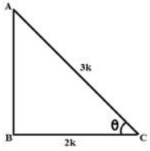
$\cos \theta=\frac{2}{3}=\frac{b}{h}= k$
$2 \sec ^2 \theta+2 \tan ^2 \theta-7$
$b=2 k , h =3 k $
Image
In $\triangle \text{ABC}$
$h ^2= p ^2+ b ^2$
$\Rightarrow(3 k )^2= p ^2+(2 k )^2$
$\Rightarrow 9 k ^2= p ^2+4 k ^2$
$\Rightarrow p ^2=9 k ^2-4 k ^2$
$\Rightarrow p ^2=5 k ^2$
$\Rightarrow p =\sqrt{ } 5 k $
Then,
$\sec \theta=\frac{3 k}{2 k}=\frac{3}{2}$ and $\tan \theta=\frac{\sqrt{5} k}{2 k}=\frac{\sqrt{5}}{2}$
$\Rightarrow 2 \sec ^2 \theta+2 \tan ^2 \theta-7$
$\Rightarrow 2\left(\frac{3}{2}\right)^2+2\left(\frac{\sqrt{5}}{2}\right)^2-7$
$\Rightarrow 2 \times \frac{9}{4}+2 \times \frac{5}{4}-7$
$\Rightarrow \frac{9}{2}+\frac{5}{2}-7$
$\Rightarrow \frac{9+5-14}{2}=0$
View full question & answer
MCQ 81 Mark
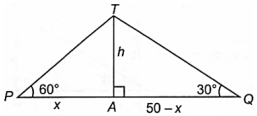
There is a small island in the middle of a 50 m wide river. A tall tree stands on the island. P and Q are points directly opposite to each other on the two banks, and in line with the tree. If the angles of elevation of the top of the tree from P and Q are respectively $60^{\circ}$ and $30^{\circ}$, then find the height of the tree.
  • A
    22.65 m
  • B
    23.56 m
  • C
    24.69 m
  • D
    21.65 m
View full question & answer
MCQ 91 Mark
If $\sqrt{3} \tan 2 \theta-3=0$ then $\theta=?$
  • $30^{\circ}$
  • B
    $60^{\circ}$
  • C
    $15^{\circ}$
  • D
    $45^{\circ}$
Answer
Correct option: A.
$30^{\circ}$
$\sqrt{3} \tan 2 \theta-3=0$
$\Rightarrow \sqrt{3} \tan 2 \theta=3$
$\Rightarrow \tan 2 \theta=\frac{3}{\sqrt{3}}$
$\Rightarrow \tan 2 \theta=\sqrt{3}$
$\Rightarrow \tan 2 \theta=\tan 60^{\circ}$
$\Rightarrow 2 \theta=60^{\circ}$
$\Rightarrow \theta=30^{\circ}$
View full question & answer
MCQ 101 Mark
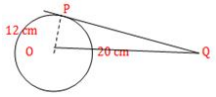
A tangent $PQ$ at point of contact $P$ to a circle of radius $12 \ cm$ meets the line through centre $O$ to a point $Q$ such that $OQ = 20 \ cm,$ length of tangent $PQ$ is:
Image
  • A
    $15 \ cm$
  • B
    $12 \ cm$
  • C
    $13 \ cm$
  • $16 \ cm$
Answer
Correct option: D.
$16 \ cm$
Image
Since op is perpendicular to $PQ,$ the $\angle \text{OPQ} =90^{\circ}$
Now, in right angled triangle $\text{OPQ},$
$ OQ ^2= OP ^2+ PQ ^2$
$\Rightarrow(20)^2=(12)^2+ PQ ^2$
$\Rightarrow PQ ^2=400-144$
$\Rightarrow PQ ^2=256$
$\Rightarrow PQ =16 \ cm$
View full question & answer
MCQ 111 Mark
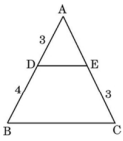
In the given figure, DE || BC and all measurements are given in centimetres. The length of AE is:
Image
  • A
    2.75 cm
  • B
    2.5 cm
  • C
    2 cm
  • 2.25 cm
Answer
Correct option: D.
2.25 cm
(D) 2.25 cm
Explanation: By BPT
$\frac{A D}{D B}=\frac{A E}{E C}$
$\frac{3}{4}=\frac{A E}{3}$
$AE =\frac{9}{4}$
AE = 2.25 cm
View full question & answer
MCQ 121 Mark
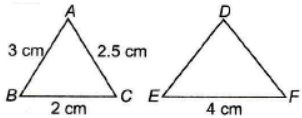
$\triangle ABC$ is such that AB = 3 cm, BC = 2 cm and CA = 2.5 cm. If $\triangle D E F \sim \triangle A B C$ and EF = 4 cm, then perimeter of $\triangle DEF$ is
  • A
    30 cm
  • B
    15 cm
  • C
    22.5 cm
  • D
    7.5 cm
View full question & answer
MCQ 131 Mark
If (a, 0), (0, b) and (x, y) are collinear, then
  • A
    ay - bx = 1
  • B
    ax + by = 1
  • C
    ay + bx = ab
  • ax - by = ab
Answer
Correct option: D.
ax - by = ab
(D) ay + bx = ab
Explanation: If given points are collinear, then the area of the triangle formed by these three points is 0.
$\therefore$ Area $=\frac{1}{2}|a(b-y)+0(y-0)+x(0-b)|=0$
$\Rightarrow \frac{1}{2}|a b-a y-b x|=0$
$\Rightarrow a b-a y-b x=0$
$\Rightarrow a y+b x=a b$
View full question & answer
MCQ 141 Mark
A quadratic equation whose one root is 3 is
Answer
Correct option: D.
(D) $x^2-5 x+6=0$
Explanation: since 3 is the root of the equation, x = 3 must satisfy the equation.
Applying x = 3 in the equation $x^2-5 x+6=0$
gives, $(3)^2-5(3)+6=0$
$\Rightarrow 9-15+6=0$
$\Rightarrow 15-15=0$
$\Rightarrow 0=0$
$\Rightarrow$ L.H.S. = R.H.S.
Hence, $x^2-5 x+6=0$ is a required equation which has 3 as root.
View full question & answer
MCQ 151 Mark
The value of k for which the system of linear equations x + 2y = 3, 5x + ky + 7 = 0 is inconsistent is:
  • $-\frac{14}{3}$
  • B
    5
  • C
    $\frac{2}{5}$
  • D
    10
Answer
Correct option: A.
$-\frac{14}{3}$
(A) 10
Explanation:For a system of equations $a_1 x+b_1 y+c_1=0 ; a_2 x+b_2 y+c_2=0$ to have no solution, the condition to be satisfied is
$\frac{a_1}{a_2}=\frac{b_1}{b_2} \neq \frac{c_1}{c_2}$
$\Rightarrow \frac{1}{5}=\frac{2}{k} \neq \frac{-3}{7}$
$\therefore$ For k = 10, the given system of equation is inconsistent.
View full question & answer
MCQ 161 Mark
If the equation $9 x^2+6 k x+4=0$ has equal roots then k = ?
  • A
    -2 or 0
  • B
    0 only
  • C
    2 or 0
  • 2 or -2
Answer
Correct option: D.
2 or -2
(D) 2 or -2
Explanation: Since the roots are equal, we have D = 0.
$\therefore 36 k ^2-4 \times 9 \times 4=0 \Rightarrow 36 k ^2=144 \Rightarrow k ^2=4 \Rightarrow k =2$ or -2
View full question & answer
MCQ 171 Mark
120 can be expressed as a product of its prime factors as
  • A
    $15 \times 2^3$
  • $5 \times 2^3 \times 3$
  • C
    $5 \times 8 \times 3$
  • D
    $10 \times 2^2 \times 3$
Answer
Correct option: B.
$5 \times 2^3 \times 3$
(B) $5 \times 2^3 \times 3$
Explanation:We have,
$120=5 \times 2^3 \times 3$
View full question & answer
MCQ 181 Mark
If a is rational and $\sqrt{b}$ is irrational, then $a+\sqrt{b}$ is:
  • an irrational number
  • B
    an integer
  • C
    a natural number
  • D
    a rational number
Answer
Correct option: A.
an irrational number
(A) an irrational number
Explanation: Let a be rational and $\sqrt{b}$ is irrational.
If possible let $a+\sqrt{b}$ be rational.
Then $a+\sqrt{b}$ is rational and a is rational.
$\Rightarrow[(a+\sqrt{b})-a]$ is rational [Difference of two rationals is rational]
$\Rightarrow \sqrt{b}$ is rational.
The contradiction arises by assuming that $a+\sqrt{b}$ is rational.
Therefore, $a+\sqrt{b}$ is irrational.
View full question & answer
M.C.Q (1 Marks) - Maths STD 10 Questions - Vidyadip