Questions

2 Marks Questions

🎯

Test yourself on this topic

7 questions · timed · auto-graded

Question 12 Marks
Calculate mode of the following distribution:
Class5-1010-1515-2020-2525-3030-35
Frequency56151054
Answer
Class5-1010-1515-2020-2525-3030-35
Frequency56151054
Modal class is 15-20.
𝑀𝑜𝑑𝑒 $=15+5 \times\left(\frac{15-6}{2 \times 15-6-10}\right)$
$=18.21$ (approx.)
View full question & answer
Question 22 Marks
If $\sin (A-B)=\frac{1}{2}$ and $\cos (A+B)=\frac{1}{2}, 0^{\circ}  < A + B <  90^{\circ}$ and $A > B,$ then find the values of $A$ and $B.$
Answer
$\sin (A-B)=\frac{1}{2} $
$\Rightarrow A-B=30^.....(i)$
$\cos (A+B)=\frac{1}{2} $
$\Rightarrow A+B=60^.....(ii)$
Solving $(i) ,(ii)$ to get $A=45^{\circ}, B=15^{\circ}$
View full question & answer
Question 32 Marks
The sum of first 𝑛 terms of an A.P. is represented by $S_n=6 n-n^2$. Find the common difference.
Answer
Putting $n=1, S_1=a=6-1^2=5$.
Putting $n=2, \quad S_2=2 a+d=6 \times 2-2^2=8$.
Solving (i) & (ii) $\quad d=-2$
View full question & answer
Question 42 Marks
The sum of the first $12$ terms of an $A.P.$ is $900.$ If its first term is $20$ then find the common difference and $12^{\text {th }}$ term.
Answer
$\frac{12}{2}[2 \times 20+11 d]=900$
$\Rightarrow d=10$
$\text { Also } a_{12}=20+11 \times 10=130$
View full question & answer
Question 52 Marks
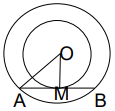
In two concentric circles, a chord of length $8 \ cm$ of the larger circle touches the smaller circle. If the radius of the larger circle is $5 \ cm,$ then find the radius of the smaller circle.
Answer
Image
$AM = 4 \ cm$
$OM =\sqrt{O A^2-A M^2}$
$=\sqrt{5^2-4^2}$
$=3 \ cm$
View full question & answer
Question 62 Marks
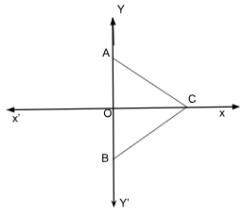
In the given figure, $\triangle ABC$ is an equilateral triangle. Coordinates of vertices $A$ and $B$ are $(0, 3)$ and $(0, −3)$ respectively. Find the coordinates of points $C.$
Image
Answer
$AB = 6 \ cm = AC$
$ OC =\sqrt{36-9}=3 \sqrt{3} \ cm$
$\text { Point } C \text { is }(3 \sqrt{3}, 0)$
View full question & answer
Question 72 Marks
$P(x, y)$ is a point equidistant from the points $A(4,3)$ and $B(3,4).$ Prove that $x − b= 0.$
Answer
$P A^2=P B^2$
$\Rightarrow(x-4)^2+(y-3)^2$
$=(x-3)^2+(y-4)^2$
$\Rightarrow x=y \text { or } x-y=0$
View full question & answer
2 Marks Questions - Maths STD 10 Questions - Vidyadip