Question types

MODEL PAPER 2025 (BASIC) question types

44 questions across 6 question groups — pick any mix to generate a Maths paper with step-by-step answer keys.

44
Questions
6
Question groups
5
Question types
Sample Questions

MODEL PAPER 2025 (BASIC) questions

One sample from each question group in this chapter. Select any group above to see the full set with answer keys.

A quadratic polynomial whose zeroes are $\frac{2}{5}$ and $\frac{-1}{5}$is
  • A
    $25 x^2+5 x-2$
  • B
    $5 x^2-2 x+1$
  • C
    $5 x^2+2 x-1$
  • $25 x^2-5 x-2$

Answer: D.

View full solution
The roots of quadratic equation $3 x^2-4 \sqrt{3} x+4=0$ are
  • A
    not real
  • real and equal
  • C
    rational and distinct
  • D
    irrational and distinct

Answer: B.

View full solution
Assertion(A): $(2+\sqrt{3}) \sqrt{3}$ is an irrational number.
Reason(R): Product of two irrational numbers is always irrational.
  • A
    Both assertion (A) and reason (R) are true and reason (R) is the correct explanation of assertion (A)
  • B
    Both assertion (A) and reason (R) are true and reason (R) is not the correct explanation of assertion (A)
  • Assertion (A) is true but reason (R) is false.
  • D
    Assertion (A) is false but reason (R) is true.

Answer: C.

View full solution
Assertion(A): The sequence −1, −1 − 1, . . . , −1 is an AP.
Reason(R): In an AP, $a_n-a_{n-1}$ is constant where $n \geq 2$ and $n \in N$
  • A
    Both assertion (A) and reason (R) are true and reason (R) is the correct explanation of assertion (A)
  • B
    Both assertion (A) and reason (R) are true and reason (R) is not the correct explanation of assertion (A)
  • Assertion (A) is true but reason (R) is false.
  • D
    Assertion (A) is false but reason (R) is true.

Answer: C.

View full solution
In two concentric circles, a chord of length $8 \ cm$ of the larger circle touches the smaller circle. If the radius of the larger circle is $5 \ cm,$ then find the radius of the smaller circle.
View full solution
Q 133 Marks Question3 Marks
The sum of a two-digit number and the number obtained by reversing the order of its digits is 99. If ten’s digit is 3 more than the unit’s digit, then find the number.
View full solution
Q 153 Marks Question3 Marks
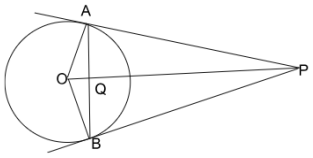
In the given figure, PA and PB are tangents to a circle centred at O. Prove that (i) OP bisects $\angle A P B$ (ii) OP is the right bisector of AB.
Image
View full solution
As observed from the top of a 75 m high lighthouse from the sea level, the angles of depression of two ships are $30^{\circ}$ and $45^{\circ}$ If one ship is exactly behind the other on the same side of the lighthouse, find the distance between the two ships (Use $\sqrt{3}=1.732)$
View full solution
From the top of a 9 m high building, the angle of elevation of the top of a cable tower is $60^{\circ}$ and angle of depression of its foot is $45^{\circ}$. Determine the height of the tower and distance between building and tower. $($ Use $\sqrt{3}=1.732)$
View full solution
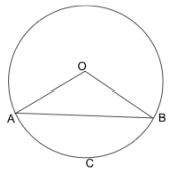
The perimeter of sector OACB of the circle centred at O and of radius 24, is 73.12 cm.
Image
(i) Find the central angle $\angle A O B$.
(ii) Find the area of the minor segment ACB. (Use $\pi=3.14$ and $\sqrt{3}=1.73$ )
View full solution
If a line is drawn parallel to one side of a triangle to intersect the other two sides in distinct points, then prove that the other two sides are divided in the same ratio.
View full solution
A train travels at a certain average speed for a distance of 132 km and then travels a distance of 140 km at an average speed of 4 km/h more than the initial speed. If it takes 4 hours to complete the whole journey, what was the initial average speed? Determine the time taken by train to cover the distances separately.
View full solution
View full solution
View full solution
A group of students conducted a survey to find out about the preferred mode of transportation to school among their classmates. They surveyed 200 students from their school. The results of the survey are as follows:
120 students preferred to walk to school.
25% of the students preferred to use bicycles.
10% of the students preferred to take the bus.
Remaining students preferred to be dropped off by car.
Based on the above information, answer the following questions:
(i) What is the probability that a randomly selected student does not prefer to walk to school?
(ii) Find the probability of a randomly selected student who prefers to walk or use a bicycle.
(iii)(A) One day 50% of walking students decided to come by bicycle. What is the probability that a randomly selected student comes to school using a bicycle on that day?
OR
(B) What is the probability that a randomly selected student prefers to be dropped off by car?
View full solution

Generate a MODEL PAPER 2025 (BASIC) paper free

Pick question groups from the list above, set marks and difficulty, and export a branded PDF with step-by-step answer keys. First 3 chapters free — no signup.
Download App