Question 14 Marks
Rinku was very happy to receive a fancy jumbo pencil from his best friend Rohan on his birthday. Pencil is a basic writing tool, when sharpened its shape is a combination of cylinder & cone as given in the picture.
Cylindrical pencil with conical head is a common shape worldwide since ages. Commonly pencils are made up of wood & plastic but we should promote pencils made up of eco-friendly material (many options available in the market these days) to save environment.
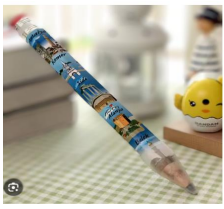
The dimensions of Rinku’s pencil are given as follows:
Length of cylindrical portion is 21cm. Diameter of the base is 1 cm and height of the conical portion is 1.2 cm
Based on the above information, answer the following questions:
(i) Find the slant height of the sharpened part.
(ii) Find curved surface area of sharpened part (in terms of $\pi$).
(iii)(A) Find the total surface area of the pencil (in terms of $\pi$).
OR
(B)The pencil’s total height decreases by 8.2 cm after sharpening it many times, what is the volume of the cylindrical part of the shortened pencil (in terms of $\pi$)?
Cylindrical pencil with conical head is a common shape worldwide since ages. Commonly pencils are made up of wood & plastic but we should promote pencils made up of eco-friendly material (many options available in the market these days) to save environment.
The dimensions of Rinku’s pencil are given as follows:
Length of cylindrical portion is 21cm. Diameter of the base is 1 cm and height of the conical portion is 1.2 cm
Based on the above information, answer the following questions:
(i) Find the slant height of the sharpened part.
(ii) Find curved surface area of sharpened part (in terms of $\pi$).
(iii)(A) Find the total surface area of the pencil (in terms of $\pi$).
OR
(B)The pencil’s total height decreases by 8.2 cm after sharpening it many times, what is the volume of the cylindrical part of the shortened pencil (in terms of $\pi$)?
Answer
View full question & answer→(i) $l^2=(1.2)^2+(0.5)^2$
= 1.44 + 0.25
$\Rightarrow l=\sqrt{1.69}=1.3 cm$
(ii) Curved surface area of sharpened part
$=\pi \times 0.5 \times 1.3$
$=(0.65 \pi) cm ^2$
(iii) (A) Total surface area of pencil
= CSA of cylinder + CSA of cone + area of base circle
$=\pi \times 0.5 \times 0.5 \times 21+0.65 \pi+\pi \times(0.5)^2$
= (5.25 + 0.65 + 0.25) $\pi$
$=(6.15 \pi) cm ^2$
OR
(B) Length of cylindrical part of shortened pencil
$=(21-8.2) cm =12.8 cm$
So, volume of cylindrical part of shortened pencil
$=\pi \times 0.5 \times 0.5 \times 12.8$
$=(3.2 \pi) cm ^3$
= 1.44 + 0.25
$\Rightarrow l=\sqrt{1.69}=1.3 cm$
(ii) Curved surface area of sharpened part
$=\pi \times 0.5 \times 1.3$
$=(0.65 \pi) cm ^2$
(iii) (A) Total surface area of pencil
= CSA of cylinder + CSA of cone + area of base circle
$=\pi \times 0.5 \times 0.5 \times 21+0.65 \pi+\pi \times(0.5)^2$
= (5.25 + 0.65 + 0.25) $\pi$
$=(6.15 \pi) cm ^2$
OR
(B) Length of cylindrical part of shortened pencil
$=(21-8.2) cm =12.8 cm$
So, volume of cylindrical part of shortened pencil
$=\pi \times 0.5 \times 0.5 \times 12.8$
$=(3.2 \pi) cm ^3$