MCQ 1011 Mark
If $E$ is a point on side $CA$ of an equilateral triangle $\text{ABC}$ such that $\text{BE}\perp\text{CA},$ then $AB^2+ BC^2+ CA^2=$
- A
$2BE^2$
- B
$3BE^2$
- ✓
$4BE^2$
- D
$6BE^2$
AnswerCorrect option: C. $4BE^2$
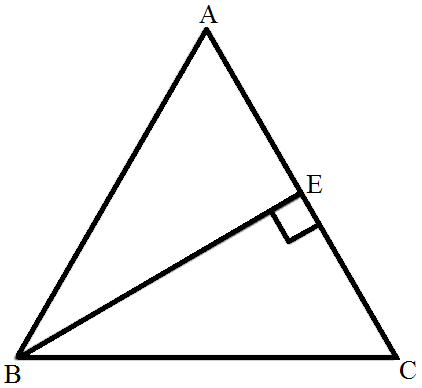
In triangle $\text{ABC}, E$ is a point on $AC$ such that $\text{BE}\perp\text{AC}.$
We need to find $AB^2+ BC^2+ AC^2$
Since $\text{BE}\perp\text{AC},$
$\text{CE} = \text{AE} = \frac{\text{AC}}{2}\ $
$($In a equilateral triangle, the perpendicular from the vertex bisects the base$.)$
In triangle $\text{ABE},$ we have,
$A B^2=B E^2+A E^2$
Since $AB = BC = AC$
Therefore, $A B^2=B C^2=A C^2=B E^2+A E^2$
$\Rightarrow A B^2+B C^2+A C^2=3 B E^2+3 A E^2$
Since in triangle $BE$ is an altitude, so $\text{BE}=\frac{\sqrt{3}}{2}\text{AB}$
$\text{BE}=\frac{\sqrt{3}}{2}\text{AB}$
$=\frac{\sqrt{3}}{2}\times\text{AC}$
$=\frac{\sqrt{3}}{2}\times2\text{AE}=\sqrt{3}\text{AE}$
$\Rightarrow\text{AB}^2+\text{BC}^2+\text{AC}^2=3\text{BE}^2+3\Big(\frac{\text{BE}}{\sqrt{3}}\Big)^2$
$=3\text{BE}^2+\text{BE}^2=4\text{BE}^2$
Hence option $C$ is correct. View full question & answer→MCQ 1021 Mark
It is given that $\triangle\text{ABC}\sim\triangle\text{PQR}$ and $\frac{\text{BC}}{\text{QR}}=\frac{2}{3}$ then $\frac{\text{ar}(\triangle\text{PQR})}{\text{ar}(\triangle\text{ABC})}=?$
- A
$\frac{2}{3}$
- B
$\frac{3}{2}$
- C
$\frac{4}{9}$
- ✓
$\frac{9}{4}$
AnswerCorrect option: D. $\frac{9}{4}$
$\triangle\text{ABC}\sim\triangle\text{PQR}$ and $\frac{\text{BC}}{\text{QR}}=\frac{2}{3}$
$\Rightarrow\frac{\text{QR}}{\text{BC}}=\frac{3}{2}$
$\frac{\text{ar}(\triangle\text{PQR})}{\text{ar}(\triangle\text{ABC})}=\frac{\text{QR}^2}{\text{BC}^2}$
$=\frac{3^2}{2^2}=\frac{9}{4}$
So, the ratio is $9 : 4.$
View full question & answer→MCQ 1031 Mark
Two poles of height $13m$ and $7m$ respectively stand vertically on a plane ground at a distance of $8m$ from each other. The distance between their tops is :
Answer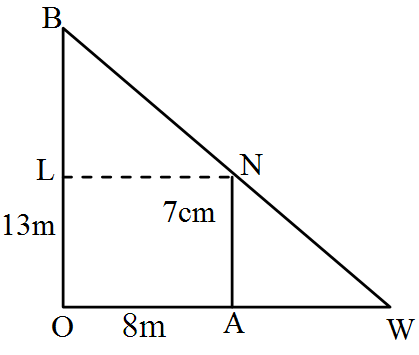
$OB$ and $AN$ are the two poles.
We have to find the distance between their tops
that is $,BN$
Construction : Draw $\text{NL}\perp\text{OB}$
$\text{OANL}$ is a rectangle $... ($Since all the angles are right anglrs$)$
$LN = OA = 8m$
$OL = AN = 7m$
$\Rightarrow BL = OB - OL $
$= 13m - 7m = 6m$
$\triangle\text{BLN}$ forms a right $-$ angled triangle.
By Pythagoras theorem,
$ \mathrm{BN}^2=\mathrm{LN}^2+\mathrm{BL}^2 $
$ \mathrm{BN}^2=8^2+6^2 $
$ \mathrm{BN}^2=64+36 $
$ \mathrm{BN}^2=100 $
$\mathrm{BN} = 10m$
So, the distance between their tops is $10m$. View full question & answer→MCQ 1041 Mark
Choose the correct answer from the given four options : In triangles $\text{ABC}$ and $\text{DEF}, \angle\text{B}=\angle\text{E},\angle\text{F}=\angle\text{C}$ and $\text{ AB}=3\text{ DE}.$ Then, the two triangles are :
- A
Congruent but not similar.
- ✓
Similar but not congruent.
- C
Neither congruent nor similar.
- D
Congruent as well as similar.
AnswerCorrect option: B. Similar but not congruent.
$\text{In}\ \triangle\text{ABC}$ and $ \triangle\text{DEF}, \angle\text{B}=\angle\text{E}=\angle\text{F}$ and $=\text{AB}=3\text{DE}$
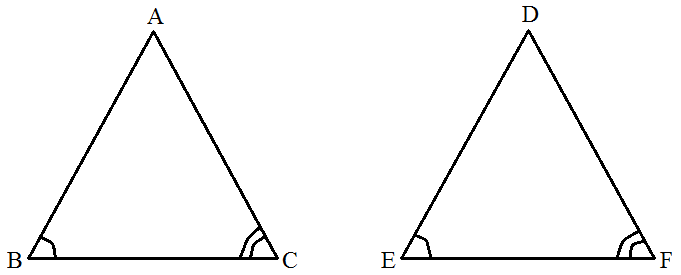
We know that, if in two triangles corresponding two angles are same, then they are similar by $\text{AAA}$ similarity criterion.
Also $\triangle\text{ABC}$ and $ \triangle\text{DEF}$ do not satisfy any rule of congruency, $\text{(SAS, ASA, SSS),}$ so both are not congruent. View full question & answer→MCQ 1051 Mark
Choose the correct answer from the given four options: If in triangles $\text{ABC}$ and $\text{DEF}, \frac{\text{AB}}{\text{DE}}=\frac{\text{BC}}{\text{FD}},$ then they will be similar, when :
- A
$\angle\text{B}=\angle\text{E}$
- B
$\angle\text{A}=\angle\text{D}$
- ✓
$\angle\text{B}=\angle\text{D}$
- D
$\angle\text{A}=\angle\text{F}$
AnswerCorrect option: C. $\angle\text{B}=\angle\text{D}$
Given, in $\triangle\text{ABC}$ and $\triangle\text{DEF},$
$\frac{\text{AB}}{\text{DE}}=\frac{\text{BC}}{\text{FD}}$
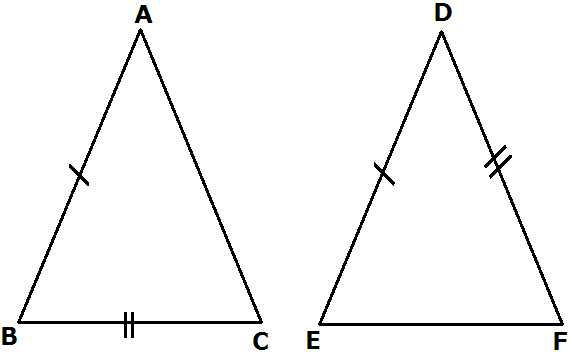
Here, Angle formed by $DE$ and $FD$ is $\angle\text{D}.$
So, $\angle\text{B}=\angle\text{D}$
$\Rightarrow\text{DABC}\sim\text{DEDF}$ View full question & answer→MCQ 1061 Mark
If $\triangle\text{ABC}\sim\triangle\text{EDF}$ and $\triangle\text{ABC}$ is not similar to $\triangle\text{DEF}$ then which of the following is not true?
- A
$\text{BC}\cdot\text{EF}=\text{AC}\cdot\text{FD}$
- B
$\text{AB}\cdot\text{EF}=\text{AC}\cdot\text{DE}$
- ✓
$\text{BC}\cdot\text{DE}=\text{AB}\cdot\text{EF}$
- D
$\text{BC}\cdot\text{DE}=\text{AB}\cdot\text{FD}$
AnswerCorrect option: C. $\text{BC}\cdot\text{DE}=\text{AB}\cdot\text{EF}$
In $\triangle\text{ABC}\sim\triangle\text{EDF},$ but $\triangle\text{ABC}$ is not similar $\triangle\text{DEF}.$
Since $\triangle\text{ABC}\sim\triangle\text{EDF},$
$\Rightarrow\frac{\text{AB}}{\text{DE}}=\frac{\text{BC}}{\text{DF}}=\frac{\text{AC}}{\text{EF}}$
So, $\text{AB}\cdot\text{EF}=\text{AC}\cdot\text{DE}$
Hence, $\text{BC}\cdot\text{DE}\not=\text{AB}\cdot\text{EF}.$
View full question & answer→MCQ 1071 Mark
It is given that $\triangle\text{ABC}\sim\text{PQR}$, with $\frac{\text{BC}}{\text{QR}}=\frac{1}{4}$ then, $\text{ar }\frac{\text{ar}\text({\triangle{\text{PRQ}}})}{\text{ar}\text({\text{ABC}})}$ is equal to :
- ✓
$16$
- B
$4$
- C
$\frac{1}{4}$
- D
$\frac{1}{16}$
AnswerGiven,
$\triangle\text{ABC}\sim\triangle\text{PQR}$
and$\frac{\text{BC}}{\text{QR}}=\frac{1}{4}$
Ratio of area of similar triangles is equal to the square of its corresponding sides.
So, $\frac{\text{ar}\text({\triangle{\text{PRQ}}})}{\text{ar}\text({\text{ABC}})}$
$=\Bigg(\frac{\text{QR}}{\text{BC}}\Bigg)^2=\Bigg(\frac{4}{1}\Bigg)^2=16$
View full question & answer→MCQ 1081 Mark
$\Rightarrow\triangle\text{ABC}\sim\triangle\text{DEF}$ such that $\text{ar}(\triangle\text{ABC})=36\text{ cm}^2$ and $\text{ar}(\triangle\text{DEF})=49\text{ cm}^2.$ Then, the ratio of their corresponding sides is :
- A
$36 : 49$
- ✓
$6 : 7$
- C
$7 : 6$
- D
$\sqrt{6}:\sqrt{7}$
AnswerCorrect option: B. $6 : 7$
$\Rightarrow\triangle\text{ABC}\sim\triangle\text{DEF}$
$\Rightarrow\frac{\text{ar}(\triangle\text{ABC})}{\text{ar}(\triangle\text{DEF})}=\frac{\text{AB}^2}{\text{DE}^2}$
$\Rightarrow\frac{36}{49}=\frac{\text{AB}^2}{\text{DE}^2}$
$\Rightarrow\frac{\text{AB}}{\text{DE}}=\frac{6}{7}$
Since the triangle are similar,
$\frac{\text{AB}}{\text{DE}}=\frac{\text{BC}}{\text{EF}}=\frac{\text{AC}}{\text{DF}}=\frac{6}{7}$
So, the ratio is $6 : 7.$
View full question & answer→MCQ 1091 Mark
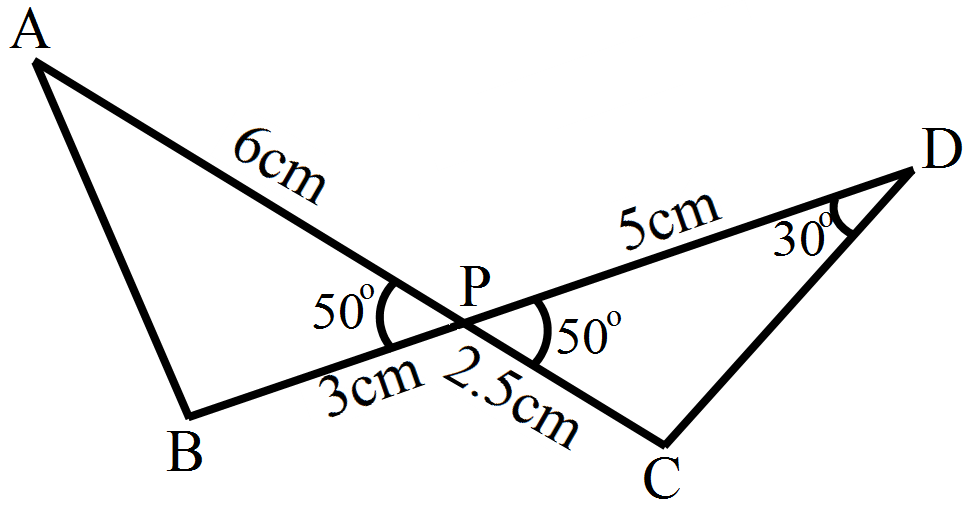
in the given figure, two line segments $AC$ and $BD$ intersect each other at the point $P$ such that $PA = 6\ cm, PB = 3\ cm, PC = 2.5\ cm, PD = 5\ cm, \angle\text{APB}=50^\circ$ and $\angle\text{CDP}=30^\circ$ then $\angle\text{PBA}=?$
- A
$50^\circ$
- B
$30^\circ$
- C
$60^\circ$
- ✓
$100^\circ$
AnswerCorrect option: D. $100^\circ$
In $\triangle\text{PBA}\sim\triangle\text{PCD}$
$\frac{\text{AP}}{\text{PD}}=\frac{\text{PB}}{\text{PC}}\dots\Big(\therefore\frac{\text{AP}}{\text{PD}}=\frac{6}{5 }$ and $\frac{\text{BP}}{\text{ BC}}=\frac{3}{2.5}=\frac{6}{5}\Big)$
So, $\angle\text{APB}=\angle\text{DPC} ....($Vertically opposite angles$)$
$\Rightarrow\triangle\text{CAD}\sim\triangle\text{PQR} ....(\text{AA}$ criterion for similarity$)$
$\angle\text{PBA}=\angle\text{DCP}$
In $\triangle\text{PCD},$
$\angle\text{PCD}=180^\circ-\angle\text{DPC}-\angle\text{PDC}$
$\Rightarrow\angle\text{PCD}=180^\circ-50^\circ-30^\circ$
$\Rightarrow\angle\text{PCD}=100^\circ$
So, $\angle\text{PBA}=\angle\text{DCP}=100^\circ.$
View full question & answer→MCQ 1101 Mark
If $\text{ABC}$ and $\text{DEF}$ are two triangles and $\frac{\text{AB}}{\text{DE}}=\frac{\text{BC}}{\text{FD}},$ then the two triangles are similar if :
- A
$\angle\text{A}=\angle\text{F}$
- ✓
$\angle\text{B}=\angle\text{D}$
- C
$\angle\text{A}=\angle\text{D}$
- D
$\angle\text{B}=\angle\text{E}$
AnswerCorrect option: B. $\angle\text{B}=\angle\text{D}$
If $\text{ABC}$ and $\text{DEF}$ are two triangles and $\frac{\text{AB}}{\text{DE}}=\frac{\text{BC}}{\text{FD}},$
then the two triangles are similar if $\angle\text{B}=\angle\text{D}$
View full question & answer→MCQ 1111 Mark
If $\triangle\text{ABC}\sim\triangle\text{DEF}$ such that $AB = 9.1\ cm$ and $DE = 6.5\ cm$. If the perimeter of $\triangle\text{DEF}$ is $25\ cm,$ then the perimeter of $\triangle\text{ABC}$ is :
- A
$36\ cm.$
- B
$30\ cm.$
- C
$34\ cm.$
- ✓
$35\ cm.$
AnswerCorrect option: D. $35\ cm.$
Given : $\triangle\text{ABC}$ is similar to $\triangle\text{DEF}$ such that $AB= 9.1\ cm, DE = 6.5\ cm.$
Perimeter of $\triangle\text{DEF}$ is $25\ cm.$
To find : Perimeter of $\triangle\text{ABC}.$
We know that the ratio of corresponding sides of similar triangles is equal to the ratio of their perimeters.
Hence,
$\frac{\text{AB}}{\text{DE}}=\frac{\text{BC}}{\text{EF}}=\frac{\text{AC}}{\text{DE}}=\frac{\text{P1}}{\text{P2}}$
$\frac{\text{AB}}{\text{DE}}=\frac{\text{P}(\triangle\text{ABC})}{\text{P}(\triangle\text{DEF})}$
$\frac{9.1}{6.5}=\frac{\text{P}(\triangle\text{ABC})}{25}$
$\text{P}(\triangle\text{ABC})=\frac{9.1\times25}{6.5}$
$\text{P}(\triangle\text{ABC})=35\text{ cm}$
Hence the correct answer is $D.$
View full question & answer→MCQ 1121 Mark
The hypotenuse of a right triangle is $25\ cm.$ The other two sides are such that one is $5\ cm$ longer than the other. The lengths of these sides are :
- A
$10\ cm, 15\ cm$
- ✓
$15\ cm, 20\ cm$
- C
$12\ cm, 17\ cm$
- D
$13\ cm, 18\ cm$
AnswerCorrect option: B. $15\ cm, 20\ cm$
The pythagoeas theorem states that, in a right $-$ angled triangle,
the hypotenuse square is equal to the sum of the squares of the opposite sides.
$(a) 10^2+ 15^2= 100 + 225 = 325$
$\mathrm{hypotenuse^2}= 25^2= 625$
So, this is not possible by $(i).$
$(b) 15^2+ 20^2= 225 + 400 = 625$
$\mathrm{hypotenuse^2}= 25^2= 626$
So, the lengths of the sides are $15\ cm$ and $20\ cm.$
$(c) 12^2+ 172 = 144 + 289 = 433$
$\mathrm{hypotenuse^2}= 25^2= 625$
So, this is not possible by $(i)$
$(d) 13^2+ 18^2= 169 + 324 = 493$
$\mathrm{hypotenuse^2}= 25^2= 626$
So, this is not possible by $(i).$
View full question & answer→MCQ 1131 Mark
Corresponding sides of two similar triangles are in the ratio $4 : 9$. Areas of these triangles are in the ratio :
- A
$2 : 3$
- B
$4 : 9$
- C
$9 : 4$
- ✓
$16 : 81$
AnswerCorrect option: D. $16 : 81$
Let the areas of the triangle be $\mathrm{A}_1$ and $\mathrm{A}_2$.
$\frac{\text{ar}(\text{A}_1)}{\text{ar}(\text{A}_2)}=\frac{4^2}{9^2}=\frac{16}{81}$
So, the ratio is $16 : 81.$
View full question & answer→MCQ 1141 Mark
The ratio of the areas of two similar triangles is equal to :
- ✓
square of the ratio of their corresponding sides.
- B
cube of the ratio of their corresponding sides.
- C
square root of the ratio of their corresponding sides.
- D
twice the ratio of their corresponding sides.
AnswerCorrect option: A. square of the ratio of their corresponding sides.
The ratio of the areas of two similar triangles is equal to the square of the ratio of their corresponding sides.
View full question & answer→MCQ 1151 Mark
A vertical stick $1.8m$ long casts a shadow $45\ cm$ long on the ground. At the same time, what is the lenght of the shadow of a pole $6m$ high?
- A
$2.4m$
- B
$1.35m$
- ✓
$1.5m$
- D
$13.5m$
AnswerCorrect option: C. $1.5m$
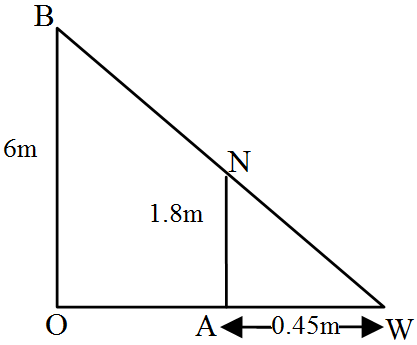
Let $AN$ be the vertical stick and $AW$ be its shadow.
Let $OB$ be the pole and $OW$ be its shadows.
$AW = 45\ cm = 0.45m$
$AN = 1.8m$
$OB = 6m$
Ratio of actual lengths $=$ ratio of their shadows
$\Rightarrow\frac{\text{OB}}{\text{AN}}=\frac{\text{OW}}{\text{AW}}$
$\Rightarrow\frac{6}{1.8}=\frac{\text{OW}}{0.45}$
$\Rightarrow\text{OW}=\frac{6\times0.45}{1.8}$
$\Rightarrow\text{OW}=1.5\text{m}$ View full question & answer→MCQ 1161 Mark
It is given that $\triangle\text{ABC}\sim\triangle\text{DFE},\angle\text{A}=30^\circ,\angle\text{C}=50^\circ ,\text{AB}=5 \text{ cm},\text{AC}=8\text{ cm}$ and $\text{DF}= 7.5\text{ cm}$ Then, the following is true :
- A
$\text{DE}=12\text{ cm},\angle\text{F}=50^\circ$
- ✓
$\text{DE}=12\text{ cm},\angle\text{F}=100^\circ$
- C
$\text{EF}=12\text{ cm},\angle\text{D}=100^\circ$
- D
$\text{EF}=12\text{ cm},\angle\text{D}=30^\circ$
AnswerCorrect option: B. $\text{DE}=12\text{ cm},\angle\text{F}=100^\circ$
$\triangle\text{ABC}\sim\triangle\text{DFE},\angle\text{A}=30^\circ,\angle\text{C}=50^\circ ,\text{AB}$
$=5 \text{ cm},\text{AC}=8\text{ cm}$ and $\text{DF}= 7.5\text{ cm}$
In triangle $\text{ABC},$
$\angle\text{a}+\angle\text{b}+\angle\text{c}=180^\circ$
$\angle\text{b}=180^\circ-30^\circ-50^\circ=100^\circ$
Since$\triangle\text{ABC}\sim\triangle\text{DFE},$ the corresponding angles are equal.
Thus,$\angle\text{D}=\angle\text{A}=30^\circ$
$\angle\text{F}=\angle\text{B}=100^\circ$
$\angle\text{E}=\angle\text{C}=50^\circ$
And
$\frac{\text{AB}}{\text{DF}}=\frac{\text{AC}}{\text{DE}}$
$\frac{5}{7.5}=\frac{8}{\text{DE}}$
$\text{DE}=\frac{(8\times7.5)}{5}=12\text{ cm}$
View full question & answer→MCQ 1171 Mark
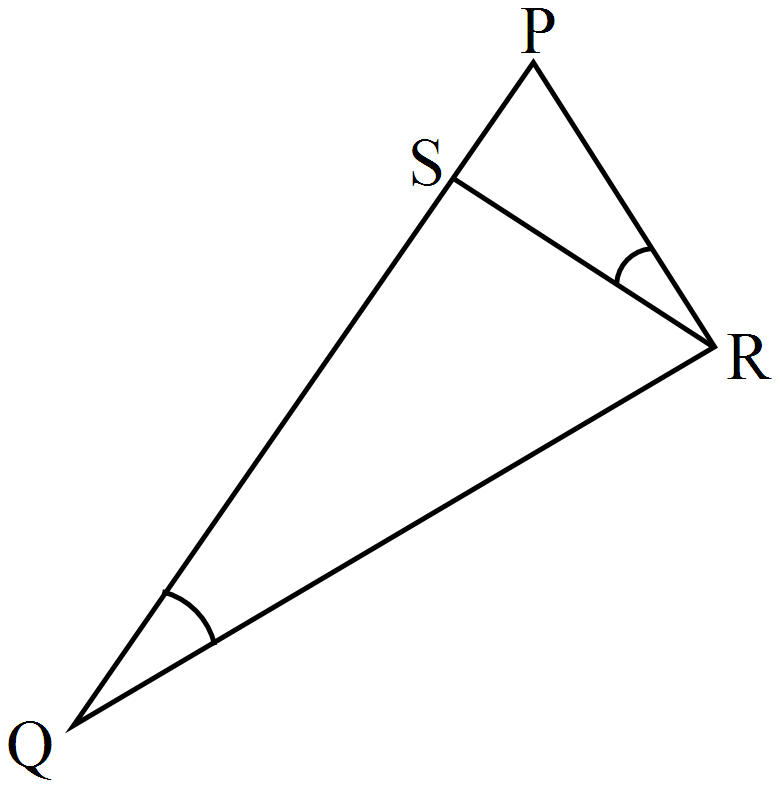
In the adjoining figure$\angle\text{PQR}=\angle\text{PRS}.$ If $PR = 8\ cm, PS = 4\ cm,$ then $PQ$ is equal to :
- ✓
$16\ cm.$
- B
$12\ cm.$
- C
$24\ cm.$
- D
$32\ cm.$
AnswerCorrect option: A. $16\ cm.$
In $\triangle\text{PQR}$ and $\triangle\text{PRS},$
$\angle\text{PRS}=\angle\text{PQR}\ [$Given$]$
$\angle\text{p}=\angle\text{p}\ [$common$]$
$\triangle\text{PQR}\sim\triangle\text{PRS} \ [$Common$]$
$\therefore\triangle\text{PQR}\sim\triangle\text{PRS}\ [$similarity$]$
$\therefore\frac{\text{PS}}{\text{PR}}\frac{\text{PR}}{\text{PQ}}$
$\Rightarrow\frac{4}{8}=\frac{8}{\text{PQ}}$
$\Rightarrow\text{PQ}=\frac{8\times8}{4}=16\text{ cm}$
View full question & answer→MCQ 1181 Mark
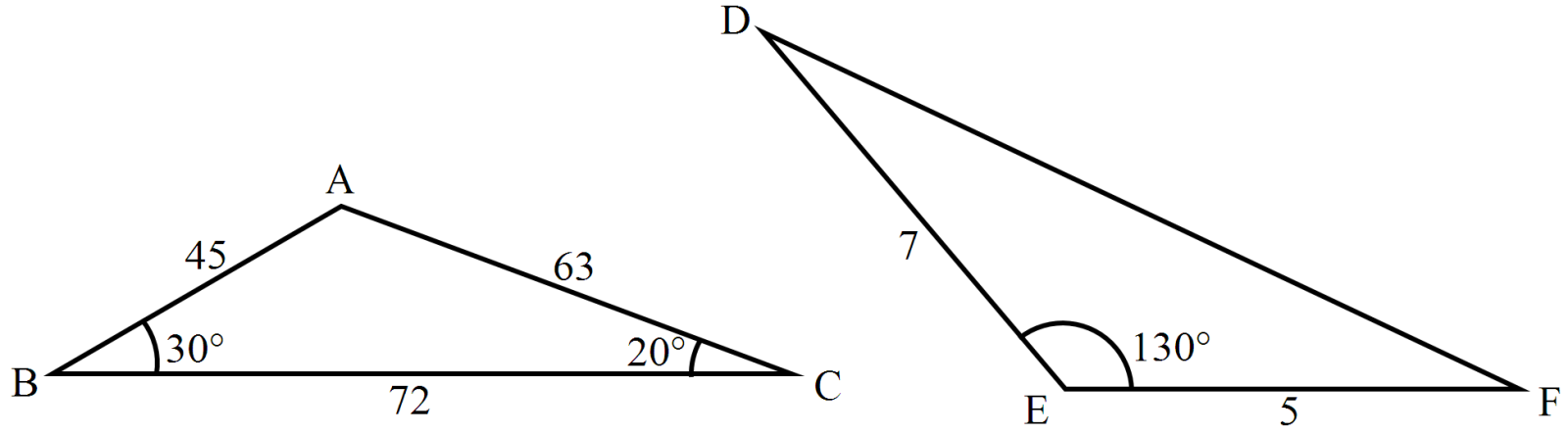
In the given figures the measures of $\angle\text{D}$ and$\angle\text{F}$ are respectively
- A
$30^\circ,20^\circ$
- B
$40^\circ,50^\circ$
- C
$50^\circ,40^\circ$
- ✓
$20^\circ,30^\circ$
AnswerCorrect option: D. $20^\circ,30^\circ$
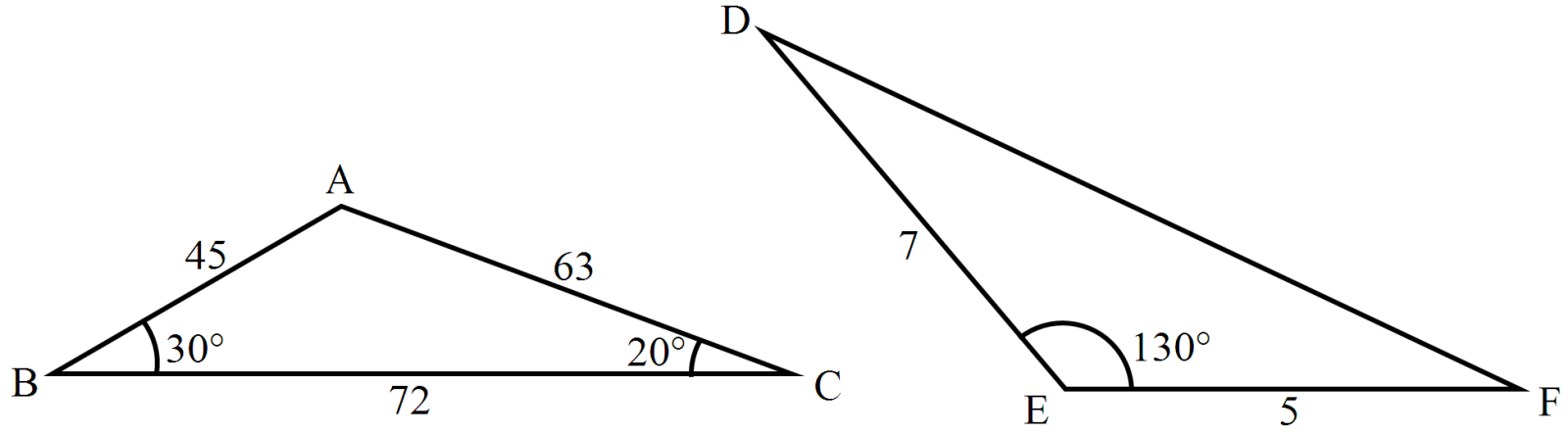
In $\triangle\text{ABC},\angle\text{A}+\angle\text{B}+\angle\text{C}=180^\circ$
$\angle\text{A}+30^\circ+20^\circ=180^\circ$
$\Rightarrow \text{A}=130^\circ$
Again in,$\triangle\text{ABC} $ and $\triangle\text{DEF},$
$\frac{\text{AB}}{\text{AC}}=\frac{\text{EF}}{\text{ED}}$
$\angle\text{A}=\angle\text{E}=130^\circ$
$\triangle\text{ABC}\sim\triangle\text{EFD}\ ($Similarity$)$
$\therefore\angle\text{F}=\angle\text{B}=30^\circ$
$\therefore\angle\text{D}=\angle\text{C}=20^\circ$ View full question & answer→MCQ 1191 Mark
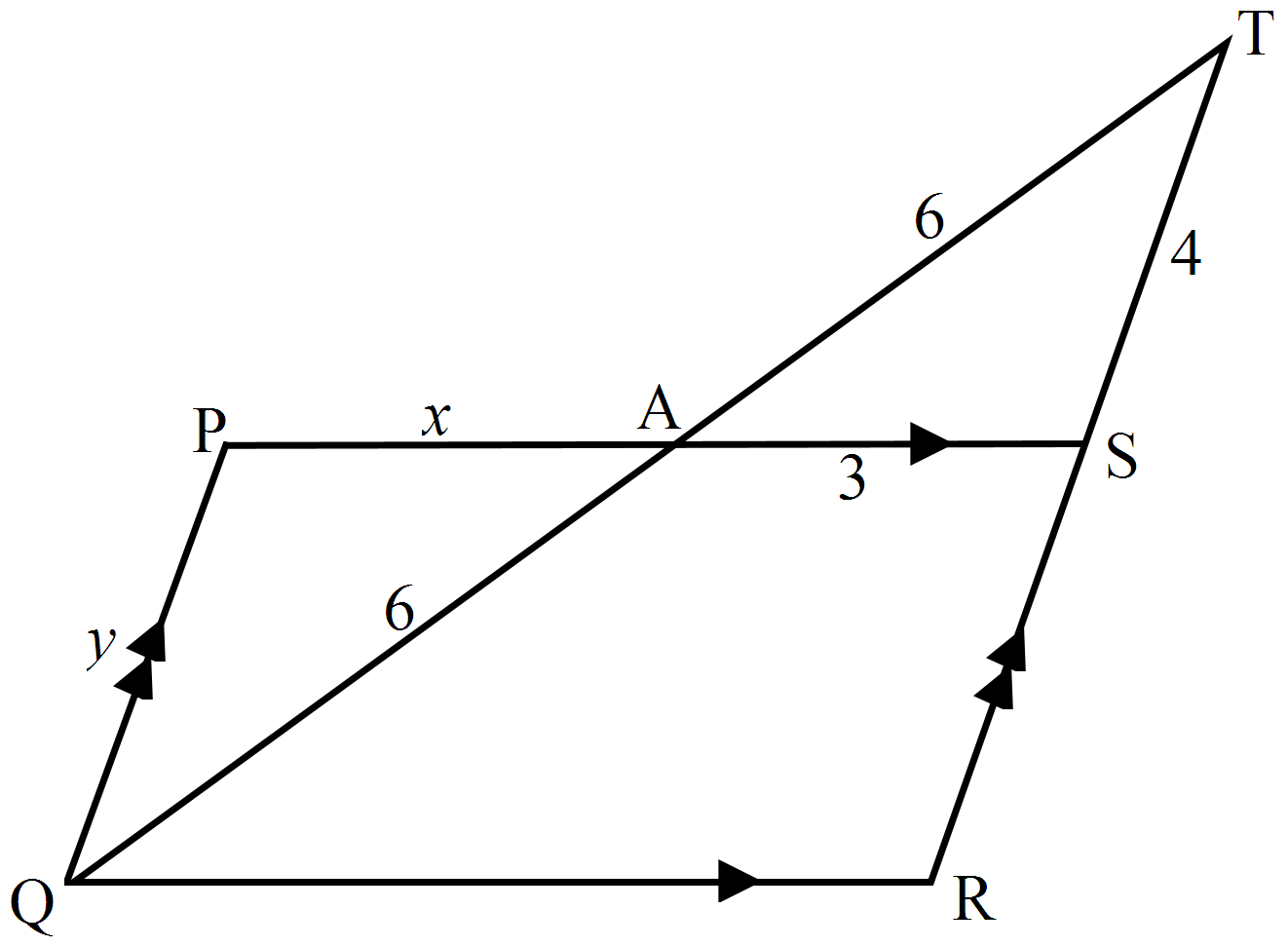
In the given figure if $\text{PS}\parallel\text{QR}$ and $\text{PQ}\parallel\text{SR}$ and $AT = AQ = 6, AS = 3, TS = 4,$ then :
- ✓
$x = 3, y = 4.$
- B
$x = 1, y = 2.$
- C
$x = 2, y = 3.$
- D
$x = 4, y = 5.$
AnswerCorrect option: A. $x = 3, y = 4.$
In triangles $\text{APQ }$ and $\text{ ATS}$
$\angle\text{PAQ}=\text{TAS}, \ [$Verticaly opposite angles$]\ $
$\angle\text{PQA}=\text{ATS},\ [$Alternate angles$]$
$\therefore\triangle\text{APQ}\sim\triangle\text{AST}\ [\text{AA}$ similarity$]$
$\therefore\frac{\text{AQ}}{\text{AT}}=\frac{\text{AP}}{\text{AS}}$
$\Rightarrow\frac{6}{6}=\frac{x}{3}$
$\Rightarrow\text{x}=\frac{6\times3}{6}=3$
And $\frac{\text{AQ}}{\text{AT}}=\frac{\text{PQ}}{\text{ST}} $
$\Rightarrow\frac{6}{6}=\frac{\text{x}}{4}$
$\Rightarrow\text{y}=\frac{4\times6}{6}=4$
$\Rightarrow$ Therefore $,\text{x}=3, \text{ y}=4$
View full question & answer→MCQ 1201 Mark
In $\triangle\text{ABC}\angle\text{BAC}=90^\circ$ and $\text{AD} \bot\text{BC}$ then :
- A
$\text{BD}.\text{CD}=\text{BC}^2$
- B
$\text{AB}.\text{AC}=\text{BC}^2$
- ✓
$\text{BD}.\text{CD}=\text{AD}^2$
- D
$\text{AB}.\text{AC}=\text{AD}^2$
AnswerCorrect option: C. $\text{BD}.\text{CD}=\text{AD}^2$
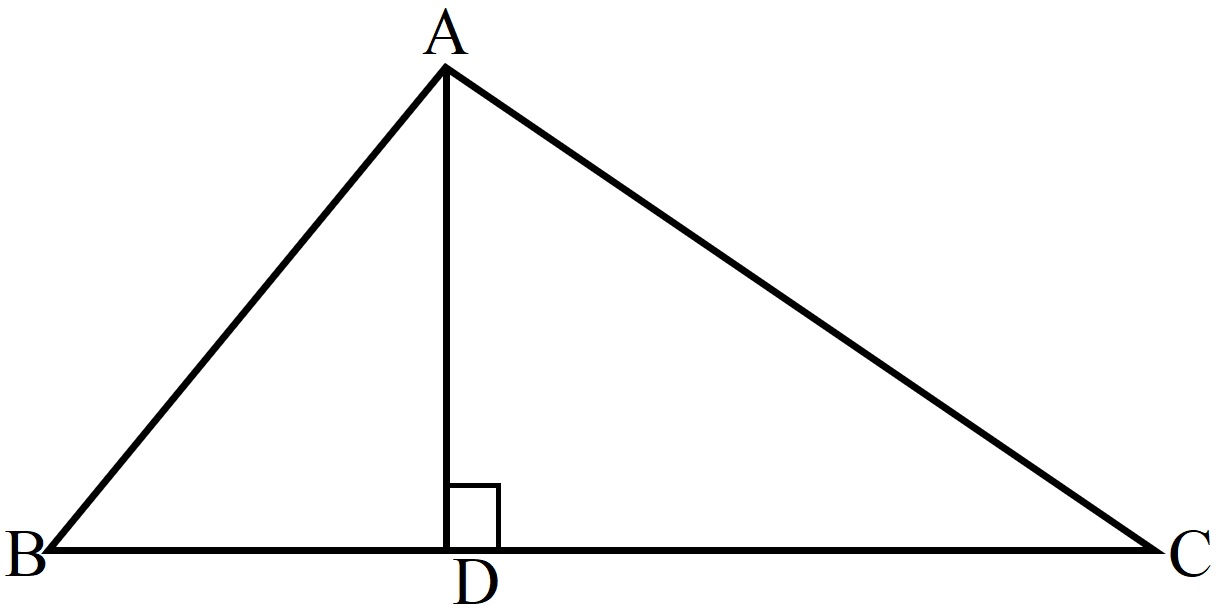
In $\triangle\text{ABC}$ and $\triangle\text{ADC}$
$\angle\text{D}=\angle\text{D}=90^\circ$
$\angle\text{DBA}=\angle\text{DAC}$
By $\text{AAA}$ similarity criterion,
$\triangle\text{ADB}\sim\triangle\text{ADC}$
$\frac{\text{BD}}{\text{AD}}=\frac{\text{AD}}{\text{CD}}$
$\text{BD.CD}=\text{AD}^2$ View full question & answer→MCQ 1211 Mark
$\triangle\text{ABC}\sim\triangle\text{PQR}$ such that $\text{ar}(\triangle\text{ABC})=4\ \text{ar}(\triangle\text{PQR}).$ If $BC = 12\ cm,$ then $QR =$
- A
$9\ cm.$
- B
$10\ cm.$
- ✓
$6\ cm.$
- D
$8\ cm.$
AnswerCorrect option: C. $6\ cm.$
Given : $\triangle\text{ABC}\sim\triangle\text{PQR}$ and $BC = 12\ cm$
$\text{ar}(\triangle\text{ABC})=4\ \text{ar}(\triangle\text{PQR})$
Now, $\frac{\text{ar}(\triangle\text{ABC})}{\text{ar}(\triangle\text{PQR})}=\Big(\frac{\text{BC}}{\text{QR}}\Big)^2$
$\Rightarrow\frac{4\text{ar}(\triangle\text{PQR})}{\text{ar}(\triangle\text{PQR})}=\frac{(12)^2}{\text{QR}^2}$
$\Rightarrow\text{QR}^2=\frac{144}{4}$
$\Rightarrow\text{QR}=\frac{12}{2}$
$\Rightarrow\text{QR}=6\text{ cm}.$
View full question & answer→MCQ 1221 Mark
Choose the correct answer from the given four options : If $\triangle\text{ABC}\sim\triangle\text{QRP},\frac{\text{ar}(\text{ABC})}{\text{ar}(\text{PQR})}=\frac{9}{4}, AB = 18\ cm$ and $BC = 15\ cm,$ then $PR$ is equal to :
- ✓
$10\ cm$
- B
$12\ cm$
- C
$\frac{20}{3}\text{ cm}$
- D
$8\ cm$
AnswerCorrect option: A. $10\ cm$
Given, $\triangle\text{ABC}\sim\triangle\text{QRP}, AB = 18\ cm$ and $BC = 15\ cm$
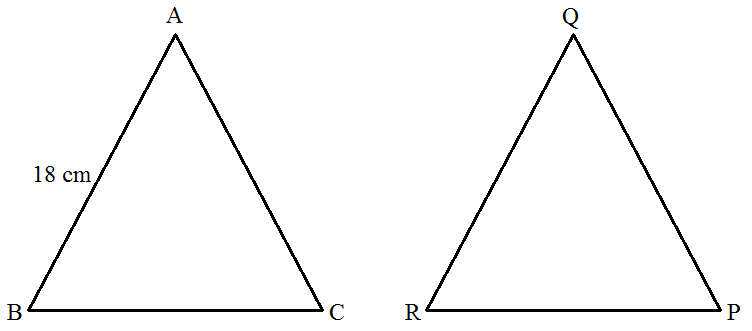
We know that, the ratio of are of two similar triangles is equal to the ratio of square of their corresponding sides.
$\therefore\frac{\text{ar}(\triangle\text{ABC})}{\text{ar}(\triangle\text{PQR})}=\frac{(\text{BC})^2}{(\text{RP})^2}$
But given $, \frac{\text{ar}(\triangle\text{ABC})}{\text{ar}(\triangle\text{PQR})}=\frac{9}{4}$
$\Rightarrow\frac{(15)^2}{(\text{RP})^2}=\frac{9}{4}$
$\Rightarrow\big(\text{RP})^2=\frac{225\times4}{9}=100$
$\therefore\text{RP}=10\text{ cm}$ View full question & answer→MCQ 1231 Mark
Tick the correct answer and justify : $\text{In}\ \triangle\text{ABC},\ \text{AB}=6\sqrt{3}\ \text{ cm},AC = 12 \ cm$ and $BC = 6 \ cm.$ The angle $B$ is :
- A
$120^\circ$
- B
$60^\circ$
- ✓
$90^\circ$
- D
$45^\circ$
AnswerCorrect option: C. $90^\circ$
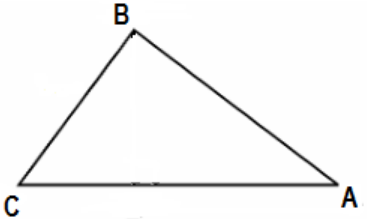
Given that, $\text{AB}=6\sqrt{3}\text{ cm}, AC = 12 \ cm,$ and $BC = 6 \ cm$
We can observe that
$ A B^2=108$
$ A C^2=144$
And, $B C^2=36$
$A B^2+B C^2=A C^2$
The given triangle, $\triangle\text{ABC},$ is satisfying Pythagoras theorem.
Therefore, the triangle is a right triangle, right $-$ angled at $B$.
$\therefore\ \angle\text{B}=90^\circ$
Hence, the correct option is $(c).$ View full question & answer→MCQ 1241 Mark
$\triangle \text{ABC}\sim\triangle\text{DEF}, \text{ar}(\triangle\text{ABC})=9\text{ cm}^2,\ \text{ar} (\triangle\text{DEF})=16\text{ cm}^2.$ If $BC = 2.1\ cm,$ then the measure of $EF$ is :
- ✓
$2.8\ cm.$
- B
$4.2\ cm.$
- C
$2.5\ cm.$
- D
$4.1\ cm.$
AnswerCorrect option: A. $2.8\ cm.$
Given : $\text{Ar}(\triangle\text{ABC})=9\text{ cm}^2,$
$\text{Ar}(\triangle\text{DEF})=16\text{ cm}^2,$ and ${BC}=2.1\text{ cm}$
To find : measure of $EF$
We know that the ratio of areas of two similar triangles is equal to the ratio of squares of their corresponding sides.
$\frac{\text{Ar}(\triangle\text{ABC})}{\text{Ar}(\triangle\text{DEF})}=\frac{\text{BC}^2}{\text{EF}^2}$
$\frac{9}{16}=\frac{2.1^2}{\text{EF}^2}$
$\frac{3}{4}=\frac{2.1}{\text{EF}}$
$\text{EF}=2.8\text{ cm}$
Hence the correct answer is $A$.
View full question & answer→MCQ 1251 Mark
In an equilateral triangle $\text{ABC}$ if $\text{AD}\perp\text{BC},$ then $AD^2=$
- A
$C D^2$
- B
$2 C D^2$
- ✓
$3 C D^2$
- D
$4C D^2$
AnswerCorrect option: C. $3 C D^2$
In an equilateral $\triangle\text{ABC},\ \text{AD}\perp\text{BC}$
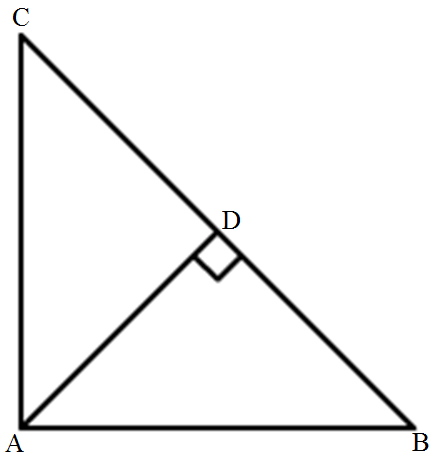
In $\triangle\text{ADC},$ applying Pythagoras theorem, we get,
$A C^2=A D^2+D C^2 $
$B C^2=A D^2+D C^2\ (\because A C=B C) $
$ (2 D C)^2=A D^2+D C^2\ (\because B C=2 D C) $
$ 4 D C^2=A D^2+D C^2 $
$ 3 D C^2=A D^2 $
$ 3 C D^2=A D^2 $
Hence, the correct option is $C.$ View full question & answer→MCQ 1261 Mark
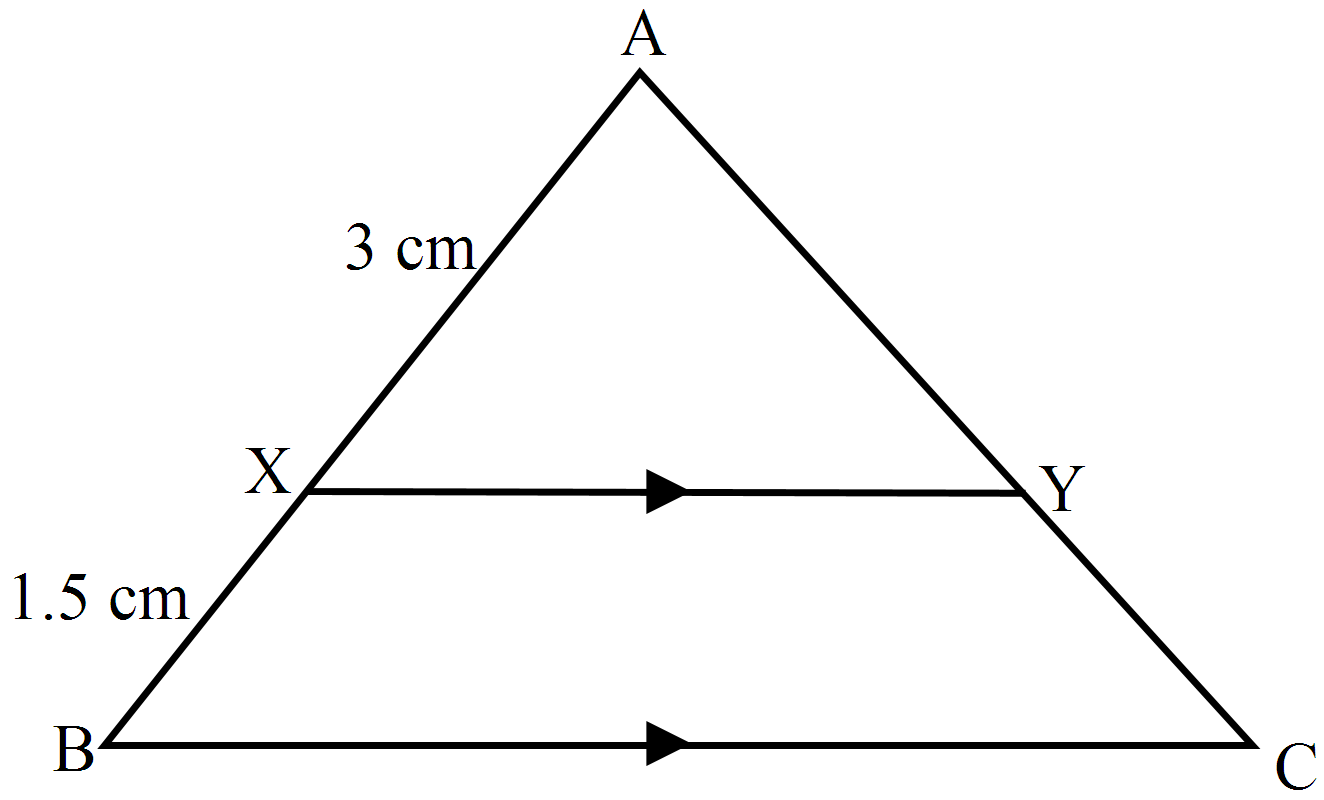
In the given figure$\text{XY}\parallel\text{BC.}$ If $AX = 3\ cm, XB = 1.5\ cm$ and $BC = 6\ cm,$ then $XY$ is equal to :
- ✓
$4\ cm.$
- B
$6\ cm$.
- C
$4.5\ cm$
- D
$3\ cm.$
AnswerCorrect option: A. $4\ cm.$
Since $\text{XY}\parallel\text{BC,} $ then using thales theorem
$\Rightarrow$$\frac{\text{AX}}{\text{AB}}=\frac{\text{XY}}{\text{BC}}$
$\Rightarrow\frac{3}{4.5}=\frac{\text{XY}}{6}$
$\Rightarrow\text{XY}=4\text{ cm}$
View full question & answer→MCQ 1271 Mark
Choose the correct answer from the given four options : In two line segments $AC$ and $BD$ intersect each other at the point $P$ such that $PA = 6\ cm, PB = 3\ cm, PC = 2.5\ cm, PD = 5\ cm, \angle\text{APB}=50^\circ$ and $ \ \angle\text{CDP}=30^\circ.$ Then $\angle\text{PBA}$ is equal to :
- A
$50^\circ$
- B
$30^\circ$
- C
$60^\circ$
- ✓
$100^\circ$
AnswerCorrect option: D. $100^\circ$
$\angle\text{APB}=\angle\text{CPD}=50^\circ \ [$vertically opposite angles$]$
$\frac{\text{AP}}{\text{PD}}=\frac{6}{5}\ ......(\text{i})$
$\text{and }\frac{\text{BP}}{\text{CP}}=\frac{3}{2.5}=\frac{6}{5}\ ......(\text{ii})$
From Eq. $(i)$ and $(ii)$
$\frac{\text{AP}}{\text{PD}}=\frac{\text{BP}}{\text{CP}}$
$\therefore\triangle\text{APB}\sim\triangle\text{DPC} \ [$by $\text{SAS}$ similarity criterion$]$
$\therefore\angle\text{A}=\angle\text{D} = 30^\circ\ [$Corresponding angles of similar triangles$]$
$\text{In}\ \triangle\text{APB},\ \ \angle\text{A}+ \angle\text{B}+ \angle\text{PBA}=180^\circ\ [$Sum of angles of a triangle $= 180^\circ ]$
$\Rightarrow30^\circ+\angle\text{B}+50^\circ=180^\circ$
$\therefore\angle\text{B}=180^\circ-(50^\circ+30^\circ)=100^\circ$
$\text{i,e.,}\ \ \angle\text{PBA}=100^\circ$
View full question & answer→MCQ 1281 Mark
In a right triangle $\text{ABC}$ right $-$ angled at $B,$ if $P$ and $Q$ are points on the sides $AB$ and $AC$ respectively, then :
- A
$\text{AQ}^2+\text{CP}^2=2(\text{AC}^2+\text{PQ}^2)$
- B
$2(\text{AQ}^2+\text{CP}^2)=\text{AC}^2+\text{PQ}^2$
- ✓
$\text{AQ}^2+\text{CP}^2=\text{AC}^2+\text{PQ}^2$
- D
$\text{AQ}+\text{CP}=\frac{1}{2}(\text{AC}+\text{PQ})$
AnswerCorrect option: C. $\text{AQ}^2+\text{CP}^2=\text{AC}^2+\text{PQ}^2$
Disclaimer : There is mistake in the problem. The question should be "In a right triangle $\text{ABC}$ right $-$ angle at $B,$ if $P$ and $Q$ are points on the sides $AB$ and $BC$ respectively, then"
Given : In the right $\triangle\text{ABC},$ right angled at $B. P$ and $Q$ are points on the sides $AB$ and $BC$ respectivelt.
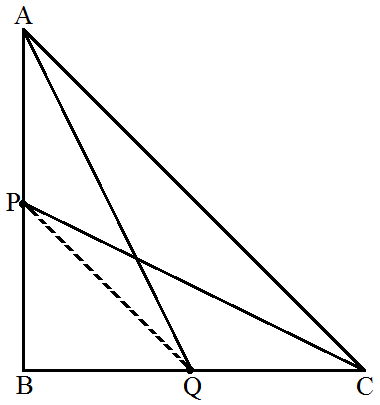
Applying Pythagoras theorem,
In $\triangle\text{AQB},$
$\text{AQ}^2=\text{AB}^2+\text{BQ}^2\ ....(1)$
In $\triangle\text{PBC}$
$\text{CP}^2=\text{PB}^2+\text{BC}^2\ ....(2)$
Adding $(1)$ and $(2),$ we get
$\text{AQ}^2+\text{CP}^2=\text{AB}^2+\text{BQ}^2+\text{PB}^2+\text{BC}^2\ \ ...(3)$
In $\triangle\text{ABC},$
$\text{AC}^2=\text{AB}^2+\text{BC}^2\ ....(4)$
In $\triangle\text{PBQ},$
$\text{PQ}^2=\text{PB}^2+\text{BQ}^2\ ....(5)$
From $(3), (4)$ and $(5),$ we get
$\text{AQ}^2+\text{CP}^2=\text{AC}^2+\text{PQ}^2$
We got the result as $C.$ View full question & answer→MCQ 1291 Mark
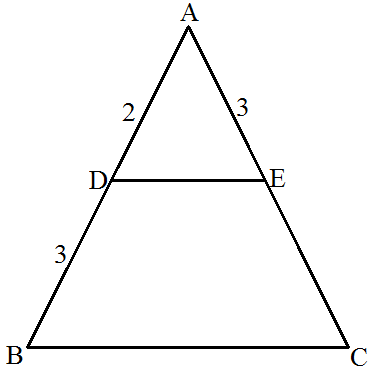
In the given figure, if $\angle\text{ADE}=\angle\text{ABC},$ then $CE =$
- A
$2$
- B
$5$
- ✓
$\frac{9}{2}$
- D
$3$
AnswerCorrect option: C. $\frac{9}{2}$
Given : $\angle\text{ADE}=\angle\text{ABC}$
To find : The value of $CE$
Since $\angle\text{ADE}=\angle\text{ABC}$
$\therefore\text{DE}\|\text{BC} \ ($Two lines are parallel if the corresponding angles formed are equal$)$
According to basic proportionality theorem if a line is parallel to one side of a triangle intersecting the other two sides, then it divides the two sides in the same ratio.
In $\triangle\text{ABC},\ \text{DE}\|\text{BC}$
$\frac{\text{AD}}{\text{DB}}=\frac{\text{AE}}{\text{EC}}$
$\frac{2}{3}=\frac{3}{\text{EC}}$
$\text{EC}=\frac{3\times3}{2 }$
$\text{EC}=\frac{9}{2}$
Hence we got the result $C$.
View full question & answer→MCQ 1301 Mark
In $\triangle\text{ABC},$ if $AB = 16\ cm, BC = 12\ cm$ and $AC = 20\ cm,$ then $\triangle\text{ABC}$ is :
- A
Acute $-$ angled.
- ✓
Right $-$ angled.
- C
Obtuse $-$ angled.
- D
AnswerCorrect option: B. Right $-$ angled.
Note that first check if the sum of any two sides is greater than the third side.
Since in this triangle, it holds, a triangle is possible.
In $\triangle\text{ABC},$
if $AB = 16\ cm, BC = 12\ cm$ and $AC = 20\ cm$
Consider,
$A B^2+B C^2=16^2+12^2=400$
$A C^2=20^2=400 $
By the Converse of Pythagoras theorem,
$\triangle\text{ABC}$ will be a right $-$ angled triangle.
View full question & answer→MCQ 1311 Mark
Which of the following triangles have the same side lengths :
AnswerEquilateral triangles have all its sides and all angles equal.
View full question & answer→MCQ 1321 Mark
If in $\triangle\text{ABC}$ and $\triangle\text{DEF}, \frac{\text{AB}}{\text{DE}}=\frac{\text{BC}}{\text{FD}},$ then $\triangle\text{ABC}\sim\triangle\text{DEF}$ when :
- A
$\angle\text{A}=\angle\text{F}$
- B
$\angle\text{A}=\angle\text{D}$
- ✓
$\angle\text{B}=\angle\text{D}$
- D
$\angle\text{B}=\angle\text{E}$
AnswerCorrect option: C. $\angle\text{B}=\angle\text{D}$
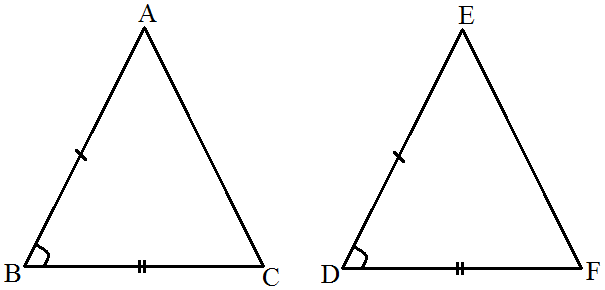
$\triangle\text{ABC}\sim\triangle\text{DEF}$
In $\triangle\text{ABC}$ and $\triangle\text{DEF},$
$\frac{\text{AB}}{\text{DE}}=\frac{\text{BC}}{\text{FD}}$
Then $\angle\text{B}=\angle\text{D} \ ($included angle $\text{SAS}$ axiom$)$. View full question & answer→MCQ 1331 Mark
Corresponding sides of two similar triangles are in the ratio of $2 : 3$. If the area of small triangle is $48\ \text{sq.cm},$ then the area of large triangle is :
- A
$230\ \text{sq.cm},$
- B
$106\ \text{sq.cm},$
- C
$107 \ \text{sq.cm},$.
- ✓
$108\ \text{sq.cm},$
AnswerCorrect option: D. $108\ \text{sq.cm},$
Let $\mathrm{A}_1$ and $\mathrm{A}_2$ are areas of the small and large triangle.
Then,
$\frac{\text{A}_2}{\text{A}_1}=\Big(\frac{\text{side of large triangle}}{\text{side of small triangle}}\Big)$
$\frac{\text{A}_2}{48}=\Big(\frac{3}{2}\Big)^2$
$\text{A}_2=108\text { sq.cm}$
View full question & answer→MCQ 1341 Mark
In a $\triangle\text{ABC} , AD$ is the bisector of $\angle\text{BAC}.$ If $AB = 6\ cm, AC = 5\ cm$ and $BD = 3\ cm,$ then $DC =$
- A
$11.3\ cm$.
- ✓
$2.5\ cm.$
- C
$3.5\ cm.$
- D
AnswerCorrect option: B. $2.5\ cm.$
In $\triangle\text{ABC}, AD$ is the bisector of $\angle\text{BAC}$
$AB = 6\ cm, AC = 5\ cm, BD = 3\ cm$
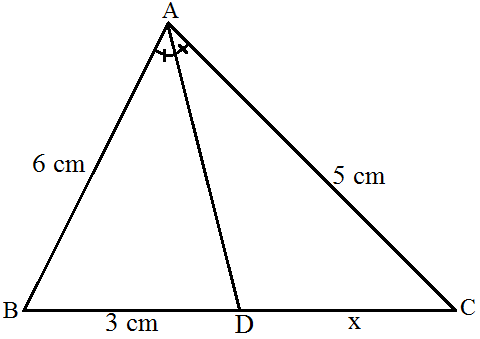
Let $DC = x$
In $\triangle\text{ABC}$
$\because AD$ is the bisector of $\angle\text{A}$
$\therefore\frac{\text{AB}}{\text{AC}}=\frac{\text{BD}}{\text{DC}}$
$\Rightarrow\frac{6}{5}=\frac{3}{\text{x}}$
$\Rightarrow\text{x}=\frac{3\times5}{6}=\frac{5}{2}=2.5$
$\therefore DC = 2.5\ cm.$ View full question & answer→MCQ 1351 Mark
In $\triangle\text{ABC}$ and $\triangle\text{PQR},$ we have $\frac{\text{AB}}{\text{QR}}=\frac{\text{BC}}{\text{PR}}=\frac{\text{CA}}{\text{PQ}}$ then :
- ✓
$\triangle\text{PQR}\sim\triangle\text{CAB}$
- B
$\triangle\text{PQR}\sim\triangle\text{ABC}$
- C
$\triangle\text{CAB}\sim\triangle\text{PQR}$
- D
$\triangle\text{BCA}\sim\triangle\text{PQR}$
AnswerCorrect option: A. $\triangle\text{PQR}\sim\triangle\text{CAB}$
In $\triangle\text{ABC}$ and $\triangle\text{DEF},$
$\frac{\text{AB}}{\text{QR}}=\frac{\text{BC}}{\text{PR}}=\frac{\text{CA}}{\text{PQ}}$
So, $\angle\text{A}\leftrightarrow\angle\text{Q},\angle\text{B}\leftrightarrow\angle\text{R},\angle\text{C}\leftrightarrow\angle\text{P},$
$\Rightarrow\triangle\text{CAB}\sim\triangle\text{PQR}$
View full question & answer→MCQ 1361 Mark
If $\triangle\text{ABC}\sim\triangle\text{QRP},\frac{\text{ar}(\triangle\text{ABC})}{\text{ar}(\triangle\text{PQR})}=\frac{9}{4},\text{AB}=18\text{ cm}$ and $\text{BC}=15\text{ cm}$ then $\text{PR}=?$
- A
$8\ cm$
- ✓
$10\ cm$
- C
$12\ cm$
- D
$\frac{20}{3}\text{ cm}$
AnswerCorrect option: B. $10\ cm$
$\triangle\text{ABC}\sim\triangle\text{QRP}$
$\Rightarrow\frac{\text{AB}}{\text{QR}}=\frac{\text{BC}}{\text{PR}}=\frac{\text{AC}}{\text{PQ}}$
Also, $\frac{\text{ar}(\triangle\text{ABC})}{\text{ar}(\triangle\text{PQR})}=\frac{\text{AB}^2}{\text{BC}^2}$
$\Rightarrow\frac{9}{4}=\frac{\text{AB}^2}{\text{BC}^2}$
$\Rightarrow\frac{\text{AB}}{\text{QR}}=\frac{3}{2}$
So, $\frac{\text{AB}}{\text{QR}}=\frac{\text{BC}}{\text{PR}}$
$\Rightarrow\frac{\text{BC}}{\text{PR}}=\frac{3}{2}$
$\Rightarrow\frac{15}{\text{PR}}=\frac{3}{2}$
$\Rightarrow\text{PR}=10\text{ cm}.$
View full question & answer→MCQ 1371 Mark
In an isosceles triangle $\text{ABC}$ if $AC = BC$ and $AB^2= 2AC^2,$ then $\angle\text{C}=$
- A
$30^\circ$
- B
$45^\circ$
- ✓
$90^\circ$
- D
$60^\circ$
AnswerCorrect option: C. $90^\circ$
In isosceles $\triangle\text{ABC},\ \text{AC}=\text{BC}$
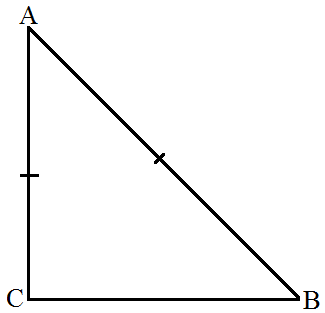
and $A B^2=A C^2+A C^2=2 A C^2$
$=A C^2+B C^2(A C=B C)$
By converse of Pythagoras
Theorem $, \angle\text{C}=90^\circ$ View full question & answer→MCQ 1381 Mark
If $\text{ABC}$ and $\text{DEF}$ are similar triangles such that $\angle\text{A}=47^\circ$ and $\angle\text{E}=83^\circ,$ then $\angle\text{C}=$
- ✓
$50^\circ$
- B
$60^\circ$
- C
$70^\circ$
- D
$80^\circ$
AnswerCorrect option: A. $50^\circ$
We have,
$\triangle\text{ABC}\sim\triangle\text{DEF}$
$\angle\text{A}=\angle\text{D}=47^\circ,\ \angle\text{B}=\angle\text{E}=83^\circ$ and $\angle\text{C}=\angle\text{F}=?$
$\angle\text{A}+\angle\text{B}+\angle\text{C}=180^\circ \ ($angle sum property$)$
$\Rightarrow47^\circ+83^\circ+\angle\text{C}=180^\circ$
$\Rightarrow130^\circ+\angle\text{C}=180^\circ$
$\Rightarrow\angle\text{C}=180^\circ-130^\circ$
$\Rightarrow\angle\text{C}=50^\circ$
View full question & answer→MCQ 1391 Mark
the lengths of the diagonals of a rhombus are $24\ cm$ and $10\ cm$. The length of each side of the rhombus is :
- A
$12\ cm$
- ✓
$13\ cm$
- C
$14\ cm$
- D
$17\ cm$
AnswerCorrect option: B. $13\ cm$
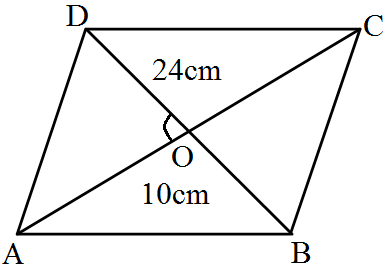
In an rhombus, the diagonals are perpendicular bisetoes of each other, and sides are equal to eachother.
So, $\text{AO}=\frac{1}{2}\text{AC}=12\text{ cm}$
$\text{OD}=\frac{1}{2}\text{BD}=5\text{ cm}$
In right $-$ angled $\triangle\text{AOD},$
$ A D^2=A O^2+O D^2 $
$ \Rightarrow A D^2=12^2+5^2 $
$ \Rightarrow A D^2=144+25 $
$ \Rightarrow A D^2=169 $
$\Rightarrow AD = 13\ cm$
So, the length of the each side of the rhombus is $13\ cm.$ View full question & answer→MCQ 1401 Mark
Which of the following is not a similarity criterion for two triangles?
- A
$\text{AAA}$
- B
$\text{SAS}$
- C
$\text{SSS}$
- ✓
$\text{ASA}$
AnswerCorrect option: D. $\text{ASA}$
The main criteria for similarity of two triangles are $\text{AAA, AA, SAS}$ and $\text{SSS}$.
View full question & answer→MCQ 1411 Mark
The height of an equilateral triangle having each side $12\ cm,$ is :
- A
$6\sqrt{2}\text{ cm}$
- ✓
$6\sqrt{3}\text{ cm}$
- C
$3\sqrt{6}\text{ cm}$
- D
$6\sqrt{6}\text{ cm}$
AnswerCorrect option: B. $6\sqrt{3}\text{ cm}$
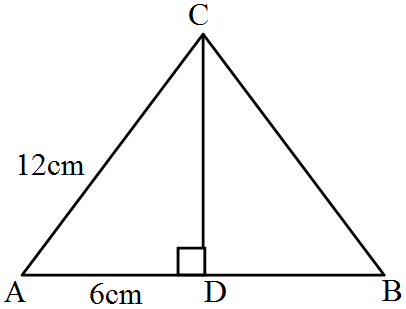
Let $\triangle\text{ABC}$ be the equilateral triangle and $AD$ be the height.
The height of an equilateral triangle is the same as its median.
So, $AD = 6m$
$\triangle\text{ABC}$ is a right $-$ angled triangle.
By Pythagoras theorem,
$ A C^2=A C^2+A D^2 $
$ \Rightarrow D C^2=A C^2-A D^2 $
$ \Rightarrow D C^2=12^2-6^2 $
$ \Rightarrow D C^2=144-36 $
$ \Rightarrow D C^2=108 $
$\Rightarrow\text{DC}=\sqrt{3\times4\times9}$
$\Rightarrow\text{DC}=6\sqrt{3}\text{ cm}$
So, the height is $6\sqrt3\text{ cm}.$ View full question & answer→MCQ 1421 Mark
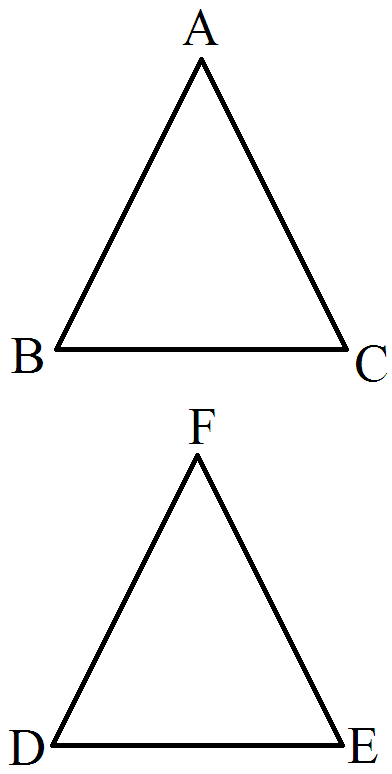
If in $\triangle\text{ABC} $ and $\triangle\text{DEF},\frac{\text{AB}}{\text{DE}}=\frac{\text{BC}}{\text{FD}}, $ then they will be similar, when :
- ✓
$\angle\text{B}=\angle\text{E}$
- B
$\angle\text{B}=\angle\text{D}$
- C
$\angle\text{A}=\angle\text{D}$
- D
$\angle\text{A}=\angle\text{F}$
AnswerCorrect option: A. $\angle\text{B}=\angle\text{E}$
In $\triangle\text{ABC} $ and $\triangle\text{DEF},\frac{\text{AB}}{\text{DE}}=\frac{\text{BC}}{\text{FD}}, $
then if, $\angle\text{b}=\angle\text{d} \ ($the included angles$)$ are equal then the traingles are similar.
View full question & answer→MCQ 1431 Mark
Which of the following are not similar figu :
AnswerAll circles, squares, and equilateral triangles are similar figures.
View full question & answer→MCQ 1441 Mark
$D$ and $E$ are the midpoints of side $AB$ and $AC$ of a triangle $\text{ABC},$ respectively and $BC = 6\ cm.$ If $DE \| BC,$ then the length $($in $cm)$ of $DE$ is :
AnswerBy midpoint theorem
$\text{DE}=\frac{1}{2}\text{BC}$
$\text{DE}=\frac{1}{2}$ of $6$
$\text{DE}=3\text{ cm}$
View full question & answer→MCQ 1451 Mark
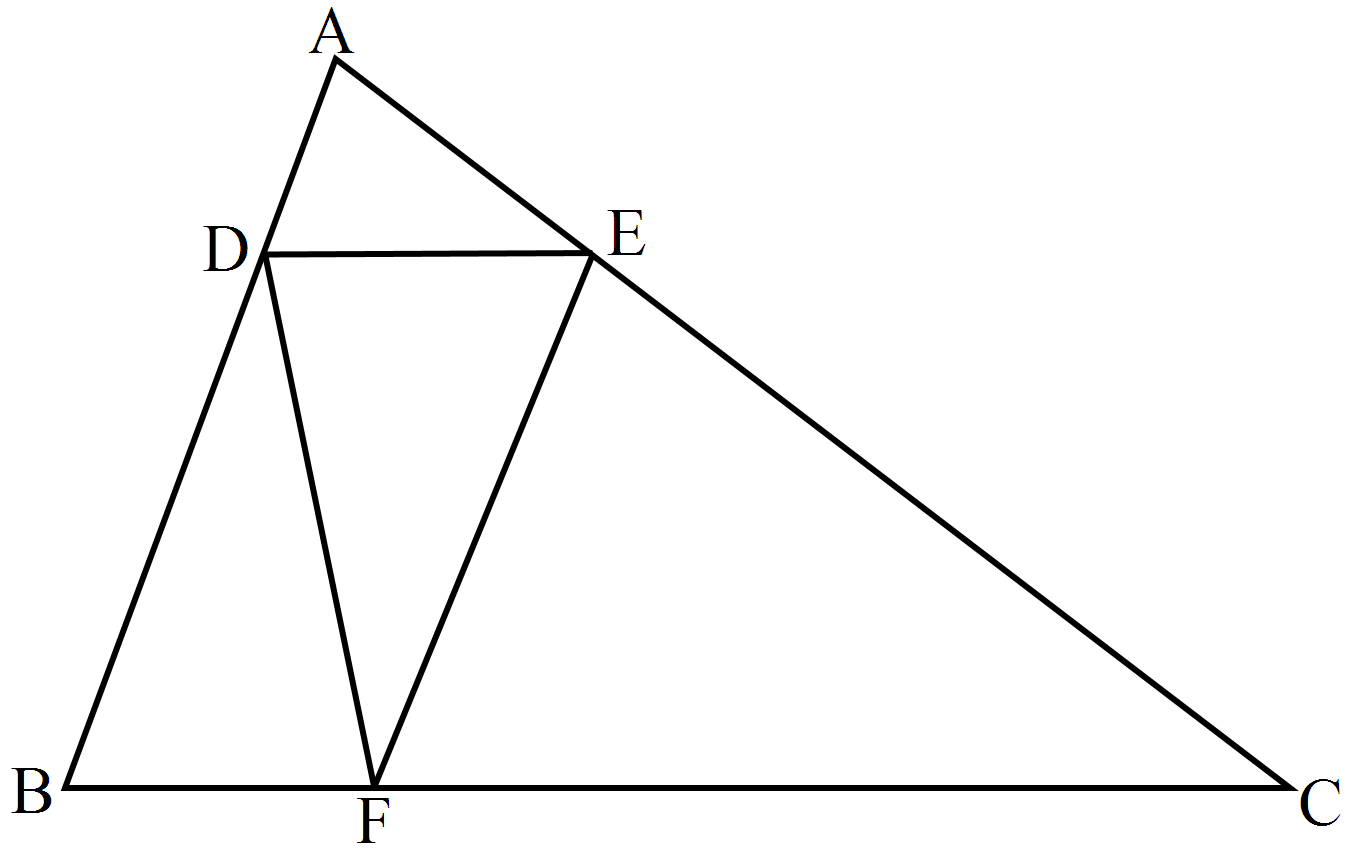
In the following figure $AD : DB = 1 : 3, AE : EC = 1 : 3$ and $BF : FC = 1 : 4,$ then :
- A
$\text{AD}\parallel\text{FE}.$
- B
$\text{AD}\parallel\text{FC}.$
- C
$\text{AE}\parallel\text{DF}.$
- ✓
$\text{DE}\parallel\text{BC}.$
AnswerCorrect option: D. $\text{DE}\parallel\text{BC}.$
Given : $\frac{\text{AD}}{\text{DB}}=\frac{1}{3}$ and $\frac{\text{AE}}{\text{EC}}=\frac{1}{3}$
$\therefore\triangle\text{ABC},\frac{\text{AD}}{\text{DB}}=\frac{\text{AE}}{\text{EC}}$
$\therefore\text{DE}\parallel\text{BC} \ ($Using Thales Theorem$)$
Here we are not considering $BF : FC = 1 : 4.$
View full question & answer→MCQ 1461 Mark
In the given figure if $\text{DE}\parallel\text{BC},\text{DE}\parallel\text{BC},$ then $x$ is equal to :
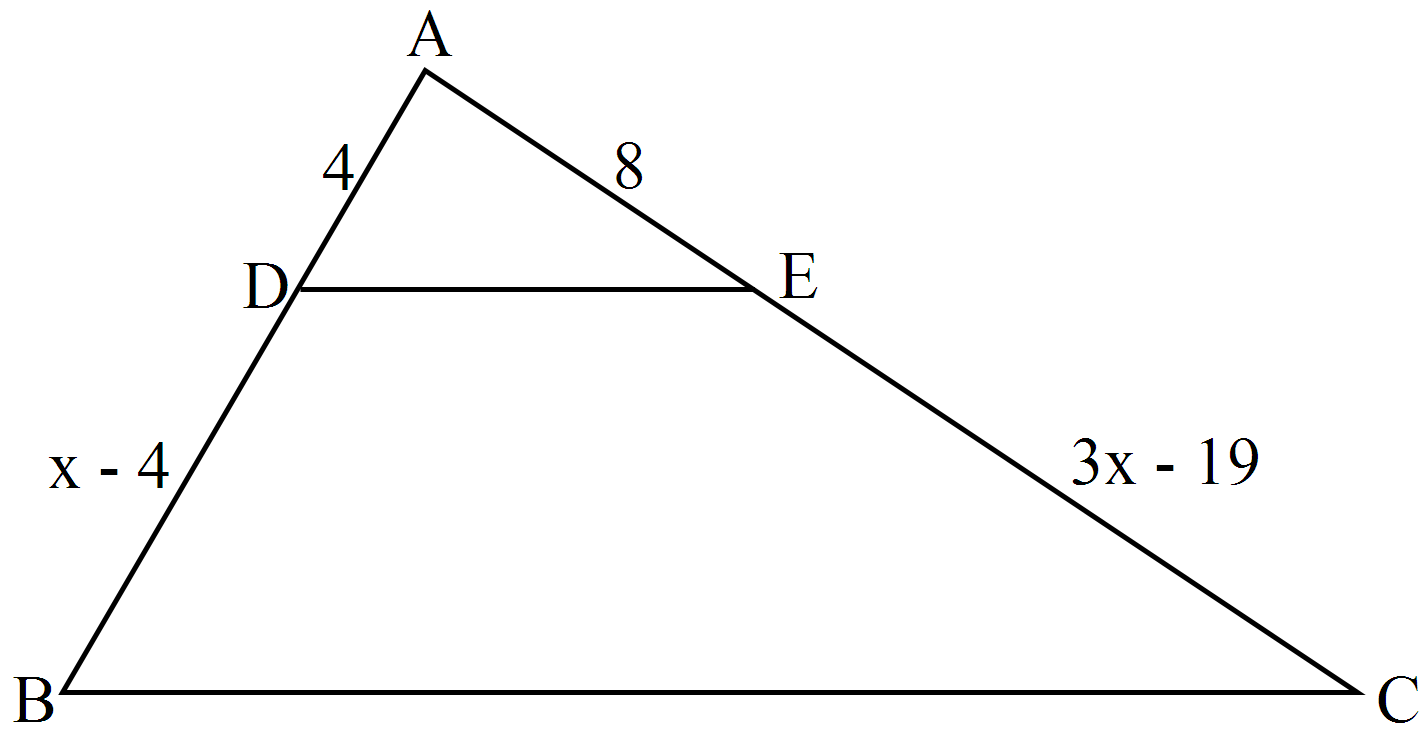
AnswerGiven : $\text{DE}\parallel\text{BC}$
$\therefore\frac{\text{AD}}{\text{DB}}=\frac{\text{AE}}{\text{EC}}$
$\Rightarrow\frac{4}{\text{x-}4}=\frac{8}{\text{3x-19}}$ by using Thale's theorem
$\Rightarrow4\text{x}=44$
$\Rightarrow\text{x}=11$
View full question & answer→MCQ 1471 Mark
$\text{ABCD}$ is a trapezium such that $BC \| AD$ and $AD = 4\ cm$. If the diagonals $AC$ and $BD$ intersect at $O$ such that $\frac{\text{AO}}{\text{OC}}=\frac{\text{DO}}{\text{OB}}=\frac{1}{2},$ then $BC =$
- A
$7\ cm.$
- ✓
$8\ cm$.
- C
$9\ cm.$
- D
$6\ cm.$
AnswerCorrect option: B. $8\ cm$.
We have,
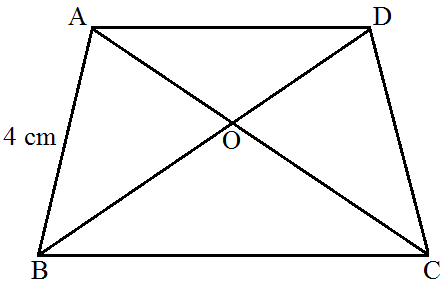
$\frac{\text{AO}}{\text{OC}}=\frac{\text{DO}}{\text{OB}}=\frac{1}{2}$
In $\triangle\text{AOB}$ and $\triangle\text{DOC}$
$\angle\text{AOB}=\angle\text{DOC} \ ($Vertically oposite angle$)$
$\angle\text{OAB}=\angle\text{OCD}\ ($Alternate angle$)$
$\therefore\triangle\text{AOB}\sim\triangle\text{DOC}$
$\frac{\text{AO}}{\text{OC}}=\frac{\text{AB}}{\text{DC}}$
$\Rightarrow\frac{1}{2}=\frac{4}{\text{DC}}$
$\Rightarrow\text{DC}=4\times2$
$\Rightarrow\text{DC}=8\text{ cm}.$ View full question & answer→MCQ 1481 Mark
The areas of two similar triangles are $25 \mathrm{~cm}^2$ and $36 \mathrm{~cm}^2$ respectively. If the altitude of the first triangle is $3.5\ cm$ then the corresponding altitude of the other triangle is :
- A
$5.6\ cm$
- B
$6.3\ cm$
- ✓
$4.2\ cm$
- D
$7\ cm$
AnswerCorrect option: C. $4.2\ cm$
We know that the ratio of areas of similar triangles is equal to the ratio of squares of their corresponding altitudes.
Let $h$ be the altitude of the other triangle.
Therefore,
$\frac{25}{36}=\frac{(3.5)^2}{\text{h}^2}$
$\Rightarrow\text{h}^2=\frac{(3.5)^2\times36}{25}$
$\Rightarrow\text{h}^2=17.64$
$\Rightarrow\text{h}=4.2\text{ cm}$
View full question & answer→MCQ 1491 Mark
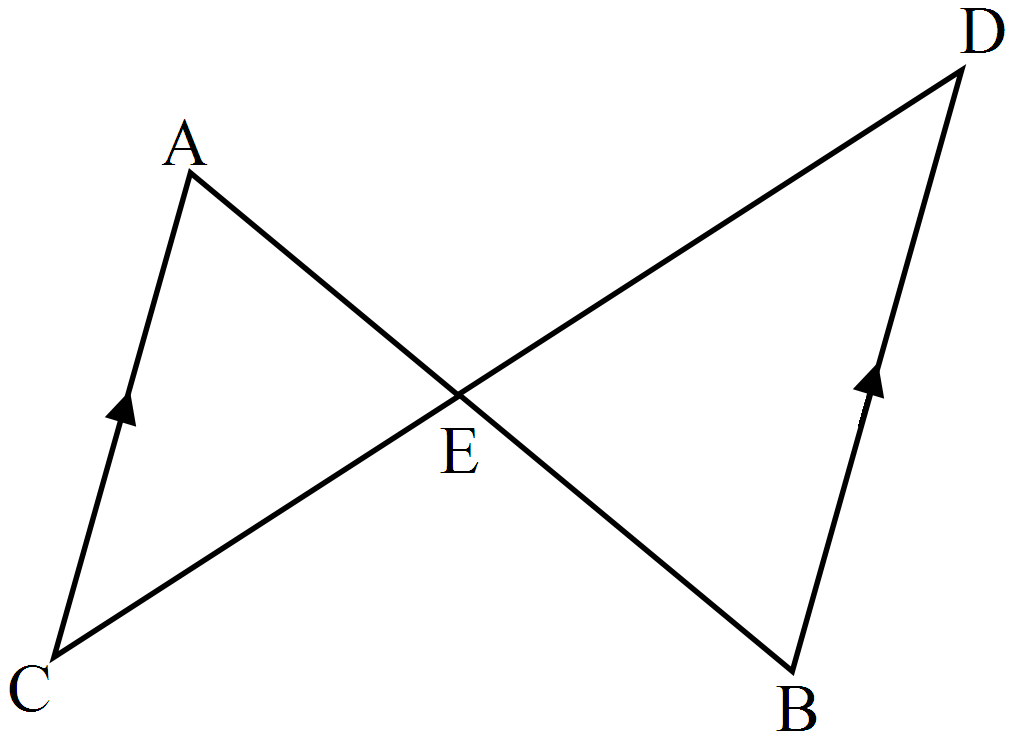
In the adjoining figure$\text{ AC}\parallel\text{BD.AC}\parallel\text{BD}$. If $, EB = 4\ cm, ED = 8\ cm, AC = 6\ cm, AE = 3\ cm$ then $CE$ and $BD$ are respectively :
- A
$7.5\ cm, 9.5\ cm.$
- ✓
$6\ cm, 8\ cm.$
- C
$4\ cm, 6\ cm.$
- D
$5\ cm, 7\ cm.$
AnswerCorrect option: B. $6\ cm, 8\ cm.$
Given : $\frac{\text{AC}}{\text{BD}}.$ and $AC = 6\ cm, AE = 3\ cm, EB = 4\ cm, ED = 8\ cm.$
In $\triangle\text{ACE}$ and $\text{DEB}, \angle\text{AEC}=\angle\text{DEB} \ [$vertically opposite angles$]$
$\angle\text{ECA}=\angle\text{EDB}$ Alternet angles as $\text{AC}\parallel\text{BD}$
$\therefore\triangle\text{ACE}\sim\triangle\text{DEB}\ [\text{AA}$ similarity$]$
$\therefore\frac{\text{EB}}{\text{AE}}=\frac{\text{ED}}{\text{EC}}$
$\Rightarrow\frac{4}{3}=\frac{8}{\text{EC}}$
$\Rightarrow\text{EC}=\frac{8\times3}{4}=6\text{ cm}$
Also $\frac{\text{EB}}{\text{AE}}=\frac{\text{BD}}{\text{AC}}$
$\Rightarrow\frac{4}{3}=\frac{\text{BD}}{6}$
$\Rightarrow\text{BD}=\frac{4\times6}{3}=8\text{ cm}$
View full question & answer→MCQ 1501 Mark
$XY$ is drawn parallel to the base $BC$ of a $\triangle\text{ABC}$ cutting $AB$ at $X$ and $AC$ at $Y$. If $AB = 4 BX$ and $YC = 2\ cm,$ then $AY =$
- A
$2\ cm.$
- B
$4\ cm.$
- ✓
$6\ cm.$
- D
$8\ cm.$
AnswerCorrect option: C. $6\ cm.$
In $\triangle\text{ABC}, XY \| BC$
$AB = 4BX, YC = 2\ cm$
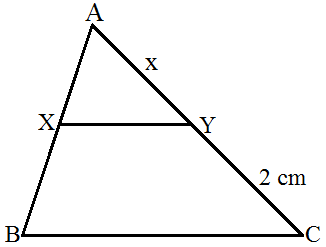
$\therefore AB = 4BX$
$ \Rightarrow AX + BX = 4BX$
$\Rightarrow AX = 4BX - BX = 3BX$
Let $AY = x$
$\because$ In $\triangle\text{ABC}, XY \| BC$
$\frac{\text{AX}}{\text{BX}}=\frac{\text{AY}}{\text{CY}}$
$\Rightarrow\frac{\text{3BX}}{\text{BX}}=\frac{\text{x}}{2}$
$\Rightarrow\frac{3}{1}=\frac{\text{x}}{2}$
$\Rightarrow\text{x}=3\times2=6$
$\therefore AY = 6\ cm.$ View full question & answer→