MCQ 511 Mark
$\triangle\text{ABC}$ and $\triangle\text{BDE}$ are two equilateral triangles such that $D$ is the mid $-$ point of $BC$. The ratio of the areas of triangle $\text{ABC}$ and $\text{BDE}$ is :
- A
$2 : 1$
- B
$1 : 2$
- ✓
$4 : 1$
- D
$1 : 4$
AnswerCorrect option: C. $4 : 1$
$\triangle\text{ABC}$ and $\triangle\text{BDE}$ are equilateral triangles and $D$ is the mid $-$ point of $PC.$
$\triangle\text{ABC}$ and $\triangle\text{BDE}$ are both equilateral triangles
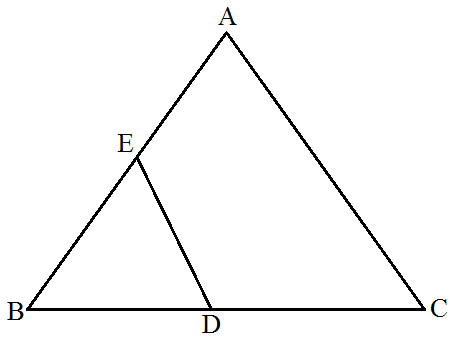
$\therefore$ They are similar also
$\therefore\frac{\text{area of }\triangle\text{ABC}}{\text{area of }\triangle\text{BDE}}=\frac{\text{BC}^2}{\text{BD}^2}$
$=\frac{\text{BC}^2}{\big(\frac{1}{2}\text{BC}^2\big)} \ [D $ is mid point of $BC]$
$=\frac{\text{BC}^2}{\frac{1}{4}\text{BC}^2}=\frac{\text{4BC}^2}{\text{BC}^2}=\frac{4}{1}$
$\therefore$ Ratio is $4 : 1$ View full question & answer→MCQ 521 Mark
Which of the following is a true statement?
- A
Two similar triangles are always congruent.
- B
Two figures are similar if they have the same shape and size.
- ✓
Two triangles are similar if their corresponding sides are proportional.
- D
Two polygons are similar if their corresponding sides are proportional.
AnswerCorrect option: C. Two triangles are similar if their corresponding sides are proportional.
Is incorrect. Since two similar triangles, may or may not be similar.
Holds even if the size is not the same.
Is surely true.
Holds only if for the polygon,
the corresponding sides are proportional and the corresponding angles are equal.
View full question & answer→MCQ 531 Mark
In $\triangle\text{ABC}$ and $\triangle\text{DEF},$ it is given that $\frac{\text{AB}}{\text{DE}}=\frac{\text{BC}}{\text{FD}}$ then :
- A
$\angle\text{B}=\angle\text{E}$
- B
$\angle\text{A}=\angle\text{D}$
- ✓
$\angle\text{B}=\angle\text{D}$
- D
$\angle\text{A}=\angle\text{F}$
AnswerCorrect option: C. $\angle\text{B}=\angle\text{D}$
In $\triangle\text{ABC}$ and $\triangle\text{DEF},$ it is given
that $\frac{\text{AB}}{\text{DE}}=\frac{\text{BC}}{\text{FD}}$
So, $\text{A}\leftrightarrow\text{E},\text{B}\leftrightarrow\text{D},\text{C}\leftrightarrow\text{F}$
$\Rightarrow\angle\text{B}=\angle\text{D}$
View full question & answer→MCQ 541 Mark
If $\triangle{\text{ABC}}\sim\triangle\text{DEF}$ then which of the following is true ?
- A
$\text{BC.EF}=\text{AC.FD}$
- ✓
$\text{BC.DE}=\text{AB.EF}$
- C
$\text{AB.EF}=\text{AC.DE}$
- D
$\text{BC.DE}=\text{AB.FD}$
AnswerCorrect option: B. $\text{BC.DE}=\text{AB.EF}$
If $\triangle{\text{ABC}}\sim\triangle\text{DEF}$ then
$\text{BC.EF}=\text{AB.DE} \ ($corresponding sides are in problem$)$
Here according to the given coundition $, \text{BC.DE = AB.EF}$
View full question & answer→MCQ 551 Mark
Two poles of height $6m$ and $11m$ stand vertically upright upright on a plane ground. If distance between their fiit is $12m$ then the distance between their tops is :
Answer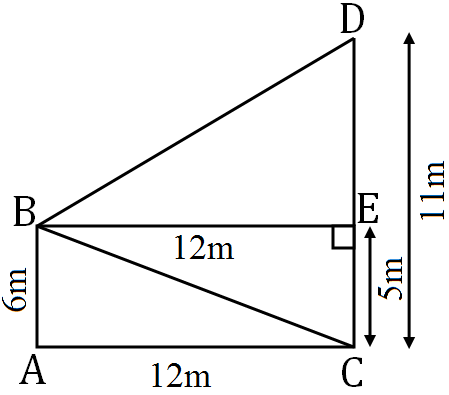
Let the poles be $AB$ and $CD$.
It is given that:
$AB = 6m$ and $CD = 11m$
Let $AC$ be $12m$.
Draw a perpendicular from $B$ on $CD$ at $E$.
Then,
$BE = 12m$
We have to finf $BD.$
Applying Pythagoras theorem in right $-$ angled triangle $\text{BED}, $we have:
$ B D^2=B E^2+E D $
$ =12^2+5^2(\therefore E D=C D-C E=11-6) $
$= 144 + 25 = 169$
$BD = 13m$ View full question & answer→MCQ 561 Mark
The height of an equilateral triangle of side $5\ cm$ is :
- ✓
$4.33\ cm$
- B
$3.9\ cm$
- C
$5\ cm$
- D
$4\ cm$
AnswerCorrect option: A. $4.33\ cm$
The height of the equilateral triangle $\text{ABC}$ divides the base into two equal parts at point $D$.
Therefore,
$BD = DC = 2.5\ cm$
In triangle $\text{ABD},$ using Pythagoras theorem,
$\text{AB}^2=\text{AD}^2+\text{BD}^2$
$5^2=\text{AD}^2+2.5^2$
$\text{AD}^2=25-6.25$
$\text{AD}^2=18.75$
$\text{AD}=4.33\text{ cm} $
View full question & answer→MCQ 571 Mark
A ladder $25m$ long just reaches the top of a building $24m$ high from the ground. What is the distance of the foot of the ladder from the building ?
- ✓
$7m$
- B
$14m$
- C
$21m$
- D
$24.5m$
Answer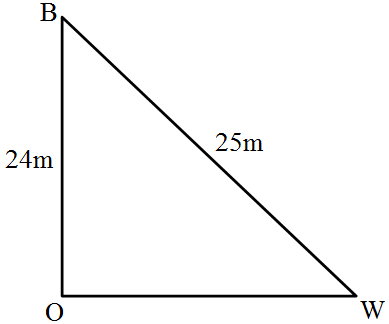
Let $BW$ be the ladder and $OB$ be the building.
$\triangle\text{BOW}$ forms a righ $-$ angled triangle.
By Pythagoras theorem,
$BW^2= OW^2+ OB^2$
$OW^2= BW^2- OB^2$
$OW^2= 25^2- 24^2$
$OW^2= (25 - 24)(25 + 24) .... ($Using $(a + b)^2= a^2+ 2ab + b^2)$
$OW^2= (1) (49)$
$OW = 7m$
So, the distance of the foot of the ladder from the bulling is $7m$. View full question & answer→MCQ 581 Mark
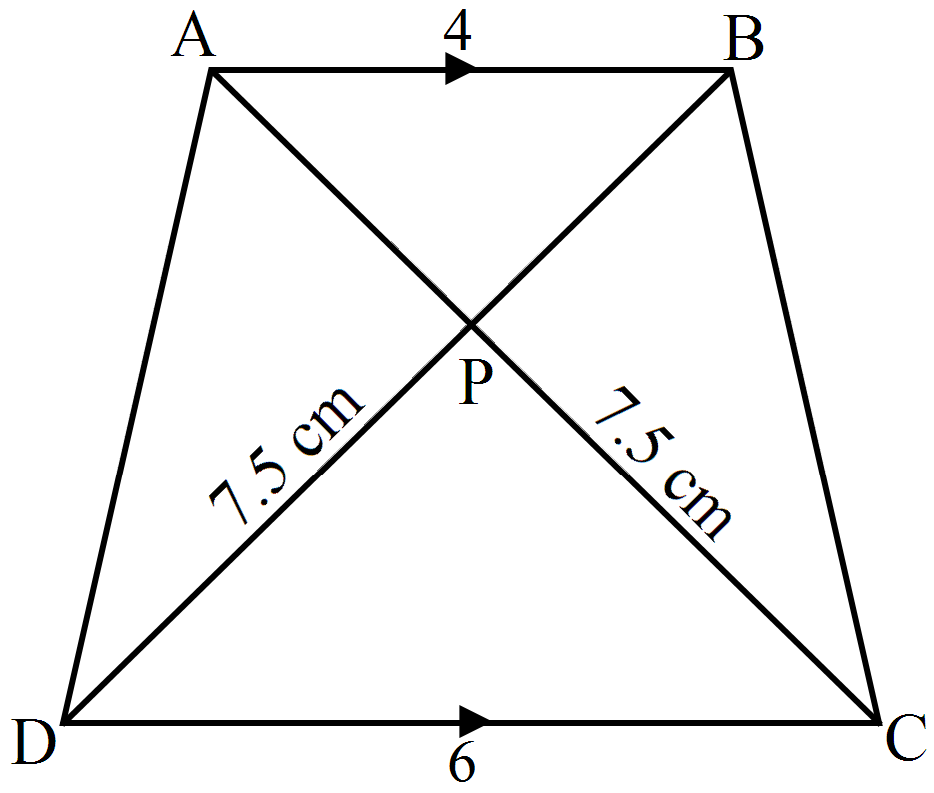
In the given figure, if $\text{AB}\parallel\text{DC}$ then $AP$ is equal to :
- A
$6\ cm.$
- B
$7\ cm.$
- C
$5.5\ cm.$
- ✓
$5\ cm.$
AnswerCorrect option: D. $5\ cm.$
In tiangles $\text{APB}$ and $\text{CPD}.$
$\angle\text{APB}=\angle\text{CPD} \ [$Vertically opposite angles$] $
$ \angle\text{BAP}=\angle\text{ACD}$ Alternaet angles as $\text{AB}\parallel\text{CD}$
$\therefore\triangle\text{APB}\sim\triangle\text{CPD} \ [\text{AA}$ similarity$]$
$\therefore\frac{\text{AB}}{\text{CD}}=\frac{\text{CP}}{\text{AP}}$
$\Rightarrow\frac{4}{6}=\frac{\text{AP}}{7.5}$
$\Rightarrow\text{AP}=\frac{7.5\times4}{5\text{ cm}}$
View full question & answer→MCQ 591 Mark
In $\triangle\text{ABC},\text{DE }\|\text{ BC}$ so that $AD = 2.4\ cm, AE = 3.2\ cm$ and $EC = 4.8\ cm$. Then $,AB =?$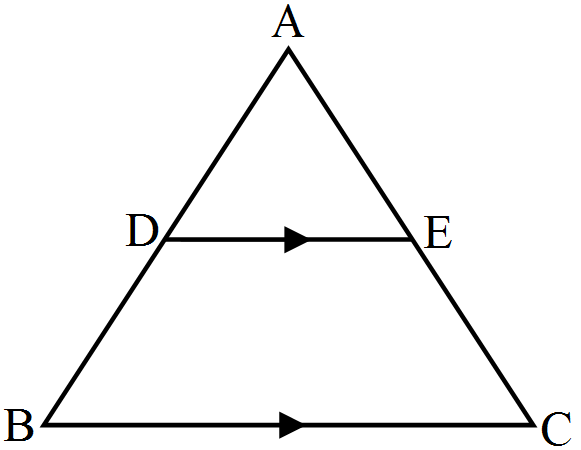
- A
$3.6\ cm$
- ✓
$6\ cm$
- C
$6.4\ cm$
- D
$7.2\ cm$
AnswerCorrect option: B. $6\ cm$
In $\triangle\text{ABC},\text{DE }\|\text{ BC}$
By Basic Proportionality theorem,
$\frac{\text{AD}}{\text{DB}}=\frac{\text{AE}}{\text{EC}}$
$\Rightarrow\frac{2.4}{\text{DB}}=\frac{3.2}{4.8}$
$\Rightarrow\text{BD}=\frac{2.4\times4.8}{3.2}$
$\Rightarrow\text{BD}=3.6\text{ cm}$
$\text{AB}=\text{AD}+\text{DB}$
$=2.4+3.6=6\text{ cm}$
View full question & answer→MCQ 601 Mark
If triangle $\text{ABC}$ is similar to triangle $\text{DEF},$ then,
- A
$\frac{\text{AB}}{\text{FD}}=\frac{\text{BC}}{\text{EF}}=\frac{\text{CA}}{\text{DE}}$
- B
$\frac{\text{AB}}{\text{DE}}=\frac{\text{BC}}{\text{DF}}=\frac{\text{CA}}{\text{EF}}$
- ✓
$\frac{\text{AB}}{\text{DE}}=\frac{\text{BC}}{\text{EF}}=\frac{\text{CA}}{\text{FD}}$
- D
$\frac{\text{AB}}{\text{BC}}=\frac{\text{CA}}{\text{DE}}=\frac{\text{EF}}{\text{FD}}$
AnswerCorrect option: C. $\frac{\text{AB}}{\text{DE}}=\frac{\text{BC}}{\text{EF}}=\frac{\text{CA}}{\text{FD}}$
If two triangles are similar, i.e. when$\triangle\text{ABC}\sim\triangle\text{DEF}$, then
$(i)$ their corresponding angles are equal and
$\angle\text{A}=\angle\text{D},\angle\text{B}=\angle\text{E},\angle\text{C}=\angle\text{F}$ and
$(ii)$ their corresponding sides are in the same ratio $($or proportion$).$
$\frac{\text{AB}}{\text{DE}}=\frac{\text{BC}}{\text{EF}}=\frac{\text{CA}}{\text{FD}}$
View full question & answer→MCQ 611 Mark
In$\triangle\text{ABC}$ and $\triangle\text{PQR}, \angle\text{B}=\angle\text{Q},\triangle\text{R}=\triangle\text{C}$ and $\text{AB}=2\text{QR}$ then, the triangles are :
- A
Congruent but not similar.
- B
Neither congruent nor similar.
- ✓
Similar but not congruent.
- D
Congruent as well as similar.
AnswerCorrect option: C. Similar but not congruent.
In $\triangle\text{ABC}$ and $\triangle\text{PQR}, \angle\text{B}=\angle\text{Q},\triangle\text{R}=\triangle\text{C}$ and $\text{AB}=2\text{QR}$
Then, the triangles are similar, by $AA$ similarity rule, but not congruent because, for congruency, sides should also be equal.
View full question & answer→MCQ 621 Mark
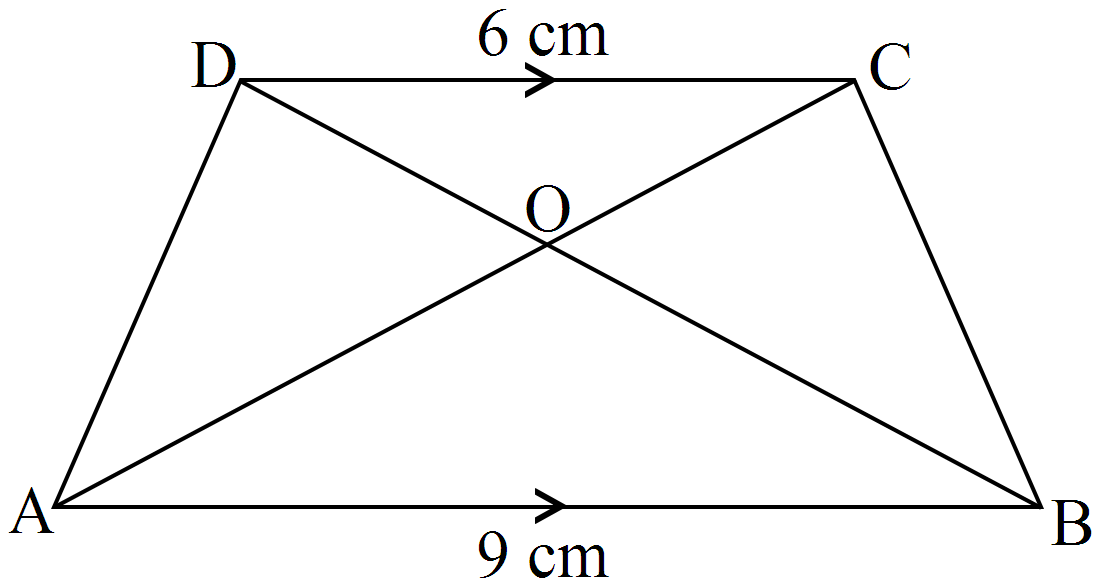
In trapezium $\text{ABCD},$ if $\text{AB}\parallel\text{DC},\text{AB}\parallel\text{DC}, AB = 9\ cm, DC = 6\ cm$ and $BD = 12\ cm,$ then $BO$ is equal to :
- A
$7.4\ cm.$
- B
$7\ cm.$
- C
$7.5\ cm.$
- ✓
$7.2\ cm.$
AnswerCorrect option: D. $7.2\ cm.$
In $\triangle\text{COD }$and $\triangle\text{AOB}$
$\angle\text{DOC}=\angle\text{AOB}\ [$vertically opposite$]$
And $\angle\text{DCO}=\angle\text{OAB} \ [$Alternate angles$]$
$\Rightarrow\triangle\text{COD}\sim\triangle\text{AOB}\ [$similarity$]$
Let $OB = x\ cm$
$\therefore\frac{\text{AB}}{\text{CD}}=\frac{\text{OB}}{\text{OD}}$
$\Rightarrow\frac{9}{6}=\frac{\text{x}}{12-\text{x}}$
$\Rightarrow108-9\text{x}=6\text{x}$
$\Rightarrow15\text{x}=108$
$\Rightarrow\text{x}=7.2\text{ cm}$
View full question & answer→MCQ 631 Mark
If in two triangles $\text{ABC}$ and $\text{DEF} , \frac{\text{AB}}{\text{DE}}=\frac{\text{BC}}{\text{FE}}=\frac{\text{CA}}{\text{FD}},$ then :
- A
$\triangle\text{FDE}\sim\triangle\text{ABC}$
- B
$\triangle\text{BCA}\sim\triangle\text{FDE}$
- ✓
$\triangle\text{FDE}\sim\triangle\text{CAB}$
- D
$\triangle\text{CBA}\sim\triangle\text{FDE}$
AnswerCorrect option: C. $\triangle\text{FDE}\sim\triangle\text{CAB}$
If in two triangles $\text{ABC}$ and $\text{DEF}, \frac{\text{AB}}{\text{DE}}=\frac{\text{BC}}{\text{FE}}=\frac{\text{CA}}{\text{FD}},$
then $\triangle\text{FDE}\sim\triangle\text{CAB} $ because for similarity,
all the corresponding sides should be in proporation.
View full question & answer→MCQ 641 Mark
Choose the correct answer from the given four options : $\text{If}\ \triangle\text{ABC}\sim\triangle\text{EDF}$ and $\triangle\text{ABC}$ is not similar to $\triangle\text{DEF},$ then which of the following is not true?
- A
$BC \times EF = AC \times FD$
- ✓
$AB \times EF = AC \times DE$
- C
$BC \times DE = AB \times EF$
- D
$BC \times DE = AB \times FD$
AnswerCorrect option: B. $AB \times EF = AC \times DE$
Given, $\triangle\text{ABC}\sim\triangle\text{EDF}$
$\therefore\ \frac{\text{AB}}{\text{ED}}=\frac{\text{BC}}{\text{DF}}$
$=\frac{\text{AC}}{\text{EF}}$
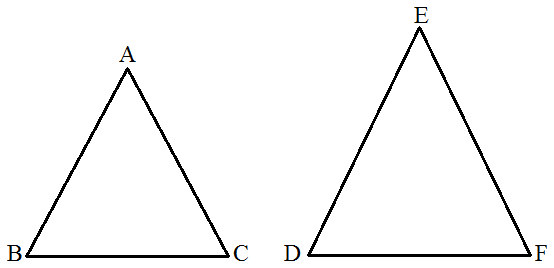
Taking first two terms, we get
$\frac{\text{AB}}{\text{ED}}=\frac{\text{BC}}{\text{DF}}$
$\Rightarrow\text{AB}\times\text{DF}=\text{ED}\times\text{BC}$
$\text{or}\ \text{BC}\times \text{DE}=\text{AB}\times\text{DF}$
So, option $(a)$ is also true.
Taking first and last terms, we get
$\frac{\text{BC}}{\text{DF}}=\frac{\text{AC}}{\text{EF}}$
$\Rightarrow\text{AB}\times\text{EF} = \text{ED}\times\text{AC}$
Hence, Option $(b)$ is true. View full question & answer→MCQ 651 Mark
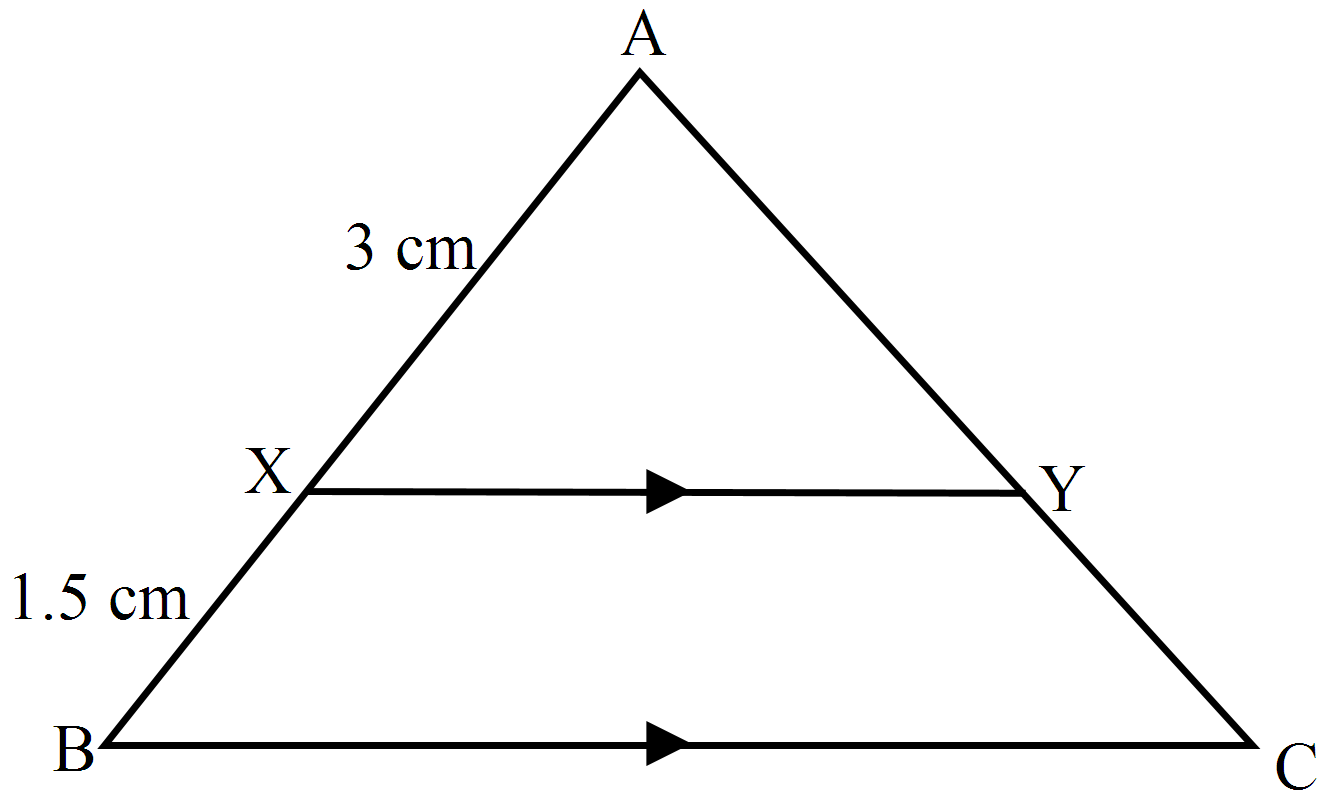
In the adjoining figure $P$ and $Q$ are points on the sides $AB$ and $AC$ respectively of $\triangle\text{ABC}$ such that $AP = 3.5\ cm, PB = 7\ cm, AQ = 3\ cm, QC = 6\ cm$ and $PQ = 4.5\ cm.$ The measure of $BC$ is equal to :
- A
$12.5\ cm.$
- B
$15\ cm$
- ✓
$13.5\ cm.$
- D
$9\ cm.$
AnswerCorrect option: C. $13.5\ cm.$
In $\triangle\text{ABC}$
$\Rightarrow \frac{\text{AQ}}{\text{AC}}=\frac{\text{AP}}{\text{PB}}$
$\Rightarrow \frac{3}{6}=\frac{3.5}{7}$
$\Rightarrow \frac{1}{2}=\frac{1}{2}$
Since $\frac{\text{AC}}{\text{QC}}=\frac{\text{AP}}{\text{PB}},$
$\therefore\text{QP}\parallel\text{BC}$
$\Rightarrow \frac{3}{9}=\frac{4.5}{\text{BC}}$
$\Rightarrow \text{BC}=13.5\text{ cm}$
View full question & answer→MCQ 661 Mark
In an isosceles triangle $\text{ABC}$, if $AB = AC = 25\ cm$ and $BC = 14\ cm,$ then the measure of altitude from $A$ on $BC$ is :
- A
$20\ cm.$
- B
$22\ cm.$
- C
$18\ cm.$
- ✓
$24\ cm.$
AnswerCorrect option: D. $24\ cm.$
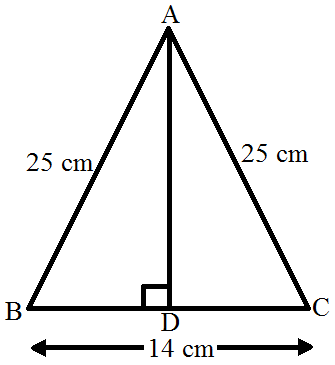
$\triangle\text{ABC}$ is an isosceles triangle in which $AB = AC = 25\ cm, BC = 14\ cm$
From $A,$ draw $\text{AD}\perp\text{BC}$
$D$ is mid $-$ point of $BC$
$\text{BD}=\frac{1}{2}\text{BC}=\frac{1}{2}\times14=7\text{ cm}$
Now in right $\triangle\text{ABD}$
$\mathrm{AD}^2=\mathrm{AB}^2-\mathrm{BD}^2$
$=(25)^2-(7)^2$
$=625-49=576=(24)^2$
$\mathrm{AD}=24 \ \mathrm{ cm}$. View full question & answer→MCQ 671 Mark
In $\triangle\text{ABC},\text{AB}=6\sqrt{\text{3 cm}}=\text{AC}=12\text{ cm}$ and $\text{BC}=6\text{ cm}$ The angle $B$ is :
- A
$120^\circ$
- B
$60^\circ$
- ✓
$90^\circ$
- D
$45^\circ$
AnswerCorrect option: C. $90^\circ$
Given,
In$\triangle\text{ABC},\text{AB}=6\sqrt{\text{3 cm}}=\text{AC}=12\text{ cm}$ and $\text{BC}=6\text{ cm}$
Here, $AC$ is the longest side.
If the square of the hypotenuse is equal to the square of the other two sides,
then it is a right angled triangle.
$\text{So},\text{AC}^2=\text{AB}^2+\text{BC}^2$
$(12)^2=(6\sqrt3)^2+(6)^2$
$144=108+36$
$144=144$
$\therefore\triangle\text{ABC}$ is a right angled triangle and angle opposite to hypotenuse,
i.e. opposite to $AC$ is $\angle\text{b}$ and is equal to $90^\circ$
View full question & answer→MCQ 681 Mark
In an equilateral triangle $\text{ABC}$ if $\text{AD}\perp\text{BC},$ then :
- A
$ 5 A B^2=4 A D^2$
- ✓
$ 3 A B^2=4 A D^2 $
- C
$ 4 A B^2=3 A D^2 $
- D
$ 2 A B^2=3 A D^2 $
AnswerCorrect option: B. $ 3 A B^2=4 A D^2 $
$\triangle\text{ABC}$ is an equilateral triangle and $\text{AD}\perp\text{BC}.$
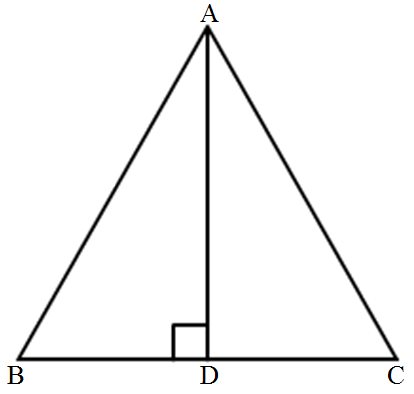
In $\triangle\text{ABD},$ applying Pythagoras theorem, we get,
$\text{AB}^2=\text{AD}^2+\text{BD}^2$
$\text{AB}^2=\text{AD}^2+\Big(\frac{1}{2}\text{BC}\Big)^2\Big(\because\text{BD}=\frac{1}{2}\text{BC}\Big)$
$\text{AB}^2=\text{AD}^2+\Big(\frac{1}{2}\text{AB}\Big)^2\Big(\because\text{AB}=\text{BC}\Big)$
$\text{AB}^2=\text{AD}^2+\frac{1}{4}\text{AB}^2$
$3\text{AB}^2=4\text{AD}^2$
We got the result as $B.$ View full question & answer→MCQ 691 Mark
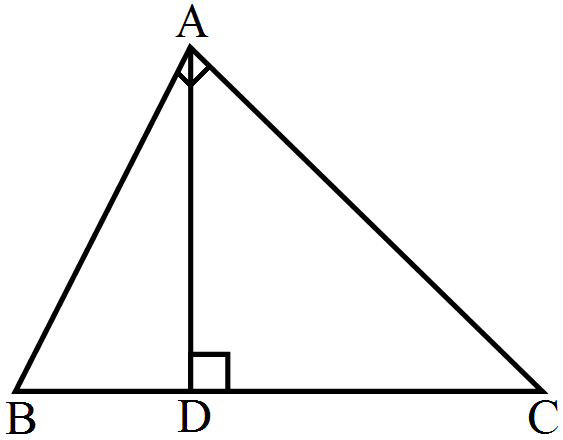
In the given figure, $\angle\text{BAC}=90^\circ$ and $\text{AD}\perp\text{BC}.$ Then :
- A
$\text{BC}\cdot\text{CD}=\text{BC}^2$
- B
$\text{AB}\cdot\text{AC}=\text{BC}^2$
- ✓
$\text{BD}\cdot\text{CD}=\text{AD}^2$
- D
$\text{AB}\cdot\text{AC}=\text{AD}^2$
AnswerCorrect option: C. $\text{BD}\cdot\text{CD}=\text{AD}^2$
In $\triangle\text{ABC},$
$\angle\text{ABD}=90^\circ-\angle\text{C}$
Similarly, in $\triangle\text{ACD},$
$\angle\text{CAD}=90^\circ-\angle\text{C}$
In $\triangle\text{DBA}$ and $\triangle\text{DAC}$
$\angle\text{ADB}=\angle\text{CDA}=90^\circ$
$\angle\text{ABD}=\angle\text{CAD}=90^\circ-\angle\text{C}$
So, $\triangle\text{DBA}\sim\triangle\text{DAC} .....(\text{AA}$ criterion of similarity$)$
$\frac{\text{BD}}{\text{AD}}=\frac{\text{AD}}{\text{CD}}$
$\Rightarrow\text{BD}\cdot\text{CD}=\text{AD}^2$
View full question & answer→MCQ 701 Mark
A man goes $24m$ due west and then $10m$ due north. How far is he from the starting point ?
Answer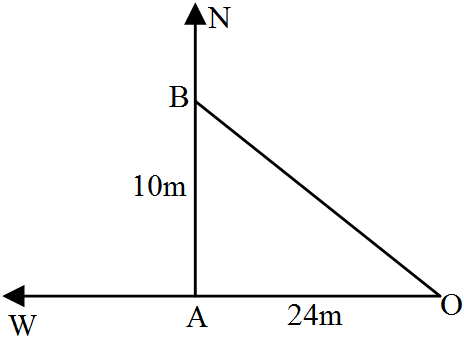
Let $O$ be the starting point.
From $O$ the man goes west that is towards, $W$ till point $A$.
He then moves $10m$ due nirth, that is towards $N$ to point $B$.
$\triangle\text{OAB}$ forms a right $-$ angled triangle.
By Pythagoras theorem,
$ O B^2=O A^2+A B^2 $
$ O B^2=24^2+10^2 $
$ O B^2=576+100 $
$ O B^2=676 $
$ O B=26 m$
So, the man is $26m$ away from the the starting point. View full question & answer→MCQ 711 Mark
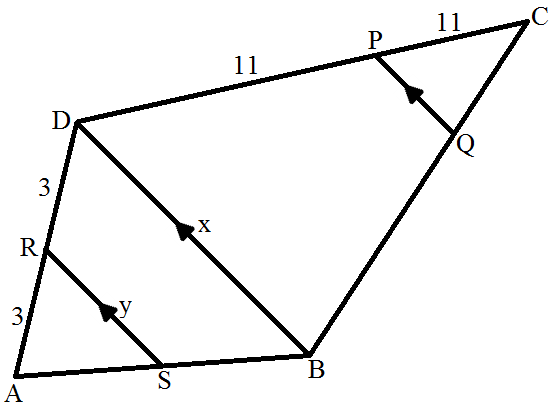
In the figure, $RS \| DB \| PQ.$ If $CP = PD = 11\ cm$ and $DR = RA = 3\ cm$. Then the values of $x$ and $y$ are respectively :
- A
$12, 10.$
- B
$14, 6.$
- C
$10, 7.$
- ✓
$16, 8.$
AnswerCorrect option: D. $16, 8.$
the figure $RS \| DB \| PQ$
$CP = PD = 11\ cm \ DR = RA = 3\ cm$
In $\triangle\text{ABD}$
$RS \| BD$ and $AR = RD$
$\text{RS}=\frac{1}{2}\text{BD}$
$\text{y}=\frac{1}{2}\text{x}$ or ${x}=2\text{y}$
Only $16, 8$ is possible.
View full question & answer→MCQ 721 Mark
In a $\triangle\text{ABC},$ perpendicular $AD$ from $A$ on $BC$ meets $BC$ at $D$. If $BD = 8\ cm, DC = 2\ cm$ and $AD = 4\ cm,$ then :
- A
$\triangle\text{ABC}$ is isosceles.
- B
$\triangle\text{ABC}$ is equilateral.
- C
$\text{AC} = 2\text{AB.}$
- ✓
$\triangle\text{ABC}$ is right $-$ angled at $A$.
AnswerCorrect option: D. $\triangle\text{ABC}$ is right $-$ angled at $A$.
in $\triangle\text{ABC},\ \text{AD}\perp\text{BC}$
$BD = 8\ cm, DC = 2\ cm, AD = 4\ cm$
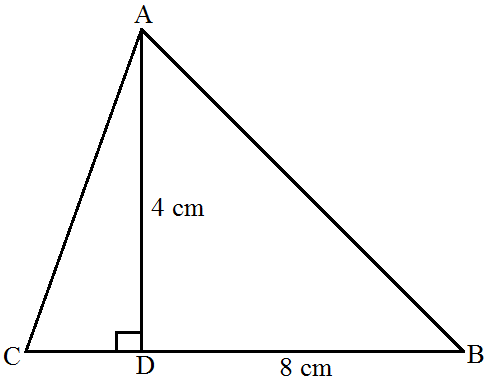
In right $\triangle\text{ACD},$
$A C^2=A D^2+C D^2 \ ($Pythagoras Theorem$)$
$=(4)^2+(2)^2=16+4=20$
and in right $\triangle\text{ABD},$
$A B^2=A D^2+D B^2$
$=(4)^2+(8)^2=16+64=80$
and $B C^2=(B D+D C)^2$
$=(8+2)^2=(10)^2=100$
$A B^2+A C^2=80+20=100=B C^2$
$\triangle\text{ABC}$ is a right triangle whose $\angle\text{A}=90^\circ$ View full question & answer→MCQ 731 Mark
The areas of two similar triangles are $121 \mathrm{cm}^2$ and $64 \mathrm{cm}^2$ respectively. If the median of the first triangle is $12.1\ cm$, then the corresponding median of the other triangle is :
- A
$11\ cm.$
- ✓
$8.8\ cm.$
- C
$11.1\ cm.$
- D
$8.1\ cm.$
AnswerCorrect option: B. $8.8\ cm.$
Given : The area of two similar triangles is $121 \mathrm{cm}^2$ and $64 \mathrm{cm}^2$ respectively.
The median of the first triangle is $12.1\ cm$.
To find : Corresponding medians of the other triangle.
We know that the ratio of areas of two similar triangles is equal to the ratio of squares of their medians.
$\frac{\text{ar}(\text{triangle 1})}{\text{ar}(\text{triangle 2})}=\Big(\frac{\text{median 1}}{\text{median 2}}\Big)^2$
$\frac{121}{64}=\Big(\frac{12.1}{\text{median 2}}\Big)^2$
Taking square root on both side, we get,
$\frac{11}{8}=\frac{12.1\text{ cm}}{\text{median 2}}$
$\Rightarrow$ median $2 = 8.8\ cm$
Hence the correct answer is $B$.
View full question & answer→MCQ 741 Mark
A chord of a circle of radius $10\ cm$ subtends a right angle at the centre. The length of the chord $($in $cm)$ is :
- A
$5\sqrt{2}$
- ✓
$10\sqrt{2}$
- C
$\frac{5}{\sqrt{2}}$
- D
$10\sqrt{3}$
AnswerCorrect option: B. $10\sqrt{2}$
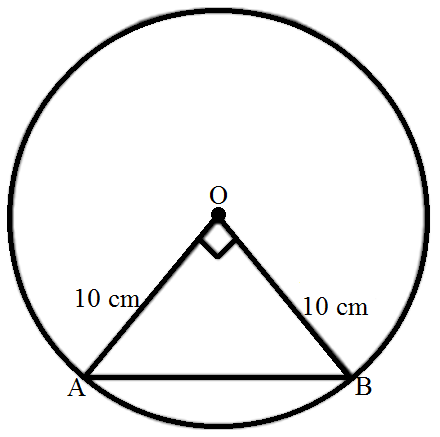
In right $\triangle\text{OAB},$
$AB^2= OA^2+ OB^2\ ($Pythagoras Theorem$)$
$\Rightarrow AB^2= (10)^2+ (10)^2(OA = OB = 10\ cm)$
$\Rightarrow AB^2= 100 + 100 = 200$
$\Rightarrow\text{AB}=\sqrt{200}=10\sqrt{2}\text{ cm}$
Thus, the length of the chord is $10\sqrt{2}\text{ cm}.$
Hence, the correct answer is option $B.$ View full question & answer→MCQ 751 Mark
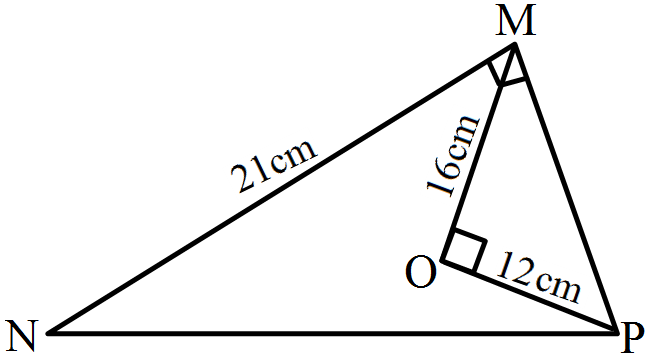
In the given figure, $O$ is a point inside a $\triangle\text{MNP}$ such that $\angle\text{MOP}=90^\circ,\text{OM}=16\text{ cm}$ and $OP = 12\ cm$. If $MN = 21\ cm$ and $\angle\text{NMP}=90^\circ$ then $NP = ?$
- A
$25\ cm$
- ✓
$29\ cm$
- C
$33\ cm$
- D
$35\ cm$
AnswerCorrect option: B. $29\ cm$
$\triangle\text{MOP}$ is a right $-$ angled triangle.
By Pythagoras theorem,
${MP}^2={MO}^2+{OP}^2$
$M P^2=16^2+12^2$
$MP = 20\ cm$
$\triangle\text{NMP}$ is a right $-$ angled triangle.
By Pythagoras theorem,
$NP^2= 21^2+ 20^2$
$NP^2= 441 + 400$
$NP = 29\ cm$
View full question & answer→MCQ 761 Mark
The areas of two similar triangles $\triangle\text{ABC}$ and $\triangle\text{DEF}$ are $144 \mathrm{~cm}^2$ and $81 \mathrm{~cm}^2$ respectively. If the longest side of larger $\triangle\text{ABC}$ be $36\ cm,$ then the longest side of the smaller triangle $\triangle\text{DEF}$ is :
- A
$20\ cm.$
- B
$26\ cm.$
- ✓
$27\ cm.$
- D
$30\ cm.$
AnswerCorrect option: C. $27\ cm.$
Given : Areas of two similar triangles $\triangle\text{ABC}$ and $\triangle\text{DEF}$ are $144 \mathrm{~cm}^2$ and $81 \mathrm{~cm}^2$.
If the longest side of larger $\triangle\text{ABC}$ is $36\ cm$
To find : the longest side of the smaller triangle $\triangle\text{DEF}$
We know that the ratio of areas of two similar triangles is equal to the ratio of squares of their corresponding sides.
$\frac{\text{ar}(\triangle\text{ABC})}{\text{ar}(\triangle\text{DEF})}=\Big(\frac{\text{longest side of larger }\triangle\text{ABC}}{\text{longest side of smaller }\triangle\text{DEF}}\Big)^2$
$\frac{144}{81}=\Big(\frac{36}{\text{longest side of smaller}\ \triangle\text{DEF}}\Big)^2$
Taking aquare root on both sides, we get
$\frac{12}{9}=\frac{36}{\text{longest side of smaller}\ \triangle\text{DEF}}$
longest side of smaller $\triangle\text{DEF}=\frac{36\times9}{12}=27\text{ cm}$
Hence the correct answer is $C$.
View full question & answer→MCQ 771 Mark
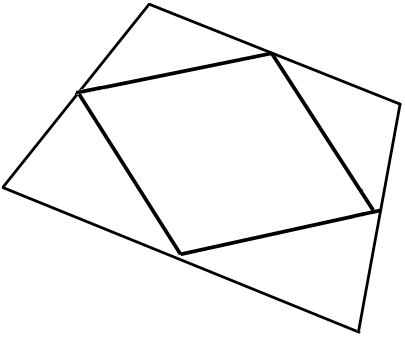
The line segments joining the midpoints of the adjacent side of a quadrilateral from :
AnswerThe line segment joining the midpoint of the adjacent sides of a quadrilateral form a parallelogram as shown below.
View full question & answer→MCQ 781 Mark
In $\triangle\text{ABC}$ and $\triangle\text{DEF},$ we have $\frac{\text{AB}}{\text{DE}}=\frac{\text{BC}}{\text{EF}}=\frac{\text{AC}}{\text{DF}}=\frac{5}{7},$ then $\text{ar}(\triangle\text{ABC}):\text{ar}(\triangle\text{DEF})=?$
- A
$5 : 7$
- ✓
$25 : 49$
- C
$49 : 25$
- D
$125 : 343$
AnswerCorrect option: B. $25 : 49$
In $\triangle\text{ABC}$ and $\triangle\text{DEF},$
$\frac{\text{AB}}{\text{DE}}=\frac{\text{BC}}{\text{EF}}=\frac{\text{AC}}{\text{DF}}=\frac{5}{7}$
$\Rightarrow\triangle\text{ABC}\sim\triangle\text{DEF} ....(\text{SSS}$ criterion for Similarity$)$
$\Rightarrow\frac{\text{ar}(\triangle\text{ABC})}{\text{ar}(\triangle\text{DEF})}=\frac{\text{AB}^2}{\text{DE}^2}=\frac{5^2}{7^2}=\frac{25}{49}$
So, the ratio is $25 : 49.$
View full question & answer→MCQ 791 Mark
$\triangle\text{PQR}\sim\triangle\text{XYZ}$ and the perimeters $\triangle\text{PQR}\sim\triangle\text{XYZ}$ are $30\ cm$ and $18\ cm$ respectively. If $QR = 9\ cm,$ then $,YZ$ is equal to :
- ✓
$5.4\ cm.$
- B
$12.5\ cm.$
- C
$9.5\ cm.$
- D
$4.5\ cm.$
AnswerCorrect option: A. $5.4\ cm.$
Given : $\triangle\text{PQR}\sim\triangle\text{XYZ}$
$\therefore\frac{\text{Permeter of }\triangle\text{PQR}}{\text{Permeter of }\triangle\text{XYZ}}=\frac{\text{QR}}{\text{YZ}}$
$\Rightarrow\frac{30}{18}=\frac{9}{\text{YZ}}$
$\Rightarrow\text{YZ}=5.4\text{ cm}$
View full question & answer→MCQ 801 Mark
In the given figure, $\text{ABCD}$ is a trapezium whose diagonals $AC$ and $BD$ intersect at $O$ such that $OA = (3x - 1)cm, OB = (2x + 1)cm, OC = (5x - 3)cm$ and $OD (6x - 5)cm.$ Then $x =?$
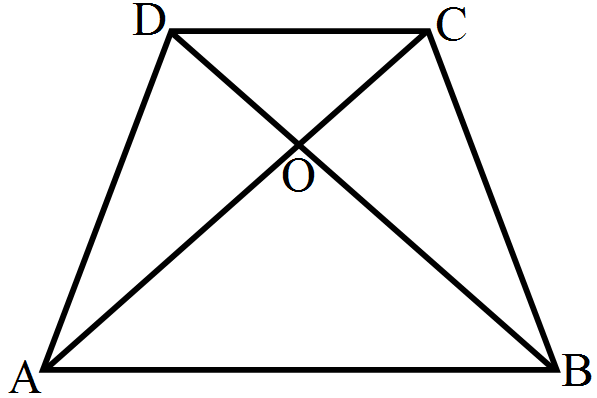
AnswerThe diagonals of a trapezium divide each other proportinally.
$\Rightarrow\frac{\text{OD}}{\text{OB}}=\frac{\text{OC}}{\text{OA}}$
$\Rightarrow\frac{6\text{x}-5}{2\text{x}+1}=\frac{5\text{x}-3}{3\text{x}-1}$
$\Rightarrow18\text{x}^2-21\text{x}+5=10\text{x}^2-\text{x}-3$
$\Rightarrow8\text{x}^2-20\text{x}+8=0$
$\Rightarrow2\text{x}^2-5\text{x}+2=0$
$\Rightarrow(\text{x}-2)(2\text{x}-1)=0$
$\Rightarrow\text{x}=2$ or $\text{x}=\frac{1}{2}$
if $\text{x}=\frac{1}{2},$ then $\text{OD}$
$=6\text{x}-5=6\Big(\frac{1}{2}\Big)-5=-2$
$R$ this is not possible since length cannot be negative.
$\Rightarrow x = 2$
View full question & answer→MCQ 811 Mark
If the bisectore of an angle of a triangle bisects the opposite side then the triangle is :
Answer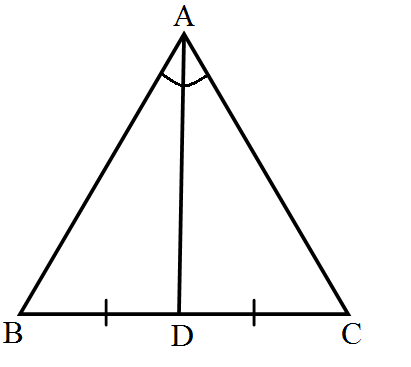
Let $\text{ABC}$ be the triangle and $AD$ be the bisector of $\angle\text{A}.$
Also $, AD$ bisects the opposite side that is $BC$.
$\Rightarrow\text{ BD} =\text{ DC} \dots\text{(i)}$
$\Rightarrow\frac{\text{AB}}{\text{AC}}=\frac{\text{BD}}{\text{DC}}$
$\Rightarrow\frac{\text{AB}}{\text{AC}}=1\dots ($from $(i))$
$\Rightarrow\text{AB}=\text{AC}$
So, the triangle is an isosceles triangle. View full question & answer→MCQ 821 Mark
A vertical stick $20m$ long casts a shadow $10m$ long on the ground. At the same time, a tower casts a shadow $50m$ long on the ground. The height of the tower is :
- ✓
$100m.$
- B
$120m.$
- C
$25m.$
- D
$200m.$
AnswerCorrect option: A. $100m.$
Height of a stick $= 20m$
and length of its shadow $= 10m$
At the same time
Let height of tower $= x m$
and its shadow $= 50m$
$20 : x = 10 : 50$
$x \times 10 = 20 \times 50$
$\Rightarrow\text{x}=\frac{20\times50}{10}=100$
Height of tower $= 100m.$
View full question & answer→MCQ 831 Mark
$\triangle\text{ABC}\sim\triangle\text{DEF}$ such that $AB = 9.1\ cm$ and $DE = 6.5\ cm$. If the perimeter of $\triangle\text{DEF}$ is $25\ cm,$ what is the perimeter of $\triangle\text{ABC}?$
- ✓
$35\ cm$
- B
$28\ cm$
- C
$42\ cm$
- D
$40\ cm$
AnswerCorrect option: A. $35\ cm$
$\triangle\text{ABC}\sim\triangle\text{DEF}$
$\Rightarrow\frac{\text{Perimeters of }\triangle\text{ABC}}{\text{Perimeters of }\triangle\text{DEF}}=\frac{\text{AB}}{\text{DE}}$
$\Rightarrow\frac{\text{Perimeters of }\triangle\text{ABC}}{25}=\frac{9.1}{6.5}$
$\Rightarrow\text{Perimeters of }\triangle\text{ABC}=\frac{9.1\times25}{6.5}$
$\Rightarrow\text{Perimeters of }\triangle\text{ABC}=35\text{ cm}$
View full question & answer→MCQ 841 Mark
In a $\triangle\text{ABC}, AD$ is the bisector of $\angle\text{BAC}.$ If $AB = 8\ cm, BD = 6\ cm$ and $DC = 3\ cm.$ Find $AC$ :
- ✓
$4\ cm.$
- B
$6\ cm.$
- C
$3\ cm.$
- D
$8\ cm.$
AnswerCorrect option: A. $4\ cm.$
Given : In a $\triangle\text{ABC}, AD$ is the bisector of angle $\text{BAC}. AB = 8\ cm,$ and $DC = 3\ cm$ and $BD = 6\ cm$.
To find : $AC$ We know that the internal bisector of angle of a triangle divides the opposite side internally in the ratio of the sides containing the angle.
Hence,
$\frac{\text{AB}}{\text{AC}}=\frac{\text{BD}}{\text{DC}}$
$\frac{8}{\text{AC}}=\frac{6}{3}$
$\text{AC}=\frac{8\times3}{6}$
$\text{AC}=4\text{ cm}$
Hence we got the result $A$.
View full question & answer→MCQ 851 Mark
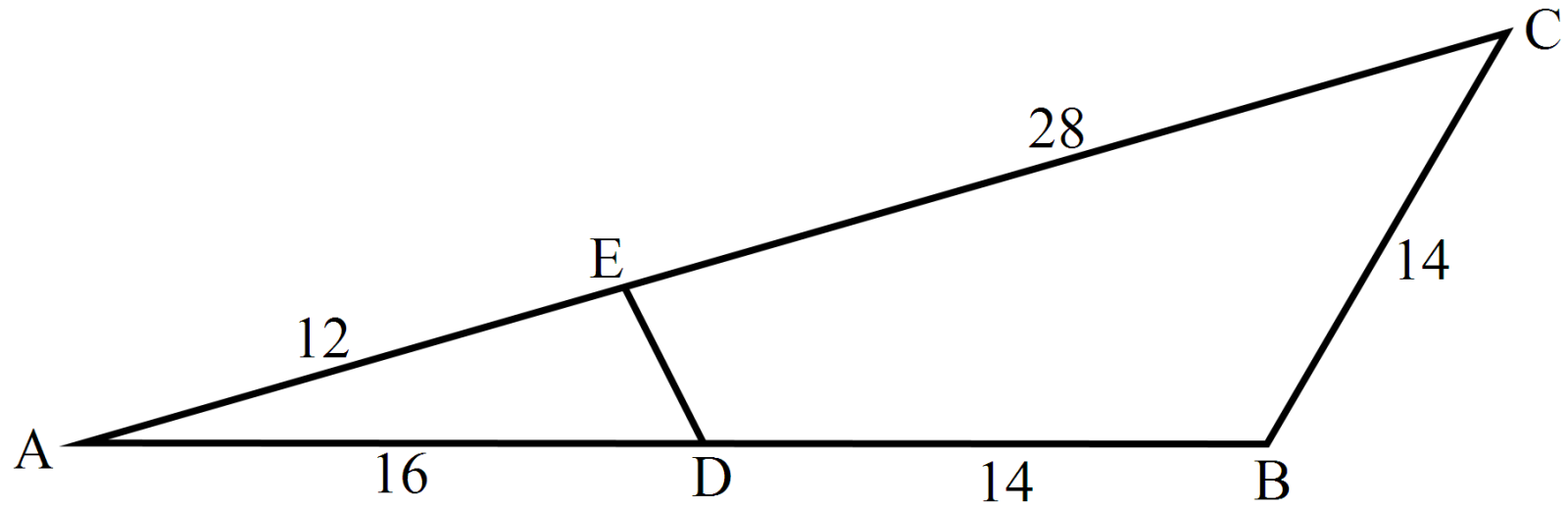
In the given figure if $\triangle\text{AED}\sim\triangle\text{ABC},$ then $DE$ is equal to :
- ✓
$5.6\ cm.$
- B
$6.5\ cm.$
- C
$7.5\ cm.$
- D
$5.5\ cm.$
AnswerCorrect option: A. $5.6\ cm.$
Since $\triangle\text{AED}\sim\triangle\text{ABC}$
$\therefore\frac{\text{AE}}{\text{AB}}=\frac{\text{DE}}{\text{BC}}$
$\Rightarrow\frac{12}{16+14}=\frac{\text{DE}}{14}$
$\Rightarrow\text{DE}=\frac{12\times14}{30}=\frac{84}{15}=5.6\text{ cm}$
View full question & answer→MCQ 861 Mark
Choose the correct answer from the given four options :
It is given that $\triangle\text{ABC}\sim\triangle\text{DEF},\ \angle\text{A}=30^\circ,\ \angle\text{C}=50^\circ,$ $AB = 5\ cm, AC = 8\ cm,$ and $DF = 7.5\ cm $ Then, the following is true:
- A
$\text{DE}=12\text{ cm},\angle\text{F}=50^\circ$
- ✓
$\text{DE}=12\text{ cm},\angle\text{F}=100^\circ$
- C
$\text{EF}=12\text{ cm},\angle\text{D}=100^\circ$
- D
$\text{EF}=12\text{ cm},\angle\text{D}=30^\circ$
AnswerCorrect option: B. $\text{DE}=12\text{ cm},\angle\text{F}=100^\circ$
Given, $\triangle\text{ABC}\sim\triangle\text{DFE},$
$\text{then }\angle\text{A}=\angle{\text{D}}=30^\circ,\angle{\text{C}}=\angle{\text{E}}=50^\circ$
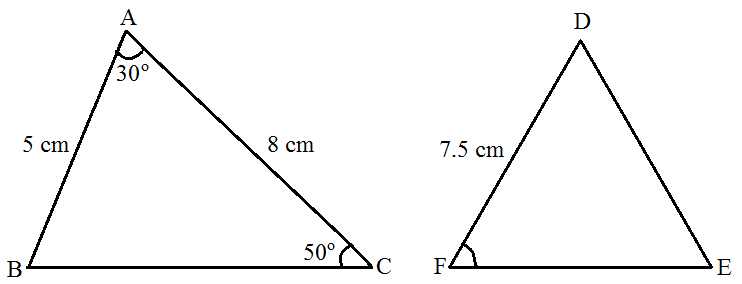
$\therefore\angle\text{B}=\angle\text{F}=180^\circ-(30^\circ+50^\circ)=100^\circ$
Also $, \text{AB}=5\text{ cm},\text{AC}=8\text{ cm}$ and $\text{ DF}=7.5\text{ cm}$
$\therefore\frac{\text{AB}}{\text{DF}}=\frac{\text{AC}}{\text{DE}}$
$\Rightarrow\frac{5}{7.5}=\frac{8}{\text{DE}}$
$\therefore\text{DE}=\frac{8\times7.5}{5}=12\text{ cm}$
Hence $,\text{DE}=12\text{ cm},\angle\text{F}=100^\circ$ View full question & answer→MCQ 871 Mark
The diagonals of a rhombus are $16\ cm$ and $12\ cm,$ in length. The side of rhombus in length is :
- A
$20\ cm$
- B
$8\ cm$
- ✓
$10\ cm$
- D
$9\ cm$
AnswerCorrect option: C. $10\ cm$
Here, half of the diagonals of a rhombus are the sides of the triangle and side of the rhombus is the hypotenuse.
By Pythagoras theorem,
$(\frac{16}{2})^2+(\frac{12}{2})^2=\text{side}^2$
${8}^2+{6}^2=\text{side}^2$
$64+36=\text{side}^2$
$\text{side}=10\text{ cm}$
View full question & answer→MCQ 881 Mark
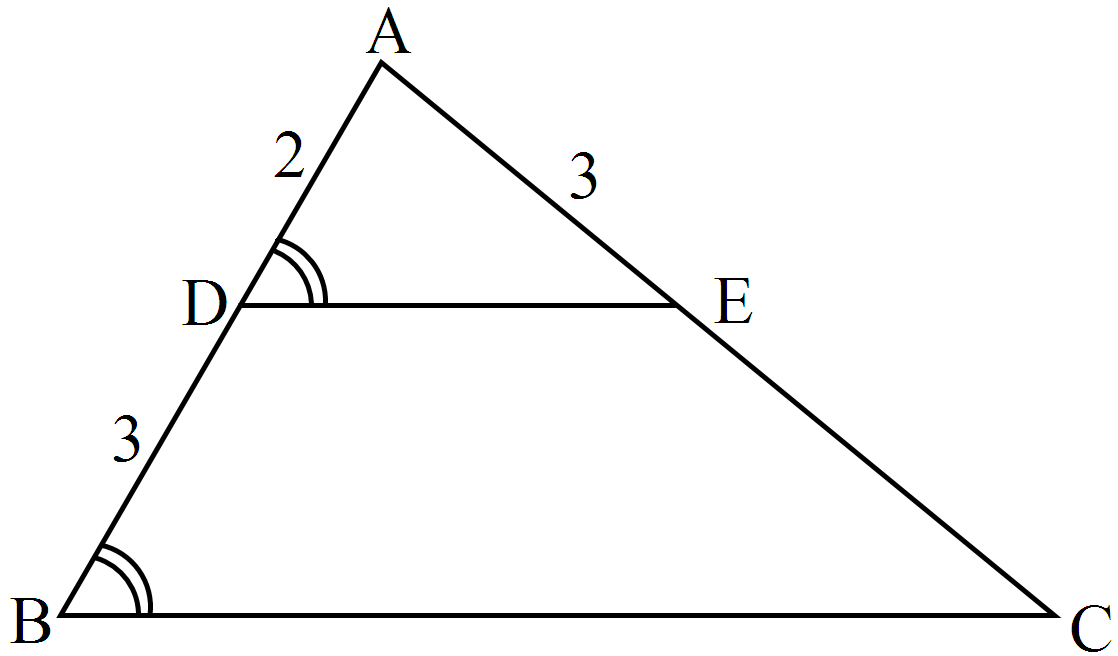
In the given figure if $\angle\text{ADE}=\angle\text{ABC},\angle\text{ADE}=\angle\text{ABC},$ then $CE$ is equal to :
- A
$3.$
- ✓
$\frac{9}{2}$
- C
$2.$
- D
$5.$
AnswerCorrect option: B. $\frac{9}{2}$
In $\triangle\text{ABC} $ and $\text{ ADE},$
$\triangle\text{ADE}=\angle\text{ABC}\ [$Given$]$
$\angle\text{A}=\angle\text{A} \ [$common$]$
$\therefore\triangle\text{ABC}\sim\triangle\text{ADE}\ [\text{AA}$ Similarity$]$
$\therefore\frac{\text{AD}}{\text{DB}}=\frac{\text{AE}}{\text{EC}}$
$\Rightarrow \frac{2}{3}=\frac{3}{\text{EC}}$
$\Rightarrow \text{EC}=\frac{9}{2}\text{ cm}$
View full question & answer→MCQ 891 Mark
It is given that $\triangle\text{ABC}\sim\triangle\text{DFE}.$ If $\angle\text{A}=30^\circ,\angle\text{C}=50^\circ,\text{AB}=5\text{ cm},\text{AC}=8\text{ cm}$ and $\text{DF}=7.5\text{ cm}$ then which of the following is true?
- A
$\text{DE}=12\text{ cm},\angle\text{F}=50^\circ$
- ✓
$\text{DE}=12\text{ cm},\angle\text{F}=100^\circ$
- C
$\text{EF}=12\text{ cm},\angle\text{D}=100^\circ$
- D
$\text{EF}=12\text{ cm},\angle\text{D}=30^\circ$
AnswerCorrect option: B. $\text{DE}=12\text{ cm},\angle\text{F}=100^\circ$
Given that,
$\angle\text{A}=30^\circ,\angle\text{C}=50^\circ$
$\triangle\text{ABC}\sim\triangle\text{DFE}$
$\Rightarrow\angle\text{A}=\angle\text{D}=30^\circ$
$\angle\text{C}=\angle\text{E}=50^\circ$
Using angle sum property,
we can find $\angle\text{B}=100^\circ$
So, $\angle\text{B}=\angle\text{F}=100^\circ$
Also $, AB = 5\ cm, AC = 8\ cm$ and $DF = 7.5\ cm$
$\frac{\text{AB}}{\text{DF}}=\frac{\text{BC}}{\text{FE}}=\frac{\text{AC}}{\text{DE}}$
$\Rightarrow\frac{5}{7.5}=\frac{\text{BC}}{\text{FE}}=\frac{8}{\text{DE}}$
$\Rightarrow\frac{5}{7.5}=\frac{8}{\text{DE}}$
$\Rightarrow\frac{8\times7.5}{5}=12\text{ cm}$
Hence $, DE = 12\ cm$ and $\angle\text{F}=100^\circ$
View full question & answer→MCQ 901 Mark
$\triangle\text{ABC}\sim\triangle\text{DEF}.$ If $BC = 3\ cm, EF = 4\ cm$ and $\text{ar}(\triangle\text{ABC})=54\text{cm}^2,$ then $\text{ar}(\triangle\text{DEF}):$
- A
$108 \mathrm{~cm}^2$
- ✓
$96 \mathrm{~cm}^2$
- C
$48 \mathrm{~cm}^2$
- D
$100 \mathrm{~cm}^2$
AnswerCorrect option: B. $96 \mathrm{~cm}^2$
$\triangle\text{ABC}\sim\triangle\text{DEF}$
$\text{BC}=3\text{ cm},\ \text{EF}=4\text{ cm}$
$\text{ar}(\triangle\text{ABC})=54\text{ cm}^2$
$\because\triangle\text{ABC}\sim\triangle\text{DEF}$
$\therefore\frac{\text{ar}(\triangle\text{ABC})}{\text{ar}(\triangle\text{DEF})}=\frac{\text{BC}^2}{\text{EF}^2}$
$\Rightarrow\frac{54}{\text{ar}(\triangle\text{DEF})}=\frac{3^2}{4^2}=\frac{9}{16}$
$\therefore\text{ar}(\triangle\text{DEF})=\frac{16\times54}{9}=96\text{ cm}^2$
View full question & answer→MCQ 911 Mark
The lenght of the hypotenuse of an isosceles right triangle whose one side is $4\sqrt{2}\text{ cm}$ is :
- A
$12\text{ cm}.$
- ✓
$8\text{ cm}.$
- C
$8\sqrt{2}\text{ cm}.$
- D
$12\sqrt{2}\text{ cm}.$
AnswerCorrect option: B. $8\text{ cm}.$
Het $\text{ABC}$ be an isosceles right triangle.
We have,
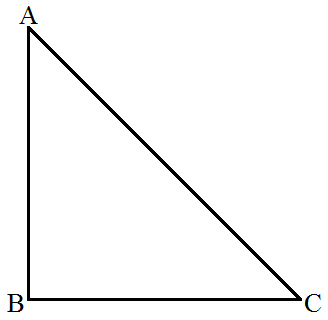
$\text{AB}=\text{BC}=4\sqrt{2}\text{ cm}$
$\Rightarrow\text{AC}^2=\text{AB}^2+\text{BC}^2$
$\Rightarrow\text{AC}^2=(4\sqrt{2})^2+(4\sqrt{2})^2$
$\Rightarrow\text{AC}^2=32+32$
$\Rightarrow\text{AC}^2=64$
$\Rightarrow\text{AC}=8\text{ cm}$
Thus, the length of hypotenuse is $8\ cm$. View full question & answer→MCQ 921 Mark
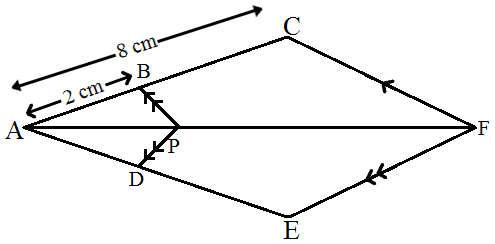
In the figure, if $PB \| CF$ and $DP \| EF, $ then $\frac{\text{AD}}{\text{DE}}=$
- A
$\frac{3}{4}.$
- ✓
$\frac{1}{3}.$
- C
$\frac{1}{4}.$
- D
$\frac{2}{3}.$
AnswerCorrect option: B. $\frac{1}{3}.$
In the figure $, PB \| CF, DP \| EF$
$AB = 2\ cm, AC = 8\ cm$
$BC = AC - AB $
$= 8 - 2 = 6\ cm$
In $\triangle\text{ACF},\ \text{BP} \| \text{CF}$
$\therefore\frac{\text{AB}}{\text{BC}}=\frac{\text{AP}}{\text{PF}}=\frac{2}{6}=\frac{1}{3}\ ....(1)$
In $\triangle\text{AEF},\ \text{DP}\|\text{EF}$
$\therefore\frac{\text{AD}}{\text{DE}}=\frac{\text{AP}}{\text{PF}}=\frac{1}{3}\ \ [$From $ (2)]$
$\frac{\text{AD}}{\text{DE}}=\frac{1}{3}.$
View full question & answer→MCQ 931 Mark
In $\triangle\text{ABC, }\text{AB}=6\sqrt{3 }\text{ cm},\text{AC}=12\text{ cm}$ and $\text{BC}=6\text{ cm}.$ Then, $\angle\text{B}$ is :
- A
$45^\circ$
- B
$60^\circ$
- ✓
$90^\circ$
- D
$120^\circ$
AnswerCorrect option: C. $90^\circ$
In $\triangle\text{ABC},$
$\text{AB}=6\sqrt{3 }\text{ cm},\text{AC}=12\text{ cm}$ and $\text{BC}=6\text{ cm}$
$\text{AB}^2+\text{BC}^2=3\sqrt{3}^2+6^2$
$=108+36=144$
$\text{AC}^2=12^2=144$
$\Rightarrow\text{AB}^2+\text{BC}^2=\text{AC}^2$
So, by the Converse of Pythagoras theorem,
$\triangle\text{ABC}$ is a right angled triangle and since $AC$ is the hypotenuse,
$\angle\text{B}$ which is opposite $\text{AC} = 90^\circ.$
View full question & answer→MCQ 941 Mark
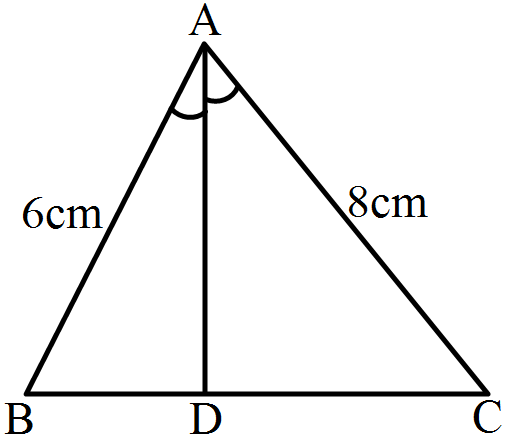
In a $\triangle\text{ABC}$ it is given that $AB = 6\ cm, AC = 8\ cm$ and $AD$ is the bisector of $\angle\text{A}.$ Then $, BD : DC =?$
- ✓
$3 : 4$
- B
$9 : 16$
- C
$4 : 3$
- D
$\sqrt{3}:2$
AnswerCorrect option: A. $3 : 4$
since $AD$ is the bisector of $\angle\text{A},$
by the angle bisector theorem,
$\frac{\text{AB}}{\text{AC}}=\frac{\text{BD}}{\text{DC}}$
$\Rightarrow\frac{6}{8}=\frac{\text{BD}}{\text{DC}}$
$\Rightarrow\frac{\text{BD}}{\text{DC}}=\frac{6}{8}=\frac{3}{4}$
So $, BD : DC = 3 : 4.$
View full question & answer→MCQ 951 Mark
In the figure, the value of $x$ for which $DE \| AB$ is :
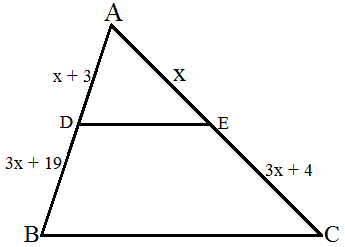
AnswerIn $\triangle\text{ABC},\ \text{DE}\|\text{BC}$
$\therefore\frac{\text{AD}}{\text{DB}}=\frac{\text{AE}}{\text{EC}}$
$\Rightarrow\frac{\text{x}+3}{3\text{x}+19}=\frac{\text{x}}{3\text{x}+4}$
$\Rightarrow(\text{x}+3)(3\text{x}+4)=\text{x}(3\text{x}+19)$
$\Rightarrow3\text{x}^2+4\text{x}+9\text{x}+12=3\text{x}^2+19\text{x}$
$\Rightarrow3\text{x}^2+13\text{x}+12=3\text{x}^2+19\text{x}$
$\Rightarrow12=3\text{x}^2+19\text{x}-3\text{x}^2-13\text{x}$
$\Rightarrow12=6\text{x}$
$\Rightarrow\text{x}=\frac{12}{6}=2$
$\therefore\text{x}=2$
View full question & answer→MCQ 961 Mark
If in two triangles $\text{ABC}$ and $\text{DEF} , \frac{\text{AB}}{\text{DE}}=\frac{\text{BC}}{\text{FE}}=\frac{\text{CA}}{\text{FD}},$ then :
- ✓
$\triangle\text{FDE}\sim\triangle\text{CAB}$
- B
$\triangle\text{FDE}\sim\triangle\text{ABC}$
- C
$\triangle\text{CBA}\sim\triangle\text{FDE}$
- D
$\triangle\text{BCA}\sim\triangle\text{FDE}$
AnswerCorrect option: A. $\triangle\text{FDE}\sim\triangle\text{CAB}$
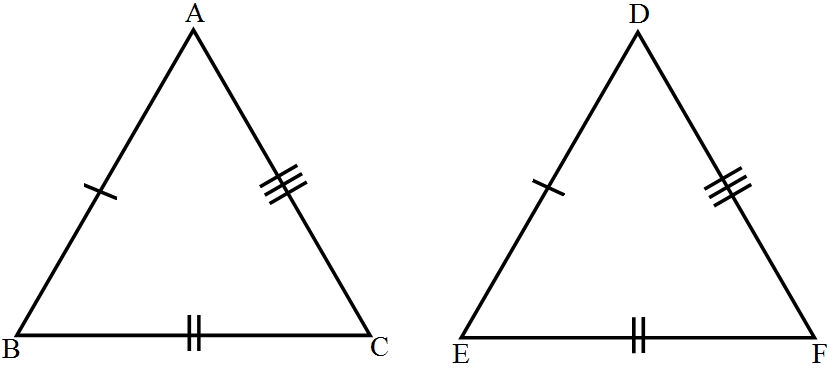
In $\triangle\text{ABC}$ and $\triangle\text{DEF,}$
$\frac{\text{AB}}{\text{DE}}=\frac{\text{BC}}{\text{FE}}=\frac{\text{CA}}{\text{FD}} \ ($By $\text{SSS}$ axiom$)$
$\therefore\triangle\text{FDE}=\triangle\text{CAB}$ View full question & answer→MCQ 971 Mark
If $\triangle\text{ABC}$ and $\triangle\text{DEF}$ are two triangles such that $\frac{\text{AB}}{\text{DE}}=\frac{\text{BC}}{\text{EF}}=\frac{\text{CA}}{\text{FD}}=\frac{2}{5},$ then area $\text{Area }(\triangle\text{ABC}):\text{Area}(\triangle\text{DEF})=$
- A
$2 : 5$
- ✓
$4 : 25$
- C
$4 : 15$
- D
$8 : 125$
AnswerCorrect option: B. $4 : 25$
Given : $\triangle\text{ABC}$ and $\triangle\text{DEF}$ are two triangles such that $\frac{\text{AB}}{\text{DE}}=\frac{\text{BC}}{\text{EF}}=\frac{\text{CA}}{\text{FD}}=\frac{2}{5}$
To find : $\text{Ar}(\triangle\text{ABC}):\text{Ar}(\triangle\text{DEF})$
We know that if the sides of two triangles are proportional, then the two triangles are similar.
Since $\frac{\text{AB}}{\text{DE}}=\frac{\text{BC}}{\text{EF}}=\frac{\text{CA}}{\text{FD}}=\frac{2}{5},$
therefore, $\triangle\text{ABC}$ and $\triangle\text{DEF}$ are similar.
We know that the ratio of areas of two similar triangles is equal to the ratio of squares of their corresponding sides.
$\frac{\text{Ar}(\triangle\text{ABC})}{\text{Ar}(\triangle\text{DEF})}=\frac{\text{AB}^2}{\text{DE}^2}$
$\frac{\text{Ar}(\triangle\text{ABC})}{\text{Ar}(\triangle\text{DEF})}=\frac{2^2}{5^2}$
$\frac{\text{Ar}(\triangle\text{ABC})}{\text{Ar}(\triangle\text{DEF})}=\frac{4}{25}$
Hence the correct answer is $b$.
View full question & answer→MCQ 981 Mark
Area of an equilateral triangle with side length a is equal to :
- A
$\sqrt{\frac{3}{2}}\text{a}$
- B
$\sqrt{\frac{3}{2}}\text{a}^2$
- ✓
$\sqrt{\frac{3}{4}}\text{a}^2$
- D
$\sqrt{\frac{3}{4}}\text{a}$
AnswerCorrect option: C. $\sqrt{\frac{3}{4}}\text{a}^2$
Area of an equilateral triangle with side length
$\text{a}=\sqrt{\frac{3}{4}}\text{a}^2$
View full question & answer→MCQ 991 Mark
In $\triangle\text{ABC}\sim\triangle\text{DEF}$ and the perimeters of $\triangle\text{ABC}$ and $\triangle\text{DEF}$ are $30\ cm$ and $18\ cm$ respectively. If $BC = 9\ cm$ then $EF =?$
- A
$6.3\ cm$
- ✓
$5.4\ cm$
- C
$7.2\ cm$
- D
$4.5\ cm$
AnswerCorrect option: B. $5.4\ cm$
$\triangle\text{ABC}\sim\triangle\text{DEF}$
$\Rightarrow\frac{\text{Perimeters of }\triangle\text{ABC}}{\text{Perimeters of }\triangle\text{DEF}}=\frac{\text{BC}}{\text{EF}}$
$\Rightarrow\frac{30}{18}=\frac{9}{\text{EF}}$
$\Rightarrow\frac{9\times18}{\text{30}}$
$\Rightarrow\text{EF}=5.4\text{ cm}$
View full question & answer→MCQ 1001 Mark
Which of the following is a false statement?
- A
If the areas of two similar triangles are equal then the triangles are congruent.
- ✓
The ratio of the areas of two similar triangles is equal to the ratio of their correspondin sides.
- C
The ratio of the areas of two similar triangles is equal to the ratio of squares of their correspondin medians.
- D
The ratio of the areas of two similar triangles is equal to the ratio of squares of their correspondin altitudes.
AnswerCorrect option: B. The ratio of the areas of two similar triangles is equal to the ratio of their correspondin sides.
Is false since the ratio of the areas of two similar triangles is equal to the ratio of squares of their corresponding sides.
View full question & answer→