Questions · Page 1 of 2

[2 Mark Questions]

🎯

Test yourself on this topic

50 questions · timed · auto-graded

Question 12 Marks
Name the two main organs of our central nervous system. Which one of them plays a major role in sending command to muscles to act without involving thinking process Name the phenomenon involved.
Answer
Two main organs of our central nervous system are:
  1. Brain and spinal cord.
  2. Spinal cord sends the command to muscles to act without involving thinking process.
  3. This phenomenon is known as reflex action.

View full question & answer
Question 22 Marks
What are hormones? Name the hormone secreted by thyroid and state its. function.
Answer
Hormones are the substances produced by glands that are released into blood and travel through the body to other cells. The hormone is thyroxin and the purpose of the thyroid gland is to make, store, and release thyroid hormones into the blood.
View full question & answer
Question 32 Marks
What is water harvesting? Mention any two water harvesting structures.
Answer
Water harvesting refers to the process of storing the rain water for future use. This water can be stored in any tank or can. There are following type of system used in water harvesting process.
  1. Setting rooftop water collecting units.
  2. Digging a series of deep pits in the beds of rive.
View full question & answer
Question 42 Marks
What are ‘nastic’ and ‘curvature’ movements? Give one example of each.
Answer
Nastic movements: These are non-directional movements which are neither towards nor away from the stimulus.
Example: Drooping of leaves.
Curvature movements: In such movements plant organs move towards or away from the stimulus.
Example: Bending of shoot towards source of light (Phototropism) and movement of root away from the source of light (geotropism).
View full question & answer
Question 52 Marks
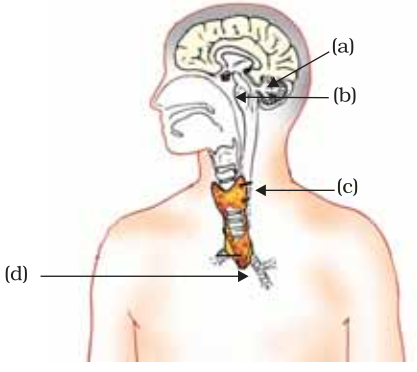
  1. Name one gustatory receptor and one olfactory receptor present in human beings.
  2. Write a and b in the given flow chart of neuron through which information travels as an electrical impulse.
Answer
  1. Gustatory receptors are located on the tongue. They help to detect taste.
The olfactory receptors are located in the nose. They help to detect smell.
  1.  
View full question & answer
Question 72 Marks
“Nervous and hormonal systems together perform the function of control and coordination in human beings.” Justify the statement.
Answer
Control and coordination of functioning of various systems is under the direct control of nervous system. It is the nervous system which governs the way a particular organ or organ system has to work. This control is achieved by a complex network of neurons which carry signals in the form of electric impulses; to and from the brain.The hormonal system, on the other hand, coordinates the functioning of nervous system. The hormonal system has somewhat indirect control on various functions. It tells a system to either slow down or pace; according to the situation.
Nervous and hormonal systems are complementary to each other. Thus, it can be said that nervous and hormonal system together perform the function of control and coordination in human beings.
View full question & answer
Question 82 Marks
The highest concentration of cytokinin is found in which area?
Answer
Cytokinin are the hormones which induce cell division which is very much needed for young fruits and seeds. to support the growth and development cytokinins are present in higher concentrations. So fruits ripen easily and seeds give rise to plant lets.
View full question & answer
Question 92 Marks
Why do muscles change their shape in response to a nerve impulse?
Answer
When a nerve impulse reaches the muscle, the muscle fibre must move. Muscle cells have special proteins that change both their shape and their arrangement in the cell in response to nervous electrical impulses. When this happens, new arrangements of these proteins give the muscle cells a shorter form.
View full question & answer
Question 102 Marks
How is geotropism necessary for the plant?
Answer
Geotropism is the influence of gravity on plant growth or movement. Geotropism guides plant roots to grown downward, or if growing horizontally in shallow topsoil, to occasionally branch and send some roots vertically downward.
View full question & answer
Question 112 Marks
Why is the folding up of the leaves of a sensitive plant on touching with a finger not a tropism?
Answer
The folding of leaves of a sensitive plant is not a case of tropism (like thigmotropism) because in this case the direction of movement of leaves does not depend on the direction of stimulus (touch).
View full question & answer
Question 122 Marks
What is meant by nastic movements in plants? Give one example of nastic movements in plants.
Answer
The movement of a plant part in response to an external stimulus in which the direction of response is not determined by the direction of stimulus is called nastic movement. Example: The folding up of the leaves of a sensitive plant on touching is an example of thigmonasty.
View full question & answer
Question 132 Marks
How does adrenaline prepare us for the stress situations?
Answer
In stress situations adrenaline is released into the blood by adrenal glands. Its target organ is heart which as results heart rates increases so as to increase the supply of the oxygen to the muscles, blood to digestive system and skin is reduced and breathing rate increases. All these responses together prepare the body to face any stressful situation.
View full question & answer
Question 142 Marks
What is meant by receptors and effectors? Give two examples of each.
Answer
A receptor is a cell (or a group of cells) in a sense organ which is sensitive to a particular type of stimulus (or a particular type of change in the environment). Example: Photoreceptors and Phonoreceptors.An effecter is the part of the body which can respond to the stimulus according to the instructions sent from the nervous system (spinal cord and brain). Example: Muscles and glands.
View full question & answer
Question 152 Marks
What is a tendril? Name the two types of tendrils. What does a tendril do in response to the touch of a support ? What is this phenomenon known as?
Answer
Tendrils are the thin, thread-like growths on the stems or leaves of climbing plants. The two types of tendrils are stem tendrils and leaf tendrils. The tendrils grow towards the things they happen to touch. This phenomenon is known as thigmotropism.
View full question & answer
Question 162 Marks
What is the difference between photonasty and thigmonasty?
Answer
Photonasty
Thigmonasty
The non-directional movement of a plant part (usually petals of flowers) in response to light is called photonasty.
Example: The opening and closing of petals of dandelion flowers in response to the intensity of light.
The non-directional movement of a plant part in response to the touch of an object is called thigmonasty.
Example: In Mimosa pudica plant, the leaves fold up in response to touch.
View full question & answer
Question 172 Marks
Plant parts show two types of movements, one dependent on growth and the other independent of growth. Give one example of the movement in plant parts:
  1. Which depends on growth.
  2. Which does not depend on growth.
Answer
  1. Bending of stem towards light.
  2. Folding up of leaves of a sensitive plant on touching.
View full question & answer
Question 182 Marks
What is the function of insulin hormone? What type of patients are given insulin injections?
Answer
The function of insulin hormone is to lower the blood sugar level (or blood glucose level). People having severe diabetes are treated by giving injections of insulin.
View full question & answer
Question 192 Marks
What is the function of receptors in our body? Think of situations where receptors do not work properly. What problems are likely to arise?
Answer
Receptors detect all the information from our environment. These receptors are located in our sense organs. In case any of the receptors do not work properly we will not be able to perceive that particular information.
View full question & answer
Question 202 Marks
How do hormones reach the organs they control?
Answer
The endocrine glands do not have ducts to secrete their hormones. They release hormones directly into the blood of a person and reach the concerned body part through the blood and act on it.
View full question & answer
Question 212 Marks
Write one function of each
  1. Auxin.
  2. Gibberellins.
Answer
Auxin:
  1. It is responsible for the photo-tropism and geotropism.
  2. It promotes root initiation in callus and stem cutting.
View full question & answer
Question 222 Marks
What happens to the dendelion flower
  1. During daytime, and
  2. At night ? What is this phenomenon known as?
Answer
  1. A dandelion flower opens up in the morning in bright light. This phenomenon is known is positive photonasty.
  2. At night, the dandelion flower closes and this phenomenon is known as negative photonasty.
View full question & answer
Question 232 Marks
Give two examples of reflexes.
Answer
Examples of reflex action are:
  1. When light acts as a stimulus, the pupil of the eye changes in size.
  2. Sudden blinking when an insect comes very near to the eyes.
  3. Sudden jerky withdrawal of hand or leg when pricked by a pin.
View full question & answer
Question 242 Marks
What is the significance of the feedback mechanism in the control of hormonal secretions?
Answer
The feedback mechanism regulates the timing and amount of hormone to be secreted, e.g. if a person has more sugar in his blood, it is detected by the cells of the pancreas. As a result, more insulin will be secreted to oxidise the sugar. As blood sugar level falls, insulin secretion is reduced.
View full question & answer
Question 252 Marks
How is the movement of leaves of the sensitive plant different from the movement of a shoot towards light?
Answer
The movement of leaves of the sensitive plant, Mimosa pudica or "touch me not", occurs in response to touch or contact stimuli. This movement is independent of growth. The movement of shoot towards light is known as phototropism. This type of movement is directional and is growth dependent.
View full question & answer
Question 262 Marks
What is autonomic nervous system? What is its function?
Answer
Autonomic nervous system means self governing nervous system. Its function is to control and regulate the functions of the internal organs of our body involuntarily.
View full question & answer
Question 272 Marks
When the leaves of a sensitive plant are touched with a finger, they fold up and when light fades at dusk, the petals of a dandelion flower close.
  1. State one way in which the above two processes are similar.
  2. State two ways in which the above two processes differ.
Answer
  1. Both the processes are similar as the response is not determined by the direction of the stimulus. They are nastic movement.
  2. The first process of folding up of leaf is thigmonastic and the stimulus is touch. The second process of closing of petals is photonastic and the stimulus is light.
View full question & answer
Question 282 Marks
A piece of thread was tied tightly around an animal's pancreatic duct. The animal subsequently had difficulty in digesting food but did not get diabetes. Explain.
Answer
When a piece of thread is tightly tied around an animal’s pancreatic duct, the pancreatic juice containing digestive enzymes will not be able to reach the small intestine. The pancreatic juice contains enzymes which help in the digestion of food. In its absence (due to the blockage of the pancreatic duct), the animal would have difficulty in digesting certain food substances.
However, the pancreas being an endocrine gland releases insulin directly into the blood. Since, the main function of insulin is to maintain the blood sugar level in the body; the animal will not suffer from diabetes.
View full question & answer
Question 292 Marks
Explain why the tongue may be considered as both a receptor and an effector organ.
Answer
Receptors are sensory structures (organs/ tissues/ cells) that detect changes in the environment, which are called stimuli, and turn them into electrical impulses to be transferred to the brain. The tongue has taste buds which can detect chemicals in food and identify taste. Hence, it is considered as receptor. Effector is an organ that responds to stimulus. The tongue is a muscular organ that can respond to a stimulus. Hence, it is also considered as an effector organ.
View full question & answer
Question 302 Marks
Define thigmotropism. Give one example of thigmotropism.
Answer
The directional growth movement of a plant part in response to the touch of an object is called thigmotropism. Example: Tendrils grow towards any support which they happen to touch and wind around it.
View full question & answer
Question 312 Marks
Why are some patients of diabetes treated by giving injections of insulin?
Answer
Diabetes is caused due to less or no secretion of hormone insulin by pancreas. In such a person, blood sugar level is high. Insulin converts extra sugar present in blood into glycogen. Thus, patients suffering from diabetes are given insulin injection to control their blood sugar level.
View full question & answer
Question 322 Marks
Distinguish between tropic movements and nastic movements in plants. Give examples to illustrate your answer.
Answer
Tropic movements:
  1. These movements are always in the direction of the stimulus.
  2. These movements are slow.
  3. These movements are exhibited by all parts of a plant. For example, movement of shoot towards the light and not towards gravity.
Nastic movements:
  1. These movements are neither away nor towards the stimulus.
  2. These movements are fast.
  3. These movements are exhibited by the flat organs (like leaves and petals of flowers) of a plant. For example, the bending and drooping of leaves in ‘Touch-me-not’ plant.
View full question & answer
Question 332 Marks
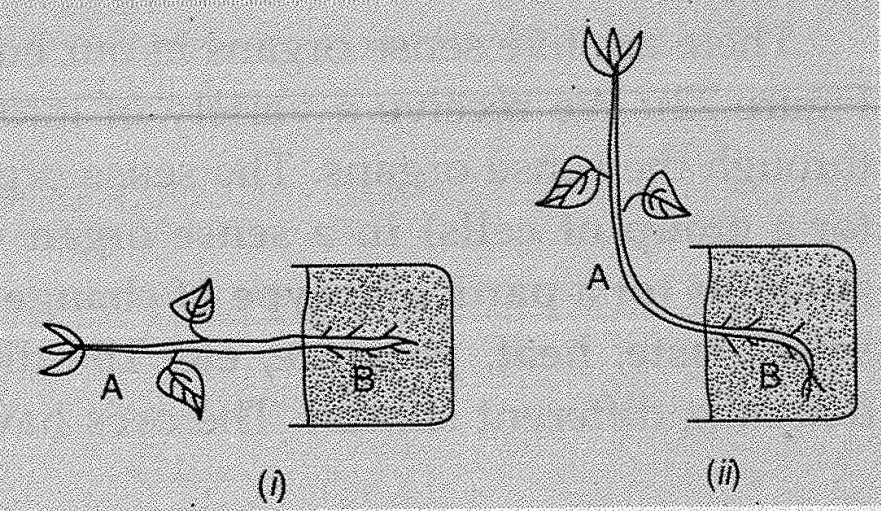
A potted plant having straight parts A and B was placed horizontally on its side as shown in figure (i). After a few days it was observed that the parts A and B of the plant acquire new positions as shown in Figure (ii).
  1. Name the phenomenon exhibited by the position of plant parts A and B in Figure (ii).
  2. Name the stimulus (other than sunlight) which causes plant part A to grow and bend upwards, and plant part B to bend downwards.
Answer
  1. The phenomenon exhibited by the positions of plant parts A and B is geotropism.
  2. The stimulus which causes plant part A to grow and bend upwards and part B to bend downwards is gravity.
View full question & answer
Question 342 Marks
What happens to the moonflower
  1. During daytime, and
  2. At night ? What is this phenomenon known as?
Answer
  1. During the daytime the petals of moon flower close when there is bright light.
  2. At night, when it is dark the petals of moon flower opens up. This phenomenon is known as photonasty.
View full question & answer
Question 352 Marks
Write one function of each.
  1. Auxin.
  2. Gibberellins.
Answer
Gibberellins:
  1. Gibberellins are useful in promoting the growth of the plants.
  2. They are also useful in in increasing sugar yield in sugarcane.
View full question & answer
Question 362 Marks
What are the various sense organs in our body?
Answer
There are 5 sense organs: Eyes, ears, nose, tongue and skin.
View full question & answer
Question 372 Marks
Define phototropism. Give one example of phototropism.
Answer
Phototropism – The movement of a plant part in response to light is called phototropism.
Example - Stem bends towards the light is positive phototropism.
View full question & answer
Question 382 Marks
What is meant by ‘tropisms’ (or tropic movements)? Explain with an example.
Answer
A growth movement ofa plant part in response to an external stimulus in which the direction of stimulus determines the direction of response is called tropism. Example – The bending of plant stem towards light is an example of positive phototropism.
View full question & answer
Question 392 Marks
Why is there a need for chemical communication in organisms?
Answer
The electrical impulses generated in the nerve cells will reach only those cells that are connected by nervous tissue, not each and every cell in the animal body. Therefore multicellular organisms require another means of communication between cells, namely, chemical communication.
View full question & answer
Question 402 Marks
What is the difference between a reflex action and walking?
Answer
A reflex action is a rapid, automatic response to a stimulus. It does not involve any thinking. For example, we close our eyes immediately when the bright light is focused. Walking, on the other hand, is a voluntary action. It is under our conscious control.
View full question & answer
Question 412 Marks
Which signals will get disrupted in case of a spinal cord injury?
Answer
  1. Reflex action.
  2. Impulses from various body parts will not conducted to brain.
  3. Message from brain will not be conducted to various organs.
View full question & answer
Question 422 Marks
What does CNS stand for? Which part of CNS:
  1. Consists of two cerebral hemispheres, and
  2. Has spinal nerves attached to it?
Answer
CNS – Central nervous system.
  1. Cerebrum.
  2. Spinal cord.
View full question & answer
Question 432 Marks
Name the five types of tropisms. How are tropic movements helpful to plants? Explain with an example.
Answer
The five types of tropisms are: Phototropism, Geotropism, Chemotropism, Hydrotropism and Thigmotropism. The various types of tropic movements help the plants to survive. Example even if a seed is planted upside down, its root will grow downwards into earth because it is positively geotropic.
View full question & answer
Question 442 Marks
How are involuntary actions and reflex actions different from each other?
Answer
Difference between involuntary and reflex actions is as follows:
Involuntary actions
Reflex actions
It is a set of muscles movement over which we do not have control. Such actions are controlled by brain. For example-contraction of muscle of our digestive tract, beating of heart etc.
It is rapid, spontaneous and involuntary activity that is produced in response to a stimulus. It is controlled by spinal cord. Example-removal of hand with jerk when someone touches a hot object.
View full question & answer
Question 452 Marks
Why is the use of iodised salt advisable?
Answer
Iodine is necessary for the thyroid gland to make thyroxin hormone. In case, iodine is absent in our diet, there is a possibility of Goitre. Iodised common salt contains proper content of iodine. To avoid deficiency of iodine, iodised salt is recommended.
View full question & answer
Question 462 Marks
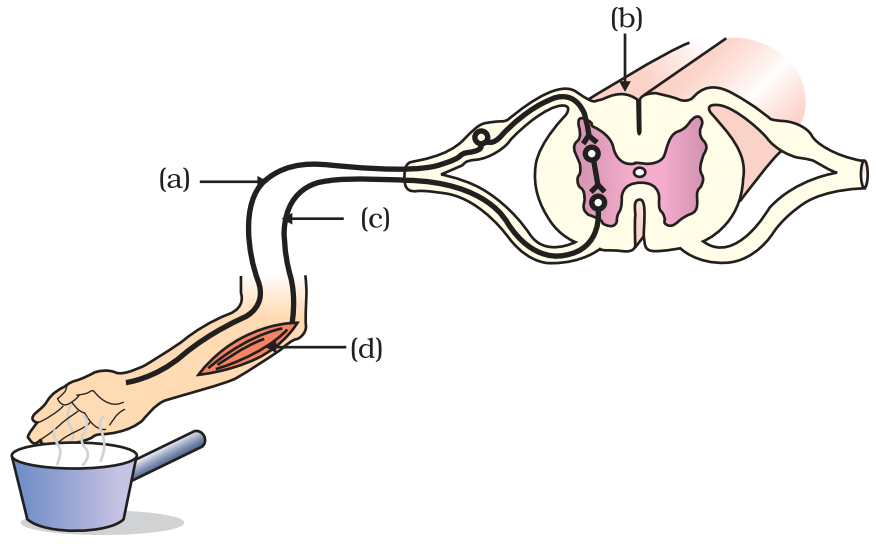
Label the parts (a), (b), (c) and (d) and show the direction of flow of electrical signals in Figure.
Answer
  1.  
  1. Sensory neuron.
  2. Spinal cord (CNS).
  3. Mortor neuron.
  4. Effector (muscle in arm)
  1. Name — Reflex arc.
Direction:
  1. Receptor (hand) to spinal cord through sensory neuron,
  2. Sensory neuron to motor neuron through Spinal cord to effector through motor neuron.
View full question & answer
Question 472 Marks
How do we detect the smell of an agarbatti (incense stick)?
Answer
The thinking part of our brain is the forebrain. It has separate areas that are specialized for hearing, smelling, sight, taste, touch, etc. The forebrain also has regions that collect information or impulses from the various receptors. When the smell of an incense stick reaches us, our forebrain detects it. Then, the forebrain interprets it by putting it together with the information received from other receptors and also with the information already stored in the brain.
View full question & answer
Question 482 Marks
Define geotropism. Give one example of geotropism.
Answer
The movement of plant part in response to gravity is called geotropism. Example – Roots grow towards gravity.
View full question & answer
Question 492 Marks
Name the source gland and one major effect of each of the following hormones:
  1. Parathormone.
  2. Progesterone.
Answer
    Source Gland Major Effect
a. Parathormone Parathyroid gland Controls the amount of calcium in blood.
b. Progesterone Ovary Thickens the utering lining and inhivits FSH and LH.
View full question & answer
Question 502 Marks
What is the function of our nervous system?
Answer
  1. The function of the nervous system is to coordinate the activities of our body.
  2. It helps all other systems of our body to work together.
  3. It receives information from the surroundings, processes it, interprets it and then responds accordingly.
View full question & answer