Questions

Assertion - Reasoning [Phy-1 M]

🎯

Test yourself on this topic

19 questions · timed · auto-graded

Question 11 Mark
In the following questions, a statement of Assertion is given by the corresponding statement of Reason. Of the statements, mark the correct answer as:

  1. If both Assertion and Reason are true and Reason is the correct explanation of Assertion.
  2. If both Assertion and Reason are true, but Reason is not the correct explanation of Assertion.
  3. If Assertion is true, but Reason is false.
  4. Assertion is false, but Reason is true.
  5. If Assertion and Reason both are false.
Assertion: Fuse wire must have high resistance and low melting point.

Reason: Fuse is used to protect the circuit.


Answer
  1. If both Assertion and Reason are true and Reason is the correct explanation of Assertion.

Explanation:

A fuse wire is an electrical instrument used for reducing the damage of electrical appliances when a high current passses into the wire. A fuse wire should have more resistance and a low melting point. It is due to the following reasons; It should melt easily if a high current passes.
View full question & answer
Question 21 Mark
In the following questions, a statement of Assertion is given by the corresponding statement of Reason. Of the statements, mark the correct answer as:
  1. If both Assertion and Reason are true and Reason is the correct explanation of Assertion.
  2. If both Assertion and Reason are true, but Reason is not the correct explanation of Assertion.
  3. If Assertion is true, but Reason is false.
  4. Assertion is false, but Reason is true.
  5. If Assertion and Reason both are false.
Assertion: Electric current will not flow between two charged bodies when connected, if their charges are same.
Reason: Current is the rate of flow of charge.
Answer
 

  1. If both Assertion and Reason are true and Reason is the correct explanation of Assertion.

Explanation:

Current flows between two points when there is distinct potential at that points. since both bodies have same potential, no current flow between them.

Current is the rate of flow of charge; it is the amount of charge flowing per second through a conductor. So a current of 1 amp is 1 coulomb of charge flowing past a point every second.

View full question & answer
Question 31 Mark
In the following questions, a statement of Assertion is given by the corresponding statement of Reason. Of the statements, mark the correct answer as:
  1. If both Assertion and Reason are true and Reason is the correct explanation of Assertion.
  2. If both Assertion and Reason are true, but Reason is not the correct explanation of Assertion.
  3. If Assertion is true, but Reason is false.
  4. Assertion is false, but Reason is true.
  5. If Assertion and Reason both are false.
Assertion: Alloys are used to make heating elements of devices such as electric iron, heater etc.
Reason: Alloys do not oxidise easily at high temperature.
Answer
  1. If both Assertion and Reason are true, but Reason is not the correct explanation of Assertion.

Explanation:

Alloys do not oxidise easily at high temperature.

Alloys are used instead of the pure metals in the electrical heating devices because they have the less electrical conductivity with the less melting point.

The Alloys does not have any single melting point instead of that they have numerous melting point.

Alloys do not oxidise readily at high temperatures because they are not pure metals nd it is a combination of 1 or 2 metals which gives them the strength to do so.

View full question & answer
Question 41 Mark
For two statements are given-one labelled Assertion (A) and the other labelled Reason (R). Select the correct answer to these questions from the codes (a), (b), (c) and (d) as given below:
  1. Both A and R are true, and R is correct explanation of the assertion.
  2. Both A and R are true, but R is not the correct explanation of the assertion.
  3. A is true, but R is false.
  4. A is false, but R is true.
Assertion: When a wire is stretched to three times of its length, its resistance becomes 9 times.
Reason: Resistance is directly proportional to length of wire.
Answer
  1. Both A and R are true, but R is not the correct explanation of the assertion.

Explanation:

Volume of material on stretching remains same. i.e., AI = constant. When I becomes three times, its area of cross-section (A) becomes $\frac{1}{3}\text{rd}$ Form $\text{R}=\text{p}\frac{\text{I}}{\text{A}},\text{R}$ would becomes 9 times.

View full question & answer
Question 51 Mark
For two statements are given-one labelled Assertion (A) and the other labelled Reason (R). Select the correct answer to these questions from the codes (a), (b), (c) and (d) as given below:
  1. Both A and R are true, and R is correct explanation of the assertion.
  2. Both A and R are true, but R is not the correct explanation of the assertion.
  3. A is true, but R is false.
  4. A is false, but R is true.
Assertion: The wires supplying current to an electric heater are not heated appreciably.
Reason: Resistance of connecting wires is very small and $\text{H}\propto\text{R}.$
Answer
  1. Both A and R are true, and R is correct explanation of the assertion.

Explanation:

Resistance of the connecting wires is much smaller than the electric appliances to which current is supplied by the wires.

View full question & answer
Question 61 Mark
For two statements are given-one labelled Assertion (A) and the other labelled Reason (R). Select the correct answer to these questions from the codes (a), (b), (c) and (d) as given below:
  1. Both A and R are true, and R is correct explanation of the assertion.
  2. Both A and R are true, but R is not the correct explanation of the assertion.
  3. A is true, but R is false.
  4. A is false, but R is true.
Assertion: The connecting wires are made of copper.
Reason: The electrical conductivity of copper is high.
Answer
  1. Both A and R are true, and R is correct explanation of the assertion.

Explanation:

Due to high electrical conductivity of copper, it conducts the current without offering much resistance.

View full question & answer
Question 71 Mark
For two statements are given-one labelled Assertion (A) and the other labelled Reason (R). Select the correct answer to these questions from the codes (a), (b), (c) and (d) as given below:
  1. Both A and R are true, and R is correct explanation of the assertion.
  2. Both A and R are true, but R is not the correct explanation of the assertion.
  3. A is true, but R is false.
  4. A is false, but R is true.
Assertion: The coil of a heater is cut into two equal halves and only one of them is used into heater. The heater will now require half the time to produce the same amount of heat.
Reason: The heat produced is directly proportional to square of current.
Answer
  1. Both A and R are true, but R is not the correct explanation of the assertion.

Explanation:

Since in the given case, the voltage is same,

Therefore, $\text{H}=\frac{\text{V}^2}{\text{R}}\text{t}=\text{constant.}$

Hence, if R is halved, t must be halved.

View full question & answer
Question 81 Mark
For two statements are given-one labelled Assertion (A) and the other labelled Reason (R). Select the correct answer to these questions from the codes (a), (b), (c) and (d) as given below:
  1. Both A and R are true, and R is correct explanation of the assertion.
  2. Both A and R are true, but R is not the correct explanation of the assertion.
  3. A is true, but R is false.
  4. A is false, but R is true.
Assertion: The 200W bulbs glows with more brightness than 100W bulbs.
Reason: A 100 watt bulb has more resistance than a 200W bulb.
Answer
  1. Both A and R are true, but R is not the correct explanation of the assertion.

Explanation:

The resistance, $\text{R}=\frac{\text{V}^2}{\text{p}},\text{i.e.,}\text{ R}\propto\frac{\text{I}}{\text{p}}$ i.e., higher is the wattage of a bulb, lesser is the resistance and so it will glow bright.

View full question & answer
Question 91 Mark
For two statements are given-one labelled Assertion (A) and the other labelled Reason (R). Select the correct answer to these questions from the codes (a), (b), (c) and (d) as given below:
  1. Both A and R are true, and R is correct explanation of the assertion.
  2. Both A and R are true, but R is not the correct explanation of the assertion.
  3. A is true, but R is false.
  4. A is false, but R is true.
Assertion: In a chain of bulbs, 50 bulbs are joined in series. One bulb is removed now and circuit is completed again. If the remaining 49 bulbs are again connected in series across the same supply, then light gets decreased in the room.
Reason: Net resistance of 49 bulbs will be less than 50 bulbs.
Answer
  1. A is false, but R is true.

Explanation:

Since the bulbs are joined in series, so when one bulb is removed from chain then the resistance of the chain is decreased, hence current flowing through each bulb is increased. As heat produced $\propto\text{i}^2,$ hence light gets increased in the room.

View full question & answer
Question 101 Mark
For two statements are given-one labelled Assertion (A) and the other labelled Reason (R). Select the correct answer to these questions from the codes (a), (b), (c) and (d) as given below:
  1. Both A and R are true, and R is correct explanation of the assertion.
  2. Both A and R are true, but R is not the correct explanation of the assertion.
  3. A is true, but R is false.
  4. A is false, but R is true.
Assertion: It is advantageous to transmit electric power at high voltage.
Reason: High voltage implies high current.
Answer
  1. A is true, but R is false.

Explanation:

As P = Vi, hence, for the transmission of same power, high voltage implies less current. Therefore, heat energy losses $\Big(\text{H} = \text{i}^2 \frac{\text{Rt}}{4.2}\Big)$ are minimized if power is transmitted at high voltage.

View full question & answer
Question 111 Mark
For two statements are given-one labelled Assertion (A) and the other labelled Reason (R). Select the correct answer to these questions from the codes (a), (b), (c) and (d) as given below:
  1. Both A and R are true, and R is correct explanation of the assertion.
  2. Both A and R are true, but R is not the correct explanation of the assertion.
  3. A is true, but R is false.
  4. A is false, but R is true.
Assertion: Heater wire must have high resistance and high melting point.
Reason: If resistance is high, the electric conductivity will be less.
Answer
  1. Both A and R are true, but R is not the correct explanation of the assertion.

Explanation:

Heater wire must have high resistance and high melting point, because in series current remains same, therefore according to Joule's law $\text{H}=\frac{\text{i}^2\text{Rt}}{4.2,}$ heat produced is high if R is high. Melting point must be high, so that wire may not melt with increase in temperature.

View full question & answer
Question 121 Mark
For two statements are given-one labelled Assertion (A) and the other labelled Reason (R). Select the correct answer to these questions from the codes (a), (b), (c) and (d) as given below:
  1. Both A and R are true, and R is correct explanation of the assertion.
  2. Both A and R are true, but R is not the correct explanation of the assertion.
  3. A is true, but R is false.
  4. A is false, but R is true.
Assertion: Good conductors of heat are also good conductors of electricity and vice versa.
Reason: Mainly electrons are responsible for conduction.
Answer
  1. Both A and R are true, and R is correct explanation of the assertion.

Explanation:

Metals are good conductors of electricity. It is because of the presence of a large number of free electrons in metals. And for metals, electrons are the main cause for thermal conduction. That's why all good conductors of heat are also good conductors of electricity.

View full question & answer
Question 131 Mark
For two statements are given-one labelled Assertion (A) and the other labelled Reason (R). Select the correct answer to these questions from the codes (a), (b), (c) and (d) as given below:
  1. Both A and R are true, and R is correct explanation of the assertion.
  2. Both A and R are true, but R is not the correct explanation of the assertion.
  3. A is true, but R is false.
  4. A is false, but R is true.
Assertion: Fuse wire must have high resistance and low melting point.
Reason: Fuse is used for small current flow only.
Answer
  1. A is true, but R is false.

Explanation:

Fuse wire must have high resistance because according to Joule's law H = I2Rt, heat produced is high if R is high. The melting point must be low so that wire may melt with increase in temperature. As a current larger than the specified value flows through the circuit, the temperature of the fuse wire increases. This melts the fuse wire and breaks the circuit.

View full question & answer
Question 141 Mark
For two statements are given-one labelled Assertion (A) and the other labelled Reason (R). Select the correct answer to these questions from the codes (a), (b), (c) and (d) as given below:
  1. Both A and R are true, and R is correct explanation of the assertion.
  2. Both A and R are true, but R is not the correct explanation of the assertion.
  3. A is true, but R is false.
  4. A is false, but R is true.
Assertion: Electron has a negative charge.
Reason: Electrons move always from a region of higher potential to a region of lower potential.
Answer
  1. A is true, but R is false.

Explanation:


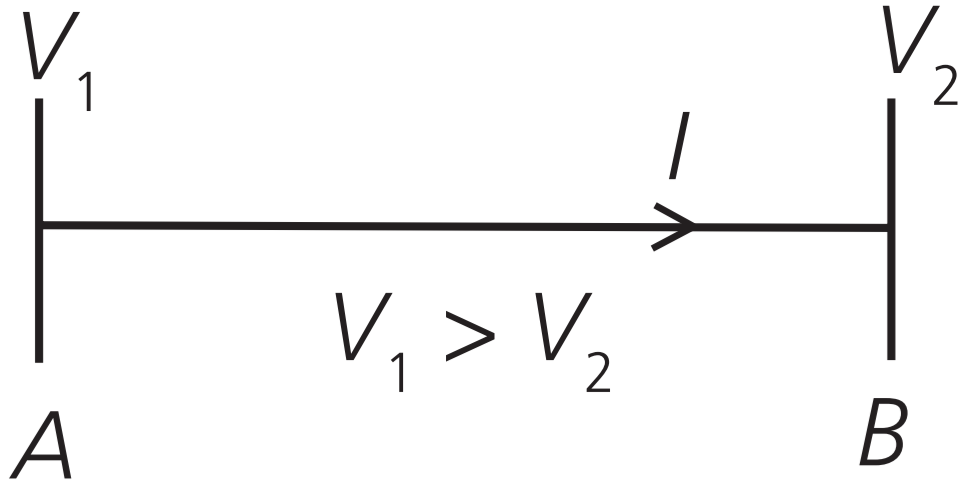
Suppose A and B are two regions having potentials V1 and V2 such that V1 > V2 So the electric current will flow from A to B (i.e., from higher potential to lower potential). Since electrons move opposite to the direction of current, hence, the electrons move from a region of lower potential to a region of higher potential.

View full question & answer
Question 151 Mark
For two statements are given-one labelled Assertion (A) and the other labelled Reason (R). Select the correct answer to these questions from the codes (a), (b), (c) and (d) as given below:
  1. Both A and R are true, and R is correct explanation of the assertion.
  2. Both A and R are true, but R is not the correct explanation of the assertion.
  3. A is true, but R is false.
  4. A is false, but R is true.
Assertion: Current is the rate of flow of charge.
Reason: Electric current will not flow between two charged bodies when connected, if they are at same potential.
Answer
  1. Both A and R are true, but R is not the correct explanation of the assertion.

Explanation:

Current will not flow when two bodies are at the same potential. When their charges are same, their potential may be different. Hence, current may flow in this case.

View full question & answer
Question 161 Mark
For two statements are given-one labelled Assertion (A) and the other labelled Reason (R). Select the correct answer to these questions from the codes (a), (b), (c) and (d) as given below:
  1. Both A and R are true, and R is correct explanation of the assertion.
  2. Both A and R are true, but R is not the correct explanation of the assertion.
  3. A is true, but R is false.
  4. A is false, but R is true.
Assertion: Bending a wire does not affect electrical resistance.
Reason: Resistance of a wire is proportional to resistivity of material.
Answer
  1. A is false, but R is true.

Explanation:

Resistance of wire, $\text{R}=\text{p}\frac{\text{I}}{\text{A}}.$

Where p is resistivity of material which does not depend on the geometry of wire. Since when wire is bended, resistivity, length and area of cross-section do not change, therefore resistance of wire also remains same.

View full question & answer
Question 171 Mark
For two statements are given-one labelled Assertion (A) and the other labelled Reason (R). Select the correct answer to these questions from the codes (a), (b), (c) and (d) as given below:
  1. Both A and R are true, and R is correct explanation of the assertion.
  2. Both A and R are true, but R is not the correct explanation of the assertion.
  3. A is true, but R is false.
  4. A is false, but R is true.
Assertion: A voltmeter and ammeter can be used together to measure resistance, but not power.
Reason: Power is proportional to voltage and current.
Answer
  1. A is false, but R is true.

Explanation:

As $\text{R}=\frac{\text{V}}{\text{I}}$ and P = VI, by measuring V and I simultaneously in circuit we can measure both resistance and power, using the given relation.

View full question & answer
Question 181 Mark
For two statements are given-one labelled Assertion (A) and the other labelled Reason (R). Select the correct answer to these questions from the codes (a), (b), (c) and (d) as given below:
  1. Both A and R are true, and R is correct explanation of the assertion.
  2. Both A and R are true, but R is not the correct explanation of the assertion.
  3. A is true, but R is false.
  4. A is false, but R is true.
Assertion: A current carrying wire should be charged.
Reason: The current in a wire is due to flow of free electrons in a definite direction.
Answer
  1. A is false, but R is true.

Explanation:

The current in a wire is due to flow of free electrons in a definite direction. But the number of protons in the wire at any instant is equal to number of electrons, and charge on electrons is equal and opposite to that of proton. Hence, net charge on the wire is zero.

View full question & answer
Question 191 Mark
For two statements are given-one labelled Assertion (A) and the other labelled Reason (R). Select the correct answer to these questions from the codes (a), (b), (c) and (d) as given below:
  1. Both A and R are true, and R is correct explanation of the assertion.
  2. Both A and R are true, but R is not the correct explanation of the assertion.
  3. A is true, but R is false.
  4. A is false, but R is true.
Assertion: A bird perches on a high-power line and nothing happens to the bird.
Reason: The circuit is incomplete for the bird sitting on high-power line.
Answer
  1. Both A and R are true, and R is correct explanation of the assertion.

Explanation:

Electric shock is due to the electric current flowing through a living body. When the bird perches on a single high-power line, no current passes through its body because its body is at equipotential surface, i.e., there is no potential difference. While when man touches the same line, standing bare foot on ground, the electrical circuit is completed through the ground. The hands of man are at high potential and his feets are at low potential. Hence, large amount of current flows through the body of the man and therefore, gets a fatal shock.

View full question & answer
Assertion - Reasoning [Phy-1 M] - Science STD 10 Questions - Vidyadip