Questions · Page 1 of 2

M.C.Q-[Phy-1M]

🎯

Test yourself on this topic

50 questions · timed · auto-graded

Question 11 Mark
Which unit could be used to measure current?
  1. Watt.
  2. Coulomb.
  3. Volt.
  4. Ampere.
Answer
  1. Ampere.

Explanation:

It is the SI unit of electric current.

View full question & answer
Question 21 Mark
Which statement/statement is/ are correct?
  1. An ammeter is connected in series in a circuit and a voltmeter is connected in parallel.
  2. An ammeter has a high resistance.
  3. A voltmeter has a low resistance.
  1. 1, 2, 3
  2. 1, 2
  3. 2, 3.
  4. 1.
Answer
  1. 1.

Explanation:

An ammeter is connected in series in a circuit and voltmeter is connected in parallel.

View full question & answer
Question 31 Mark
Which of the following units could be used to measure electric charge?
  1. Ampere.
  2. Joule.
  3. Volt.
  4. Coulomb.
Answer
  1. Coulomb.

Explanation:

The coulomb (symbol: C) is the International System of Units (SI) unit of electric charge. It is the charge (symbol: Q or q) transported by a constant current of one ampere in one second.

View full question & answer
Question 41 Mark
Which of the following statements correctly defines a volt?
  1. A volt is a joule per ampere.
  2. A volt is a joule per coulomb.
Answer
A volt is a joule per coulomb.
View full question & answer
Question 51 Mark
Which of the following is the most likely temperature of the filament of an electric light bulb when it is working on the normal 220V supply line?
  1. 500°C
  2. 1500°C
  3. 2500°C
  4. 4500°C
Answer
  1. 2500°C

Explanation:

It is the temperature of an electric bulb filament when it glows.

View full question & answer
Question 61 Mark
Which of the following is likely to be the correct wattage for an electric iron used in our homes?
  1. 60W.
  2. 250W.
  3. 850W.
  4. 2000W.
Answer
  1. 850W.

Explanation:

An electric iron may use a power of 850 watts.

View full question & answer
Question 71 Mark
Which of the following characteristic is not suitable for a fuse wire?
  1. Thin and short.
  2. Thick and short.
  3. Low melting point.
  4. Higher resistance than rest of wiring.
Answer
  1. Thick and short.

Explanation:

This is so because in this case, the resistance of the wire will be low.

View full question & answer
Question 81 Mark
When the diameter of a wire is doubled, its resistance becomes:
  1. Double.
  2. Four times.
  3. One-half.
  4. One-fourth.
Answer
  1. One-fourth.

Explanation:

$\text{R}=\rho\frac{\text{I}}{\text{A}}$

When the diameter is doubled, d = 2d

Radius, r' = 2r

Area of cross section, $\text{A}'=\pi\text{r}'^2=\pi(2\text{r})=4\pi\text{r}^2=4\text{A}$

The area of cross-section will increase by four times.

Then the new resistance, $\text{R}'=\frac{\rho\text{I}}{\text{A}'}$

$\text{R}'=\frac{\rho\text{I}}{4\text{A}}$

$\text{R}'=\frac{\text{R}}{4}$

Thus, the resistance will get reduced by four times.

View full question & answer
Question 91 Mark
When the area of cross-section of a conductor is doubled, its resistance becomes:
  1. Double.
  2. Half.
  3. Four time.
  4. One-fourth.
Answer
  1. Half.

Explanation:

We know that the resistance of a conductor is given by:

$\text{R}=\rho\frac{\text{I}}{\text{A}}$

where $\rho=\text{resistivity}$

length of the conductor

A = area of the cross-section of the conductor

Let the new resistance be R' when the area of cross-section of the conductor is doubled

$\text{R}'=\rho\frac{\text{I}}{2\text{A}}$

View full question & answer
Question 101 Mark
When an electric lamp is connected to 12V battery, it draws a current of 0.5A. The Power of the lamp is:
  1. 0.5W.
  2. 6W.
  3. 12W.
  4. 24W.
Answer
  1. 6W

Explanation:

Power, P = VI = 12V × 0.5A = 6W

View full question & answer
Question 111 Mark
When a $4 Ω$ resistor is connected across the terminals of a 12V battery, the number of coulombs passing through the resistor per second is:
  1. 0.3
  2. 3
  3. 4
  4. 12
Answer
  1. 3

Explanation:

The number of coulombs passing through the resistor is the current passing through it.

$\text{Current}=\frac{\text{Voltage}}{\text{Resistance}}$

$\text{I}=\frac{\text{V}}{\text{R}}$

$\text{I}=\frac{12}{4}$

$\text{I}={3\text{A}}$

Thus, when a $4 Ω$ resistor is connected across the terminals of a 12V battery, the number of coulombs passing through the resistor per second will be 3.

View full question & answer
Question 121 Mark
Using the circuit given below, state which of the following statement is correct?
img...........................
  1. When S1 and S2 are closed, lamps A and B are lit.22
  2. With S1 open and S2 closed, A is lit and B is not lit.
  3. With S2 open and S1 closed A and B are lit.
  4. With S1 closed and S2 open, lamp A remains lit even if lamp B gets fused.
Answer
  1. With S2 open and S1 closed A and B are lit.

Explanation:

This is so because if the switch, S2 is open, the current will flow through lamp A because it is a parallel circuit.

View full question & answer
Question 131 Mark
The work done in moving a unit charge across two points in an electric circuit is a measure of:
  1. Current.
  2. Potential difference.
  3. Resistance.
  4. Power.
Answer
  1. Potential difference.

Explanation:

The difference in potential between two points that represents the work involved or the energy released in the transfer of a unit quantity of electricity from one point to the other.

View full question & answer
Question 141 Mark
The unit of electrical resistance is:
  1. Ampere.
  2. Volt.
  3. Coulomb.
  4. Ohm.
Answer
  1. Ohm.

Explanation:

The unit of electrical resistance is ohm.

View full question & answer
Question 151 Mark
The unit for measuring potential difference is:
  1. Watt.
  2. Ohm.
  3. Volt.
  4. KWh.
Answer
  1. Volt.

Explanation:

It is the SI unit of potential difference.

View full question & answer
Question 161 Mark
The unit for expressing electric power is:
  1. Volt.
  2. Joule.
  3. Coulomb.
  4. Watt.
Answer
  1. Watt.

Explanation:

Watt is the unit of electric power.

View full question & answer
Question 171 Mark
The substance having infinitely high electrical resistance is called:
  1. Conductor.
  2. Resistor.
  3. Superconductor.
  4. Insulator.
Answer
  1. Insulator.

Explanation:

A substance having infinitely high electrical resistance is called an insulator.

View full question & answer
Question 181 Mark
The SI unit of energy is:
  1. Joule.
  2. Coulomb.
  3. Watt.
  4. Ohm-metre.
Answer
  1. Joule.

Explanation:

Joule is the SI unit of energy.

View full question & answer
Question 191 Mark
The resistivity of copper metal depends on only one of the following factors. This factor is:
  1. Length.
  2. Thickness.
  3. Temperature.
  4. Area of cross-section.
Answer
  1. Temperature.

Explanation:

The resistivity of copper depends only on temperature.

View full question & answer
Question 201 Mark
The resistivity of a certain material is $0.6 Ω\ \text{m}. $ The material is most likely to be:
  1. An insulator.
  2. A superconductor.
  3. A conductor.
  4. A semiconductor.
Answer
  1. A semiconductor.

Explanation:

The resistivity of a certain material is $0.6 Ω\ \text{m}. $The material is most likely to be a semiconductor because it has moderate resistivity.

View full question & answer
Question 211 Mark
The resistance of a wire of length 300m and cross-section area 1.0mm2 made of material of resistivity $1.0\times10−7 Ω\ \text{m}$ is:
  1. $2 Ω$
  2. $3 Ω$
  3. $20 Ω$
  4. $30 Ω$
Answer
  1. $30 Ω$

Explanation:

Resistance, $\text{R}=\frac{\rho\text{I}}{\text{A}}$

Length, I = 300m

Cross section area, A = 1.0mm2 = 10-6 m2

Resistivity, $\rho=1.0\times10^{-7}\Omega\ \text{m}$

Resistance, $\text{R}=\frac{10^{-7}\times300}{10^{-6}}$

$\text{R}=30\Omega$

View full question & answer
Question 221 Mark
The p.d. across a $ 3Ω$ resistor is 6V. The current flowing in the resistor will be:
  1. $\frac{1}{2}\text{A}$
  2. 1A.
  3. 2A.
  4. 6A.
Answer
  1. 2A.

Explanation:

If the p.d. across a $3\Omega$ resistor is 6V, the current flowing in the resistor will be 2A as current (I) is given by the equation, $\text{I}=\frac{\text{V} (\text{Voltage})}{\text{R}(\text{Resistance})}.$

or $\text{I}=\frac{\text{V}}{\text{R}}$

$\text{I}=6\ \frac{\text{V}}{3}\ Ω$

$\text{I} = 2\text{A.}$

View full question & answer
Question 231 Mark
The other name of potential difference is:
  1. Ampereage.
  2. Wattage.
  3. Voltage.
  4. Potential energy.
Answer
  1. Voltage.

Explanation:

The term voltage came from volt, which is the SI unit of potential difference.

View full question & answer
Question 241 Mark
The lamps in a house hold circuit are connected in parallel because:
  1. This way they required less current.
  2. If one lamp fails the others remain lit.
  3. This way they require less power.
  4. If one lamp fails the other also fail.
Answer
  1. If one lamp fails the others remain lit.

Explanation:

This is so because in a parallel circuit, if one device fails, it does not affect the working of the other devices.

View full question & answer
Question 251 Mark
The heat produced in a wire of resistance 'x' when a current 'y' flows through it in time 'z' is given by:
  1. x2 × y × z.
  2. x × z × y2.
  3. y × z2 × x.
  4. y × z × x.
Answer
  1. x × z × y2.

Explanation:

This is so because heat, H = I2Rt.

View full question & answer
Question 261 Mark
The heat produced by passing an electric current through a fixed resistor is proportional to the square of:
  1. Magnitude of resistance of the resistor.
  2. Temperature of the resistor.
  3. Magnitude of current.
  4. Time for which current is passed.
Answer
  1. Magnitude of current.

Explanation:

We know that:

H = I2Rt

It shows that the heat produced is proportional to the square of the current.

View full question & answer
Question 271 Mark
The figure given below shows three resistors?


Their combined resistance is:

  1. $1\frac{5}{7}\Omega$

  2. $14\Omega$

  3. $6\frac{2}{3}\Omega$

  4. $7\frac{1}{2}\Omega$

Answer
  1. $7\frac{1}{2}\Omega$

Explanation:

The resistors of 6I and 2I are connected in parallel.

$\therefore\frac{1}{\text{R}}=\frac{1}{\text{R}_1}+\frac{1}{\text{R}_2}$ Here,

$\text{R}_1=6\Omega$

$\text{R}_2=2\Omega\ \frac{1}{\ \text{R}}=\frac{1}{6}+\frac{1}{2}\frac{1}{\text{R}}=\frac{4}{6}\ \text{R}=\frac{6}{4}$

This arrangement is further connected in series with the 6I resistor.

$\therefore$ Net resistance $=\frac{6}{4}+6=7\frac{1}{2}\Omega$

View full question & answer
Question 281 Mark
The elements of electrical heating devices are usually made of:
  1. Tungsten.
  2. Bronze.
  3. Nichrome.
  4. Argon.
Answer
  1. Nichrome.

Explanation:

Nichrome has a high resistance.
View full question & answer
Question 291 Mark
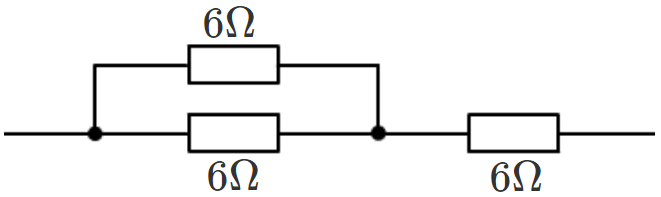
The diagram below shows part of a circuit:

If this arrangement of three resistors was to be replaced by a single resistor, its resistance should be:
  1. $9\Omega$
  2. $4\Omega$
  3. $6\Omega$
  4. $18\Omega$
Answer
  1. $9\Omega$

Explanation:

The two resistors of 6I are connected in parallel with each other. So, their net resistance 3I is connected in series with a resistance of 6I. So, the net resistance of the complete arrangement is $9 Ω.$

View full question & answer
Question 301 Mark
The device used for measuring potential difference is known as:
  1. Potentiometer.
  2. Ammeter.
  3. Galvanometer.
  4. Voltmeter.
Answer
  1. Voltmeter.

Explanation:

A voltage meter is an instrument used for measuring the potential difference, or voltage, between two points in an electrical or electronic circuit.

View full question & answer
Question 311 Mark
The current passing through an electric kettle has been doubled. The heat produced will become:
  1. Half.
  2. Double.
  3. Four time.
  4. One-fourth.
Answer
  1. One-fourth.

Explanation:

Heat produced is directly proportional to the square of the current.

View full question & answer
Question 321 Mark
The commercial unit of energy is:
  1. Watt.
  2. Watt-hour.
  3. Kilowatt-hour.
  4. Kilo-joule.
Answer
  1. Kilowatt-hour.

Explanation:

Kilowatt-hour is the commercial unit of electrical energy.

View full question & answer
Question 331 Mark
One coulomb charge is equivalent to the charge contained in:
  1. 2.6 × 10¹⁹ electrons.
  2. 6.2 × 10¹⁹ electrons.
  3. 2.65 × 10¹⁸ electrons.
  4. 6.25 × 10¹⁸ electrons.
Answer
  1. 6.25 × 10¹⁸ electrons.

Explanation:

The coulomb is the SI unit of electric charge. It is the charge transported by a constant current of one ampere in one second. It is equivalent to the charge of approximately 6.25 × 10¹⁸ protons or electrons.

View full question & answer
Question 341 Mark
Ohm's law gives a relationship between:
  1. Current and resistance.
  2. Resistance and potential difference.
  3. Potential difference and electric charge.
  4. Current and potential difference.
Answer
  1. Current and potential difference.

Explanation:

Ohm's law gives the relationship between current and potential difference.

View full question & answer
Question 351 Mark
Keeping the potential difference constant, the resistance of a circuit is doubled. The current will become:
  1. Double.
  2. Half.
  3. One-fourth.
  4. Four times.
Answer
  1. Half.

Explanation:

As we know from Ohm’s law:

Voltage = Current × Resistance

V = IR

If the voltage is constant, the resistance is doubled and the current becomes half.

View full question & answer
Question 361 Mark
Keeping the p.d. constant, the resistance of a circuit is halved. The current will become:
  1. One-fourth.
  2. Four time.
  3. Half.
  4. Double.
Answer
  1. Double.

Explanation:

As we know from Ohm’s law:

Voltage = Current × Resistance

V = IR

If the voltage is constant, the resistance of the circuit is halved. That is, it becomes $\frac{\text{R}}{2}$

Current, $\text{I}=\frac{\text{V}}{\text{R}}$

$\text{I}=\frac{\text{V}}{\text{R}}$

$\text{I}=\frac{\frac{\text{V}}{\text{R}}}{2}=2\text{I}$

Thus by keeping the p.d. constant, the resistance of a circuit is halved and the current is doubled.
View full question & answer
Question 371 Mark
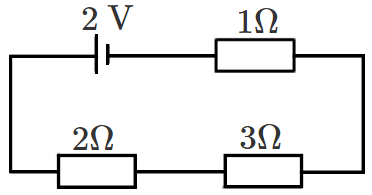
In the circuit shown below:

The potential difference across the $3 Ω$ resistor is:

  1. $\frac{1}{9}\text{V}$

  2. $\frac{1}{2}\text{V}$

  3. 1V

  4. 2V

Answer
  1. 1V

Explanation:

The resistors of $1 Ω, 2 Ω$ and $3 Ω$ are connected in series. Therefore, the net resistance,

$\text{R} = \text{R}_1 + \text{R}_2 +\text{R}_3$

$\text{R}=1\Omega+2\Omega+3\Omega=6\Omega$

Current in the circuit will be,

$\text{I}=\frac{\text{V}}{\text{R}}$

or $\text{I}=\frac{2}{6}=\frac{1}{3}\text{A}$

Current $=\frac{1}{3}\text{A}$

Therefore, the voltage across the 3I resistor,

V = IR

or $\text{V}=\frac{1}{3}\times3=1\text{V}$

View full question & answer
Question 381 Mark
In a filament type light bulb, most of the electric power consumed appears as:
  1. Visible light.
  2. Infra-red-rays.
  3. Ultraviolet rays.
  4. Fluorescent light.
Answer
  1. Infra-red rays

Explanation:

This is so because of the heat produced when a filament type light bulb glows.

View full question & answer
Question 391 Mark
If two resistors of $25 Ω$ and $15 Ω$ are joined together in series and then placed in parallel with a $15 Ω$ resistor, the effective resistance of the combination is:
  1. $0.1\Omega$
  2. $10\Omega$
  3. $20\Omega$
  4. $40\Omega$
Answer
  1. $20\Omega$

Explanation:

When $25 Ω$ and $15 Ω$ are connected in series, then:

Total resistance, R = 25 + 15 = 40I

This 40I is connected in parallel with the 40I resistor.

Therefore, the net resistance $=\frac{40}{2}=20\text{I}$

View full question & answer
Question 401 Mark
If the resistance of a certain copper wire is $1 Ω,$ then the resistance of a similar nichrome wire will be about:
  1. $25 Ω$
  2. $30 Ω$
  3. $60 Ω$
  4. $45 Ω$
Answer
  1. $60 Ω$

Explanation:

If the resistance of a certain copper wire is $1 Ω,$ the resistance of a similar nichrome wire will be about $60 Ω$ because the resistivity of nichrome is 60 times the resistivity of copper.

View full question & answer
Question 411 Mark
If the potential difference between the ends of a fixed resistor is halved, the electric power will become:
  1. Double.
  2. Half.
  3. Four times.
  4. One-fourth.
Answer
  1. One-fourth.

Explanation:

Since $\text{P}=\frac{\text{V}^2}{\text{R}}, $ when the potential difference is halved, the power becomes one-fourth.

View full question & answer
Question 421 Mark
If the diameter of a resistance wire is halved, then its resistance becomes:
  1. Four times.
  2. Half.
  3. One-fourth.
  4. Two times.
Answer
  1. Four times.

Explanation:

Resistance of the wire is given by:

$\text{R}=\rho\frac{\text{I}}{\text{A}}$

When the diameter is halved:

$\text{d}'=\frac{\text{d }}{2}$

Radius:

$\text{r}'=\frac{\text{r}}{2}$

Area of cross-section:

$\text{A}'=\pi\text{r}'^2=\pi\Big(\frac{\text{r}}{2}\Big)^2=\frac{\pi\text{r}}{4}=\frac{\text{A}}{4}$

Area of cross-section will get reduced by four times.

Then the new resistance:

$\text{R}'=\frac{\rho\text{I}}{\text{A}}$

$\text{R}'=\frac{4\rho\text{I}}{\text{A}}$

$\text{R}'=4\text{R}$

Thus, the resistance will increase by four times.

View full question & answer
Question 431 Mark
If the current through a floodlamp is 5A, what charge passed in 10 seconds?
  1. 0.5C.
  2. 2C.
  3. 5C.
  4. 50C.
Answer
  1. 50C.

Explanation:

Here, current, I = 5A

Time, t = 10s

So, using the relation, $\text{I} =\frac{\text{Q}}{\text{t}}$

Q = I × t

Charge, Q = 5 × 10 = 50C

Thus, a charge of 50C is passed in 10s.

View full question & answer
Question 441 Mark
If the current flowing through a fixed resistor is halved, the heat produced in it will become:
  1. Double.
  2. One-half.
  3. One-fourth.
  4. Four times.
Answer
  1. One-fourth.

Explanation:

This is so because heat produced is directly proportional to the square of the current passing through the resistor.

View full question & answer
Question 451 Mark
If the area of cross-section of a resistance wire is halved, then its resistance becomes:
  1. One-half.
  2. 2 times.
  3. One-fourth.
  4. 4 times.
Answer
  1. 2 times.

Explanation:

The resistance of a conductor is inversely proportional to its area of cross-section, i.e. R α 1/ A. So, whenthe area of cross-section of a resistance wire is halved, its resistance will increase by two times.

View full question & answer
Question 461 Mark
How much energy does a 100W electric bulb transfer in 1 minute?
  1. 100J.
  2. 600J.
  3. 3600J.
  4. 6000J.
Answer
  1. 600J.

Explanation:

Energy transferred, E = power × time = 100W × 60s = 6000J

View full question & answer
Question 471 Mark
How many joules of electrical energy are transferred per second by a 6V; 0.5A lamp?
  1. 30J/ s
  2. 12J/ s
  3. 0.83J/ s
  4. 3J/ s
Answer
  1. 30J/ s

Explanation:

Electrical energy transferred per second, E = V × I × t = 6V × 0.5A × 1s 6V × 0.5A × 1s = 3J/ s

View full question & answer
Question 481 Mark
f the amount of electric charge passing through a conductor in 10 minutes is 300C, the current flowing is:
  1. 30A.
  2. 0.3A.
  3. 0.5A.
  4. 5A.
Answer
  1. 0.5A.

Explanation:

Here, charge, Q = 300C

Time, t = 10 minutes = (10 × 60)s = 600s

Then, current, $\text{I}=\frac{\text{Q}}{\text{t}}$

$=\frac{300}{600}=0.5\text{A}.$

View full question & answer
Question 491 Mark
A wire of resistance R1 is cut into five equal pieces. These five pieces of wire are then connected in parallel. If the resultant resistance of this combination be R2, then the ratio $\frac{\text{R}_1}{\text{R}_2}$ is:
  1. $\frac{1}{25}$
  2. $\frac{1}{5}$
  3. 5
  4. 25
Answer
  1. 25

Explanation:

If the resistance wire is cut into five pieces, the resistance of each wire is $\frac{\text{R}}{5}.$ If we connected the pieces in parallel, we will get the net resistance as $\frac{\text{R}}{25}$ Therefore, the ratio will be 25.

View full question & answer
Question 501 Mark
At a given time, a house is supplied with 100A at 220V. How many 75W, 220V light bulb could be switched on in the house at the same time (if they are all connected in parallel)?
  1. 93
  2. 193
  3. 293
  4. 393
Answer
  1. 293

Explanation:

El Total power provided in the house, P = VI = 100A × 220V = 22000W

This is the maximum power that can be drawn in the house.

Total power drawn by x bulbs = 75 x W

Maximum power x bulbs can draw = 22000W.

$\Rightarrow75\text{x}=22000$

$\Rightarrow \text{x}=\frac{22000}{75}\approx293$

View full question & answer
M.C.Q-[Phy-1M] - Science STD 10 Questions - Vidyadip