Questions · Page 2 of 3

[3 Mark Questions]

Question 513 Marks
What are fossils? Giving one example, explain how fossils provide evidence for evolution.
Answer
The remains of dead animals or plants that lived in the remote past are known as fossils. The fossils provide evidence of evolution.
For example: a fossil bird called Archaeopteryx looks like a bird but it has many features which are found in reptiles. This is because Archaeopteryx has feathered wings like those of birds but teeth and tail like those of reptiles. Therefore, Archaeopteryx is a connecting link between the reptiles and birds and suggests that birds have evolved from reptiles. Thus, fossils provide evidence that the present plants and animals have originated from the previously existing ones through the process of continuous evolution.
View full question & answer
Question 523 Marks
Explain analogous organs and homologous organs. Identify the analogous and homologous organs amongst the following:
Wings of an insect, wings of a bat, forelimbs of frog, forelimbs of a human.
Answer
Analogous organs: The organs having similar functions but different structures are called analogous organs. Homologous organs: The organs having similar structure and different functions are called homologous organs. They give the indication of common ancestor.Identification:
Homologous organs: Forelimbs of frog and forelimbs of a human. Analogous organs: Wings of an insect and wings of a bat.
View full question & answer
Question 533 Marks
What are fossils? What do they tell us about the process of evolution?
Answer
The preserved remains or traces of dead plants and animals that lived in the geological past and were buried under the rocks millions of years ago are called fossils.
Fossils tell us about the process of evolution. Fossils give an idea about the structure of organisms and corresponding period of their existence in the past. Fossils found under different strata of earth across different geological locations, provide evidence of evolutionary relationship among existing and extinct species of organism. They give us clues about extinct species of organisms and reasons behind their disappearance from earth due to different conditions of climatic change in the past.
View full question & answer
Question 543 Marks
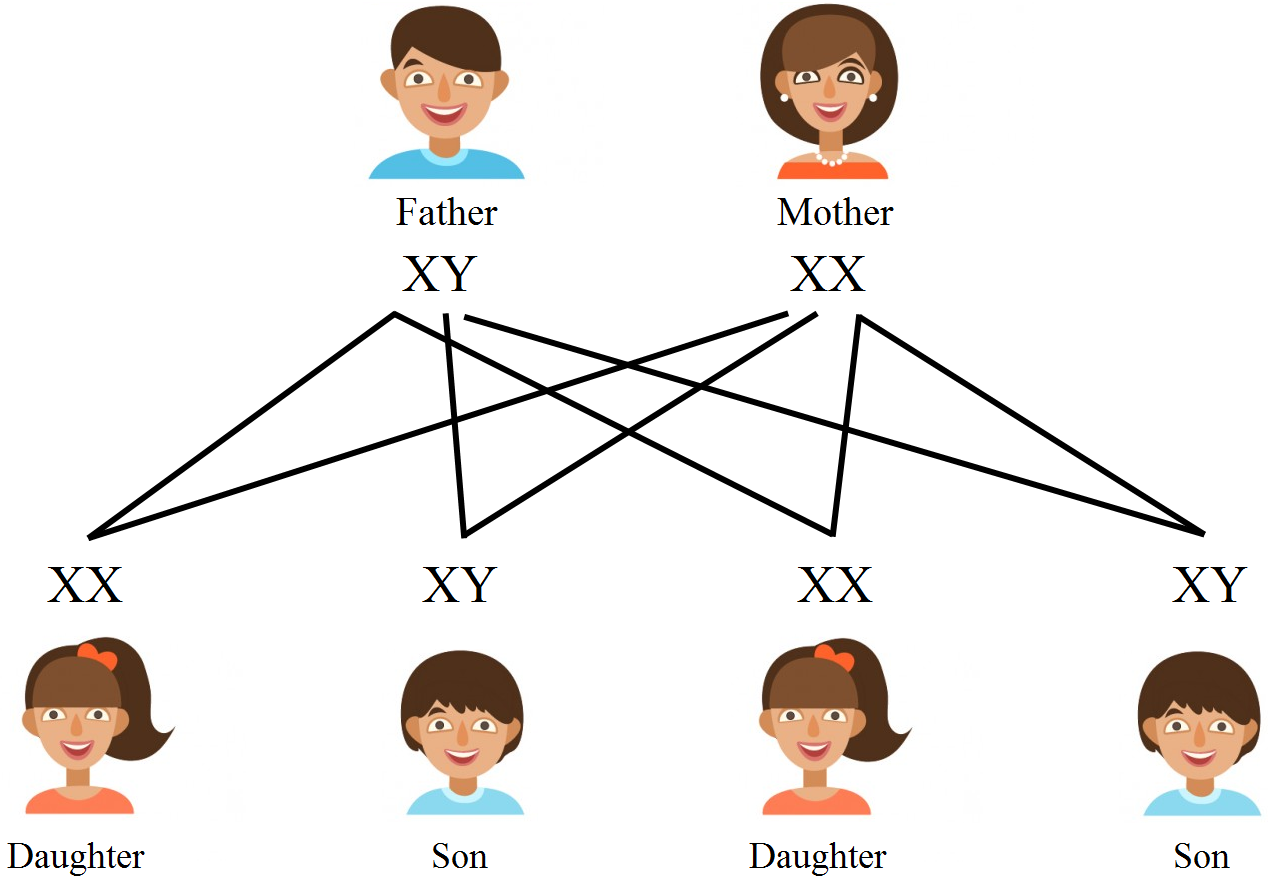
“It is a matter of chance whether a couple will have a male or a female child." Justify this statement by drawing a flow chart.
Answer
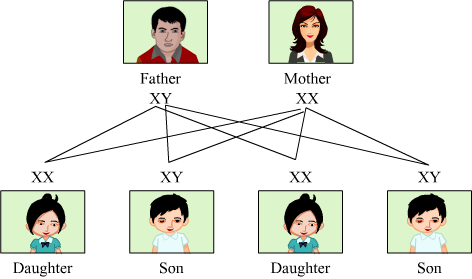
A male has XY sex chromosomes, while a female has XX sex chromosomes.
  • Parent Line- XY * XX
  • Gametes- X Y * X X
  • $F_1$ generation- XX XY
Whatever maybe the gender of the child the mother contributes only the X chromosome. If the X chromosome of the father fuses, then the baby born is a girl. If the Y chromosome of the father fuses, then the baby born is a boy. Hence it is a matter of chance whether the baby born is a girl or a boy.
View full question & answer
Question 553 Marks
State the evidence we have for the origin of life from inanimate matter.
Answer
We have the following evidence from inanimate matter as conducted by MILEY and UREY in 1953 in the following ways:-
  1. With the inspiration of JBS Haldane they created an experimental atmosphere similar as it was at the beginning of earth.
  2. With the mixture of gases they stimulated lightning and passed off sparks in it.
  3. At the end of the week they observed some organic compounds were formed like amino acids which make up protien and animate matters. Fact It was the proof of Earth's first kind of atmosphere, infact the whole environment.
View full question & answer
Question 563 Marks
Explain Mendel’s experiment with peas on inheritance of characters considering only one visible contrasting character.
Answer
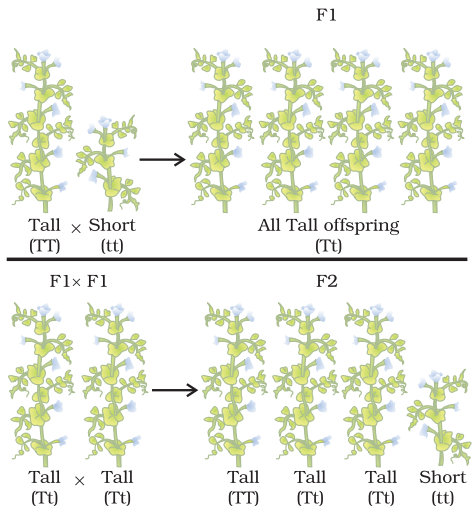
Mendel conducted breeding experiments with garden peas-
  1. He studied (pure) plants of a tall/short varieties.
  2. He crossed them and obtained F1 progeny.
  3. He found that F1 progeny was all tall plants.
  4. He selfed the (hybrid) plants of F1 progeny.
  5. He found that in F2 progeny there were tall as well as short plants.
  6. The three quarter plants were tall and one quarter was short.
View full question & answer
Question 573 Marks
An object is placed at a distance of 8 cm form a convex mirror of focal length 12 cm. Find the position of the image formed?
Answer
According to the question,
Focal length (f) = 12cm,
Object distance (u) = -8cm,
By mirror formula,
$\frac{1}{\text{v}}+\frac{1}{\text{u}}=\frac{1}{\text{f}}$
$\Rightarrow\frac{1}{\text{v}}+\frac{1}{-8}=\frac{1}{12}$
$\Rightarrow\frac{1}{\text{v}}=\frac{1}{8}+\frac{1}{12}$
$\Rightarrow\frac{1}{\text{v}}=\frac{3+2}{24}$
$\frac{1}{\text{v}}=\frac{5}{24}$
$\Rightarrow\text{v}=\frac{24}{5}=4.8\text{cm}$
Since v = 4.8cm which is positive hence image is behind the mirror.
The image is formed at the distance of 4.8cm behind the mirror and is virtual and erect.
View full question & answer
Question 583 Marks
List two differences in tabular form between dominant trait and recessive traits. What percentage/ proportion of the plants in the $F_2$ generation/ progeny were round, in Mendel’s cross between round and wrinkled pea plants?
Answer
Dominance
Recessive
Dominance allele it is able to express itself even inthe presence of its recessive allele
Recessive allele of factor is unable to express its effect in the presence of dominant allele.
It does not require another similar allele to produce its effect on the phenotype. e.g., Tt is tal
It producse allele its phenotypic effect only in the presence of similar allele, e.g., tt is dwarf.
Dominant allele or factor can from complete polypeptide or enzyme for expressing its effects e.g., red colour of flower in pea.
The recessive allele an incomplete or defective polypeptide or enzyme so that the expression consists of absence of the effect of dominant allele, e.g., white flower colour in pea.
75% of the plants were with round seeds.
View full question & answer
Question 593 Marks
Out of bacteria, spider, fish and chimpanzee, which organism has a better body design in evolutionary terms? Give reason for your answer.
Answer
In evolutionary terms, we can say that bacteria has a ‘better’ body design than spiders, fish, and, chimpanzees. This is because though bacteria is one of the simplest and primitive life forms but it still inhabits and survives in some of the most inhospitable (most unfavourable) habitats such as hot springs, deep-sea thermal vents and ice in Antarctica. Most other organisms (including spider, fish and chimpanzees) cannot survive in such harsh environments.
View full question & answer
Question 603 Marks
Some of the important fossils which have been studied are those of organisms X, Y and Z. X were marine arthropods which were common between 400 to 600 million years ago. Y were the invertebrate animals (molluscs) with a flat, coiled, spiral shell which lived in the sea about 180 million years ago. Z are the extinct carnivorous or herbivorous reptiles which appeared on the earth about 250 million years ago and became extinct about 65 million years ago. What are X, Y and Z?
Answer
X are trilobites, Y are ammonites and Z are dinosaurs.
View full question & answer
Question 613 Marks
With the help of an example justify the following statement:
“A trait may be inherited, but may not be expressed”.
Answer
When Mendel cross-pollinated pure breeding tall pea plants (TT) with pure breeding short pea plants (tt), all the plants he obtained in $F _1$ generation were tall ( Tt ). When the $F _1$ tall plants were self-pollinated both tall and dwarf plants were obtained in a $3: 1$ ratio in the $F _2$ generation. This means that even though two alleles were present together in alternative forms ( Tt ) in the $F _1$ only one, the dominant form ( T ), was expressed in the $F _1$. The recessive trait allele was inherited but not expressed.
View full question & answer
Question 623 Marks
On the basis of the possibilities of combination of the sex chromosomes, what percentage probability does a couple have of having a son or a daughter? Show the same by making a cross.
Answer
The sex of a baby is determined by the type of male gamete that fuses with the female gamete. All human beings have 23 pairs of chromosomes in their nuclei. Out of these 23 pairs, the last pair is known as the sex chromosome. The human males have 23 pairs of chromosomes including XY sex chromosomes. Therefore, the male gamete has 22 chromosomes and either an X or Y sex chromosome.
Male gametes can be of two types: 22 + X or 22 + Y
Females have 23 pairs of chromosomes including XX sex chromosomes. Therefore, their gametes can only have 22 chromosomes and one X sex chromosome.
Type of female gametes: 22 + X

Thus, as the mother provides only X chromosome, the sex of the baby is determined by the type of male gamete (X or Y) that fuses with the X chromosome of the female. Thus, there are 50 percent chances of having either male or female child.
View full question & answer
Question 633 Marks
Explain the following:
  1. Speciation.
  2. Natural Selection.
Answer
SPECIATION: The process of formation of one or more new species from the existing one by evolutionary means is known as speciation.
NATURAL SELECTION: The process in nature by which, according to Darwin's theory of evolution, only the organisms best adapted to their environment tend to survive and transmit their genetic characteristics in increasing numbers to succeeding generations while those less adapted tend to be eliminated.
View full question & answer
Question 643 Marks
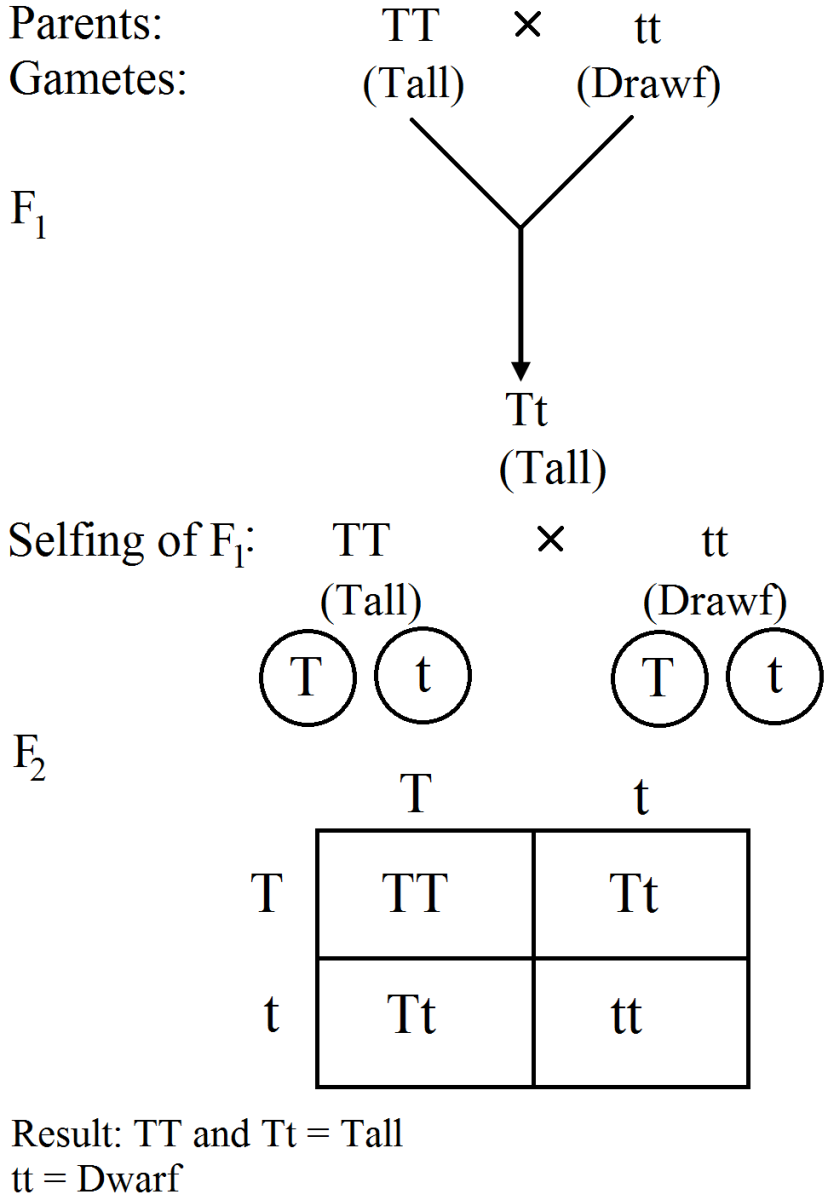
If we cross pure-bred tall (dominant) pea plant with pure-bred dwarf (recessive) pea plant will get pea plants of $F_1$ generation. If we now selfcross the pea plant of $F_1$ generation, then we obtain pea plants of $F_2$ generation.
i. What do the plants of $F_1$ generation look like?
ii. State the ratio of tall plants to dwarf plants in $F_2$ generation.
iii. State the type of plants not found $F_1$ in generation but appeared in $F_2$ generation, mentioning the reason for the same.
Answer
i. All the plants of $F_2$ generation are tall.
ii. The ratio of tall to dwarf plants in the $F_2$ generation is $3: 1$
iii. The dwarf plants are not found in the $F_1$ generation but appear in the $F_2$ generation.

The trait for dwarfness is recessive. Thus, t does not express itself in the heterozygous condition that is when the Dominant T allele is present (tallness).

In $F_1$ generation the plants produced are all heterozygous tall. Thus the Dwarf allele ( $t$ ) does not express itself. However in the $F_2$ generation due to independent assortment the plant acquire homozygous condition and thus the dwarf allele expresses itself.
View full question & answer
Question 653 Marks
How do we get an idea about the extinct or previously existing organisms?
Answer
To know about the extinct or previously existing animals we can look at the fossils. Fossils and not just the buried teeth, skull and bones but can also be the footprints of any animal are the outlines of the Fallen leaves or plants which under the pressure of the layers of soil becomes preserved as fossils. The study of fossils is known as paleontology.
View full question & answer
Question 663 Marks
‘‘Evolution and classification of organisms are interlinked.’’ Give reasons to justify this statement.
Answer
  • Different life forms have evolved during the course of evolution. Classification deals with the grouping of these life forms into groups and sub groups based on similarities and differences.
  • The more characteristics any two species have in common, more closely they are related.
  • Thus classification helps in tracing the evolutionary relationship between the two organisms. Hence, evolution and classification are interlinked.
View full question & answer
Question 673 Marks
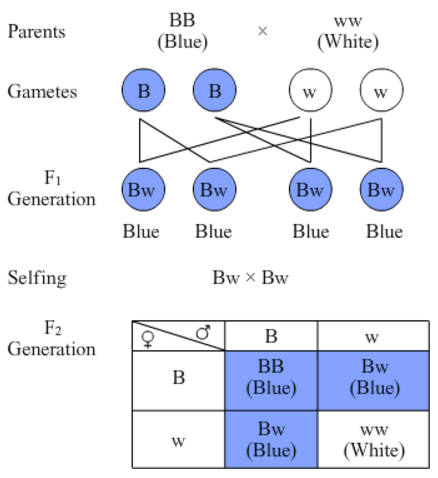
A pea plant with blue colour flower denoted by BB is cross-bred with a pea plant with white flower denoted by ww.
a. What is the expected colour of the flowers in their $F _1$ progeny?
b. What will be the percentage of plants bearing white flower in $F_2$ generation, when the flowers of $F_1$ plants were selfed?
c. State the expected ratio of the genotype BB and Bw in the $F _2$ progeny.
Answer

a. The expected colour of flowers in their $F_1$ progeny is blue.
b. $1 / 4$ of the $F_2$ generation have white flowers. So, we can calculate the percentage as follows:
$1 / 4 \times 100=25 \%$
Hence, the percentage of plants bearing white flowers in $F _2$ progeny is 25.
c. The ratio of the genotype $B B$ and $B w$ in the $F_2$ progeny is $1(B B): 2(B w)$.
View full question & answer
Question 683 Marks
Name the plant Mendel used for his experiment. What type of progeny was obtained by Mendel in $F_1$ and $F_2$ generations when he crossed the tall and short plants? Write the ratio he obtained in $F_2$ generation plants.
Answer
Mendel used pea plant (Pisum sativum) for his experiments. When Mendel crossed tall and short plants, the progeny obtained in $F _1$ generation were tall. When the $F_1$ plants were selfed, the $F_2$ generation showed three tall and one dwarf plant. The genotypic ratio of $F_2$ generation is $1: 2: 1$ (TT : Tt : Tt : tt) and the phenotypic ratio is $3: 1$ (Tall : Dwarf).
View full question & answer
Question 693 Marks
How did Mendel explain that it is possible that a trait is inherited but not expressed in an organism?
Answer
In Mendel's experiment, when pure tall pea plants were crossed with pure dwarf pea plants, only tall pea plants were obtained in $F_1$ generation. On selfing the pea plants of $F_1$ generation both tall and dwarf pea plants were obtained in $F_2$ generation.
Reappearance of the dwarf pea plants in $F_2$ generation proves that the dwarf trait was inherited but not expressed in $F_1$ generation.
View full question & answer
Question 703 Marks
What are chromosomes? Explain how in sexually reproducing organisms the number of chromosomes in the progeny is maintained.
Answer
Chromosomes are made of proteins and DNA. They are present in the nuclei of the cells. In sexually reproducing organisms, the gametes undergo meiosis and hence, each gamete contains only half set of chromosomes. When two gametes fuse, the zygote formed contains the full set of chromosomes. Hence, the formation of gametes by meiosis helps to maintain the number of chromosomes in progenies.
View full question & answer
Question 713 Marks
With the help of a flow chart explain in brief how the sex of a newborn is genetically determined in human beings. Which of the two parents, the mother or the father, is responsible for determination of the sex of a child?
Answer
In human beings, sex is determined by the sex chromosomes. Males have XY constitution of sex chromosomes. Females have XX constitution of sex chromosomes Sex of child depends on what happens during fertilization.
  1. If a sperm carrying X chromosome fertilizes an ovum which carries X chromosome, then the child born will be a girl.
  2. If a sperm carrying Y chromosome fertilizes an ovum which carries X chromosome, then the child born will be a boy.
View full question & answer
Question 723 Marks
List three main factors responsible for the speciation and briefly describe each one of them.
Answer
The process by which new species develope from the exiting species is known as speciation.
Important factors which could lead to the formation of a new species are as follows:
  • Genetic drift caused by drastic changes in the frequencies of particular genes by chance alone.
  • Geographical isolation of a population caused by various types of barriers like mountain ranges, river, sea etc. The geographical isolation leads to reproductive isolation due to which there is no flow of genes between separated groups of population.
  • Variation caused in individuals due to natural selection.
  • Sometimes the sub-population becomes reproductively isolated by ecological barriers. Therefore it occurs within the same geographical area and within the original population.
View full question & answer
Question 733 Marks
List in tabular form two distinguishing features between acquired traits and inherited traits, with one example of each.
Answer
Acquired Traits
Inherited Traits
Traits developed during lifetime.
Traits presents since the birth.
Cannot be inherited that is do not pass to the off springs.
Are inherited by the off springs.
Not in the genes. for example behavior, art of playing an instrument.
In the genes. For example hair colour, height.
View full question & answer
Question 743 Marks
"Two areas of study namely 'evolution' and 'classification' are interlinked". Justify this statement.
Answer
Evolution is a slow change in the body design and other characteristics of an organism over a long period of period that ultimately causes the formation of new speciation from pre-existing species. Different forms of organisms/ life have evolved during the course of evolution.
Classification deals with grouping of these organisms into groups and subgroups based on their similarities and differences. The more characteristics any two species have in common more closely they are related/ will have a more recent ancestor and vice versa. Thus, classification helps tracing the evolutionary relationships between the two organisms hence classification and evolution are interlinked.
View full question & answer
Question 753 Marks
List two differences between acquired traits and inherited traits by giving an example of each.
Answer
Differences between Acquired Traits and Inherited Traits:
Acquired Traits
Inherited Traits
These are somatic variations.
These are genetic variations.
Acquired traits develop due to the effects of environmental factors, use and disguise of organs and special (conscious) efforts.
Inherited traits develop due to a reshuffling of genetic material and mutations.
These traits develop throughout the lifetime of an individual.
These traits are transferred (inherited) by the parents to their offspring.
Example- Learning of dance, music, etc. and muscular body of a wrestler.
Example- Attached or free earlobe and curly hair.
View full question & answer
Question 763 Marks
Explain how the sex of the child is determined at the time of conception in human beings.
Answer
In human body, there are 23 pairs of chromosomes in the cell. Out of these, 22 pairs have a maternal and a paternal copy of genes, but do not take part in sex-determination in human being. The $23^{\text {rd }}$ pair, which is not always a perfect pair, is called sex chromosomes. Women have a perfect pair of sex chromosomes $X X$. But men have a mismatched pair of chromosomes in the form XY . This cell is divided meiotically in both men and women to form gametes. All children will inherit an $X$ chromosome from their mother regardless of whether they are boys or girls and an $X$ or $Y$ chromosomes from their father. Thus, the sex of the children will be determined by what they inherit from their father. A child who inherits an $X$ chromosome from her father will be a girl, and one who inherits a $Y$ chromosome from him will be a boy.
View full question & answer
Question 773 Marks
How did Mendel’s experiments show that different traits are inherited independently? Explain.
Answer
Mendel carried out dihybrid crosses by crossing two pea plants differing in contrasting traits of two characters. For example he crossed a pea plant having yellow coloured and round seed with another pea plant bearing green coloured and wrinkled seed. In the $F_2$ generation, he got the pea plants with two parental and two recombinant phenotypes as yellow round and green wrinkled (parental) and yellow wrinkled and green round (recombinant). This indicated that traits separated from their original parental combinations and got inherited independently.
View full question & answer
Question 783 Marks
In one of his experiments with pea plants Mendel observed that when a pure tall pea plant is crossed with a pure dwarf pea plant, in the first generation, $F_1$ only tall plants appear.
  1. What happens to the traits of the dwarf plants in this case?
  2. When the $F_1$ generation plants were self-fertilised, he observed that in the plants of second generation, $F_2$ both tall plants and dwarf plants were present. Why it happened? Explain briefly.
Answer
  1. The dwarf traits of the plants is not expressed in the presence of the dominant tall trait.
  2. In the $F_2$ generation, both the tall and dwarf traits are present in the ratio of 3 : 1. This showed that the traits for tallness and dwarfness are present in the $F_1$ generation, but the dwarfness, being the recessive trait does not express itself in the presence of tallness, the dominant trait.
View full question & answer
Question 793 Marks
"Natural selection and speciation leads to evolution." Justify this statement.
Answer
Natural selection is the phenomenon by which the nature selects those species which possess survival advantage over the other species. According to theory of natural selection, there is "struggle for existence" within the species of a population for the environmental resources and this struggle leads to survival of certain organisms and elimination of the less competent species. Thus, in this competition, some organisms might undergo genetic changes which help them in their survival. The better adapted organisms would, thus, survive and pass on their traits to next generation, gradually leading to evolution.
Speciation is a process of formation of new species from the existing one due to reproductive isolation of a part of its population. This reproductive isolation can occur due to geographical isolation of a part of population.
With time, the genetic drift will accumulate different variations in each of the geographically separated sub-populations. Ultimately, all the individuals of these two groups will isolate reproductively, thus, leading to formation and evolution of new species. Thus, we can say that both natural selection and speciation lead to the evolution of species on earth.
View full question & answer
Question 803 Marks
How do Mendel’s experiments show that traits may be dominant or recessive?
Answer
Mendel took pea plants with contrasting characteristics- tall plant and dwarf (short) plant. On cross pollination, he got all tall plants in F1 generation. Then by self pollination of F1 tall plants, he produced second generation (F2) consisting of tall and short plants in the ratio of 3:1. Then he concluded that, ‘T’ (tall) trait is dominant while ‘t’ trait for shortness is recessive.
View full question & answer
Question 813 Marks
List three factors that provide evidences in favour of evolution in organisms and state the role of each in brief.
Answer
Three factors/evidences and their roles.
  1. Analogous organs– organisms with similar looking organs may have different origin.
  2. Homologous organs— organisms with apparently different looking organs may have similar origin.
  3. Fossils— allow us to make estimates of how far back evolutionary relationships go. Fossils when chronologically arranged help in tracing the evolutionary history of an organism.
View full question & answer
Question 823 Marks
What is meant by dominant genes and recessive genes? Give one example of each.
Answer
There is a pair of genes for each characteristic of an organism, one is dominant gene and the other is recessive gene. Each parent passes only one of the two genes of the pair for each characteristic to its progeny through gametes. Thus, the male gamete and the female gamete carry one gene for each characteristic from the gene pairs of the parents. When a male gamete fuses with a female gamete during fertilisation they make a new cell called zygote which grows and develops to form a new organism having characteristics from both the parents which it has inherited through genes.
View full question & answer
Question 833 Marks
‘‘A trait may be inherited, but may not be expressed.’’ Justify this statement with the help of a suitable example.
Answer
  • Mendel crossed pure-bred tall pea plants with pure-plants and found that only tall pea plants were produced in the $F_1$ generation.
  • Mendel then crossed the tall pea plants of $\text{F}_{1}$ generation and found that tall plants and dwarf plants were obtained in the $\text{F}_{2}$ generation in the ratio of 3:1.
  • This experiment shows that the traits of dwarfness had not been lost but it was merely concealed in the $\text{F}_{1}$ generation.
Thus “A trait may be inherited, but may not be expressed.”
View full question & answer
Question 843 Marks
Mention the total number of chromosomes along with the sex chromosomes that are present in a human female and a human male. Explain how in sexually producing organisms the number of chromosomes in the progeny remains the same as that of the parents.
Answer
The total number of chromosomes present in both human male and female is 46. Out of these, two chromosomes are the sex chromosomes. In human males, the two sex chromosomes present are X and Y, while in human female, both sex chromosomes are X.
During sexual reproduction, the new individual is formed by the fusion of gametes from both the parents. These gametes are haploid in nature, i.e. they contain only one set of the chromosomes. They are formed by the meiosis, a type of cell division which reduces chromosome number to half. When these haploid gametes fuse during fertilization, the two nuclei of these two gametes fuse and the chromosome number is then restored to normal. Hence, the progeny formed has the same number of chromosomes as that of the parents.
View full question & answer
Question 853 Marks
  1. Give the evidence that the birds have evolved from reptiles.
  2. Insects, octopus, planaria and vertebrates possess eyes. Can we group these animals together on the basis of eyes that they possess? Justify your answer giving reason.
Answer
  1. A fossil bird called Archaeopteryx looks like a bird but it has many Features which are found in reptiles. Archaeopteryx has feathered wings like birds but teeth and tail like those of reptiles. Therefore Archaeopteryx is a connecting link between the reptiles and birds and hence suggests that the birds have evolved from the reptiles.
  2. Insects, octopus, planaria and vertebrates posses eyes but these animals can not be put together on the bases of eyes because structure of eyes in each of there organisms is different which suggests their separate evolutionary origins. Thus all these animals are put in different groups.
View full question & answer
Question 863 Marks
Differentiate between the acquired traits and the inherited traits in tabular form, giving one example for each.
Answer
Acquired Inherited
The acquired traits are the traits which are experienced by an individual during his life time.
 
Inherited traits are distinguishing qualities or characteristics which one acquires from the ancestors.
The acquired traits of an organism cannot be passed on to its future generations.
The inherited traits of an organism are passed on to its future generations
For e.g., 'low weight' of beetle. 'cut tail' of a mouse.
For e.g., red colour of beetles, fur coat of guinea pigs.
View full question & answer
Question 873 Marks
List any three factors and mention how they could lead to the rise of a new species.
Answer
Factors responsible for rise of a new species are:
  1. Genetic drift: Over a generation, genetic drift may accumulate which lead to the formation of a new species.
  2. Natural selection: Due to natural selection, variation may occur which lead to the formation of a new species.
  3. DNA change: Variation during DNA copying often lead to the formation of a new species.
View full question & answer
Question 883 Marks
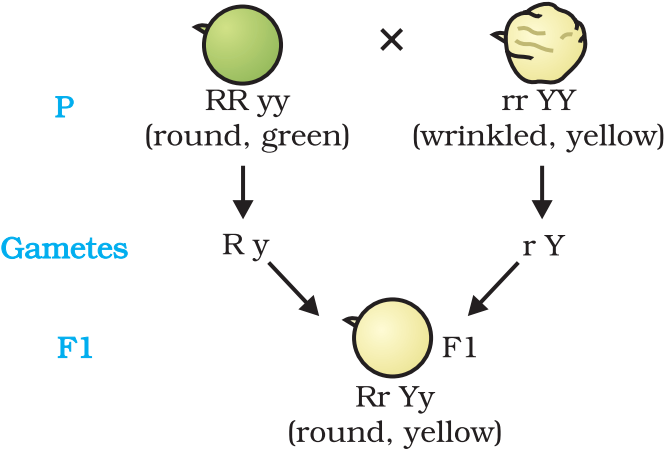
A cross was made between pure breeding pea plants, one with round and green seeds and the other with wrinkled and yellow seeds.
a. Write the phenotype of $F_1$ progeny. Give reason for your answer.
b. Write the different types of $F_2$ progeny obtained along with their ratio when $F_1$ progeny was selfed.
Answer
  1. The cross was made between round, green seeds and wrinkled, yellow seeds. In the given cross, two traits were taken into account, which is dihybrid cross. Yellow colour and round shape is dominant over green colour and wrinkled shape.


The above cross shows round and yellow seeds in $F _1$ generation. It occurs because dominant traits (round and yellow) express themselves, whereas recessive traits (wrinkled and green) get suppressed.
b. On selfing of $F_1$ progeny, different types of $F_2$ progeny were obtained.
$F_2$ progeny along with their ratios obtained in $F_2$ generation:
9
:
3
:
3
:
1
Round yellow (both dominating Traits)
 
Round Green
 
Wrinkled yellow
 
Wrinkled Green(both recessive Traits)
Phenotypic ratio - 9 : 3 : 3 : 1

Round yellow0 - 9, Round green - 3, Wrinkled yellow - 3, Wrinkled green - 1.
View full question & answer
Question 893 Marks
With the help of suitable examples, explain why certain traits cannot be passed on to the next generation. What are such traits called?
Answer
Such traits are called acquired traits. Acquired traits are experienced by an individual during his lifetime. These traits involve changes in non-reproductive cells (somatic cells) which are not transferred to germ cells. So, these traits cannot be passed on to the next generation.
For example- Learning skills like swimming, dancing, cooking, body building, etc are acquired traits and can not be passed on to the next generation.
View full question & answer
Question 903 Marks
How are fossils formed? Describe, in brief, two methods of determining the age of fossils.
Answer
Fossils are formed in the following way:Usually, when the organisms die, their bodies decompose and be lost. But sometimes the body or at least some parts may be trapped in an environment that does not let it decompose completely and eventually harden and retain the impression of the body parts. All such preserved traces of living organisms form fossils.
Two methods to determine the age of fossils:
  1. When dug into the Earth, the fossils closer to the surface are more recent as compared to the fossils found in deeper layers.
  2. The fossils can also be dated by detecting the ratios of different isotopes of the same element in the fossil material. This process is known as radiocarbon dating.
View full question & answer
Question 913 Marks
What is DNA copying? State its importance.
Answer
The process of production of a new DNA molecule from an already existing DNA molecule through chemical reactions is known as DNA copying. It is accompanied by the creation of new cellular apparatus so that the daughter DNA and parent DNA can be separated.Importance of DNA copying:
  1. It helps in the transmission of characteristics from parents to offspring.
  2. It helps in the maintenance of the chromosomal number in the new cell.
View full question & answer
Question 923 Marks
What is meant by the term speciation? List four factors which could lead to speciation.
Answer
Speciation is the the formation of new and distinct species in the course of evolution.Reasons for speciation’s are:
  1. Reproductive isolation.
  2. Genetic drift.
  3. Geographical isolation.
  4. Natural selection.
View full question & answer
Question 933 Marks
With the help of two suitable examples, explain why certain experiences and traits earned by people during their lifetime are not passed on to their next generations. When can such traits be passed on?
Answer
He experiences and qualifications that a person earns during his/her lifetime are examples of acquired traits. These traits cannot be inherited, as they do not affect genetic makeup of an organism. In fact, these traits develop due to use and disuse of organs, or due to direct affect of environment. Thus, they are not passed on to the next generation. For example, a wrestler develops large muscles because of his training programme; it does not mean that his offspring will necessarily have large muscles. Similarly, if a lady pierces her nose, the children produced to her will not have pierced nose by birth.
Traits can be passed on to the next generation only when they have some direct effect on the genes. For example, if a mutation is caused in the germ cells of a person due to exposure to some harmful radiations, it is highly likely that the mutation caused will be passed on to the subsequent generations.
View full question & answer
Question 943 Marks
List three distinguishing features, in tabular form, between acquired traits and the inherited traits.
Answer
The two distinguishing features between the acquired traits and the inherited traits is stated below in tabulate form:
Acquired Traits
Inherited Traits
Acquired traits are not inherited but develop during the lifetime of an individual.
Inherited traits are those which are obtained from parents or caused by a change in its genes (or DNA).
These cannot be passed on to the future generations.
These can be passed to the future generations.
These cannot direct evolve.
For example: muscular body of wrestler.
These can directly evolve.
For example: fused ear lobes.
View full question & answer
Question 953 Marks
How are the areas of study – evolution and classification – interlinked?
Answer
Classification involves grouping of organism into a formal system based on similarities in internal and external structure or evolutionary history. Two species are more closely related if they have more characteristics in common. And if two species are more closely related, then it means they have a more recent ancestor.
For example, in a family, a brother and sister are closely related and they have a recent common ancestor i.e., their parents. A brother and his cousin are also related but less than the sister and her brother. This is because the brother and his cousin have a common ancestor i.e., their grandparents in the second generation whereas the parents were from the first generation.
With subsequent generations, the variations make organisms more different than their ancestors. This discussion clearly proves that we classify organisms according to their resemblance which is similar to creating an evolutionary tree.
View full question & answer
Question 963 Marks
  1. Planaria, insects, octopus and vertebrates all have eyes. Can we group eyes of these animals together to establish a common evolutionary origin? Justify your answer.
  2. "Birds have evolved from reptiles". State evidence to prove the statement.
Answer
  1. The eyes seen in planaria, insects, octopus and vertebrates vary greatly in their structure. These organisms can be used for studying evolution of eyes as the eyes of planaria are simple without lens, insects have compound eyes and vertebrates have highly specialized eyes. However, all of them perform the same function of vision. Hence, a common evolutionary origin can be established.
  2. Birds like reptiles have developed wings. Although the way the wings are used is different because it was used for providing insulation from cold in case of reptiles whereas it is used for flight in case of the birds. But this shows that wings are analogous organs and the reptiles and birds adapted in a similar manner in hostile conditions.
View full question & answer
Question 973 Marks
What evidence do we have for the origin of life from inanimate matter?
Answer
The evidence was given by Stanley L. Miller and Harold C. Urey in 1953. They assembled an atmosphere similar to that thought to exist on early earth over water. This was maintained by them at a temperature just below 100 degree celsius and sparks were passed through the mixture of gases to stimulus lightening. At the end of week, they found that 15% of the carbon had been converted to simple compounds of carbon including amino acids which make up protein molecules.
View full question & answer
Question 983 Marks
How does comparing DNA of different specials help in tracing evolutionary relationship?
Answer
Comparing of DNA is known as molecular phylogeny species deduced from fossils record to be closely related are more similar in their DNA than as species thought to be more distinctly related.
Tracing evolutionary relationships between organisms is called as phylogeny while studying structures of various DNAs to establish evolutionary relationships between them is called as, while studying structures of various DNAs to establish evolutionary relationships between them is called as molecular phylogeny.
View full question & answer
Question 993 Marks
Explain the term genetic drift.
Answer
Although variations of genes (also known as alleles) can be selected for because they help or hinder an organism, other mutations can have no effect. When the allele itself is not responsible for the change in its frequency in a population, genetic drift is acting on the allele. the frequency of these genes can change drastically over time, especially with the smallest populations.
In the largest populations, the allele frequency of each gene stays relatively stable. This happens because the genes are not affecting fitness, and thus do not have a natural selection pressure against or for the allele. In the smallest populations, the frequency of these genes can fluctuate greatly. Some become fixed within the population, while others disappear. These chance events which lead to changes in frequency are called genetic drift.
View full question & answer
Question 1003 Marks
Differentiate between inherited and acquired characters. Give one example for each type.
Answer
 
Acquired Traits
Inherited Traits
1.
Development: The traits develop during life time of an individual.
The traits are obtained from the parents.
2.
Nature: They are somatic variations.
They are genetic variations.
3.
Cause: Acquired traits develop due to direct effect of environment, use and conscious efforts.
The traits develop due to mutations and reshuffling of genetic material.
4.
Fate: They die with the death of the individual.
Ex. Muscular body of a wrestler.
They are passed on to the next generation.
Ex. Fused and free ear lobes.
View full question & answer
[3 Mark Questions] - Page 2 - Science STD 10 Questions - Vidyadip