Questions · Page 1 of 4

Answer the questions.[Phy-1M]

🎯

Test yourself on this topic

50 questions · timed · auto-graded

Question 11 Mark
The magnification produced by a plane mirror is +1. What does this mean?
Answer
$\text{m}=\frac{\text{h}_\text{i}}{\text{h}_\text{0}} = \frac{\text{v}}{\text{u}}$

Magnification produced by a plane mirror is +1 which means that size of image formed is exactly equal to size of object behind the mirror.
View full question & answer
Question 21 Mark
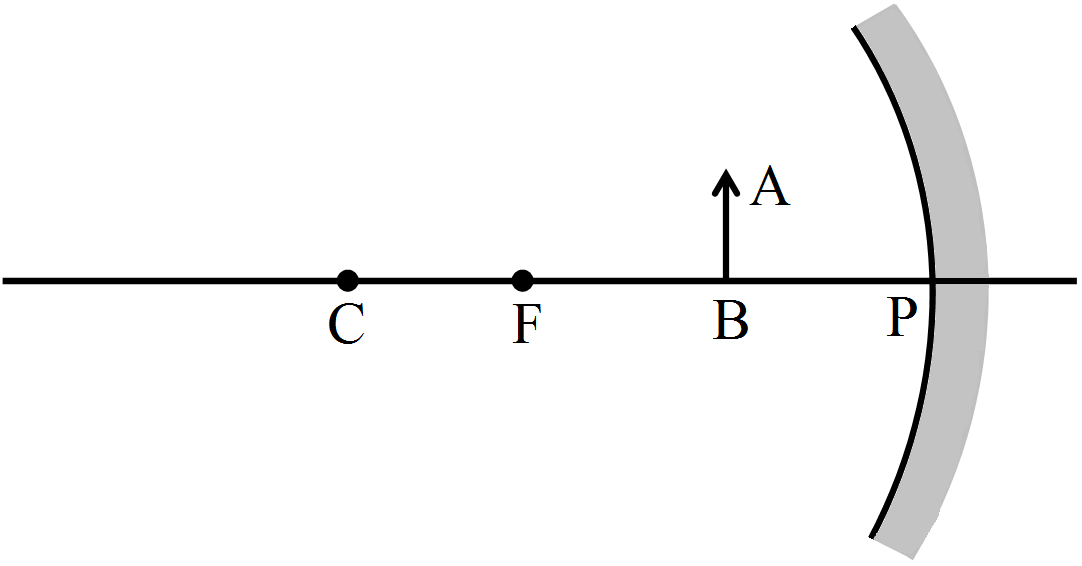
Draw the following diagram in your answer-book and show the formation of image of the object AB with the help of suitable rays.
View full question & answer
Question 31 Mark
What is the magnification of the images formed by plane mirrors and why?
Answer
The magnification of the image formed by a plane mirror is 1. This is because the size of the image formed is equal to the size of the object.
Magnification, $m = \frac{H_{i}}{H_{o}} = 1 \ \ \ \ \ \ \ (H = H_{o})$
Here, $H_{i}$ is the height of the image and $H_{o}$ is the height of the object.
View full question & answer
Question 41 Mark
What is meant by power of a lens?
Answer
Power of a lens- The degree of convergence or divergence of light rays achieved by a lens/Reciprocal of focal length of a lens.
View full question & answer
Question 51 Mark
What is the nature of the image formed by a concave mirror if the magnification produced by the mirror is + 3?
Answer
The magnification has a plus sign then the image is virtual and erect. Here the magnification is greater than 1 therefore the image will be formed is larger than the object.
View full question & answer
Question 61 Mark
Explain why a ray of light passing through the centre of curvature of a concave mirror gets reflected along the same path.
Answer
This is because the angle of incidence is 00 that is the ray passing through the centre of curvature is incident normally to the mirror. The angle of reflection should also be 00.
View full question & answer
Question 71 Mark
Why does a ray of light bend when it travels from one medium into another?
Answer
The refraction of light (bending of light ray) depends upon the change in speed of light. If speed of light changes so it will bend when travelling from one medium to another.
View full question & answer
Question 81 Mark
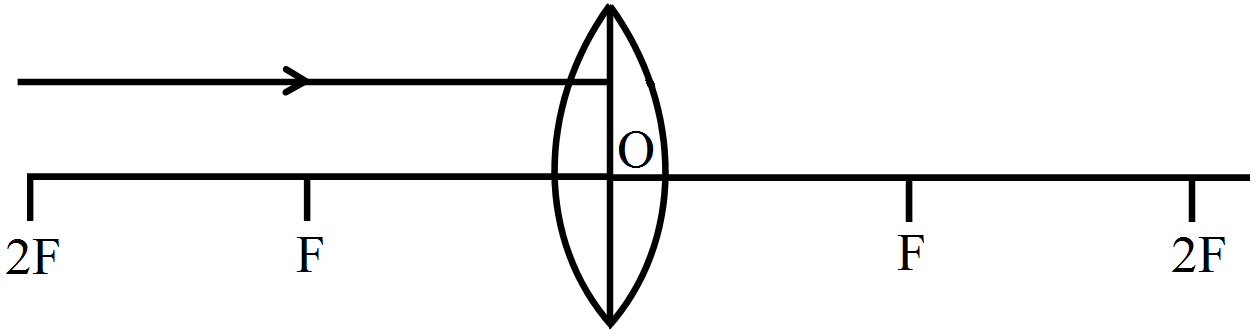
Draw the given diagram in your answer book and complete it for the path of ray of light beyond the lens.
View full question & answer
Question 91 Mark
The refractive index of diamond is 2.42. What is the meaning of this statement in relation to speed of light?
Answer
The refractive index of diamond is 2.42. This means that the speed of light in diamond will reduce by a factor of 2.42 as compared to its speed in air.
View full question & answer
Question 111 Mark
Write the relation between the angle of incidence and the angle of refraction for a medium.
Answer
$\text{Refractive index} = \frac{\text{sine of the angle of incidence}}{\text{sine of the angle of refraction}}$
View full question & answer
Question 121 Mark
Write the mirror formula. Give the meaning of each symbol which occurs in it.
Answer
$\frac{1}{\text{image distance}}+\frac{1}{\text{object distance}}=\frac{1}{\text{focal lenght}}$

Or

$\frac{1}{\text{v}}+\frac{1}{\text{u}}=\frac{1}{\text{f}}$

v = distance of image from mirror.

u = distance of object from mirror.

f = focal length of mirror.

View full question & answer
Question 131 Mark
Why is the magnification produced by a concave lens always less than 1?
Answer
The magnificent of image formed by concave lens is always less than 1. a concave lens is thinner in the middle and thicker at the edges. a concave lens is also a diverging lens. a concave lens will make an image that is always virtual, upright, smaller than the object.
View full question & answer
Question 151 Mark
Why are we advised not to see the sun directly?
Answer
Sun releases UV rays and cause cancer. Direct rays on eyes make a bright shine and put pressure on eyes therefore we are not advised to see sun directly.
View full question & answer
Question 161 Mark
Which typie of lens has (a) a positive power, and (b) a negative power?
Answer
  1. Positive power: Convex lens.

  2. Negative power: Concave lens.

View full question & answer
Question 191 Mark
Which type of mirror has:
  1. Positive focal length?
  2. Negative focal length?
Answer
  1. Convex mirror.
  2. Concave mirror.
View full question & answer
Question 211 Mark
Which type of lenses are:
  1. Thinner in the middle than at the edges?
  2. Thicker in the middle than at the edges?
Answer
  1. Concave lenses.
  2. Convex lenses.
View full question & answer
Question 221 Mark
Which property of light makes a pencil cast a shadow when it is held in front of a light source?
Answer
Light travels in straight lines.
View full question & answer
Question 231 Mark
Which phenomenon of light makes the water to appear shallower than it really is?
Answer
Refraction of light.
View full question & answer
Question 241 Mark
Which one of these circumstances enables a concave mirror to be used as a shaving mirror?
Answer
A concave mirror can be used as a shaving mirror when the object is placed between the pole and focus of a concav mirror.
View full question & answer
Question 251 Mark
Which of the two has a greater power:
A lens of short focal length or a lens of large focal length?
Answer
Lens of short focal length.
View full question & answer
Question 271 Mark
Which mirror always produces a virtual, erect and diminished image of an object?
Answer
Convex mirror always produces a virtual, erect and diminished image.
View full question & answer
Question 281 Mark
Which has more power: a thick convex lens or a thin convex lens, made of the same glass? Give reason for your choice.
Answer
Thick convex lens has more power because of its shorter focal length.
View full question & answer
Question 301 Mark
Which causes more bending (or more refraction) of light rays passing through it:
a convex lens of long focal length or a convex lens of short focal length?
Answer
Convex lens of short focal length causes more bending of light rays passing through it.
View full question & answer
Question 311 Mark
Where should an object be placed in order to use a convex lens as a magnifying glass?
Answer
Object should be placed at a distance less than focal length.
View full question & answer
Question 321 Mark
Where should an object be placed in front of the concave mirror so as to obtain its virtual, erect and magnified image?
Answer
Between pole and focus.
View full question & answer
Question 331 Mark
Where should an object be placed in front of a convex lens so as to obtain its virtual, erect and magnified image?
Answer
The object should be placed within focus.
View full question & answer
Question 341 Mark
Where should an object be placed in front of a convex lens so as to obtain its real, inverted and magnified image?
Answer
Object should be placed between f and 2f.
View full question & answer
Question 361 Mark
When do an object and its image coincide in a convergent mirror?
Answer
When the object is placed at centre of the curvature of the concave mirror, the object and its image coincides.
View full question & answer
Question 371 Mark
When a ray of light passes from air into glass, is the angle of refraction greater than or less than the angle of incidence?
Answer
Angle of refraction is less than the angle of incidence.
View full question & answer
Question 381 Mark
What type of mirror could be used:
  1. As a shaving mirror?
  2. As a shop security mirror?
Answer
  1. Concave mirror.
  2. Convex mirror.
View full question & answer
Question 391 Mark
What type of lens would you use as a magnifying glass? How close must the object be to the lens?
Answer
Convex lens. The object must be withing the focus of the lens.
View full question & answer
Question 401 Mark
What type of lens is an air bubble inside the water?
Answer
The air bubble acts as a DIVERGING LENS (concave lens) in water.
View full question & answer
Question 411 Mark
What type of image is formed:
  1. In a plane mirror?
  2. On a cinema screen?
Answer
  1. Virtual image.
  2. Real image.
View full question & answer
Question 421 Mark
What type of image/ images are formed by:
  1. A convex mirror?
  2. A concave mirror?
Answer
  1. Virtual and erect.
  2. Virtual and erect; real and inverted.
View full question & answer
Question 431 Mark
What sign (+ve or -ve) has been given to the following on the basis of Cartesian Sign Convention?
  1. Height of a real image.
  2. Height of a virtual image.
Answer
  1. Negative.
  2. Positive.
View full question & answer
Question 441 Mark
What name is given to the ratio of sine of angle of incidence to the sine of angle of refraction?
Answer
Refractive index.
View full question & answer
Question 451 Mark
What kind of mirrors are used in big shopping centres to watch the activities of the customers?
Answer
Convex mirrors.
View full question & answer
Question 461 Mark
What kind of mirror is required for obtaining a virtual image of the same size as the object?
Answer
Plane mirror.
View full question & answer
Question 471 Mark
What kind of mirror can have a focal length of, – 20cm?
Answer
Concave mirror (since focal length is negative).
View full question & answer
Question 481 Mark
What is the value of 1n2 × 2n1?
Answer
The value is 1, because both the refractive indicies 1n2 and 2n1 are reciprocals of each other.
View full question & answer
Question 501 Mark
What is the ratio of the height of an image to the height of an object known as?
Answer
The ratio of the height of an image to the height of an object known as magnifincation.
View full question & answer
Answer the questions.[Phy-1M] - Science STD 10 Questions - Vidyadip