Questions · Page 2 of 4

Answer the questions.[Phy-1M]

Question 511 Mark
What is the radius of curvature of a plane mirror?
Answer
The focal length of plane mirrors is considered to be infinite, as the radius of curvature is infinite.
View full question & answer
Question 521 Mark
What is the power of a convex lens whose focal length is 80cm?
Answer
$\text{f}=80\text{cm}=0.08\text{m}$

$\text{p}=\frac{1}{\text{f}}=\frac{1}{0.08}=+1.25\text{D}$

View full question & answer
Question 531 Mark
What is the power of a convex lens of focal length 0.5m?
Answer
$\text{f}=0.5\text{m}$

$\text{p}=\frac{1}{\text{f}}=\frac{1}{0.5}=+2\text{D}$

View full question & answer
Question 541 Mark
What is the nature of the image formed by a convex lens if the magnification produced by the lens is, -0.5?
Answer
The image will be real and inverted, since the magnification has negative value.
View full question & answer
Question 551 Mark
What is the nature of a mirror having a focal length of, + 10cm?
Answer
Convex mirror (since focal length is positive).
View full question & answer
Question 581 Mark
What is the name of the phenomenon in which the right side of an object appears to be the left side of the image in a plane mirror?
Answer
Lateral inversion.
View full question & answer
Question 591 Mark
What is the magnification produced by a plane mirror?
Answer
The magnification produced by a plane mirror is +1 implies that the image formed by a plane mirror is virtual , erect and of the same size, as that of object.
View full question & answer
Question 601 Mark
What is the distance between the image and the plane mirror, if the object is at 15m?
Answer
It will be 15m because as you must have known that distance of the object is equal to distance of the image in a plane mirror.
View full question & answer
Question 611 Mark
What is the difference between the two images formed above?
Answer
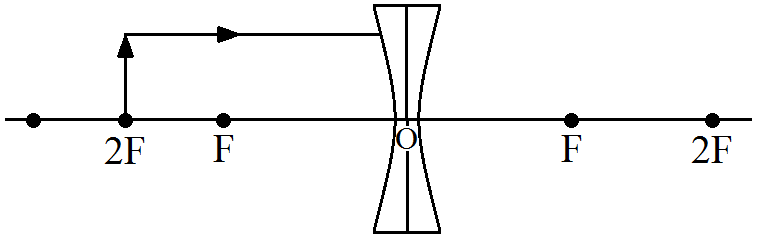
The virtual image formed by a converging lens is magnified wheres that formed by a diverging lens is diminished.
View full question & answer
Question 621 Mark
What is real image?
Answer
A real image is a reproduction of an object via light that can be formed on a surface. A real image exists regardless of whether an observer is present. for example, in a pinhole camera in which no lenses are used.
View full question & answer
Question 631 Mark
What is meant by the refractive index of a substance?
Answer
Refractive index of substance: The ratio of speed of light in vacuum to the speed of light in a medium, is calles the refractive index of that medium.
View full question & answer
Question 641 Mark
What is inverted image?
Answer
An image in which up and down, as well as left and right, are interchanged, that is, an image that results from rotating the object 180° about a line from the object to the observer, such images are formed by most astronomical telescopes. Also known as reversed image.
View full question & answer
Question 651 Mark
What is convex mirror?
Answer
A convex mirror or diverging mirror is a curved mirror in which the reflective surface bulges towards the light source. Convex mirrors reflect light out wards, therefore they are not used to focus light.
View full question & answer
Question 661 Mark
What is concave mirror?
Answer
A concave mirror, or converging mirror, has a reflecting surface that is recessed inward (away from the incident light). Concave mirrors reflect light inward to one focal point. They are used to focus light.
View full question & answer
Question 671 Mark
What happens when a ray of light falls normally (or perpendicularly) on the surface of a plane mirror?
Answer
As ray of light falls normally on mirror, this means that angle of incidence is 0°. From second law of reflection, we know that angle of incidence is equal to angle of reflection. So, angle of reflection will also be zero.

Therefore, the light ray will be reflected back along the same path.

View full question & answer
Question 681 Mark
What happens to the image when the object is moved away from the mirror gradually?
Answer
Virtual and erect; real and inverted.
View full question & answer
Question 701 Mark
The refractive index of diamond is 2.42. What is the meaning of this statement?
Answer
The refractive index of diamond is 2.42. This means that the speed of light in diamond will reduce by a factor of 2.42 as compared to its speed in air.
In other words, the speed of light in diamond is 1/2.42 times the speed of light in vacuum.
View full question & answer
Question 711 Mark
The radius of curvature of a spherical mirror is 20 cm. What is its focal length?
Answer
Radius of curvature, R = 20 cm

Radius of curvature of a spherical mirror = 2 × Focal length (f) R = 2f

$\text{f}=\frac{\text{R}}{2}=\frac{20}{2}=10$

Hence, the focal length of the given spherical mirror is 10 cm.

View full question & answer
Question 721 Mark
The power of a lens is, -2D. What is its focal length?
Answer
$\text{P}=-2\text{D}$

$\text{P}=\frac{1}{\text{f}}$

$\text{f}=\frac{1}{\text{P}}=\frac{1}{(-2)}=-0.5\text{m}=-50\text{cm}$

View full question & answer
Question 731 Mark
The power of a lens is +0.2D. Calculate its focal length.
Answer
$\text{P}=+0.2\text{D}$

$\text{P}=\frac{1}{\text{f}}$

$\text{f}=\frac{1}{\text{P}}=\frac{1}{0.2}=+5\text{m}$

View full question & answer
Question 741 Mark
The lens A has a focal length of 25cm whereas another lens B has a focal length of 60cm. Giving reason state, which lens has more power: A or B
Answer
Lens A has more power because of its shorter focal length.
View full question & answer
Question 751 Mark
The image seen in a plane mirror cannot be formed on a screen. What name is given to this type of image?
Answer
Virtual image.
View full question & answer
Question 761 Mark
The focal length of a convex lens is 25cm. What is its power?
Answer
$\text{f}=25\text{cm}=0.25\text{cm}$

$\text{p}=\frac{1}{\text{f}}=\frac{1}{0.25}=+4\text{D}$
View full question & answer
Question 791 Mark
State whether concave lens has a real focus or a virtual focus.
Answer
A concave lens has a virtual focus.
View full question & answer
Question 811 Mark
State the relation between object distance, image distance and focal length of a spherical mirror (concave mirror or convex mirror).
Answer
$\frac{1}{\text{image distance}}+\frac{1}{\text{object distance}}=\frac{1}{\text{focal lenght}}$

Or

$\frac{1}{\text{v}}+\frac{1}{\text{u}}=\frac{1}{\text{f}}$

v = distance of image from mirror.

u = distance of object from mirror.

f = focal length of mirror.
View full question & answer
Question 821 Mark
State one use of concave mirror based on the formation of image as in case (z) above.
Answer
one use of concave mirror based on the formation of image as in case (i) above: As a shaving mirror.
View full question & answer
Question 831 Mark
State any two uses of convex lenses.
Answer
Two uses of convex lenses:
  1. As a magnifying glass.
  2. For making a simple camera.
View full question & answer
Question 841 Mark
Refractive indices of carbon disulphide and ethyl alcohol are 1.63 and 1.36 respectively. Which is optically denser?
Answer
Carbon disulphide is more denser than the ethyl alcohol.
View full question & answer
Question 851 Mark
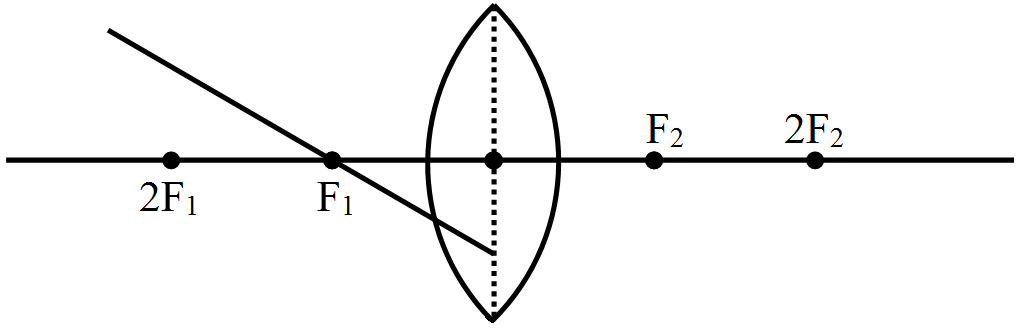
Redraw the ray diagram given below in your answer book and completer the path of ray.
Answer
When this point light source is placed at the focus of convex lens then after falling on convex lens it will become parallel to the principal axis.
View full question & answer
Question 861 Mark
Out of convex mirror and concave mirror, whose focus is situated behind the mirror?
Answer
Convex mirror.
View full question & answer
Question 871 Mark
One wants to see a magnified image of an object in a mirror. What type of mirror should one use?
Answer
Concave mirror should be used to get a magnified image.
View full question & answer
Question 881 Mark
  1. What type of images can a convex lens make?
  2. What type of image is always made by a concave lens?
Answer
  1. Real and virtual.
  2. Virtua.
View full question & answer
Question 891 Mark
Name two factors on which the focal length of a lens depends.
Answer
Focal length of a lens depends on the refractive index of the glass from which it is made, and on the curvature of its two surfaces.
View full question & answer
Question 921 Mark
Name the spherical mirror which can produce a virtual and diminished image of an object.
Answer
Convex mirror.
View full question & answer
Question 931 Mark
Name the spherical mirror which can produce a real and diminished image of an object.
Answer
Concave mirror.
View full question & answer
Question 951 Mark
Name the phenomenon responsible for the following effect:
When we sit in front of a plane mirror and write with our right hand, it appears in the mirror that we are writing with the left hand.
Answer
Lateral inversion.
View full question & answer
Question 961 Mark
Name the phenomenon due to which a swimming pool appears less deep than it really is.
Answer
This is due to refraction of light.
View full question & answer
Question 971 Mark
Name the phenomenon due to which a pencil partly immersed in water and held obliquely appears to be bent at the water surface.
Answer
Refraction of light.
View full question & answer
Question 981 Mark
Name the mirror which can give:
  1. An erect and enlarged image of an object.
  2. An erect and diminished image of an object.
Answer
  1. Concave mirror.
  2. Convex mirror.
View full question & answer
Question 991 Mark
Name the lens which can concentrate sun’s rays to a point and burn a hole in a piece of paper.
Answer
Converging lens.
View full question & answer
Question 1001 Mark
Name one simple optical instrument in which the above arrangement of convex lens is used.
Answer
A simple camera.
View full question & answer
Answer the questions.[Phy-1M] - Page 2 - Science STD 10 Questions - Vidyadip