$\text{f}=\frac{100}{\text{p}} \ \text{cm}=\frac{100}{1.5}$
$=\frac{1000}{15}=+66.67 \ \text{cm}=+0.67 \ \text{m}$
As the focal length is +ve, it is convex lens. Hence, it is a converging lens.50 questions · timed · auto-graded
$\text{f}=\frac{100}{\text{p}} \ \text{cm}=\frac{100}{1.5}$
$=\frac{1000}{15}=+66.67 \ \text{cm}=+0.67 \ \text{m}$
As the focal length is +ve, it is convex lens. Hence, it is a converging lens.$\text{P} = \frac{1}{\text{f}}\text{ or f } = \frac{1}{\text{P}}$
$\text{f} = \frac{1}{-2.0}= -0.5 \text{m.}$
(-ve) sign of focal length means that the lens is concave lens.| Medium | Refractive Index |
| A | 1.6 |
| B | 1.8 |
| C | 1.5 |
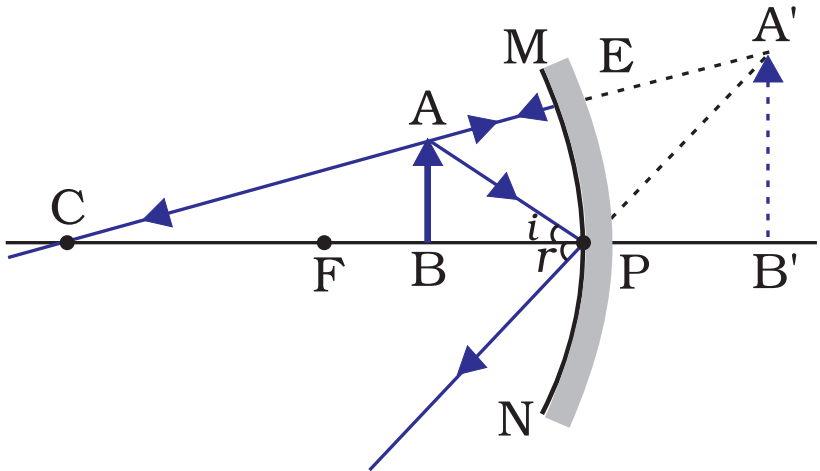
$\Rightarrow \frac{1}{\text{v}}=\frac{1}{\text{f}}+\frac{1}{\text{u}} =\frac{1}{(-30)} + \frac{1}{(-15)}$
$\therefore \frac{1}{\text{v}}=-\frac{3}{30}=-\frac{1}{10}$
$\therefore \text{v}=-10\text{cm}$
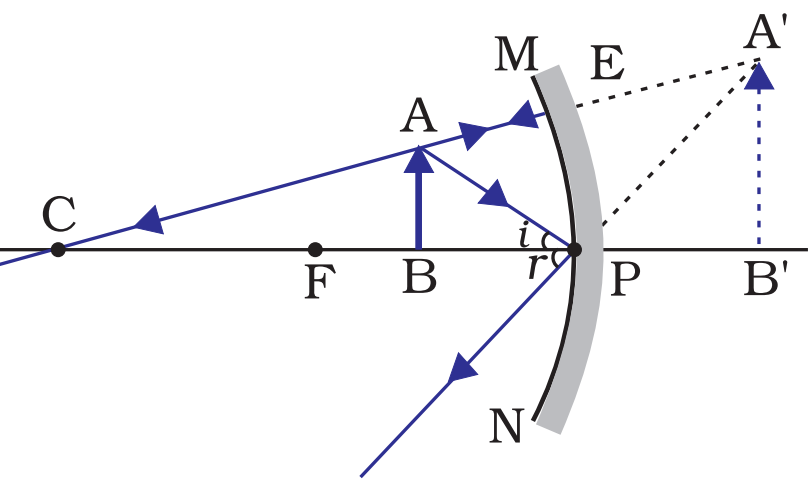
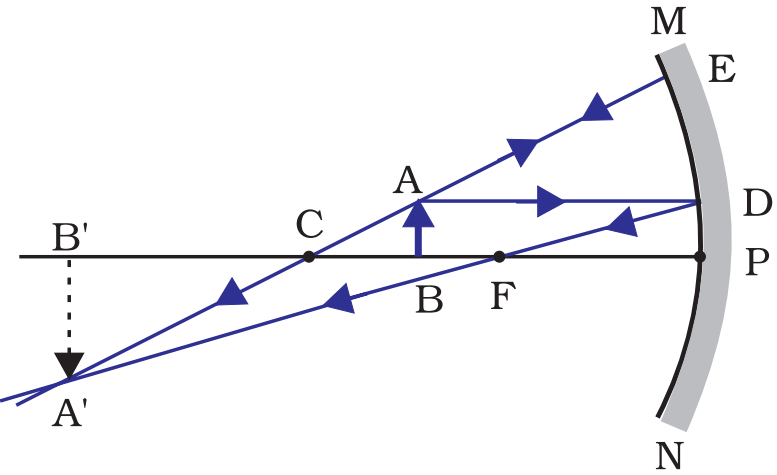
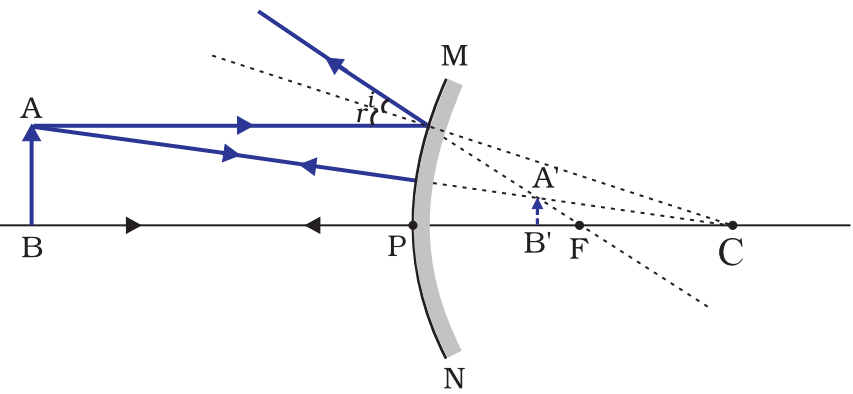
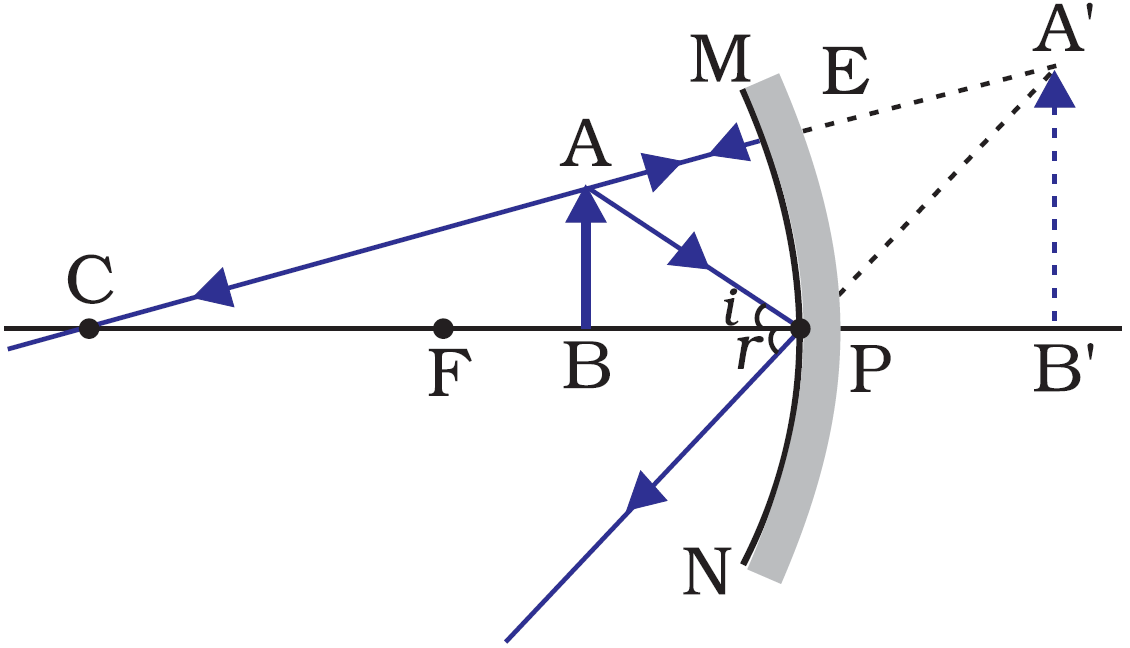
The negative sign of the image distance shows that the image is fromed on the left side of the concave mirror. Thus, the image formed by a mirror is virtual, erect and on the same side as the object.$\frac{3}{2} = \frac{\text{Speed of light in air}}{\frac{2 \times 10^{8} \text{m/s}}{\text{Speed of light in air = 3} {\times 10^{8} \text{m/s}}}}$
$\text{Speed of light in water} = \frac{3 \times 10^{8} \text{m/s}}{4/3} 2.25 \times 10^{8} \text{m/s}$


$\frac{1}{\text{f}} = \frac{1}{\text{v}}-\frac{1}{\text{u}}$
$\frac{1}{\text{v}} = \frac{1}{\text{f}}-\frac{1}{\text{u}}$
$\frac{1}{\text{v}}=\Big(\frac{1}{-15}\Big)+\Big(\frac{1}{-30}\Big)$
$\frac{1}{\text{v}}=\Big(\frac{1}{-10}\Big)$
On substituting v = -10cm$\text{m}=\frac{\text{v}}{\text{u}}$
$\text{m}=\frac{-10}{-30}$
$\text{m}=\frac{1}{3}=.33$
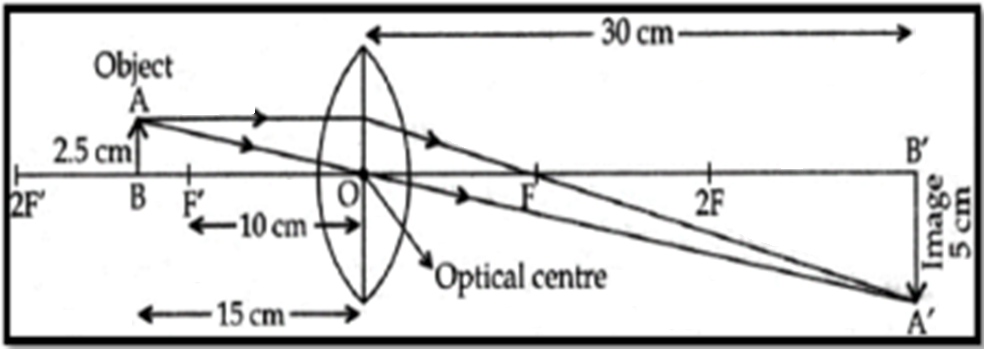
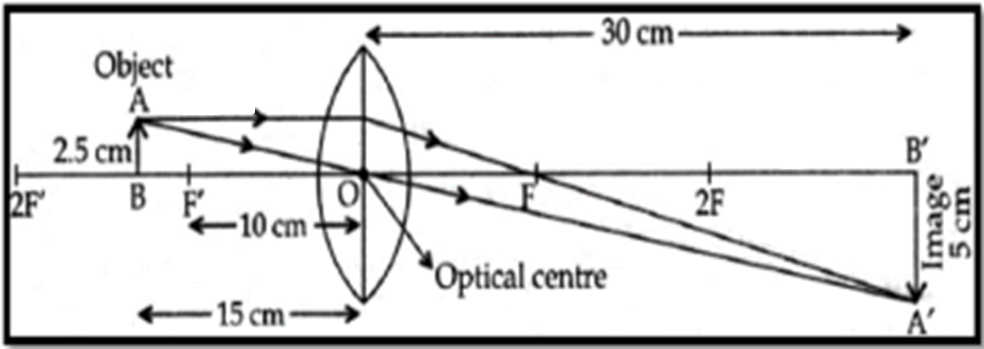
The magnification is positive so it is a virtual erect image, m is less than 1 so the image is diminished and v is negative so the image is formed on the same side of the lens.
$\text{n}_{w} = \frac{3}{2};$
$\text{v}_{g} = 2\times10^{8}\text{m/s}$
$\text{n}_{g} = \frac{\text{C}}{\text{v}_{g}}$
$\therefore\text{c} = \text{n}_{g}\text{v}_{g} =\frac{4}{3}\times2\times10^{8}\text{m/s} = 2.67\times10^{8}\text{m/s}$
$\therefore\text{V}_{w} =\frac{\text{C}}{\text{n}_{w}} =\frac{2.67\times2\times10^{8}}{3} = 1.78\times10^{8}\text{m/s}.$


$\frac{1}{\text{v}}+\frac{1}{\text{u}}=\frac{1}{\text{f}}$
$\frac{1}{\text{v}}-\frac{1}{20}=\frac{1}{15}$
$\frac{1}{\text{v}}=\frac{1}{15}+\frac{1}{20}$
$\frac{1}{\text{v}}=\frac{4+3}{60}$
$\text{v}=\frac{60}{7}=8.5\text{cm}$
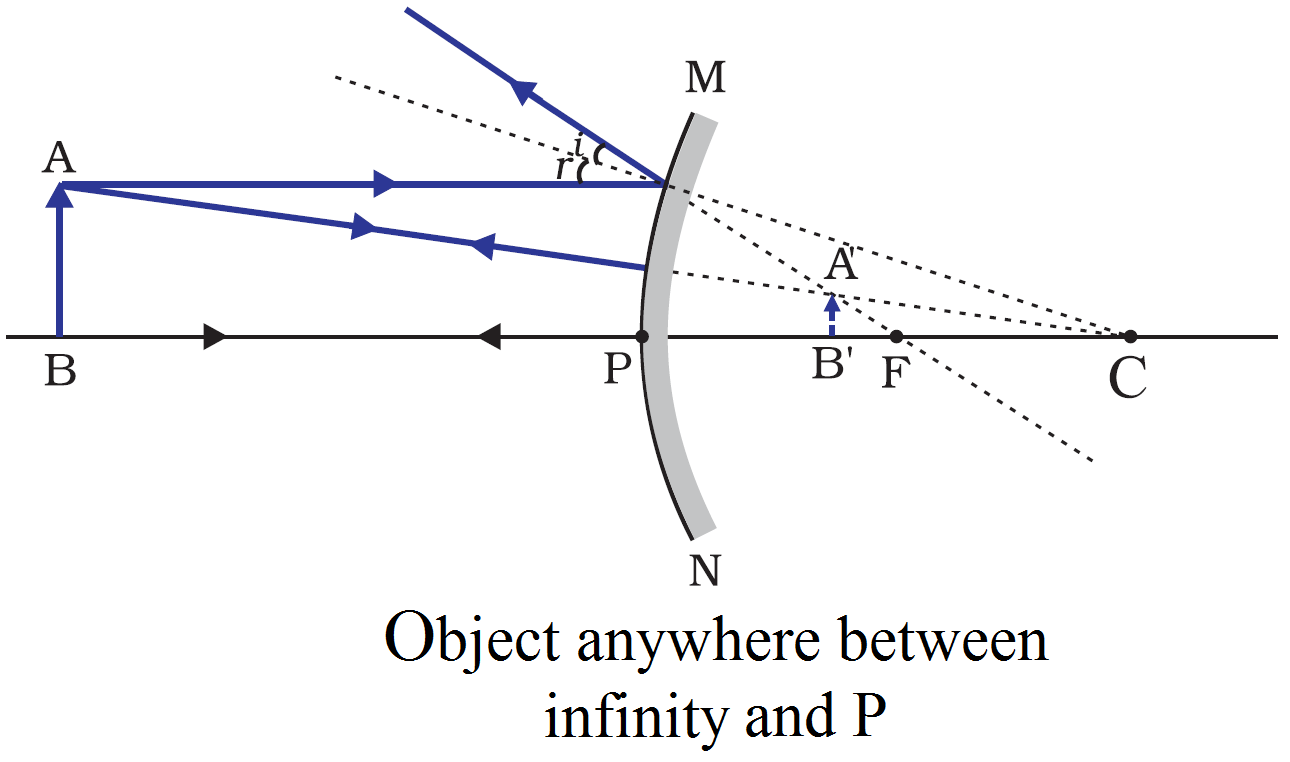
Therefore, the image formed behind the mirror and forms virtual, erect, diminished, image.$=\frac{1}{\text{f}}=\frac{100}{\text{f (in cm)}}$
This expression indicates that the power of a lens of shorter focal length is greater than the power of a lens of longer focal length. Power of a convex lens is positive and that of a concave lens is negative.
$\frac{1}{\text{v}}+\frac{1}{\text{u}}=\frac{1}{\text{f}}$
$\frac{1}{30}+\frac{1}{\text{v}}=\frac{1}{15}$
Solving the above e.q. for v, we get v = 30cmIn case (ii) The image is real and inverted.


Alternate Answer
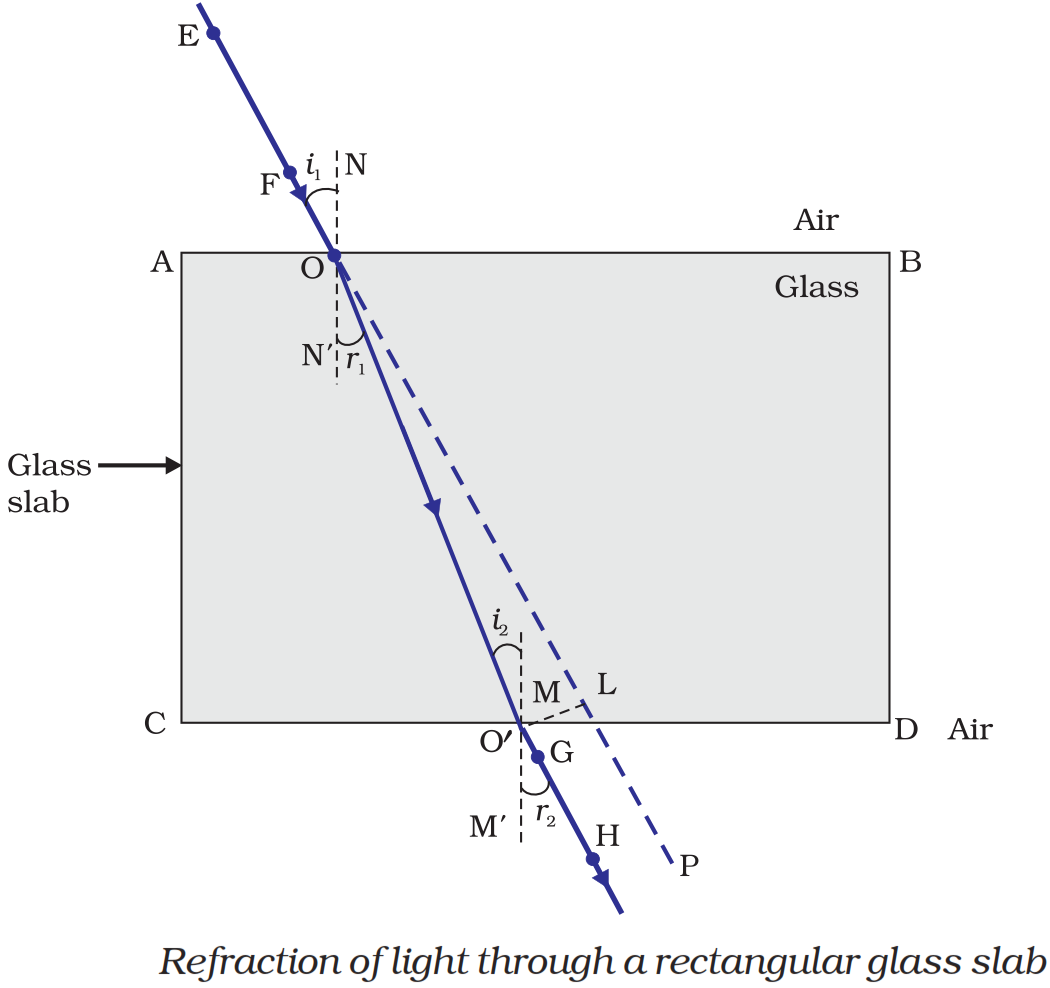
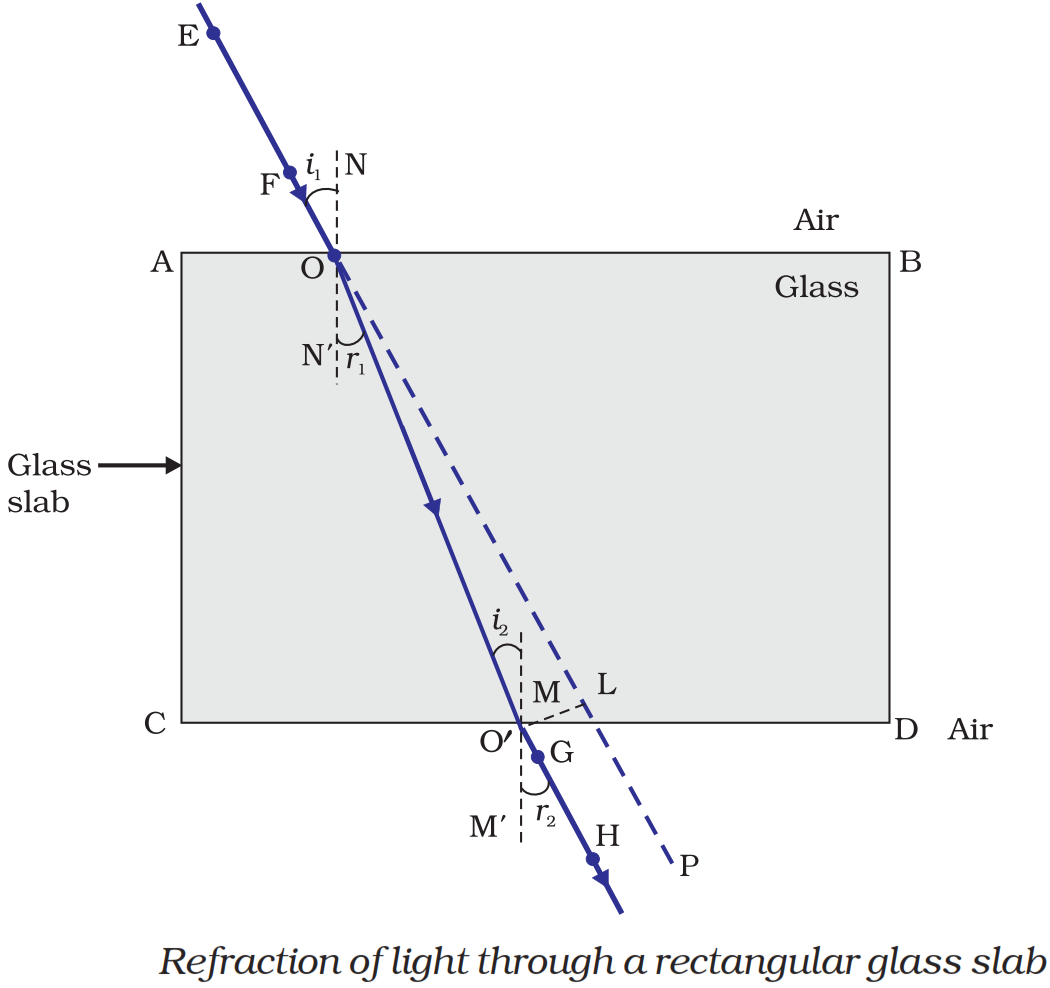
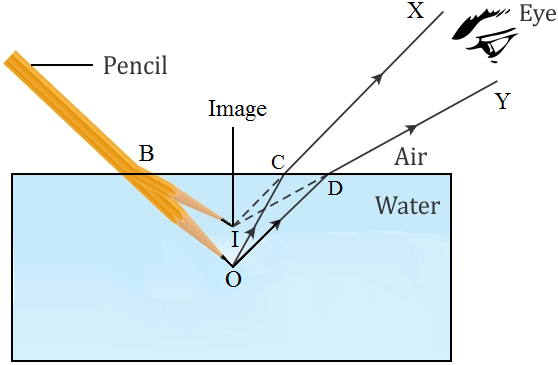
Incident rays from pecil travel form water to air, and they bend away from normal, To an observer image of the immersed part of the pencil forms at a different position and pencil appears to be bent.
Object size (h1) = 4cm
Object distance (u) = -30cm
Focal length (f) = 20cm
$\frac{1}{\text{f}}=\frac{1}{\text{v}}-\frac{1}{\text{u}}$
$\frac{1}{+20}=\frac{1}{\text{v}}-\frac{1}{-30}$
$\frac{1}{\text{v}}=\frac{1}{20}-\frac{1}{30}=0.016$
⇒ Image distance (v)= 62cm
We know that,
$\text{m}=\frac{\text{height of image (h}_2)}{\text{height of object (h}_1)}=\frac{\text{v}}{\text{u}}=\frac{62}{-30}=-2.0$
Thus the approximate ratio of height of image to height of object is -2cm.
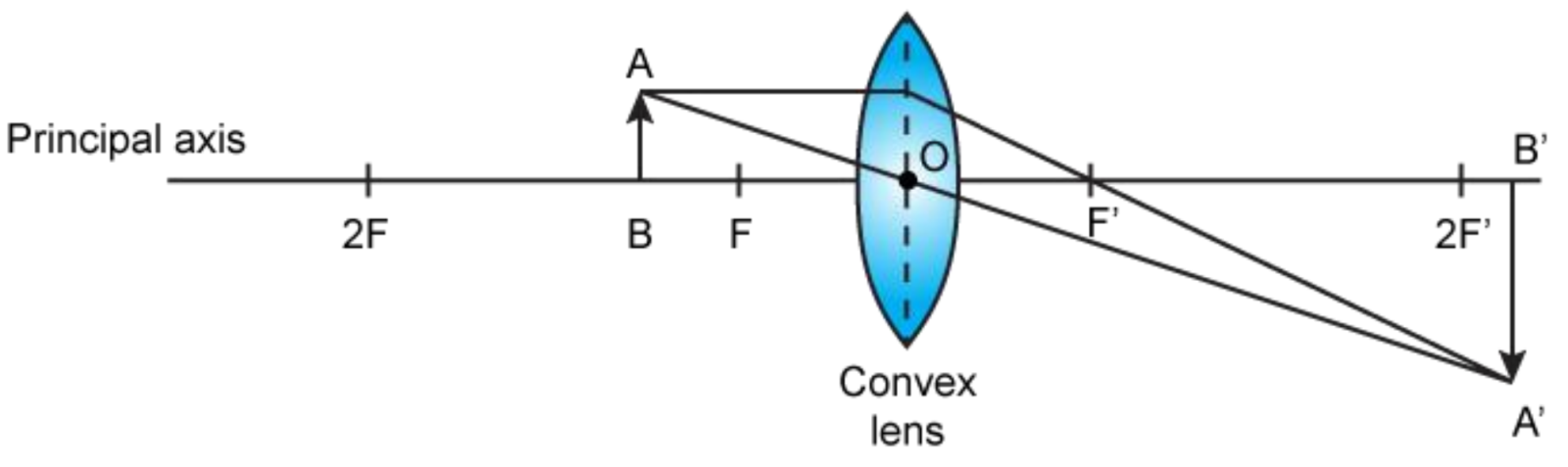
Negative sign denotes that image formed is inverted and real.
As the value of magnification is 2, the image is magnified.
Thus nature of image is real, inverted and magnified.

$2\text{HCl}+\text{Na}_2\text{CO}_3\xrightarrow{\ \ \ \ \ \ \ }2\text{NaCl}+\text{H}_2\text{O}+\text{CO}_2$